Your Cart is Empty


Modular Architecture in Design Software: The Shift from Monolithic Applications to Adaptive Platforms
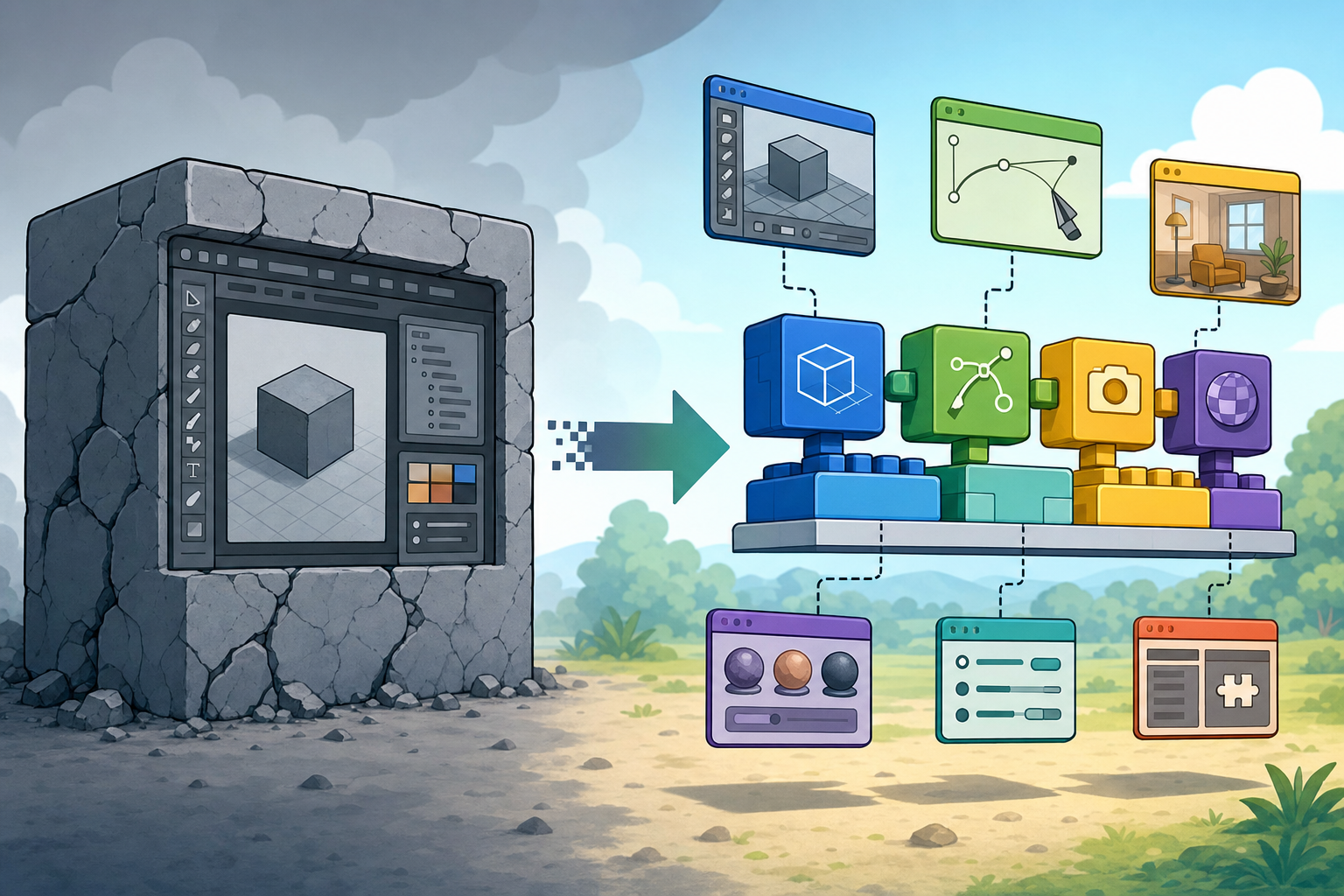


From Fixed Applications to Adaptive Design Platforms
The pressure behind architectural change
Design software is no longer only a digital drafting board, a surface modeler, or a numerical solver packaged behind a single interface. It has become a connected environment where product teams, architects, fabricators, analysts, visualization specialists, and operations stakeholders continuously exchange design intelligence. The modern workflow now spans CAD, CAE, CAM, BIM, rendering, PLM, simulation, collaboration, manufacturing preparation, digital asset production, and lifecycle analytics. A single project may begin as a conceptual sketch, move into parametric modeling, pass through structural validation, continue into photorealistic visualization, generate fabrication instructions, and later feed a digital twin. That range of responsibility is too broad for a rigid application architecture built around one installation, one release cycle, and one tightly coupled codebase. This is why leading platforms are moving toward modular software architecture, where specialized services can evolve independently while still sharing consistent design data. The shift is not cosmetic; it changes how design tools are built, updated, extended, secured, and integrated across the entire digital thread.
Why Design Platforms Are Moving Away from Monolithic Software
The limits of the all-in-one application model
Traditional design applications grew up as monolithic systems because early CAD, BIM, and engineering tools were usually designed to run on a workstation, store files locally, and perform a relatively bounded set of tasks. Over time, vendors added sketching, constraints, assemblies, drawings, rendering, simulation, data management, documentation, scripting, manufacturing output, and collaboration features into the same application shell. This created powerful environments, but also increased internal complexity. Every new capability had to coexist with legacy functions, established user interface conventions, proprietary file structures, and deeply embedded dependencies. Updating one subsystem could unexpectedly affect another, especially when geometry, metadata, graphics, constraints, and downstream drawing references were all interwoven. As feature expectations accelerated, monolithic applications became harder to refactor without risk. Users wanted faster improvements, cloud collaboration, web access, GPU rendering, automated meshing, AI-assisted modeling, and manufacturing intelligence, while software teams still had to protect mature modeling workflows that professionals rely on daily. The result was a growing architectural mismatch between modern design expectations and older software foundations.
Feature expansion beyond the original purpose
The scope of design software has expanded far beyond geometry creation, and this expansion is one of the strongest reasons monolithic systems are under stress. Mechanical engineers expect integrated tolerance management, topology optimization, additive manufacturing validation, motion studies, and simulation-driven decision making. Architects expect BIM authoring, clash detection, energy analysis, construction sequencing, GIS integration, visualization, and building performance feedback. Product designers expect real-time materials, cloud libraries, immersive reviews, and direct connections to marketing content pipelines. Manufacturing teams expect CAM, nesting, build preparation, inspection planning, robotic toolpaths, and machine connectivity. Each of these capabilities evolves at a different pace and often requires different compute resources. Rendering may depend on GPU acceleration and cloud streaming, while simulation may need scalable high-performance compute clusters. Collaboration tools require identity management, permissions, versioning, and real-time synchronization. A monolithic platform can include these functions, but doing so often creates a large, fragile application where every update becomes more expensive. Modular architecture allows each capability to progress on its own technical timeline while remaining connected through shared data and APIs.
Collaboration and cloud expectations
Cloud collaboration has fundamentally changed what users expect from design platforms. Teams no longer accept workflows where files are emailed, manually checked out, duplicated across folders, and reconciled after mistakes appear. They expect controlled access, browser-based review, live markup, secure model sharing, automatic version histories, and collaboration across suppliers, clients, consultants, and internal departments. These expectations require services that are naturally networked, continuously available, and independently scalable. A local monolithic application can connect to cloud storage, but true cloud collaboration requires more than file syncing. It needs permissions, activity logs, conflict management, lightweight viewing, data translation, notification systems, and sometimes simultaneous multi-user editing. These functions are better implemented as connected services rather than as hardwired features inside a desktop application. For example, a product model can remain in a controlled cloud data environment while different users access only the modules they need: a reviewer opens a web viewer, an analyst runs simulation, a manufacturing engineer prepares toolpaths, and a designer edits parametric features. Cloud-native collaboration is therefore a major force pushing platforms away from monolithic design software.
AI, automation, and security as moving targets
Artificial intelligence and automation add another layer of urgency to modular architecture because they evolve faster than traditional CAD or BIM release cycles. AI copilots, generative design assistants, automated drawing checkers, natural language query tools, and optimization agents depend on models, APIs, compute services, and security controls that may change frequently. Embedding every AI function directly into a monolithic application would make experimentation slow and updates risky. A modular platform can instead introduce AI as a service connected to geometry, metadata, standards, simulation results, and project history through controlled interfaces. The same logic applies to security. Modern platforms must address authentication, encryption, audit trails, vulnerability patches, regulatory requirements, and supply-chain security. These requirements cannot wait for annual software releases. Security services must be patched quickly, monitored continuously, and adapted to new threats. Containerized services, cloud identity layers, and API gateways allow platform providers to strengthen protection without forcing users to reinstall an entire design environment. This is a practical reason modularity is not only about innovation; it is also about resilience, maintainability, and responsible platform governance.
Industry movement toward service-based infrastructure
The move away from monolithic software reflects a broader transformation across enterprise technology. Financial systems, logistics platforms, media production tools, and industrial automation environments have all shifted toward service-based infrastructure because complex digital operations require flexibility. Design software is following the same pattern. Instead of treating the CAD model, simulation solver, rendering engine, and collaboration environment as inseparable functions, modern platforms increasingly treat them as interoperable services connected by shared data models and APIs. This matters because design organizations rarely use a single tool for everything. An engineering team may prefer one modeling system, a specialized solver from another vendor, a PLM platform for release management, and a visualization pipeline optimized for sales configurators. A rigid application forces awkward translation between tools, while a modular ecosystem can expose services that exchange structured data more reliably. The most advanced platforms are therefore becoming ecosystems rather than isolated products. They support external extensions, automate workflows through APIs, and scale compute-intensive tasks in the cloud. In this environment, flexible digital infrastructure becomes as important as individual modeling features.
- Rapid feature expansion makes tightly coupled applications harder to maintain without destabilizing existing workflows.
- Cloud collaboration requires identity, storage, review, synchronization, and access-control services that operate beyond the desktop.
- AI integration benefits from independent update cycles, scalable compute, and structured access to design data.
- Cross-platform deployment demands web, desktop, mobile, and server-side components that do not all share the same runtime assumptions.
- Security requirements move faster than conventional application release schedules and need continuous service-level updates.
What Modular Architecture Means in Design Software
Independent components connected by shared intent
A modular design platform is built from independent but connected components that perform specific responsibilities within a larger system. These components may include geometry kernels, constraint solvers, simulation engines, rendering systems, cloud storage services, collaboration tools, AI assistants, manufacturing preparation modules, API layers, and plugin frameworks. The essential idea is that each module has a clear role and communicates with other modules through defined interfaces rather than through hidden internal dependencies. A geometry kernel, for example, can focus on robust modeling operations such as boolean operations, filleting, offsetting, and surface continuity. A simulation engine can focus on meshing, boundary conditions, material behavior, and numerical solving. A rendering module can handle materials, lighting, global illumination, viewport acceleration, and output formats. When these modules are separated intelligently, one can be improved or replaced without rewriting the entire platform. This does not mean the user experience must feel fragmented. The goal is the opposite: users should experience a coherent workflow, while the underlying architecture remains flexible enough to evolve. Modularity separates implementation complexity from workflow continuity.
Geometry kernels as the foundation layer
The geometry kernel remains one of the most important modules in any design platform because it defines how shapes are represented, modified, and interpreted. In a monolithic application, the geometry kernel is often deeply tied to feature history, drawing generation, assembly constraints, and file structure. In a modular environment, the kernel can still provide robust modeling functionality while exposing stable interfaces to other services. This allows simulation tools, manufacturing modules, rendering engines, and automation scripts to query geometry without duplicating interpretation logic. For example, a manufacturing preparation module may need access to wall thickness, curvature, overhang angles, hole features, and surface normals. A sustainability analysis tool may need volumes, material assignments, and embodied carbon metadata. A rendering module may need tessellated representations optimized for real-time display rather than exact boundary representation. The kernel does not need to perform all these tasks directly, but it must expose reliable geometric intelligence. When kernel access is modular and well-governed, the platform can support multiple downstream workflows without corrupting the source model or locking every capability into one application executable.
Simulation, rendering, and manufacturing services
Simulation, rendering, and manufacturing preparation are ideal candidates for modular architecture because they often require specialized algorithms and scalable compute resources. Structural simulation may demand finite element solvers and high-quality meshing. Computational fluid dynamics may require different discretization strategies, turbulence models, and parallel processing. Additive manufacturing simulation may analyze thermal distortion, support structures, residual stress, and build orientation. Rendering systems may rely on ray tracing, physically based materials, denoising, GPU acceleration, and cloud rendering queues. CAM modules may generate toolpaths, simulate machine kinematics, detect collisions, and output controller-specific code. These capabilities should not necessarily be locked inside the same update cycle as sketch constraints or drawing annotations. Modular platforms allow expensive computations to run locally, in the cloud, or in hybrid configurations, depending on the project. A designer might submit a topology optimization task to a cloud solver, continue modeling in the desktop environment, and receive ranked results later. This separation supports productivity because heavy computation no longer freezes the entire design application or requires every user to install the same specialized tools.
Microservices, APIs, containers, and plugins
Several architectural patterns make modular design platforms practical. Microservices are commonly used for cloud-based functions such as file translation, model viewing, notifications, identity management, rendering queues, simulation job submission, and collaboration events. API-first development ensures services can be accessed by internal modules, external applications, automation scripts, and third-party extensions through documented interfaces. Plugin frameworks allow vendors, consultants, and enterprise teams to add specialized commands without modifying the core application. Containerized services help scale computation because simulation workers, translation engines, AI services, or rendering tasks can be deployed on demand in consistent environments. Shared data models keep information aligned across modules by defining how geometry, metadata, revisions, materials, requirements, manufacturing features, and annotations are represented. Without a shared data strategy, modularity can degrade into disconnected tools. With it, independent services can participate in a consistent design environment. The best modular platforms combine these patterns carefully: APIs provide access, containers provide scalability, plugins provide extensibility, microservices provide distributed functionality, and shared models provide coherence across the digital thread.
- Microservices support independent cloud functions such as viewing, translation, collaboration, and compute orchestration.
- Plugin frameworks give experts a way to extend workflows without waiting for core software changes.
- API-first development makes interoperability a designed capability rather than an afterthought.
- Containerized services allow demanding tasks to scale across cloud infrastructure or private compute environments.
- Shared data models preserve consistency when multiple services read and write design information.
Reducing innovation risk
One of the most valuable benefits of modular architecture is that it reduces the risk of innovation. In a monolithic platform, adding a new AI assistant, solver, renderer, or collaboration mechanism can introduce instability because the new feature may interact unpredictably with established code. Design professionals are understandably conservative about core modeling reliability; a new feature is not useful if it compromises file integrity, parametric regeneration, or drawing associativity. Modular architecture creates boundaries that help isolate change. A rendering service can be upgraded without altering the geometry engine. A cloud translation service can be improved without changing sketch behavior. An AI assistant can be connected through permissioned access to model data rather than embedded deeply into every command. If a module fails, the platform can often degrade gracefully instead of collapsing entirely. This is especially important in professional environments where downtime directly affects engineering schedules, construction coordination, manufacturing deliveries, or client reviews. By separating responsibilities, modular platforms make it easier to experiment, deploy improvements incrementally, test services independently, and roll back problematic changes without damaging the entire software environment.
How Modularity Changes Design Workflows
Toolchains tailored to the project rather than the application
Modularity changes design workflows by allowing teams to assemble toolchains around project requirements rather than forcing every task through one fixed application. A consumer product team may need industrial design surfacing, mechanical packaging, photorealistic visualization, injection molding feedback, tolerance analysis, and supplier collaboration. An aerospace component team may prioritize lightweighting, structural optimization, thermal simulation, additive manufacturing preparation, inspection planning, and configuration management. An architecture practice may combine BIM authoring, daylight analysis, GIS context, energy modeling, coordination review, and immersive visualization. These workflows overlap, but they are not identical. A modular platform allows specialized services to be activated when needed, licensed more flexibly, updated independently, and connected through project data. This helps avoid software bloat, where every user carries every function whether or not it is relevant. It also supports expertise-based workflows: analysts can use solver modules, manufacturing engineers can use CAM modules, visualization teams can use rendering modules, and designers can work in modeling environments while still contributing to the same authoritative information structure. The workflow becomes configurable rather than predetermined.
Specialized capabilities activated on demand
Advanced design capabilities are often valuable only at specific moments in the process, which makes them well suited to modular deployment. Topology optimization may be essential during early structural exploration but unnecessary during final drawing release. Additive manufacturing simulation may be critical before build preparation but irrelevant for conventionally machined parts. Photorealistic rendering may matter during stakeholder review and marketing asset creation but not during internal constraint modeling. Sustainability analysis may be performed at concept milestones, material selection phases, or regulatory submissions. Model-based definition may become central when a team moves from drawings toward semantic product manufacturing information. Generative design exploration may be useful when requirements are flexible, but less useful once interfaces and packaging constraints are frozen. Modular systems let teams bring these services into the workflow at the right time. This reduces friction because users are not required to maintain separate file copies for each phase. Instead, a model can carry geometry, metadata, materials, requirements, and version history while specialized modules compute results, attach findings, or generate outputs connected to the same design source.
- Advanced topology optimization can explore load paths, mass reduction, and performance tradeoffs during concept development.
- Additive manufacturing simulation can predict distortion, support requirements, build risks, and post-processing implications.
- Photorealistic rendering can reuse engineering geometry for design reviews, configurators, and marketing visuals.
- Sustainability analysis can connect material choices, mass properties, manufacturing processes, and lifecycle assumptions.
- Model-based definition can attach tolerances, annotations, surface finishes, and inspection intent directly to the 3D model.
- Generative design exploration can evaluate design alternatives against structural, manufacturing, cost, and packaging criteria.
Connecting departments through the digital thread
The most important workflow impact of modular architecture is the creation of a more fluid digital thread. In many organizations, design information still moves through departments as exported files: a CAD model becomes a STEP file for simulation, a mesh for rendering, a drawing package for manufacturing, a spreadsheet for procurement, and a simplified model for marketing. Each translation introduces delay, data loss, and ambiguity. Modular systems reduce this fragmentation by allowing multiple departments to connect to shared design information through appropriate services. Engineering can connect CAD to simulation, requirements management, and PLM without manually rebuilding context. Manufacturing can link design data to CAM, MES, ERP, inspection systems, and additive build preparation. Marketing can reuse approved product models for visualization, interactive configuration, augmented reality, and digital content creation. Architecture teams can connect BIM, GIS, energy analysis, cost estimation, construction sequencing, and real-time visualization without continuously exporting disconnected versions. This does not eliminate the need for format translation entirely, but it changes the default goal from file handoff to structured information flow. The result is faster coordination and fewer interpretation gaps.
Practical example in product development
Consider a product development workflow for a lightweight handheld industrial tool. In a monolithic environment, the design team might model the housing, export geometry to a simulation package, simplify the model for rendering, send another version for manufacturing review, and later reconstruct metadata in a PLM system. In a modular environment, the model can remain connected to a shared data layer while different services operate on it. The industrial designer refines ergonomic surfaces and appearance materials. The mechanical engineer validates internal mounting bosses, ribs, fasteners, and sealing features. A simulation module evaluates drop performance and vibration behavior. A topology optimization module proposes bracket alternatives for the internal frame. A manufacturing preparation module checks wall thickness, draft, tool access, and potential additive fixtures. A rendering service generates product visuals from approved material definitions. A PLM module controls revision states and release permissions. The practical advantage is not simply that many tools exist; it is that they operate with less duplication. Design decisions become traceable because performance results, manufacturing feedback, and visual assets remain related to the evolving product definition.
Practical example in architectural design
In architectural design, modularity is equally transformative because building projects combine geometry, performance, context, documentation, construction coordination, and stakeholder communication. A BIM authoring module may define walls, slabs, systems, spaces, doors, equipment, and semantic building information. A GIS module may provide terrain, surrounding infrastructure, flood zones, access networks, and environmental constraints. An energy analysis service can compute heating loads, solar gain, daylight performance, and operational carbon assumptions. A structural module can evaluate framing schemes and lateral systems. A visualization module can generate real-time walkthroughs, material studies, and client-facing imagery. Construction planning services can connect models to scheduling, quantities, and site logistics. When these functions are modular but data-connected, architects and engineers can evaluate decisions with less manual reconstruction. Moving a façade element can trigger downstream checks for daylight, thermal performance, cost quantities, and visualization updates. The value is not only efficiency; it is better design reasoning. Teams can see how formal, environmental, structural, and construction consequences interact, which supports more informed decisions earlier in the process and reduces late-stage coordination surprises.
New expectations for interoperability and governance
Modular workflows introduce new responsibilities as well as new opportunities. If services are assembled from multiple sources, organizations must define rules for data ownership, naming conventions, model maturity, access permissions, approved integrations, and version control. Interoperability does not happen automatically simply because APIs exist. A geometry service, simulation module, PLM system, and visualization pipeline must agree on identifiers, units, material definitions, classification structures, coordinate systems, and revision states. Without governance, modularity can create confusion through too many disconnected plugins or inconsistent automation scripts. Mature design organizations therefore treat modular platform strategy as both a technical and process concern. They define which data is authoritative, which modules can write back to the model, which services are read-only, and how results are validated before they influence downstream work. This is especially important when AI assistants enter the workflow. An AI copilot that proposes design changes must operate with clear permissions and traceability. Modular design software works best when technical flexibility is matched by disciplined information management.
Modularity as the Foundation for Future Design Platforms
Beyond geometry creation
Modular architecture is becoming essential because design software is expanding beyond geometry creation into intelligence, collaboration, automation, and lifecycle management. Geometry will remain fundamental, but the competitive frontier is shifting toward what platforms can do with design information once it exists. Can the platform evaluate manufacturability while a designer models? Can it suggest lower-carbon materials based on performance requirements? Can it compare simulation outcomes across design variants? Can it produce approved visualization assets without remodeling? Can it synchronize product definitions with PLM, manufacturing execution, inspection planning, and service documentation? Can it support digital twins after the product or building is delivered? These questions require architectures that can connect many types of computation and data services. A fixed application can deliver a polished set of tools, but it may struggle to incorporate new technologies at the speed users demand. A modular platform can introduce new intelligence layers, connect external solvers, integrate automation agents, and support lifecycle feedback more naturally. The platform becomes less like a single tool and more like a design operating environment.
AI copilots and automated design reasoning
AI copilots will accelerate the need for modularity because useful design intelligence must access many specialized contexts. A meaningful assistant cannot only understand command syntax; it needs access to geometry, requirements, materials, standards, manufacturing constraints, simulation results, prior decisions, and release status. It may need to generate a script, modify parameters, summarize design changes, detect drawing inconsistencies, propose lightweighting opportunities, or explain why a simulation failed. These actions cross module boundaries. If AI is treated as a hardcoded feature inside one application, its usefulness will remain limited. If AI is treated as a permissioned service connected through secure APIs, it can orchestrate workflows across modeling, analysis, documentation, and manufacturing preparation. For example, a designer might ask an AI assistant to compare three enclosure concepts for weight, estimated tooling complexity, cooling performance, and visual quality. The copilot would not solve everything itself; it would coordinate geometry queries, simulation services, manufacturing checks, and rendering previews. This orchestration role makes AI-driven design automation one of the strongest arguments for modular platform architecture.
Real-time rendering, digital twins, and manufacturing automation
Future design platforms will also need to connect real-time rendering, digital twins, and manufacturing automation as normal parts of the workflow rather than as isolated downstream tasks. Real-time rendering turns engineering and architectural models into interactive experiences for design reviews, training, sales, and immersive collaboration. Digital twins connect design intent to operational data, enabling feedback from sensors, maintenance records, environmental performance, or production behavior. Manufacturing automation connects design data to toolpaths, robotic systems, additive machines, inspection equipment, and enterprise planning systems. These domains have different data needs, but they benefit from a common design foundation. A modular architecture allows rendering services to consume optimized visual geometry, digital twin services to track asset identity and operational state, and manufacturing services to interpret tolerances, materials, features, and process constraints. The important shift is that design information no longer stops at release. It continues into fabrication, construction, operation, maintenance, and future redesign. Platforms that support this extended lifecycle will need modular services that can be updated independently as hardware, standards, processes, and analytics methods evolve.
The competitive shape of design ecosystems
The most competitive design platforms will be those that allow users to assemble workflows from interoperable services rather than depend on one fixed application. This does not mean the end of integrated user experiences. Professional users still need coherent interfaces, reliable modeling behavior, responsive graphics, and predictable commands. The difference is that integration will increasingly be achieved through platform architecture rather than through a single executable containing every function. Vendors that build strong APIs, stable data models, secure cloud infrastructure, scalable computation, and well-documented extension frameworks will attract broader ecosystems. Independent developers will create specialized tools. Enterprises will automate internal processes. Universities and research groups will connect experimental solvers. Manufacturing partners will plug in process-specific validation. Visualization teams will connect real-time engines and asset pipelines. The winners will not simply have the longest feature list; they will provide the most adaptable foundation. In this environment, openness and governance must coexist. Platforms must be extensible enough to encourage innovation but structured enough to maintain data integrity, security, and professional reliability.
The long-term impact on design practice
The long-term impact of modular architecture is a more open and adaptive design environment where software can evolve as quickly as the products, buildings, and systems it helps create. Designers and engineers will spend less time translating files, rebuilding context, waiting for specialized installations, or working around rigid tool boundaries. Instead, they will increasingly operate within connected ecosystems where modeling, simulation, rendering, collaboration, manufacturing preparation, and lifecycle intelligence reinforce one another. This will change expectations for design processes. Early concepts will be evaluated against performance and manufacturability sooner. Visualization will be generated from live design data rather than recreated manually. Manufacturing constraints will feed back into modeling decisions before release. Building performance analysis will become more continuous. AI assistants will help orchestrate routine tasks, expose hidden conflicts, and accelerate exploration. The central promise of modularity is not fragmentation; it is adaptability. By separating services while preserving shared design information, platforms can innovate faster without sacrificing stability. Modular architecture is becoming the foundation for the next generation of design software, enabling tools to grow as flexible ecosystems rather than rigid applications.
Also in Design News