Your Cart is Empty


Real-time CFD for Design Reviews: Progressive Solvers, GPU Pipelines, and Uncertainty-Aware Collaboration


Introduction
From slideware to shared physics in the room
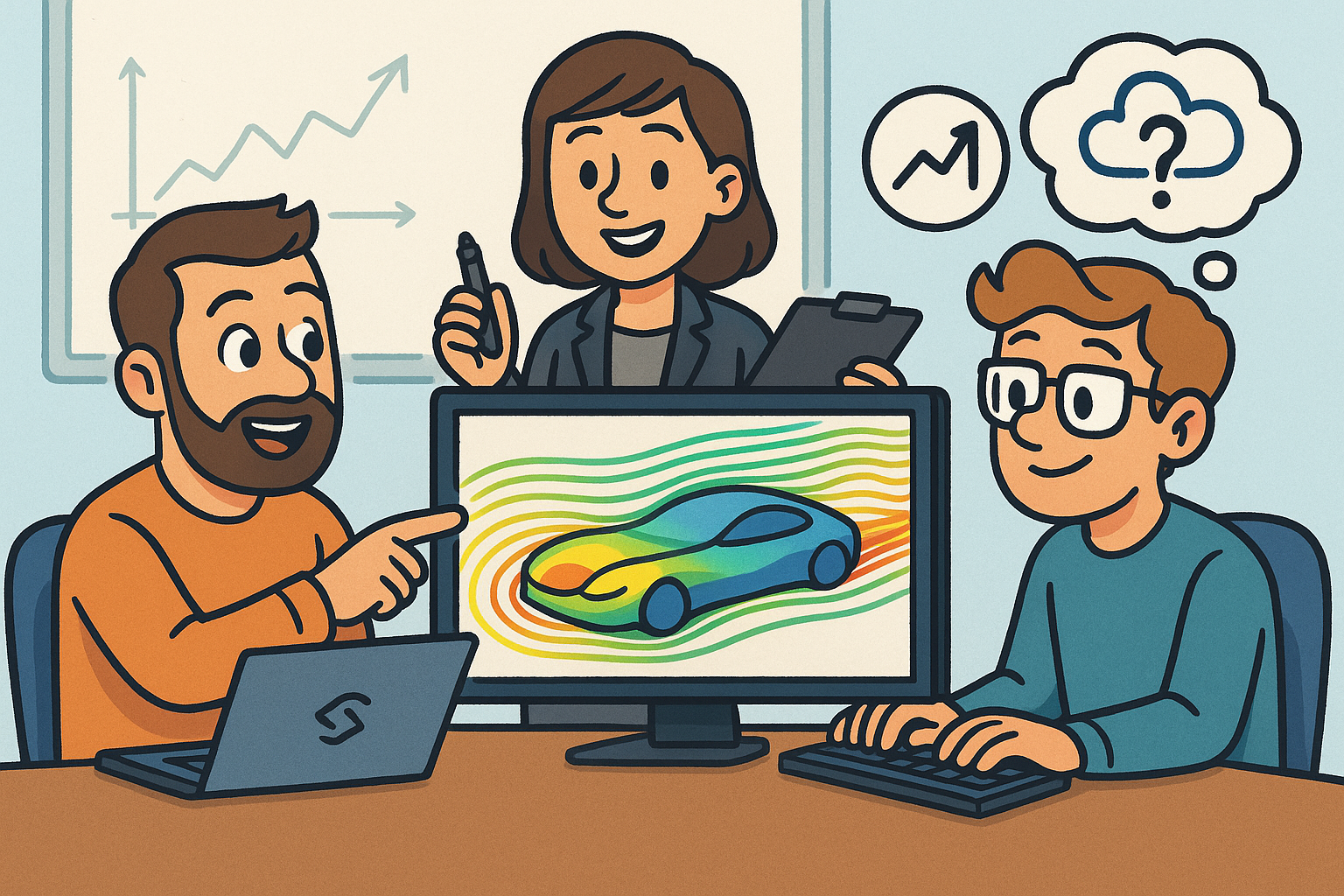
Design reviews are at their best when teams converge on evidence rather than opinion, yet traditional CFD workflows often keep the evidence out of the room. Analysts prepare meshes, launch jobs on clusters, and return with plots days later—by which time the geometry has changed and the opportunity for rapid iteration has passed. Bringing real-time CFD directly into design reviews compresses that loop, letting the room ask “what if?” and see the flow field respond in seconds. The shift is not about replacing high-fidelity solvers; it is about converting meetings from speculative discussions into physics-informed conversations that preserve momentum and capture tacit knowledge on the spot. In this article, we outline where immediate feedback is reliable, where it is not, and how to architect a stack—from CAD to a progressive solver to GPU rendering and collaboration—that delivers actionable signals without overpromising. You will see concrete interaction patterns, numerical guardrails, and governance steps that enable teams to trust what they see, escalate when appropriate, and leave the room with a shared understanding of trade-offs and next actions.
Why bring real-time CFD into design reviews
Reduce decision latency by keeping physics in the loop
Every hand-off between design, analysis, and management introduces delays and information loss. Weekly simulation cycles encourage batch thinking: questions pile up, changes accumulate, and by the time results arrive, the discussion has shifted. Real-time CFD flips that cadence. Instead of framing issues for later, participants test hypotheses in the moment—modify a diffuser angle, nudge a baffle, or adjust an inlet flow rate—and observe the field react in seconds to minutes. The outcome is a drastic reduction in decision latency: the time from posing a question to trusting an answer. In practice, this reduces the number of follow-up meetings, defers fewer decisions to email threads, and shortens the path from promising concept to committed design. Critically, it also captures context. When a field changes on screen, the team can annotate the scene, bookmark operating points, and tie decisions to specific parameter sets. This persistent, physics-aware trail complements formal PLM change records with the nuance of what was considered and why it was accepted or rejected.
What “real-time” really means for CFD feedback
Real-time in this context is not magic; it is a disciplined performance envelope. Aim for 10–30 FPS visualization for smooth interactivity, while maintaining sub-2 s parameter-to-field updates for simple knobs (like a flow rate slider) and tens of seconds for geometry edits that require local revoxelization and re-projection. The solver should operate progressively: Level 0 results provide immediate cues in seconds, Level 1 refines over 30–60 s, and Level 2 enriches turbulence and wall effects over 1–3 minutes. Equally important is progressive accuracy. The UI must disclose that early frames are coarse and improving, and show how residuals and mass balance error tighten over time. This calibration of expectation is the difference between trust and skepticism. If the team understands that sub-second feedback offers qualitative guidance and that quantitative deltas stabilize after a minute or two, they can use the tool as intended: steer early using fast signals, then wait for tighter numbers when debating close trade-offs.
High-impact use cases where the feedback changes the conversation
Not every flow problem benefits equally from in-room interactivity. Focus on scenarios where incompressible or weakly compressible flow dominates and geometry changes are localized. The following categories consistently deliver leverage:
- HVAC diffusers, cleanrooms, and occupied spaces: visualize throw patterns, mixing efficiency, and comfort indices; move diffusers live and watch recirculation zones collapse or disperse.
- Electronics cooling: adjust heat-sink fin pitch, blower curves, or vent locations and observe hotspot migration and maximum component temperatures trend downward in near-real time.
- Marine hull tweaks: small fillets, trim adjustments, or appendage placements at low Froude numbers; see how wake structure and boundary-layer thickness respond.
- Low-Mach external aerodynamics: mirrors, camera pods, fairings, or grille shutters; optimize pressure drag contributions with immediate feedback on separation bubbles.
- Intakes and ducts: reshape elbows, add guide vanes, or widen sections and monitor pressure drop and flow uniformity at outlets while iterating.
- Wind around buildings: rotate massing, add screens, or reorient canopies and assess pedestrian wind comfort using fast metrics and uncertainty-aware visualization.
These cases share practical features: moderate Reynolds numbers amenable to fast RANS/WMLES approximations, geometric variants expressible as CAD parameter deltas, and performance indicators (pressure drop, max velocity, uniformity) that converge quickly enough to guide decisions in the room.
What not to promise—and how to set expectations responsibly
Realtime feedback must be framed with clear scope. Avoid claiming fidelity for phenomena that inherently demand high resolution, long horizons, or specialized physics. Specifically, do not promise accurate shocks or transonic to supersonic flows with strong compressibility; do not claim validated behavior for chemically reacting flows or combustion; and treat complex multiphase problems—free-surface breakup, cavitation, sediment transport—with extreme caution. In these domains, the interactive system should act as a previewer. Use it to sanity-check boundary conditions, visualize gross flow paths, and explore geometry edits that will later feed into offline, high-fidelity solvers. The UI should surface uncertainty bands, ghost out regions pending refinement, and provide an explicit “escalate to offline solver” path with packaged boundary conditions and meshes. When a design review touches a high-risk phenomenon, frame the session as a scoping exercise: establish the question, gather candidate configurations, and commit to a verification plan that relies on the appropriate solver stack and test data where applicable.
KPIs and organizational outcomes to quantify value
The promise of real-time CFD is not just speed; it is collective clarity. To measure impact, track technical and human-centered KPIs during and after sessions:
- Frame rate and end-to-end latency: ensure 10–30 FPS camera motion and sub-2 s response for parameter sliders under typical loads.
- Residual thresholds and pressure/velocity mass balance: display absolute and relative residuals, plus continuity error trends, with gating rules for “good enough” confidence.
- Uncertainty bands: quantify variability from coarse grids and turbulence models; annotate field visualizations with confidence overlays.
- User task completion time: measure how long designers take to answer predefined questions (e.g., reduce pressure drop by 10%).
Organizational outcomes then become tangible: fewer follow-up runs because geometry choices are converged in the room; earlier detection of recirculation zones and hot spots; and more productive trade-off discussions anchored in side-by-side “before vs after” views. Over time, the organization builds a shared mental model—a “house style” of flow behavior for their products—grounded in immediate, visualized physics rather than abstract heuristics alone.
Reference architecture: from CAD to progressive solver to GPU rendering
Geometry ingestion: from B-rep to watertight SDF without heavy meshing
Interactivity starts with fast, robust geometry handling. A live link to CAD parameters is essential; the tool should subscribe to deltas—fillet radius adjustments, inlet diameter tweaks, baffle placements—rather than re-importing monolithic models. Convert B-rep to a signed distance field (SDF) via voxelization on a hierarchy (uniform or octree), performing watertightness checks and automatic hole patching to reduce leakage paths that would destabilize a pressure projection. The SDF unlocks immersed-boundary or cut-cell methods that avoid body-fitted meshing while maintaining accurate boundary conditions. A practical pipeline looks like this:
- Receive CAD deltas and regenerate only affected patches; cache triangle soups per body and compute conservative bounds for revoxelization.
- Voxelize with conservative rasterization and winding-number checks; fill pinholes smaller than a grid-dependent threshold; flag suspect thin features for user review.
- Compute narrow-band SDF near walls for accurate wall distance and normal estimation; downstream turbulence and wall models rely on this signal.
- Construct cut-cell coefficients or immersed boundary masks on a Cartesian/octree grid, allowing boundary conditions to be enforced without remeshing.
This approach slashes turnaround times for geometry edits. Instead of regenerating unstructured meshes, the system updates local SDF tiles, re-evaluates masks, and warm-starts the solver on an updated domain, preserving as much of the velocity and pressure fields as consistency allows.
Progressive solver stack for incompressible flow
A multi-level solver stack delivers immediate cues without sacrificing a path to higher confidence. Level 0 targets seconds-to-first-pixels: a coarse lattice-Boltzmann variant or a stabilized projection method on a uniform grid supplies plausible advection and rough recirculation hints. This level is ideal during camera motion and when scrubbing parameters; it should prioritize stability with aggressive diffusion and large time steps under a conservative CFL. Level 1 activates over tens of seconds: adaptive octree refinement near walls, predicted separation zones, and high-shear regions; multigrid-preconditioned pressure solves restore divergence-free velocity with tighter tolerances. This level stabilizes KPIs like pressure drop and outlet flow uniformity with acceptable error bars for review decisions. Level 2 enriches turbulence in minutes: eddy-viscosity RANS (e.g., k-omega SST or SA) with wall models, or a hybrid RANS/LES in refined regions, resolves separation onset, reattachment length, and vortex shedding tendencies within the session’s time budget. Across all levels, warm-starts are critical. Reuse prior fields for incremental CAD edits, and apply ROM/POD or autoencoder predictions to initialize velocity and pressure. Guard ROM usage with physics-respecting constraints and envelope checks: if parameter changes exceed training ranges, gracefully fall back to CFD-only initialization, clearly signaling reduced prior confidence.
GPU compute path and mixed-precision strategies
To achieve sub-minute convergence windows on commodity workstations and cloud instances, the compute path must be built for GPUs from the ground up. Use CUDA, Metal, or Vulkan compute for stencil-heavy kernels (advection, diffusion, divergence, gradient) with shared-memory tiling and persistent kernels to minimize launch overhead. Zero-copy interoperability—CUDA-GL or Metal buffers shared with the renderer—prevents PCIe round-trips; field slices, glyphs, and pathlines read from GPU-resident textures or SSBOs. Mixed precision is often safe and beneficial: run transport and turbulence updates in FP16/FP32 while accumulating pressure solves and residual calculations in FP32 for stability. Employ fused operations and avoid denormal penalties. Practical tactics include:
- Kernel fusion for advection-diffusion steps to reduce memory bandwidth pressure; keep data in registers/shared memory across sub-steps.
- Asynchronous streams: overlap SDF updates, pressure solves, and rendering prep; fence only where data dependencies demand.
- Auto-tuning tile sizes per GPU architecture; favor coalesced accesses and avoid bank conflicts in shared memory.
- On multi-GPU nodes, decompose the domain with halo exchanges via NVLink/PCIe peer-to-peer; compress halos with lightweight quantization if bandwidth-limited.
The result is a compute pipeline that sustains high visualization frame rates while background refinement and convergence tighten, meeting the human-in-the-loop responsiveness threshold without hiding numerical costs.
Rendering and interaction: seeing and steering the flow
Visualization should communicate both flow structure and confidence. Combine texture-based and geometry-based techniques: LIC or FTLE slices to show coherent structures; pathlines and streaklines seeded interactively; glyphs (“hedgehogs”) for local direction cues; and iso-surfaces of Q-criterion or vorticity to reveal swirling cores. For thermal problems, volume-render temperature or enthalpy with transfer functions that emphasize hotspots. Focus+context is essential: allow interactive slice planes, probe widgets, and region-of-interest refinement toggles that cue the solver to spend cycles where users care. Progressive visuals keep motion fluid: during camera travel, render coarser fields and adaptive decimation; when the view stabilizes, refine and re-dither. Thoughtful defaults help: colorblind-safe palettes, readable legends, and unit-consistent annotations. Interaction design should privilege direct manipulation: drag handles to morph boundaries, sliders for flow rates and temperatures, and right-click menus to place probes or measure deltas. When parametric changes are applied, the system should immediately reflect causal arrows—highlight updated regions, show pending refinement halos, and overlay uncertainty tinting until residual criteria are met.
Collaboration fabric: low-latency streaming and shared state
Design reviews are social. A server-side simulation with WebRTC or QUIC streaming enables distributed participants to share the same scene with near-live updates. Delta-encode field tiles, pushing only changed regions, and apply GPU-friendly compression like ZFP or SZ on scalars to balance bandwidth and fidelity. Shared state—annotations, bookmarks, probe placement—is synchronized with CRDTs to avoid conflicts; every participant’s actions are merged deterministically. Deterministic time-scrub replays allow the team to rewind the session: revisit a parameter sweep, compare alternatives, and export a compact “session digest” for stakeholders who could not attend. For topology and parameter changes, broadcast semantic diffs (e.g., “inlet diameter +5%”) alongside pixel streams to ensure that downstream archiving and PLM systems can index and audit what changed. On the client side, offer thin and thick modes: a lightweight browser viewer that renders received textures and glyphs, and a full-featured desktop client that can also compute locally for solo exploration between reviews.
Interaction patterns, UX signals, and numerical guardrails
Progressive disclosure that earns trust
Trust is earned by showing your work. Always display convergence status: residual curves for momentum and pressure, mass and energy balance indicators, and the current solver level. Confidence overlays—color-coded uncertainty or ghosted regions where refinement is pending—set expectations for what is safe to compare. For example, when a user drags a baffle, the field should snap to a Level 0 response within seconds, but the UI immediately overlays an uncertainty tint proportional to grid spacing and turbulence model sensitivity, shrinking as Level 1 and Level 2 results arrive. A panel should enumerate gating rules: “Pressure drop within 3% stability range,” “Outlet mass imbalance below 0.5%,” “Shear stress under wall-model validity.” If these are not met, the app should discourage hard decisions by gray-out of export buttons or by labeling values as provisional. To further bolster understanding, provide miniature tooltips that explain what each metric means and how it evolves during progressive solves. Transparency transforms a black box into a collaborator.
Controls that match how designers think and work
Controls must map to intent. Designers manipulate geometry and operating points, then compare outcomes. Provide direct-manipulation handles for boundary edits (dragging diffuser vanes, rotating louvers, stretching ducts), sliders for flow rates and temperatures with unit-aware inputs, and quick presets for operating points (idle, cruise, worst-case summer). A one-click “snapshot vs current” diff is non-negotiable: it should display field deltas, KPI tables (pressure drop, max velocity, hotspot area), and toggleable overlays to see where and how much the field changed. To streamline sessions:
- Offer param groups: link related sliders (e.g., intake mass flow and fan RPM) with constraints that reflect physics or system controls.
- Enable templated edits: “add a 30 mm screen at outlet,” “insert a 5 mm fillet here,” with guardrails that keep geometry valid.
- Support probe templates: arrays of virtual anemometers or thermocouples at standard locations, so comparisons remain consistent across variants.
- Implement keyboard shortcuts for toggling LIC, iso-surfaces, and uncertainty overlays to keep the conversation fluid.
By letting users act at the level of their design language rather than solver parameters, the system keeps attention on the problem, not the tool.
Performance budgets that stay ahead of user attention
Performance is a contract with attention. Plan VRAM-aware grid sizing: on 12–24 GB GPUs, aim for effective 300–500³ resolutions with adaptivity in regions that matter, and establish hard caps that preserve interactivity. During camera motion, dynamically downsample textures and streamline seed counts, then restore detail when the view settles. Adaptive time stepping follows CFL limits; display current CFL and link it to stability so users understand why updates may slow under aggressive parameter sweeps. A background refinement scheduler should prioritize tiles where probes are active, confidence is low, or gradients are high; give users a “refine here” toggle to spend cycles where insight is most valuable. Prefetch meshes or SDF tiles for likely edits inferred from interaction history: if a user repeatedly alters diffuser angles, keep neighboring voxels hot in memory. Finally, track and report performance KPIs alongside numerical ones: GPU utilization, frame budget breakdown, and input-to-photon latency. When the system runs at the edge of its budget, surfacing these numbers sets realistic expectations and guides the facilitator to adjust workflow.
Stability, modeling choices, and ROM hygiene
Stable boundary conditions and model choices are the backbone of credible real-time results. Implement robust blended Dirichlet/Neumann handling at walls and inlets to avoid spurious oscillations; apply pressure outlet stabilization and backflow guards at exits—when backflow is detected, transition to velocity constraints that preserve stability without masking physics. Turbulence models should be chosen for speed and reliability: fast SA-RANS for default reviews, and hybrid RANS/LES activated in risk areas flagged by separation predictors or user markers. Document known artifacts—over-dissipation in shear layers, delayed separation in certain Reynolds ranges—and visualize where those risks apply. ROMs provide warm-start speed but demand hygiene: enforce physics constraints in the latent space (divergence-free projections, positivity for turbulent viscosity), and monitor extrapolation with Mahalanobis or distance-to-manifold scores. If a parameter move leaves the training envelope, visibly downgrade confidence, throttle ROM influence, and fall back to CFD-only evolution. This posture prevents subtle ROM biases from being mistaken for ground truth.
Validation, governance, and accessibility woven into the workflow
Validation must be continuous, not episodic. Maintain “golden cases”—high-fidelity baselines from trusted solvers or experiments—and auto-compare quick results whenever a scenario matches within defined tolerances. Trigger thresholded warnings when deviations exceed limits and provide drill-down links to see where the flow fields disagree. Traceability is equally important: log parameter sets, solver levels, residual histories, and timestamps; hash SDFs and mesh states; and export compact session bundles to PLM so decisions can be audited months later. Accessibility and clarity expand the circle of effective participants: adopt colorblind-safe palettes, ensure legible legends at conference-room distances, keep units consistent (SI/imperial toggles tied everywhere), and provide assistive keyboard shortcuts. This governance spine—validation hooks, audit trails, and inclusive presentation—makes it easier for organizations to accept decisions made in the room, because they can be replayed, inspected, and, if necessary, escalated to offline verification without friction.
Conclusion
Turning meetings into physics-driven decisions
Real-time CFD in design reviews accelerates insight and consensus by putting a living, responsive model in front of the team. When the geometry changes and the flow field reacts within seconds, conversations become concrete: people point, probe, and iterate toward solutions rather than deferring questions to a future report. The practical recipe is straightforward but disciplined: SDF-based geometry with immersed boundary or cut-cell methods on the GPU; a progressive solver that moves from coarse cues to refined answers; mixed-precision kernels and zero-copy rendering; ROM warm-starts guarded by physics constraints; and uncertainty-aware visualization paired with collaborative streaming and shared state. Guardrails matter just as much as speed. Scope physics appropriately, surface convergence and uncertainty honestly, maintain validation links to high-fidelity solvers, and preserve audit trails that connect session choices to PLM records. To get started, pilot two or three bounded scenarios where incompressible assumptions hold and KPIs converge quickly. Instrument the experience: track latency, residuals, mass balance, and decision time saved. Iterate on UX and solver levels in response to real questions asked by your teams. Finally, formalize governance that spells out when to trust, when to warn, and when to escalate results. Do this, and your design reviews stop being speculative debates and become shared physics explorations that move the product—and the organization—forward.
Also in Design News