Your Cart is Empty


Design Software History: APT to G‑Code Dialects: The Evolution and Persistence of Vendor‑Specific CNC Post‑Processing


Introduction
Context and focus
The story of computer numerical control output—from the first APT-driven Cutter Location (CL) data to today’s sprawling G-code dialects—is less a tale of failed standards and more a chronicle of converging realities: machine physics, controller nuance, and shop-floor practice. Across seven decades, researchers at MIT, engineers at the U.S. Air Force, software pioneers at companies such as Unigraphics, Dassault Systèmes, PTC, CNC Software, DP Technology, Autodesk, and ICAM, and control manufacturers like Fanuc, Siemens, Heidenhain, Okuma, and Mazak systematically pushed capabilities forward while unintentionally enshrining differences. This article follows that historical arc and explains why, despite multiple waves of standardization, post-processors remain vendor-specific and indispensable. It also surveys the business ecosystems that grew around posts, verification, and virtual NC, and ends by mapping credible pathways for incremental harmonization—paired with a sober look at why complete unification is unlikely soon. Throughout, the emphasis is practical: what core technologies made these divergences necessary, who shaped the tooling we use, and which elements of the workflow can realistically converge without sacrificing the determinism, safety, and performance demanded by modern machining.
How we got here — from APT and CL data to G-code dialects
Early NC era: APT and the birth of CL data
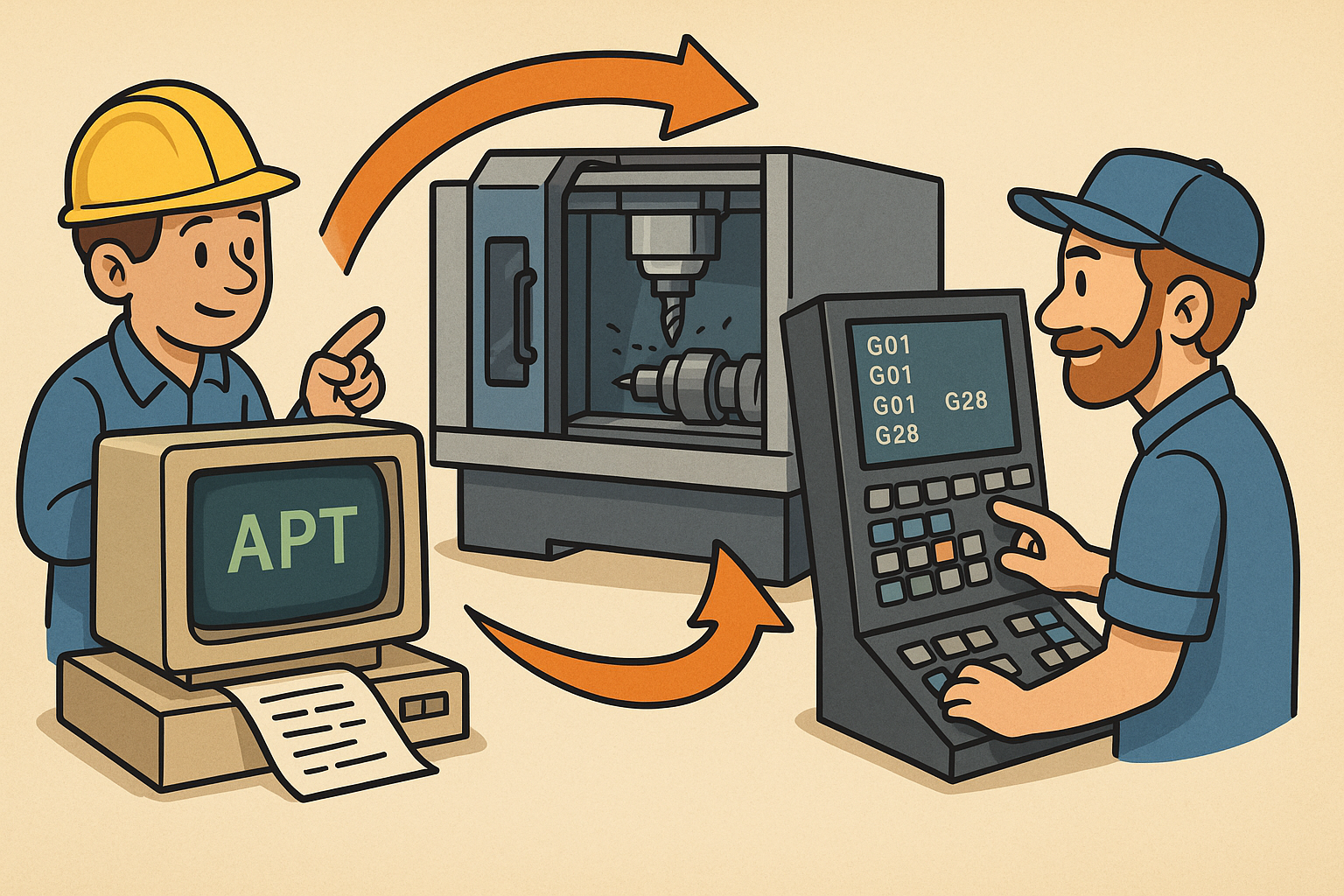
In the 1950s, the MIT Servomechanisms Laboratory, partnering with the U.S. Air Force, developed the Automatically Programmed Tool system—better known as APT—under the leadership of Douglas T. Ross and collaborators. APT introduced a high-level geometric and motion description that separated part intent from machine idiosyncrasies. The system’s output was Cutter Location (CL) data: a geometric sequence of tool positions, orientations, and motion commands, independent of the target machine tool. CL, in principle, could be fed to a secondary program, a post-processor, which would translate the geometry-rich instructions into device-specific code. This decoupled the motion-planning intellect from the hardware interface, allowing early adopters in aerospace and defense to experiment with new machines while maintaining continuity in their programming environment. At the time, controller hardware and communication bandwidth were severe constraints; controllers executed relatively simple point-to-point or linear motions, while the host computer performed geometry and path planning. The post-processor, therefore, became the bridge, tasked with expressing complex geometry as a controller’s limited instruction set while embedding the practical needs of each builder’s machine.
- APT elevated part programming from raw coordinate entry to feature-like statements.
- CL files encoded motion independent of machine control syntax.
- Posts localized output, compensating for controller limits and shop conventions.
Standardization attempts: EIA RS‑274 and ISO 6983
As numerically controlled machines proliferated, the Electronics Industry Association introduced RS‑274, later formalized as ISO 6983—the language we colloquially call G-code. The ambition was to provide a common baseline for moves, feeds, spindle control, tool changes, and simple cycles. In practice, RS‑274/ISO 6983 scoped the essentials but left significant latitude. Many aspects—coordinate system management, arc definitions, canned cycles, modal behaviors, and macro syntax—were either optional or under-specified. Vendors had legitimate reasons to deviate: hardware pipelines differed, look-ahead depths varied, and kinematic arrangements demanded custom coordinate transforms. Over time, that flexibility conferred commercial advantages. A control vendor could add a probing cycle or smoothing option that demonstrably improved throughput, even if it departed from the baseline vocabulary. Users benefited materially from performance, while the cost—bespoke post logic—felt acceptable. Thus, a standard designed for universality became a platform for divergence: broadly familiar, yet deeply heterogeneous.
- RS‑274/ISO 6983 standardized motion primitives and basic machine functions.
- Optional and ambiguous areas spurred vendor-specific innovations.
- Performance pressure rewarded differentiated control features.
Reality sets in: controller families diverge by design
By the 1980s and 1990s, controller lineages matured and diverged intentionally. Fanuc emphasized modal simplicity and reliability across vast OEM integrations. Siemens Sinumerik embraced rich kinematic functions and high-level commands such as TRAORI for Tool Center Point control. Heidenhain TNC advanced conversational paradigms and cycles aligned with European job shops. Okuma OSP and Mazak Mazatrol layered in conversational programming, probing, and automation interfaces tailored to their machine portfolios. Each control family accrued extensions: canned cycles with distinct parameter orders, macro languages with different variables and scoping, and motion interpolation options (spline/NURBS, smoothing, jerk control) that were either proprietary or licensed options. As a result, canned drilling on a Fanuc mill is not a drop-in substitute for the same operation on a Heidenhain, and a Siemens 5‑axis simultaneous program that leans on controller-side TCP has no direct analog on a bare-bones 3‑axis Fanuc without optional features. Posts evolved into compact policy engines that encode these differences into predictable, safe, and performant output.
- Controller dialects expanded around their strengths and markets.
- Canned cycles, macro syntax, and motion options diverged widely.
- Posts embedded machine-, control-, and option-specific choices.
CAM integration compresses the APT→CL→post pipeline
As commercial CAM matured—Unigraphics/UG (later Siemens NX), CATIA, Pro/NC from PTC, Mastercam by CNC Software, Esprit by DP Technology, hyperMILL from Open Mind, GibbsCAM, and later Autodesk Fusion/HSM—the classical APT→CL→post chain narrowed. CAM engines became machine-aware, computing toolpaths with knowledge of cutter profiles, holder clearance, and even rudimentary machine kinematics for collision avoidance. Vendors embedded post frameworks within the CAM environment and distributed libraries of controller-specific posts, turning the traditional APT compiler into an internal component or bypassing it altogether. Still, the last mile remained vendor-specific: the same CAM toolpath could yield different G-code lines depending on whether the post targeted Fanuc with G43.4 for TCP, Siemens with TRAORI, or Heidenhain with TCPM. The core advance was tighter feedback—simulation, tool libraries, setup sheets—and easier customization. Yet, the vast installed base of controls ensured that post-processors continued to mediate between generalized toolpath intent and the gritty reality of each machine’s instruction set and kinematics.
- CAM systems internalized geometry and strategy, reducing reliance on external CL.
- Embedded post environments accelerated customization and distribution.
- Machine-aware toolpaths still required controller-specific expression.
The technical reasons post-processors stayed vendor-specific
Machine kinematics diversity makes equivalence elusive
The kinematic variety of modern machines is staggering: 3‑axis vertical mills, 3+2 indexers, trunnion-style 5‑axis, head‑table hybrids, table‑table gantries, mill‑turns with subspindles and B‑axis heads, hybrid mill‑grind platforms, and additive‑subtractive cells. Each configuration has unique pivot points, travel limits, and singularity behaviors, and those properties drive real differences in how a controller must interpret paths. Tool Center Point control—branded as TCP, TCPC, or TCPM—varies in syntax and math across vendors. Rotary conventions (right‑hand vs. left‑hand, modulo behavior, shortest‑path rules) and kinematic transforms differ not only between controls but sometimes between options on a single controller family. The moment a programmer leaves 3‑axis territory, a “universal” expression of motion becomes slippery: two machines can cut the same surface while commanding radically different rotary positions and feed semantics. Posts exist to bind CAM intent to the actual machine model in play, compensating for how rotary axes stack, how limits are approached, and what the control expects to manage at runtime versus what must be baked into the code.
- Rotary stacking order and pivot definitions materially change commanded angles.
- Singularities, wrap handling, and shortest‑path heuristics vary by control.
- TCP/TRAORI/TCPM features differ in availability and parameterization.
Controller dialects, modal groups, and motion semantics diverge
Even where RS‑274/ISO 6983 nominally applies, the details don’t. G/M codes differ in meaning, presence, and modal grouping. Probing cycles may be native (Renishaw macro suites on Fanuc, Siemens integrated probing cycles, Heidenhain cycles), but argument order, coordinate frames, and return behavior rarely match. Threading and drilling cycles diverge further: peck definitions, dwell units, retract planes, and canned return modes are inconsistent. Motion semantics split at subtler levels: inverse‑time feed (G93) versus units‑per‑minute (G94) and units‑per‑rev (G95), arc specification as IJK vectors or R radius values, and the presence of spline/NURBS interpolation (e.g., Siemens Cycle832 options, Fanuc’s NURBS on higher‑end series). Smoothing, look‑ahead, and jerk limits are tuned with different G‑codes and parameters. Macro languages also fragment: Fanuc’s #‑variables and system parameters contrast with Siemens’ high‑level constructs, while Heidenhain programs blend conversational cycles and parameter programming. Posts must select the correct combination—feeds, arcs, splines, cycles—so that the controller interprets intent unambiguously and performs optimally.
- Modal conflicts: what cancels what, and when, is controller-dependent.
- Arc/spline formats influence surface finish and controller load.
- Macro syntax and performance vary widely across vendors.
Shop- and builder-specific customization embeds policy in code
Even identical controls behave differently after the machine tool builder and the shop wire in reality. M‑codes are often mapped to per‑machine peripherals: chillers, pallet pools, bar feeders, lasers, chip conveyors, mist collectors, and custom probes. Safety and startup sequences reflect local policy—warm‑ups, spindle seasoning, axis homing, and coolant purge patterns. Tool‑change choreography depends on magazine style, swing clearances, and probe locations. Workholding varies from dovetail vises to vacuum tables and tombstones; each demands unique macros and offsets. The post becomes a policy engine, enforcing naming rules for tools, offset conventions (G54+ variants, local datum strategies), cutter comp approaches (wear vs. control, entry/exit strategy), restart blocks for mid‑program recovery, and traceability comments for quality systems. Builder integration layers in more variance: a Fanuc control on a Brother drill/tap center is not the same animal as a Fanuc on a large Okuma‑built mill‑turn with multiple channels. Shop practices and builder mappings therefore bind the post to a specific machine identity, beyond brand and model.
- M‑codes and I/O mapping differ per machine integration.
- Safety sequences and warm‑ups encode local risk tolerance.
- Offsets, tool naming, and traceability reflect shop quality systems.
Risk, determinism, and real-time constraints favor tight scoping
Small ambiguities in code can have large, costly consequences: collisions, gouges, scrapped parts, or worse—injury and machine damage. Shops prize proven posts precisely because they reduce uncertainty, enabling consistent cycle times and predictable finishes. The physics of cutting amplifies the benefits of determinism: high‑speed machining and simultaneous 5‑axis demand consistent feed interpretation, exact stop behaviors, and smoothing tuned to a controller’s planner and servo capabilities. Generic code tends to underperform: either it is conservative, sacrificing throughput, or it risks tripping modal conflicts and planner bottlenecks. Furthermore, controller firmware is a moving target—option codes change, bug‑fixes adjust behaviors at the margins, and new hardware adds interpolation features. Post‑processor maintainers track these changes and encode safe defaults, vendor‑recommended sequences, and shop‑verified tactics. That is why vendor-specific posts endure: they deliver a curated, deterministic interface between CAM intent and the real-time constraints of the controller and machine.
- Ambiguities convert into crashes or degraded finish.
- Controller-tuned output improves surface quality and cycle time.
- Posts absorb firmware changes, option quirks, and safe defaults.
The business, products, and standardization stories
Post ecosystems and the companies that shaped them
Around the technical necessities grew a durable ecosystem. ICAM Technologies in Montreal specialized in post-processing and simulation, partnering with major PLM suites to deliver tailored posts. Austin N.C., Inc. carried forward the GPost lineage, widely used across aerospace suppliers and integrators. Siemens NX Post embedded a powerful Post Builder and TCL-based runtime that let customers craft sophisticated logic aligned with NX CAM’s machine simulation. CATIA integrated with partners like ICAM to support the large OEM supply chain. Mastercam popularized the MP language, spawning a wide community of post authors. DP Technology’s Esprit distributed a curated post suite tuned for complex mill‑turn. Autodesk Fusion/HSM democratized access with an open, JavaScript-based post framework and a public post library that made community-driven improvements practical. Alongside posts, verification and “virtual NC” tools such as CGTech Vericut, Hexagon NCSIMUL, and MachineWorks-powered simulators reduced risk by emulating controller behavior, catching over-travel, collisions, and illegal moves before metal cutting. These tools didn’t eliminate the need for machine-specific code; instead, they made that specificity safer and more productive.
- Commercial post frameworks reduced time-to-value for new machines.
- Open libraries (e.g., Fusion/HSM) encouraged community iteration.
- Virtual NC and verification tools complemented, rather than replaced, posts.
Why standards didn’t unify output, despite multiple attempts
ISO 6983’s flexibility, while pragmatic early on, fixed a long tail of interpretations into the installed base. Reversing that gravity would require controller vendors to surrender differentiating features or support parallel modes indefinitely—neither economically attractive. The successor vision, STEP‑NC (ISO 14649 / AP238), promised intent-level programming—features, tolerances, and strategies—leaving the controller to compute motion. Prototypes from NIST collaborators and OEMs showed promise, and researchers like Thomas R. Kramer and Frederick M. Proctor advocated richer semantics and reference interpreters. Yet barriers loomed: legacy hardware with limited compute and memory; scarce incentives for controller makers to re‑architect their planners; and liability concerns for shops asked to trust controller-side toolpath generation during production. Adjacent standards such as MTConnect improved monitoring and interoperability of status data, not execution semantics. As industrial reality evolved, the de facto standard became “G-code plus vendor best practices, verified by virtual NC,” rather than a single, universal toolpath language. The spring-loaded need for determinism—who decides the exact move?—kept motion authority with offline CAM and the post.
- ISO 6983’s permissiveness entrenched dialects across decades of machines.
- STEP‑NC/AP238 shifted computation to the controller, raising risk and cost.
- MTConnect solved visibility, not motion definition.
Realities on the ground: variance, investment, and relationships
Even within “the same brand,” controllers vary by purchased options, firmware level, and the machine builder’s integration. Two Fanuc-equipped mills can demand different posts because one includes NURBS interpolation and probing macros while the other does not. Large manufacturers often fund bespoke posts and high-fidelity digital twins—machine kinematics, controller emulation, and post logic co‑developed with vendors—to compress prove‑out time and enforce global policy. Small and midsize enterprises typically start with community or vendor-supplied posts and iterate locally, hardening them around their fixtures, stock strategies, and quality requirements. Industry relationships matter: Siemens’ close coupling of NX CAM, Sinumerik, and Run MyVirtual Machine; Dassault Systèmes’ CATIA and partner posts; PTC’s Pro/NC and third‑party post vendors; and the enduring presence of ICAM, Austin N.C., and CGTech shape today’s status quo. Over time, this web of products and partnerships optimized for repeatability and throughput, not homogeneity, ensuring that vendor-specific post-processing remains both rational and economically favored.
- Option codes and builder wiring make “same-brand” machines behave differently.
- Enterprises invest in bespoke posts and virtual commissioning to de-risk change.
- Vendor partnerships align tools to specific controller strengths.
Conclusion — why vendor-specific endures, and what might change
Why specialization persists
Vendor-specific post-processing persists because it encodes the last mile of manufacturing reality: heterogeneous kinematics, controller divergence, shop-level customs, and the high stakes of safety, quality, and compliance. It is a compact embodiment of machine physics plus policy, delivering deterministic, controller-tuned code that meets throughput and finish targets. Attempting to “flatten” these differences into a universal output would either erase performance advantages or push complexity onto the controller at inopportune times—risking ambiguity at the spindle. The ecosystem grew precisely because of this boundary. CAM provides feature- and strategy-level sophistication; posts translate that intent into the control’s idiom; verification proves the result against a digital twin; and the shop wraps it with procedures that reflect local risk and quality norms. The specialized post is thus not technical debt to be deleted, but the interface where abstract planning becomes metal‑cutting certainty.
- Posts bind abstract toolpath intent to concrete machine/controller behavior.
- Determinism and safety outweigh the allure of universal syntax.
- Local policy and hardware options require encoded specificity.
Where progress is real, and where to watch
Progress is tangible on several fronts. CAM post frameworks are richer, with open libraries—like Autodesk Fusion/HSM—accelerating peer review and shared improvements. Controllers increasingly standardize subsets that matter, such as Tool Center Point control and modern probing cycles, trimming the surface area of difference. Verification loops are tighter: CGTech Vericut, Hexagon NCSIMUL, and controller-backed digital twins reduce the distance between offline planning and on-machine behavior. The most credible near-term change is domain-specific harmonization: common probing templates; consistent additive-subtractive handoff conventions; and clearer feed/tolerance controls for high-speed machining. Longer term, renewed STEP‑NC/AP238 experiments could gain traction in vertically integrated cells where a single vendor controls CAM, controller, and machine—collapsing incentives and liability into one package. Finally, machine/controls digital twins are closing gaps between CAM, post, and simulation, enabling earlier detection of kinematic corner cases and more robust post logic.
- Open post libraries accelerate quality and coverage.
- Controller features standardize important subsets (TCP, probing).
- Vertical integration creates safe sandboxes for intent-level programming.
Pragmatic bottom line
It is tempting to declare that a universal G-code is just an engineering sprint away; history suggests otherwise. What we will get—and are already getting—is better tooling, deeper verification, and selective standardization where it truly helps. The bottom line is that vendor-specific post-processing endures because it captures the marriage of shop policy, controller nuance, and machine physics. The future will likely blend modular, open post frameworks; robust machine/controls digital twins for validation; and incremental harmonization in high-value domains like probing, mill‑turn coordination, and additive‑subtractive scheduling. When an entire cell is under a single vendor’s umbrella, intent-level formats like AP238 may finally shine. Everywhere else, the post remains the trusted hinge between CAM intent and spindle reality—an artifact as much of economics and liability as of geometry and control theory, and a tool we will continue refining rather than replacing.
- Selective convergence beats brittle universality.
- Digital twins and verification strengthen, not supplant, posts.
- Intent-level standards thrive in vertically integrated ecosystems.
Also in Design News