Your Cart is Empty


Modern DFM Software: Real-Time Manufacturability for Additive and Subtractive Design
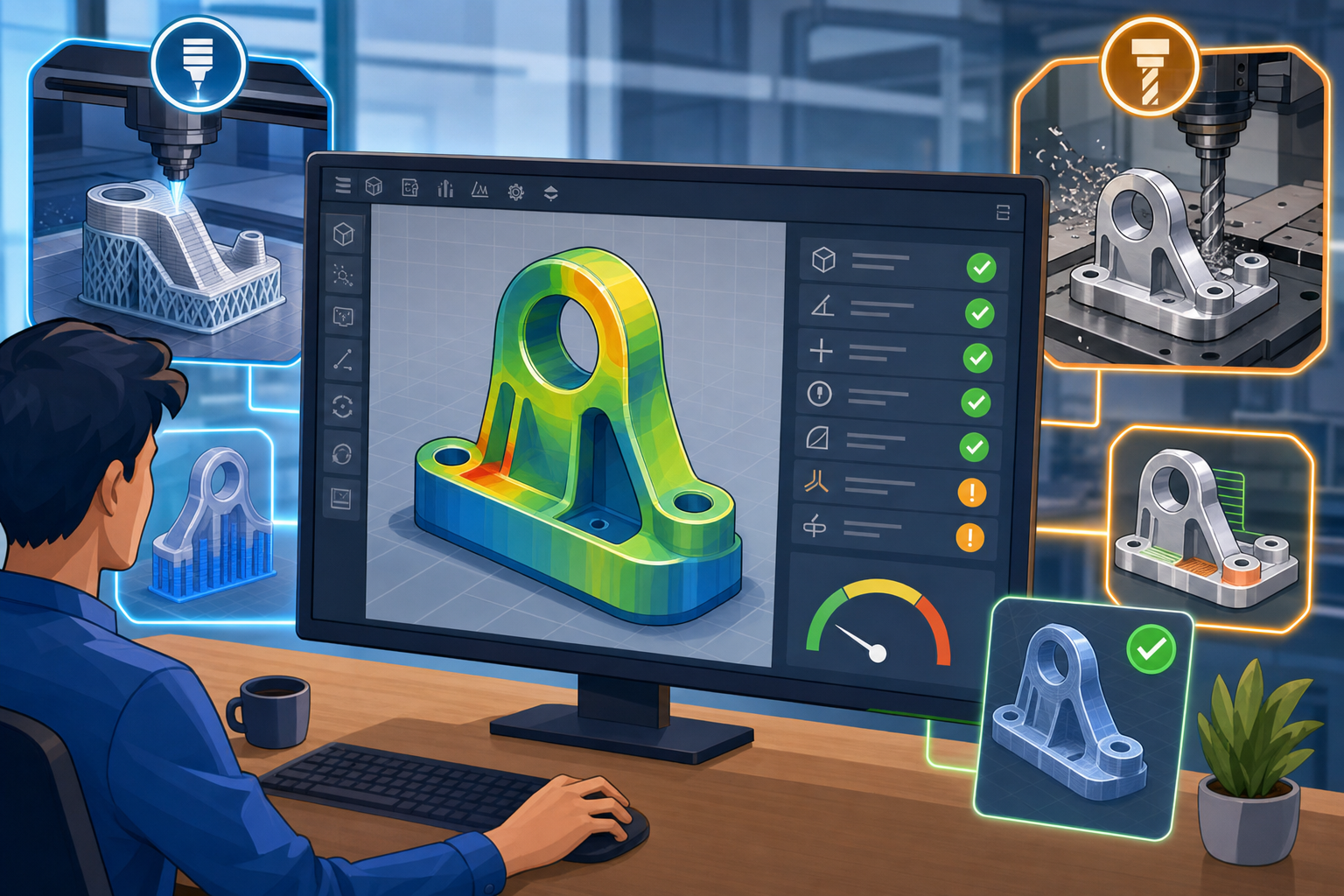


Design for manufacturability is no longer a review step that waits politely at the end of the engineering process. It is becoming a live decision layer embedded directly into how parts, assemblies, and production strategies are conceived. That change matters because product teams are being asked to move faster while also handling greater material diversity, tighter tolerances, more customization, and a broader mix of fabrication methods. In that environment, modern DFM software is not simply identifying errors after geometry is complete. It is helping teams understand which shapes are practical, which process paths are fragile, and which design moves increase cost or risk before those choices become expensive to reverse. The most important shift is that DFM is moving from isolated manufacturability validation toward continuous, process-aware guidance that informs the design itself.
Why DFM tools are changing now
From late-stage review to continuous design feedback
For many years, DFM software behaved like a gatekeeper. A designer built the model, engineering refined it, and then a manufacturability check exposed the likely problems. That sequence made sense when products changed slowly, process options were limited, and digital workflows were less connected. It is increasingly inadequate today. In fast-moving development environments, a manufacturability issue discovered after design freeze is not a small inconvenience. It can trigger model rework, drawing revisions, toolpath changes, procurement delays, and repeated prototype cycles. As a result, the value of DFM has shifted from final approval to continuous intervention. Modern tools are now expected to run inside the design loop and deliver feedback while geometry is still fluid, dimensions are still negotiable, and process intent is still being defined.
The cost of delayed manufacturability insight
This change is especially visible in organizations managing both custom and production-ready parts. A bracket designed for machining may later be considered for powder bed fusion to reduce weight. A plastic housing first envisioned for printing may need to migrate toward molded or machined prototypes. If manufacturability feedback only appears at the end, the team effectively learns too late which assumptions were wrong. Contemporary DFM platforms instead aim to expose these realities continuously. They analyze wall conditions as features are edited, identify inaccessible cuts before detailing is complete, and estimate whether build orientation will inflate support requirements before a print job is ever scheduled. That is why the new generation of DFM is not merely faster rule-checking. It is an attempt to reduce uncertainty early enough that design exploration remains productive rather than wasteful.
One DFM environment for additive and subtractive thinking
Another major reason DFM tools are evolving is that modern product development rarely stays loyal to one fabrication method. The same team may prototype in FDM, validate geometry with SLA, produce small-batch metal parts by machining, and then re-evaluate additive routes for customized production. Traditional DFM systems were often process-specific and siloed. A machinability checker knew about minimum corner radii and tool reach, while a printability tool focused on support angles and powder evacuation. That distinction is no longer sufficient because teams need to compare processes, not just validate one. They need to know whether a geometry optimized for lightweight additive production has hidden post-processing burdens, or whether a machined part could be partially redesigned for printed inserts, conformal channels, or reduced setup complexity.
Why process comparison has become essential
This is pushing software vendors toward DFM environments that support both additive and subtractive manufacturing in the same decision space. Instead of saying only whether a part can be machined or printed, advanced systems are now being built to reveal how the design behaves across multiple manufacturing paths. That might include a side-by-side interpretation of tool accessibility versus support volume, projected cycle time versus build time, and tolerance capability versus post-processing effort. Unified DFM is powerful because manufacturability is no longer a binary pass-fail condition. It is a strategic comparison among competing process routes. The team wants to know not only what is possible, but what is robust, scalable, economical, and tolerant of change. That broader framing is one of the clearest reasons DFM software is changing so quickly.
From static rules to context-aware manufacturing guidance
Software vendors are also moving beyond static rule libraries because manufacturing decisions are highly conditional. A 1 millimeter wall is not inherently bad or good. It depends on the material, machine, orientation, part size, thermal loads, support strategy, finishing requirements, and the role of that wall in the larger assembly. Older DFM tools often reported these conditions as generic violations, leaving the engineer to interpret the practical meaning. Newer tools are trying to supply context-aware guidance instead. Rather than warning that a feature is problematic in the abstract, the software increasingly explains why that feature creates risk for a chosen process and what realistic alternatives may improve the outcome.
What context-aware guidance looks like in practice
That change matters because actionable guidance shortens decision time. A useful DFM workflow now tends to combine geometric analysis with manufacturing context such as:
- selected process family and machine envelope
- material behavior and tolerance capability
- surface finish targets and post-processing assumptions
- estimated setup count, support burden, or cycle-time impact
- feature-level implications for cost and lead time
By attaching manufacturability logic to realistic production conditions, the software starts to function less like an auditor and more like an engineering advisor. This is a meaningful shift in philosophy. Teams do not need more red flags by themselves; they need DFM systems that explain tradeoffs in language aligned with design intent, plant capability, and delivery pressure. That is exactly where innovation is now concentrated.
The operational pressure driving DFM adoption
The final force changing DFM is operational pressure. Manufacturing organizations are under sustained demand to reduce iteration loops, scrap, setup changes, machine downtime, and quality escapes. Even small inefficiencies can cascade when production schedules are tight and supply chains are unstable. A feature that adds one extra setup, demands a custom tool, or causes support removal labor on every printed part can quietly erode margin across hundreds or thousands of units. DFM software has become strategically important because it helps expose those hidden multipliers while there is still time to redesign intelligently. This is particularly relevant in distributed organizations where design, manufacturing engineering, suppliers, and production planners may be working in separate systems and under different assumptions.
Why DFM is becoming a design operating layer
In that context, the most advanced DFM tools are becoming part of a broader digital production stack rather than a narrow validation utility. Their role is to reduce manufacturing risk before that risk becomes embedded in released geometry. The practical goals are clear:
- fewer redesign loops between CAD and fabrication
- less scrap caused by predictable geometry-process conflicts
- lower setup complexity and less tooling surprise
- faster quotation and more credible lead-time forecasting
- better alignment between design decisions and shop-floor reality
These pressures explain why DFM is changing now and why the innovation is more profound than a better checker or a richer report. The market is redefining manufacturability software as an active layer of decision support embedded inside product development itself.
What’s new in DFM for additive manufacturing
Automated printability analysis is becoming much more granular
The additive side of DFM has advanced rapidly because geometric freedom in printing does not eliminate manufacturing constraints; it simply changes where those constraints appear. The latest tools are far better at identifying printability issues automatically and doing so at a feature level that supports intervention early in design. Unsupported overhangs remain one of the most visible checks, but the real innovation lies in more nuanced interpretation. Rather than marking all steep surfaces equally, advanced systems can now assess local geometry relative to selected process technology, orientation choices, anticipated support strategy, and thermal behavior. This helps distinguish between acceptable risk and likely failure, which is critical because excessive warnings can be nearly as harmful as insufficient analysis. Designers need to know which conditions genuinely jeopardize print success, dimensional control, or post-processing effort.
Beyond overhangs: hidden additive failure modes
Modern additive DFM also pays more attention to issues that are less obvious from a visual inspection of the model. These commonly include:
- unsupported overhangs that may sag, curl, or demand excessive support
- trapped powder or resin in enclosed voids and complex internal channels
- thin walls that may not survive the process or post-processing steps
- distortion risk caused by thermal gradients, residual stress, or weak anchoring
- inaccessible internal features that cannot be cleaned, inspected, or finished effectively
This broader set of checks matters because additive manufacturing often fails not at the idealized geometry stage but in the transition from digital shape to physical recovery, depowdering, curing, support removal, and finishing. DFM tools that reveal these issues early are becoming indispensable for parts with internal lattices, channels, topology-optimized forms, and highly integrated assemblies.
Recommendations are now tied to the selected printing process
A major step forward in additive DFM is the shift toward process-aware recommendations. It is no longer adequate for software to say that a feature may be risky for printing in general. Teams need guidance specific to the chosen technology because printability rules differ sharply across process families. A geometry that is acceptable in SLS may fail economically in SLA due to support burden, while a form that performs well in FDM may be problematic in metal powder bed fusion because of thermal accumulation and support removal complexity. The best tools now evaluate manufacturability with awareness of machine behavior, build style, support dependency, and expected post-processing sequence. This makes feedback more precise and also more credible to engineers who understand that additive is not one process but many.
How process-specific DFM changes design decisions
For example, process-aware additive DFM may guide decisions differently depending on technology:
- For FDM, it may emphasize bridge length, anisotropy, layer adhesion, nozzle diameter limits, and support scarring on visible surfaces.
- For SLS, it may focus more on powder escape, heat accumulation in packed builds, thin unsupported geometries, and nested part spacing.
- For SLA, it may prioritize peel forces, drainage paths, cupping risk, suction effects, and support touchpoint consequences for finish quality.
- For metal powder bed fusion, it may analyze residual stress, support anchoring, recoater interference, distortion probability, and orientation effects on structural accuracy.
This technology-specific feedback is reshaping additive design behavior because it links geometry decisions directly to what the fabrication process is likely to tolerate. That is significantly more useful than broad printability heuristics detached from actual production conditions.
DFM is integrating with orientation, supports, and lattice design
Another important development is the tighter integration between additive DFM and neighboring workflow tools such as build orientation analysis, support generation, and lattice optimization. In earlier software environments, these functions were often disconnected. A designer would model the part, check printability, send it to another application for orientation, and then discover that the support strategy introduced new finishing problems or lengthened build time beyond what was acceptable. Today, more platforms are connecting these decisions so manufacturability can be assessed as a system rather than as isolated checks. This is especially important in additive because orientation changes can alter an enormous range of outcomes simultaneously, including support volume, surface quality, strength directionality, thermal stress, build height, print duration, and powder or resin drainage behavior.
Why integrated additive decisions matter
When DFM is integrated with these tools, the software can reveal design tradeoffs in a more practical way. A reoriented part may reduce unsupported surfaces but increase distortion risk. A lattice may lower mass but create inaccessible zones for powder removal. A support scheme may stabilize the build yet add removal time and compromise cosmetic surfaces. The most effective systems can now compare these competing effects and guide the user toward a more balanced outcome. This integrated view is one of the most valuable advances in additive DFM because successful printing is not determined by a single geometric criterion. It is determined by the interaction between part shape, orientation, support logic, material behavior, machine strategy, and post-processing effort. Bringing those variables into one design workflow dramatically improves the quality of manufacturing decisions.
Cost and lead-time estimates are moving upstream
Costing and scheduling are also being pulled earlier into additive design. Traditionally, a team might verify that a part was printable and then ask a separate manufacturing or supplier function to estimate build cost, lead time, and finishing effort. That division slows decision-making and often masks the true cost of a design choice until late in the process. New additive DFM tools increasingly embed early estimates directly into the design workflow. They can approximate build duration, machine utilization, support material volume, post-processing labor, and even probable queue implications based on part count and orientation scenarios. While such estimates are not a substitute for full production planning, they are more than rough guesses. Their value lies in making economic consequences visible while alternatives are still being considered.
Turning printability into production viability
This upstream costing matters because additive manufacturing often appears deceptively simple when viewed only through geometric feasibility. A part may be printable, but that does not make it commercially sensible. DFM systems that expose likely cost and lead-time drivers help prevent teams from optimizing for geometry alone. Key additive workflow insights now often include:
- expected support removal burden
- estimated finishing steps for cosmetic or functional surfaces
- build packing implications for throughput
- orientation-driven changes in print time and recovery effort
- preliminary cost differences between material and machine options
As these estimates become more reliable, additive DFM turns into an early production viability tool rather than a narrow printability checker. That makes it much more useful to engineering managers and manufacturing planners, not just model authors.
AI and simulation are improving prediction before fabrication
Perhaps the most advanced development in additive DFM is the growing use of AI and simulation to predict print outcomes before a build begins. Simulation has long been used to understand thermal distortion or residual stress in high-value additive parts, especially for metals. What is changing is the degree to which prediction is becoming more accessible, automated, and embedded closer to everyday design activity. Instead of reserving advanced analysis for exceptional parts only, newer software can increasingly combine geometric detection, process heuristics, historical build data, and surrogate models to estimate where a part is likely to fail or require redesign. This does not eliminate the need for engineering judgment, but it greatly improves the speed and consistency of decision-making.
The new predictive layer in additive DFM
AI-driven additive DFM can help rank risk areas, propose geometry changes, and identify patterns that traditional rule systems may miss. For example, it may infer that a particular combination of wall thickness, overhang progression, and part orientation creates a distortion tendency that is not obvious from any single isolated rule. Simulation adds another layer by estimating thermal or mechanical response under process conditions, allowing teams to address likely deformation before fabrication starts. Together, AI and simulation are making additive DFM more predictive and less reactive. That is a crucial improvement because every avoided failed build saves not only material and machine time, but also schedule confidence. In advanced workflows, the goal is no longer simply to ask whether a part can be printed. The goal is to predict whether it will print successfully, finish efficiently, and meet requirements with minimal iteration.
What’s new in DFM for subtractive manufacturing
Machining-aware analysis is becoming more intelligent and immediate
Subtractive DFM is also advancing quickly, though in a different direction. Machining has always depended on practical realities such as tool reach, machine envelope, fixture access, setup planning, tolerance stack behavior, and material removal efficiency. What is new is how directly modern software can connect those realities back to the CAD model in real time. Instead of checking only generic feature rules after the fact, current DFM platforms are becoming much more effective at recognizing the manufacturing implications of geometry as it evolves. This is especially important because subtractive manufacturability problems often hide behind otherwise valid shapes. A pocket may be technically machinable yet require a long-reach tool that compromises rigidity. A hole pattern may satisfy design intent yet trigger extra setups or awkward fixturing. Smarter analysis now aims to expose these process penalties while the model is still easy to modify.
The features modern machining DFM evaluates best
Many of the strongest improvements are in the interpretation of classic machinability factors, including:
- tool access for pockets, side features, and deep internal regions
- corner radii that are too sharp for efficient standard tooling
- hole depth-to-diameter ratios that increase drilling difficulty and cycle time
- undercuts that require specialty tools or alternate setups
- setup complexity driven by feature orientation and datuming strategy
The difference now is that software can evaluate these conditions in ways that are increasingly tied to available machines, likely tool selections, and practical manufacturing preferences rather than purely abstract limits. That makes the resulting guidance much more useful to both designers and manufacturing engineers.
Cycle-time and tooling penalties are easier to spot early
Another key development is the automatic identification of features that increase cycle time or force custom tooling. This is a major advance because many subtractive designs are not rejected outright; they simply become unnecessarily expensive to produce. A very deep narrow slot, a tiny internal radius, or a collection of difficult side features may all be machinable, but each can add hidden cost by requiring reduced feeds, extended tool reach, special cutters, or multiple re-clamping operations. In traditional workflows these consequences might only become visible once a CAM programmer starts selecting tools and planning operations. By then, redesign is often politically or procedurally difficult. Modern DFM brings those manufacturing signals upstream so they inform design decisions before process planning hardens around a poor geometry choice.
Examples of cost-driving subtractive features
Useful subtractive DFM increasingly distinguishes between impossible geometry and expensive geometry. It can flag, prioritize, and sometimes quantify features such as:
- deep cavities that demand long, unstable tools
- nonstandard radii that prevent use of common tool libraries
- thread and hole combinations that require extra tool changes
- features that break one-setup assumptions and force re-fixturing
- tight tolerances applied to surfaces with low functional importance
This matters because competitive manufacturing is often won through reduction of needless complexity rather than heroic process capability. DFM software that reveals those inefficiencies early provides a measurable advantage in quoting, programming, and throughput planning.
CAD and CAM are becoming more tightly linked through DFM
One of the most practical changes in subtractive workflows is the improving link between CAD geometry and CAM constraints. Historically, those domains have often been bridged through file transfer and specialist interpretation. The designer defines shape and nominal intent; the CAM programmer then translates that shape into toolpaths, setup logic, and cutting sequences. The disconnect between those stages is a common source of delay and misunderstanding. Better DFM platforms now operate as a connective layer, mapping geometric conditions to manufacturing consequences in a way that accelerates handoff. If a feature exceeds typical tool reach, violates preferred depth limits, or forces a nonstandard setup orientation, the software can communicate that immediately and often with enough specificity to support a quick redesign.
Why tighter CAD-CAM continuity matters
This is especially effective in environments where the software can reference machine capability, tool libraries, tolerance classes, and preferred strategies from the production side. Instead of relying on generalized machinability assumptions, DFM can align the model with what the shop actually does well. That reduces friction in several ways:
- faster transition from model release to CAM programming
- fewer back-and-forth clarifications about inaccessible or inefficient features
- better consistency between design intent and machine capability
- earlier recognition of dimensions or tolerances that create avoidable cost
- more reliable preparation for fixture planning and setup sequencing
The strategic advantage is not just speed. It is the creation of a more continuous workflow in which manufacturability knowledge is preserved rather than rediscovered at each handoff.
Real-time feedback is becoming process and material specific
Real-time manufacturability feedback in subtractive tools is also getting more sophisticated because machining outcomes are strongly influenced by material choice, machine capability, and tolerance requirements. A geometry that is straightforward in aluminum may become substantially more difficult in a tough nickel alloy. A pocket that is easy on a 5-axis machine may be awkward on a 3-axis platform. A thin wall may survive roughing in one material and chatter or deform in another. The latest DFM tools increasingly account for these variables as active parameters in the evaluation rather than as assumptions left to human interpretation. This means designers can get earlier guidance that reflects actual production context, not idealized best-case capability.
Manufacturability is now conditional, not generic
This context matters because many manufacturing decisions are conditional rather than absolute. Advanced subtractive DFM can now present guidance such as whether a requested tolerance is realistic for the material and process path, whether a hole depth is acceptable for a selected machine-tool combination, or whether a feature’s surface finish requirement is likely to force an additional operation. By tying manufacturability feedback to the chosen production environment, the software helps prevent overengineering and reduces the gap between design optimism and machining reality. In practice, this often results in smarter simplifications: wider internal radii, shallower pockets, consolidated hole specifications, less aggressive tolerancing, and more setup-friendly geometry. Those moves may seem ordinary, but across production they can produce major gains in throughput, quality stability, and cost control.
The rise of hybrid DFM comparisons across process routes
One of the most forward-looking changes in subtractive DFM is the growing role of hybrid workflows. Instead of assuming that a part belongs to machining by default, newer systems increasingly compare whether a component is better suited for CNC machining, additive manufacturing, or a mixed production strategy. This is where DFM becomes strategically powerful. A part with deep internal channels, low production volume, and complex mass reduction requirements may appear expensive in machining but efficient in metal additive followed by finish machining. A printed near-net shape may reduce waste and setup count for a demanding alloy. Conversely, a part first imagined for additive may become faster and cheaper to machine if internal complexity is reduced slightly. DFM tools are beginning to support these comparisons in a more explicit and systematic way.
How hybrid manufacturing decisions are being informed
Hybrid-aware DFM does not simply compare geometric feasibility. It increasingly evaluates broader production criteria such as:
- material utilization and buy-to-fly implications
- required tolerances and where finish machining would still be necessary
- internal complexity that favors printing over cutting
- setup count versus build preparation burden
- post-processing effort across both additive and subtractive steps
This capability reflects a deeper change in manufacturing strategy. The question is no longer, “Can we machine this?” or “Can we print this?” It is, “Which process combination delivers the best balance of performance, time, cost, and risk?” DFM software that can help answer that question is no longer just an analysis tool. It becomes part of strategic process planning itself.
Conclusion
DFM is becoming an active decision system
Modern DFM tools are evolving from passive checklists into active design decision systems. That transition is significant because manufacturability is no longer a downstream concern that can be delegated safely to a final review step. As additive and subtractive workflows become more interconnected, and as product teams face stronger pressure for speed and reliability, DFM must operate earlier, with more process awareness, and with clearer guidance tied to real production conditions. The biggest innovation is not simply that software can detect more errors. It is that the software can increasingly explain tradeoffs, compare process paths, and connect geometric decisions to cost, schedule, setup burden, post-processing effort, and production risk before those choices are locked in. That changes the role of DFM from validation to strategy.
The future is unified, predictive, and continuous
Teams that adopt these tools well can reduce redesigns while making manufacturing strategy part of the design process itself. The future of DFM lies in unified platforms that connect CAD, simulation, costing, and production knowledge into one continuous workflow. In that environment, the most valuable capability will be the ability to move seamlessly from shape creation to manufacturability insight to process selection without losing context. Designers will not just ask whether a model passes a rule set. They will expect live, process-specific guidance that helps them choose better geometry, better fabrication paths, and better timing for decisions. As AI, simulation, and production data mature, DFM will become even more predictive, enabling teams to identify successful manufacturing outcomes before fabrication begins. That is the real direction of innovation: turning manufacturability from a constraint discovered late into a design intelligence system that shapes the product from the start.
Also in Design News