Your Cart is Empty


Design Software History: University of Utah and the Origins of 3D Graphics in Design Software
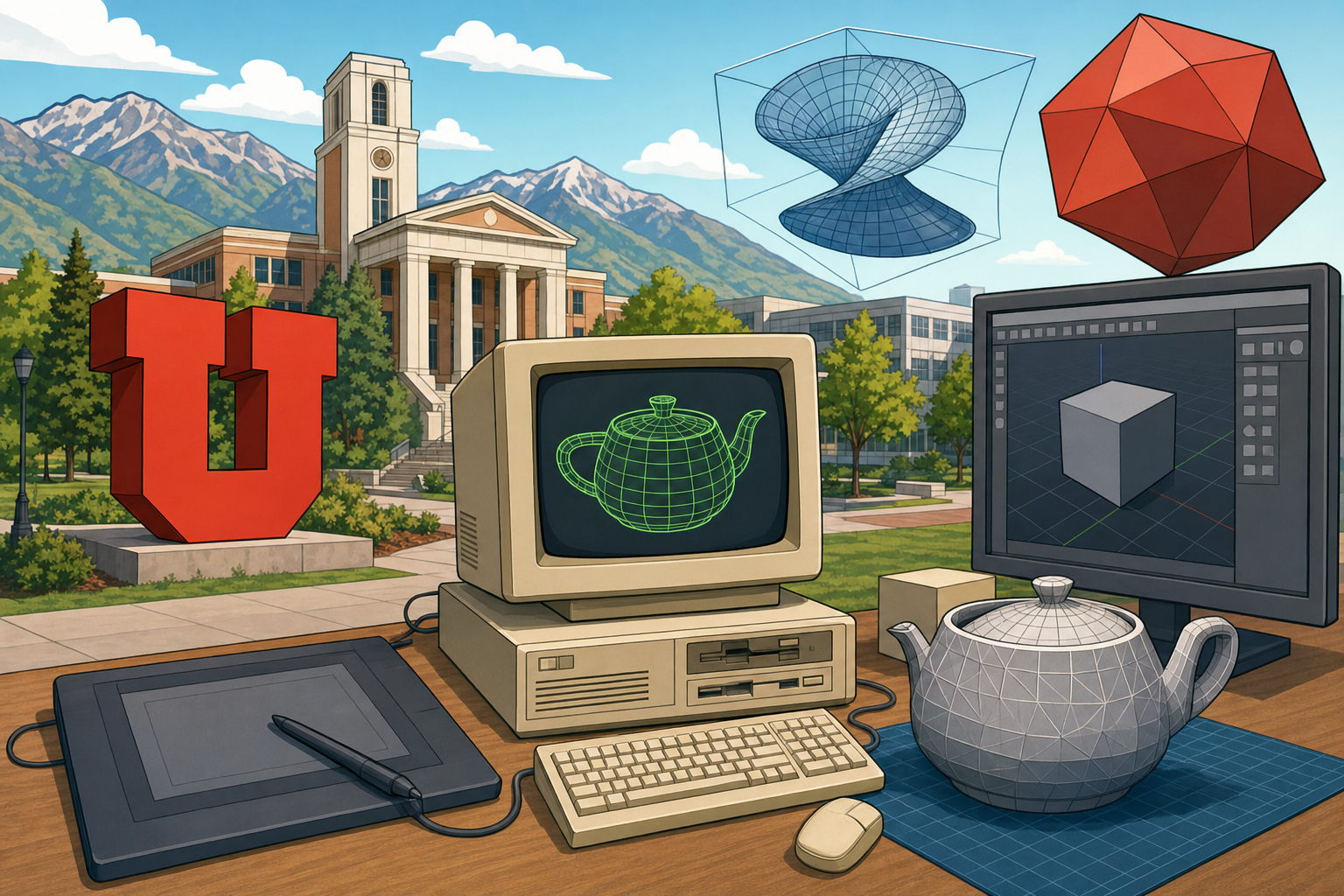


Why the University of Utah mattered in the birth of 3D graphics
A research center at the exact right historical moment
The University of Utah occupies a singular place in the history of computer graphics because it became one of the rare environments where mathematics, engineering, computing hardware, and visual experimentation converged early enough to influence the formation of entire industries. In the 1960s and early 1970s, the technological landscape was still unsettled. Interactive computing was not yet a default assumption. Most computers were expensive institutional machines, graphics terminals were uncommon, memory was scarce, and display technology was primitive by later standards. In that environment, even drawing lines on a screen in real time represented a meaningful technical achievement. What made Utah extraordinary was that it did not treat graphics as a peripheral novelty. It treated visual computation as a serious scientific and engineering problem, one with implications for simulation, design, and human interaction with machines. That orientation is why Utah became foundational not only to the history of computer graphics, but also to the deep technological lineage of design software, digital modeling, and 3D visualization. Its importance lies in the fact that it was not merely producing isolated demonstrations; it was shaping a research culture that turned visual computing into a systematic field.
The rarity of interactive graphics in the 1960s and 1970s
To understand Utah’s importance, it helps to remember how limited the era really was. Commercial CAD had not yet matured into the software category later represented by companies such as Autodesk, Dassault Systèmes, PTC, or Bentley Systems. During the period when Utah was building its reputation, much of what would later be called computer-aided design still emerged from defense-sponsored laboratories, aerospace contractors, elite universities, and a handful of advanced industrial research groups. Researchers were wrestling with basic questions that later generations would inherit as standard features. How should a machine represent shape? How should a user manipulate geometry interactively? How can a display communicate depth, surface orientation, or occlusion with such little computational power? Those questions were not abstract. They were the starting conditions for every later viewport, modeling kernel, rendering engine, and interactive design environment. Utah mattered because its faculty and students worked on those problems at a time when solutions were far from obvious, and because they approached them with unusual rigor in geometry, computation, and image synthesis.
Utah inside the ARPA research network
The University of Utah also mattered because it was embedded in a broader ARPA-funded research system that linked a relatively small number of institutions doing frontier work in interactive computing. The Advanced Research Projects Agency, later DARPA, played a pivotal role in concentrating technical talent and funding in places where high-risk computer research could flourish. Utah stood within the same broad networked universe as MIT, Stanford, and later Xerox PARC, yet it developed a distinctly graphics-centered identity. MIT had seminal work in interactive computing, including Ivan Sutherland’s earlier development of Sketchpad at Lincoln Laboratory, a project often described as a conceptual ancestor of CAD. Xerox PARC would later become synonymous with graphical user interfaces, personal computing, and object-oriented software environments. Utah’s role was different but complementary. It became a pipeline for researchers who treated image generation, geometric representation, hidden surfaces, shading, and 3D interaction as core computational challenges. The institution’s relationship to this national research ecosystem amplified its influence. Ideas moved through grants, dissertations, conferences, military contracts, startup companies, and the migration of graduates into industry. Utah was not isolated brilliance. It was a high-intensity node in a network that shaped the technical vocabulary of modern design computing.
An ecosystem rather than a single invention
The central reason the University of Utah deserves such prominence is that its influence did not come from one famous breakthrough alone. It came from a concentration of people, ideas, and methods that later flowed into commercial CAD, product visualization, simulation, digital animation, and engineering workstations. The university fostered an environment where a remarkable number of future leaders worked in overlapping proximity, learning from one another and pushing forward related problems in graphics and modeling. That concentration produced long-term consequences across multiple technical layers:
- Rendering techniques that made surfaces legible and realistic
- Methods for hidden surface determination that made 3D scenes understandable
- Surface and spline research tied to geometric modeling and shape design
- Interactive hardware and display thinking that influenced workstation development
- A talent network that spread across major firms such as Xerox PARC, Adobe, Silicon Graphics, Pixar, and Evans & Sutherland
In retrospect, Utah looks less like a single department and more like an origin chamber for the modern visual computing stack. That is why its contribution to design software history is so important: it helped define not just what computers could draw, but what designers, engineers, and visualization specialists would later expect computers to do.
The people, projects, and breakthroughs that made Utah legendary
Ivan Sutherland, David Evans, and the creation of a powerhouse
No account of Utah’s rise can begin anywhere but with Ivan Sutherland and David Evans. Sutherland had already secured a place in computing history through Sketchpad, developed in 1963 as his doctoral work at MIT under Claude Shannon. Sketchpad demonstrated constraints, interactive drawing with a light pen, hierarchical structure, and direct manipulation concepts that would echo through CAD for decades. When Sutherland moved into the Utah orbit and joined forces with David Evans, the result was not simply a graphics lab but a training ground for a generation of researchers who would define modern graphics. Evans brought organizational force, technical seriousness, and a vision for creating a leading academic program. Together, Evans and Sutherland created an environment that attracted highly ambitious students and gave them difficult, foundational problems. The significance of their partnership extends beyond academia because they later co-founded Evans & Sutherland in 1968, a company that became a bridge between advanced graphics research and commercial systems, particularly in simulation and high-performance display technology. That bridge mattered enormously. It showed that ideas born in academic graphics research could be translated into industrial hardware and software used for serious technical work.
A concentration of extraordinary talent
What made Utah legendary was the density of people who passed through it. Edwin Catmull, later a co-founder of Pixar and a major figure in computer animation and imaging, conducted famous work on texture mapping foundations, hidden surface algorithms, and curved surface representation. Henri Gouraud developed Gouraud shading, a method that interpolated vertex intensities across polygonal surfaces, dramatically improving the visual quality of rendered forms. Bui Tuong Phong advanced that trajectory with Phong shading and the Phong reflection model, adding smoother highlights and a more convincing sense of material response to light. Jim Blinn, though often associated with later work at NASA’s Jet Propulsion Laboratory and elsewhere, became one of the most influential interpreters and developers of shading, lighting, and image synthesis techniques. Martin Newell contributed the famous Utah teapot model, originally derived from a teapot and teacup set measured by his wife Sandra Newell, which became a durable benchmark object in graphics research. The broader Utah orbit also touched figures such as Alan Kay, who would become central at Xerox PARC, John Warnock, later co-founder of Adobe, and James Clark, who founded Silicon Graphics. Few institutions in computing history can claim such a list without exaggeration.
Why these people mattered to design software
It would be a mistake to treat those names as simply the cast of a heroic academic story. Their work mattered because it produced practical building blocks for later design and visualization systems. CAD viewports need to communicate shape clearly. Industrial designers and mechanical engineers need shaded models that reveal curvature and edge flow. Architects need surfaces and lighting cues that make form understandable before construction. Simulation and scientific visualization need accurate spatial representation and interactive scene control. The Utah researchers were working on precisely those classes of problem, even before the downstream software markets fully existed. Their breakthroughs created capabilities that later became routine expectations in software used for engineering and design:
- Displaying 3D objects without visual confusion from hidden lines and obscured faces
- Representing light across polygonal models in a way that conveyed smoothness
- Developing mathematically grounded methods for surface definition and interpolation
- Improving the realism and legibility of computer-generated objects
- Making digital objects manipulable, inspectable, and presentable in interactive systems
In other words, Utah’s breakthroughs were not detached from design practice. They solved the visual and geometric preconditions that later allowed digital design workflows to become credible alternatives to drawings, physical mockups, and static plots.
Hidden surfaces, shading, and the problem of seeing form
Among Utah’s most enduring contributions were the techniques that made 3D form visible in an intelligible way. Early wireframe displays were useful but limited. A wireframe cube can be read as spatial structure, but as objects become more complex, line drawings quickly become ambiguous and visually crowded. Hidden surface methods addressed a core issue: if one surface blocks another from the viewer, the display should respect that spatial ordering. Without that capability, digital models remain visually confusing and difficult to inspect. Hidden surface research, including work done by Catmull and others in the Utah sphere, gave later CAD and graphics systems the means to show coherent solids rather than tangled line webs.
From flat polygons to readable products
Shading methods pushed this progress much further. Gouraud shading improved visual continuity across polygonal meshes by interpolating intensities from vertices, producing smoother transitions than flat-shaded polygons. Phong shading went deeper by interpolating normals and evaluating illumination more continuously across a surface, producing far better specular highlights and helping curved forms appear truly curved. This mattered greatly for product visualization, industrial design review, and engineering interpretation. A polished housing, a turbine blade, an automotive body panel, or a consumer electronics enclosure cannot be judged properly if every polygon appears as a separate plate. The promise of digital reviewing depends on visual smoothness and coherent light response. That promise was built on exactly the kind of mathematically informed shading research associated with Utah. Today, even modest modeling tools assume that smooth shaded display is a basic capability. That expectation was hard won.
Texture mapping foundations, surfaces, and the Utah teapot
Edwin Catmull’s contributions are especially important because they connect several threads that later became central to visual design software. His work on texture mapping foundations opened the door to attaching image detail to geometric surfaces, a concept that would later become indispensable in rendering, visualization, digital prototyping, and animation. Texture mapping is often discussed as a realism technique, but in design software it also serves communication. Surface finishes, labels, patterns, and visual material references help teams evaluate products before they exist physically. Catmull’s research also touched curved surfaces and subdivision-related thinking, helping move graphics beyond crude faceting. At the same time, surface and spline research more broadly was developing in ways that mattered directly to CAD. While Bézier curves emerged at Renault through Pierre Bézier and B-spline and NURBS developments drew from multiple streams including work associated with Paul de Casteljau, Carl de Boor, and later CAD kernel developers, Utah’s graphics environment was part of the wider movement that took shape representation seriously as a mathematical problem. The famous Utah teapot, introduced by Martin Newell, became more than a joke or mascot. It provided a shared reference object for testing rendering algorithms, surface handling, shadowing, shading, and image quality. In this sense, the teapot symbolized something larger: Utah’s ability to turn technical experimentation into durable standards of comparison.
The Evans & Sutherland connection to commercial systems
The role of Evans & Sutherland deserves special emphasis because it linked academic research to operational graphics systems with a directness that many universities never achieve. Founded by David Evans and Ivan Sutherland, the company became highly influential in graphics hardware, simulation, and visual display systems, especially for flight simulation and training. This mattered to design software history because high-performance interactive visualization did not emerge purely from desktop software firms. It evolved through a blend of military simulation, display engineering, specialized workstations, and research-driven graphics architectures. Evans & Sutherland showed that the techniques explored in university labs had commercial and industrial value in environments where image quality, responsiveness, and spatial credibility were mission-critical. The company also helped normalize the idea that advanced graphics deserved dedicated hardware and software stacks. That idea would later be echoed and expanded by firms such as Silicon Graphics, which transformed graphics computing for technical users, designers, animators, and scientific researchers. The Utah tradition thus combined theory with systems thinking: algorithms, displays, hardware, and software were understood as interdependent parts of a usable visual computing environment.
How Utah’s research flowed into commercial design software
From campus laboratories to industrial power centers
The University of Utah’s long-term importance becomes clearest when one traces where its people and ideas went. Its legacy did not stay confined to dissertations or conference papers. It moved outward through alumni who became central at some of the most important computing companies of the late twentieth century. Xerox PARC absorbed Utah-linked talent into a culture that reinvented interactive computing with bitmap displays, graphical interfaces, object-oriented programming, and networked workstations. Adobe, co-founded by John Warnock and Charles Geschke, transformed digital publishing and graphics with PostScript and later PDF, changing how geometry, curves, text, and page imaging were handled across software ecosystems. Silicon Graphics, founded by James Clark, turned advanced graphics workstations into key tools for engineering, scientific visualization, animation, and 3D software development. Pixar, with Edwin Catmull as a central technical and organizational figure, advanced rendering, digital imaging, and animation production pipelines that influenced visual communication far beyond film. Evans & Sutherland remained a critical conduit for simulation-grade graphics. Through these pathways, Utah’s impact entered both the visible interface of software and the deeper infrastructure beneath it.
Interactive graphical interfaces and the culture of direct manipulation
One layer of Utah’s influence reached design software through the broader development of interactive graphical interfaces. Although no single institution can claim sole ownership of the GUI, Utah-trained researchers helped carry forward assumptions first made credible by early interactive graphics: the user should manipulate visible objects directly, visual feedback should be immediate, and the computer should support iterative exploration instead of batch submission. Those principles are now so embedded in CAD and modeling environments that they seem natural. A designer rotates a model, drags a control point, inspects a section, changes a surface property, and expects live visual response. That expectation reflects a lineage stretching from Sketchpad and advanced academic graphics to workstation software and ultimately modern desktop and cloud tools. Xerox PARC, in particular, played a crucial role in making interactive visual computing more humane and more personal, and people with Utah ties were part of that migration. The resulting culture of direct manipulation shaped not only industrial and engineering software, but also drawing programs, layout systems, visualization interfaces, and eventually digital content creation tools used across architecture and product development.
Rendering methods as core design infrastructure
Another layer of influence lies in rendering methods, which became inseparable from how design software communicates geometry. In contemporary engineering and industrial design systems, users often move fluidly between shaded views, hidden-line views, technical illustrations, ray-traced previews, and real-time material displays. Those capabilities rest on decades of graphics research, much of it seeded by Utah’s intellectual environment. Smooth shading is not merely cosmetic. It helps reveal continuity, curvature defects, edge transitions, and the relationship between adjacent faces. Hidden surface calculations make assemblies legible. Texture handling and illumination models support marketing visuals, digital mockups, and review workflows. As software matured, these methods moved from research demonstrations into daily design practice. The viewport became not only a modeling window but also a decision-making device. Engineers evaluate manufacturability and fit. Industrial designers assess visual quality. Architects communicate intent to clients and contractors. The graphical clarity these workflows require depends on rendering conventions that trace back to the Utah tradition. What once demanded specialized research systems has become standard functionality in applications across CAD, CAE, BIM, and 3D visualization.
Geometric modeling research and shape representation
Utah’s effect on design software also passed through the larger field of geometric modeling. Even when later breakthroughs came from other institutions or companies, Utah helped establish the seriousness of mathematically grounded shape research and the expectation that visual computing had to engage with geometry, not just images. Commercial CAD eventually depended on robust representations of curves, surfaces, and solids, from spline-driven automotive surfacing to boundary representation kernels in mechanical design systems. Companies such as SDRC, Applicon, Computervision, Intergraph, Parametric Technology Corporation, Dassault Systèmes, and later Siemens PLM Software built software ecosystems around advanced geometry and engineering workflows. The specific kernels and modeling paradigms often emerged from multiple sources, including solid modeling work at institutions like the University of Rochester and corporate developments such as ShapeData’s Parasolid or Spatial’s ACIS. Yet the visual and geometric mindset cultivated at Utah contributed to the broader technical culture in which 3D modeling became central. Utah normalized the idea that representing and displaying form digitally required a marriage of mathematics, software engineering, and user interaction.
Workstation culture and hardware acceleration
Perhaps one of the most underappreciated aspects of Utah’s legacy is its contribution to the culture of high-performance graphics workstations and specialized hardware. Before commodity PCs could handle serious 3D work, advanced graphics depended on expensive, purpose-built systems. Evans & Sutherland, and later Silicon Graphics, embodied the notion that demanding visual computation justified dedicated architectures. That assumption was essential for industries that needed real-time scene update, strong display fidelity, and computationally intensive geometry handling. Aerospace, automotive, scientific labs, and advanced design groups often adopted such workstations because interactive graphics had direct operational value. Hardware acceleration for line drawing, depth buffering, rasterization, shading, and eventually texture operations made sophisticated software feasible in professional settings. This workstation culture shaped the delivery of commercial design software for years. Many landmark CAD and CAE systems were first meaningful on high-end graphics machines rather than mass-market computers. The path from Utah’s research ethos to these specialized environments is not accidental. Utah helped form the belief that graphics was not an optional output device but a central computational mode deserving serious hardware support.
Influence beyond CAD into animation, simulation, and architecture
The effects of Utah’s research spilled far beyond conventional CAD. In animation, Utah-linked ideas about rendering, surface modeling, texture, and shading became central to digital image synthesis and character pipelines. In scientific visualization, the need to render complex volumetric or spatial data in understandable ways drew heavily on graphics techniques refined by the same technical tradition. In simulation, especially flight simulation and training, the work of Evans & Sutherland and related systems demonstrated how interactive 3D scenes could support decision-making and realism under demanding constraints. In architectural presentation, smoother shading, hidden surface removal, and eventually more advanced material and lighting methods transformed how buildings and interiors could be communicated before construction. These domains are distinct, but they share a dependence on techniques that make digital space legible, manipulable, and believable. That is precisely what Utah researchers helped pioneer. Their work altered not just how images looked, but how professionals interacted with information and judged form across industries.
What became standard started as research tradition
Today, many expectations feel so ordinary that their historical origins are easy to forget. Users assume that a 3D model can be rotated interactively with a mouse or stylus and remain visually coherent. They assume surfaces can appear smooth even when built from polygons. They assume reflections and highlights will help reveal geometry. They assume viewports can switch between wireframe, hidden-line, shaded, and realistic representations instantly. They assume dedicated graphics processors or graphics APIs will support dense models and responsive navigation. Those expectations did not emerge spontaneously from commercial demand alone. They grew out of research traditions shaped significantly at the University of Utah. The institution’s most important legacy may be that it transformed advanced graphics from a collection of isolated experiments into a set of durable capabilities that software developers, hardware makers, and professional users could build upon. In that sense, Utah did not merely influence the history of design software. It helped define the baseline of what modern design software is supposed to be.
Why Utah still deserves recognition in the history of design software
An institution whose ecosystem changed multiple industries
The University of Utah deserves recognition as one of the most influential institutions in the history of 3D graphics and design software because its contribution was systemic rather than narrow. It produced exceptional researchers, but just as importantly, it created an ecosystem in which mathematical insight, algorithmic innovation, hardware awareness, and practical visualization problems reinforced one another. That ecosystem generated breakthroughs in hidden surfaces, shading, texture concepts, surface representation, and interactive graphics, while also sending highly influential people into companies that redefined computing. The result was a rare academic-to-commercial pathway with lasting consequences. Utah’s legacy can be seen in the design review viewport, the graphics workstation, the rendering engine, the visual simulation system, the animation pipeline, and the user expectation that digital form should be interactive, smooth, and spatially intelligible. Few universities can claim to have influenced such a broad vertical stack, from underlying graphics mathematics to commercial products used by engineers, architects, industrial designers, and visual effects teams.
The long future of foundations laid decades ago
The forward-looking significance of Utah is equally striking. Many current trends in real-time rendering, GPU-driven design workflows, immersive visualization, and hybrid engineering visualization still depend on principles established by Utah researchers and their intellectual descendants. Modern GPUs execute shading and visibility calculations at scales those pioneers could scarcely access, yet the underlying goals remain familiar: represent form efficiently, compute light meaningfully, preserve interactivity, and help humans understand complex geometry. Contemporary design tools use physically based materials, real-time shadows, mesh processing, procedural textures, and immersive interfaces, but these advances still build on the same long arc of visual computing that Utah helped shape. Whether one looks at CAD systems for mechanical assemblies, architectural walkthrough platforms, digital twins, XR-based review tools, or high-fidelity product configurators, the historical foundations remain visible. Utah mattered because it created a durable research culture where deep mathematics met practical image-making and where academic breakthroughs could become industrial reality. That combination is why its place in the history of design software remains not just important, but indispensable.
Also in Design News