Your Cart is Empty


Knowledge-Based Engineering for Scalable Design Reuse


Why Design Reuse Is Still Hard in Modern Engineering
The Hidden Cost of Existing Knowledge
Most engineering organizations are not short on design history. They have decades of CAD assemblies, released drawings, simulation reports, supplier notes, machining recommendations, tolerance studies, service bulletins, configuration spreadsheets, and product documentation. The difficulty is that much of this knowledge exists as a collection of disconnected artifacts rather than as an operational design system. A designer may find an old model that looks similar to the new requirement, but the model rarely explains why a fillet was added, why a wall thickness changed, why a fastener pattern was selected, or what manufacturing compromise shaped the final geometry. This is why **design reuse remains difficult even in organizations with mature CAD and PLM environments**. The issue is not the absence of historical data; it is the absence of structured, searchable, executable engineering reasoning. When teams reuse only the final geometry, they inherit the visible outcome but not the decision chain that produced it. That creates risk, because copied geometry may satisfy an old operating condition, regulatory requirement, supplier capability, or cost target that no longer applies to the new product context.
Design Intent Locked Inside Legacy Models
Parametric CAD was supposed to make reuse easier, and in many ways it did. Features, constraints, sketches, relations, design tables, and assemblies allow engineers to build models that adapt to changing dimensions. However, many legacy parametric models are difficult to interpret because the original design intent is buried inside feature trees, naming conventions, suppressed geometry, spreadsheet links, and undocumented equations. A model may technically be parametric while still being fragile, obscure, and unsafe to modify. For example, a bracket might include equations linking hole spacing, bend radius, material thickness, and clearance zones, but if those equations are not associated with design rules or explanatory logic, the next engineer must reverse-engineer the reasoning from the model structure. This creates a common form of false reuse: a part is copied because it appears reusable, but the underlying constraints are misunderstood. When the model later fails during configuration, machining, simulation, or installation, the organization discovers that it reused geometry without reusing knowledge. In advanced engineering workflows, **design intent must be explicit, governed, and reusable beyond the individual CAD file**.
The Persistence of Tribal Knowledge
One of the most serious barriers to reuse is the continued reliance on tribal knowledge. Senior engineers, manufacturing specialists, analysts, and field service experts often know which assumptions are safe, which supplier limits are real, which tolerances cause trouble, and which design shortcuts should be avoided. Yet this expertise is frequently exchanged through informal conversations, email threads, review meetings, or personal notebooks rather than captured in a structured engineering system. When those experts are unavailable, retired, or assigned to other programs, younger engineers are forced to rediscover decisions that the organization has already paid to learn. This is especially damaging when product platforms evolve over many years and each generation accumulates small undocumented decisions. The result is inefficient repetition: similar brackets are recalculated, similar housings are remodeled, similar weldments are checked again, and similar compliance questions are reopened. The organization may believe it has a reuse strategy because it stores released data, but real reuse requires access to the reasoning behind the release. Without that reasoning, engineering history becomes a library of artifacts rather than a source of reusable intelligence.
- Design assumptions may be hidden in emails, spreadsheets, or review notes.
- Manufacturing preferences may be understood locally but not documented globally.
- Simulation boundary conditions may be repeated inconsistently between teams.
- Product standards may vary across business units, regions, or generations.
- Similar components may be recreated because engineers cannot trust older data.
Reuse Is More Than Copying CAD Geometry
Design reuse is often discussed as if it means finding an existing model, copying it, adjusting dimensions, and releasing a new variant. That view is too narrow for modern engineering. A reusable design includes geometry, but it also includes rules, constraints, calculations, manufacturing logic, material limits, supplier preferences, compliance requirements, inspection criteria, and configuration knowledge. In a sheet metal enclosure, for example, the useful knowledge is not only the shape of the panels. It includes minimum bend radii, allowable fastener spacing, preferred blank sizes, coating restrictions, ventilation rules, structural stiffness requirements, grounding provisions, thermal assumptions, packaging rules, and assembly access constraints. If those relationships are not captured, every new variant becomes an exercise in reconstructing missing knowledge. This is where many design libraries fail: they organize files but not decisions. A searchable part library can reduce modeling time, but it cannot guarantee that the selected part is appropriate for a new load condition, regulatory environment, manufacturing site, or customer configuration. Effective reuse must therefore move from model retrieval to **knowledge-driven design reuse**, where the system understands what can change, what must remain fixed, and what must be verified automatically.
What Knowledge-Based Engineering Adds to Design Software
Embedding Engineering Logic into the Design Environment
Knowledge-Based Engineering, or KBE, extends design software by turning engineering expertise into structured logic that can participate directly in the design process. Instead of relying entirely on manual modeling, memory, and document lookup, KBE systems embed rules, formulas, constraints, configuration options, and validation procedures into the same environment where products are created. This changes the role of CAD from a geometric authoring tool into a platform for intelligent product definition. A KBE-enabled model does not merely contain sketches and features; it can understand allowable ranges, material choices, manufacturing capabilities, interface requirements, and calculation dependencies. For example, if an engineer enters a customer load requirement, the system can select a structural member size, update connection geometry, verify stress limits, check fastener spacing, and flag manufacturing restrictions before the design reaches review. This does not remove engineering judgment. Rather, it automates repeatable decisions so engineers can focus on exceptions, trade-offs, innovation, and system-level performance. The core value of KBE is that **engineering knowledge becomes executable rather than passive**, transforming standards and expert practices into reusable digital assets.
The Building Blocks of a KBE System
A practical KBE environment usually combines several layers of technology and process. Rule-based templates define how products or components should be generated. Parametric models provide adaptable geometry. Calculation engines evaluate sizing, stress, flow, thermal behavior, cost, weight, or performance. Configuration logic controls which features, options, and components are valid together. Manufacturing constraints prevent designs that cannot be produced efficiently. Material and standards databases ensure that selections align with approved engineering practice. Automated validation checks compare the resulting design against rules before release. The strongest systems connect these elements through CAD, CAE, CAM, PLM, and sometimes ERP data, so that geometry, analysis, process planning, sourcing, and lifecycle governance are aligned. This is significantly more powerful than a traditional design table or macro. A macro may automate a repetitive modeling task, but KBE captures the reasoning that determines what the task should produce. In mature implementations, engineers interact with design inputs, requirements, and constraints, while the KBE layer generates compliant models, drawings, bills of materials, and verification outputs from validated templates.
- Rule-based design templates encode repeatable engineering decisions.
- Parametric product models create adaptable geometry from controlled inputs.
- Calculation engines evaluate performance, load, cost, mass, or sizing logic.
- Configuration rules prevent invalid combinations of options and features.
- Manufacturing constraints ensure that generated designs remain producible.
- Automated validation checks reduce late-stage review and correction effort.
From Manual Choices to Automated Decisions
The practical difference between conventional CAD and KBE becomes clear when examining common engineering decisions. In a manual workflow, an engineer may review requirements, open a similar model, modify dimensions, consult a spreadsheet, check a design standard, select components from a catalog, perform a calculation, update drawings, and request review. Each step depends on attention, experience, and interpretation. In a KBE workflow, many of those steps can be governed by predefined logic. A crane beam can be sized automatically from span, load class, duty cycle, deflection limit, and material availability. An HVAC duct assembly can be generated from airflow, pressure drop, installation zone, acoustic limit, and fabrication rules. A modular product enclosure can be configured from customer options while automatically preserving clearance, service access, grounding, heat dissipation, and assembly sequence requirements. These examples show that KBE is not simply a faster way to draw. It is a method for capturing the engineering relationship between input requirements and valid design outcomes. When the logic is properly maintained, new variants can be produced with greater speed and consistency because the system applies the same proven reasoning every time.
Connecting CAD, CAE, CAM, PLM, and Enterprise Data
The most advanced KBE systems are not isolated configurators. They operate across the digital thread, where product requirements, CAD geometry, simulation results, manufacturing processes, procurement rules, and lifecycle records inform one another. When KBE is connected to CAE, generated geometry can be automatically evaluated against analysis templates, with results used to refine dimensions or trigger engineering review. When connected to CAM, the system can account for tool access, machining stock, fixture requirements, additive manufacturing orientation, or post-processing constraints before geometry is released. When connected to PLM, rules can reference approved materials, standard parts, revision status, compliance classifications, and release workflows. When connected to ERP or supplier data, component selection can include availability, cost, lead time, and preferred sourcing. This integration is where **design automation becomes enterprise intelligence**. The design system no longer generates shapes in isolation; it generates validated product definitions that reflect engineering, manufacturing, supply chain, and governance realities. This broader connection also makes KBE easier to audit because decisions are traceable to managed rules, approved data, and controlled templates rather than individual interpretation.
How KBE Accelerates Reuse Across Product Development
Making Past Decisions Repeatable and Scalable
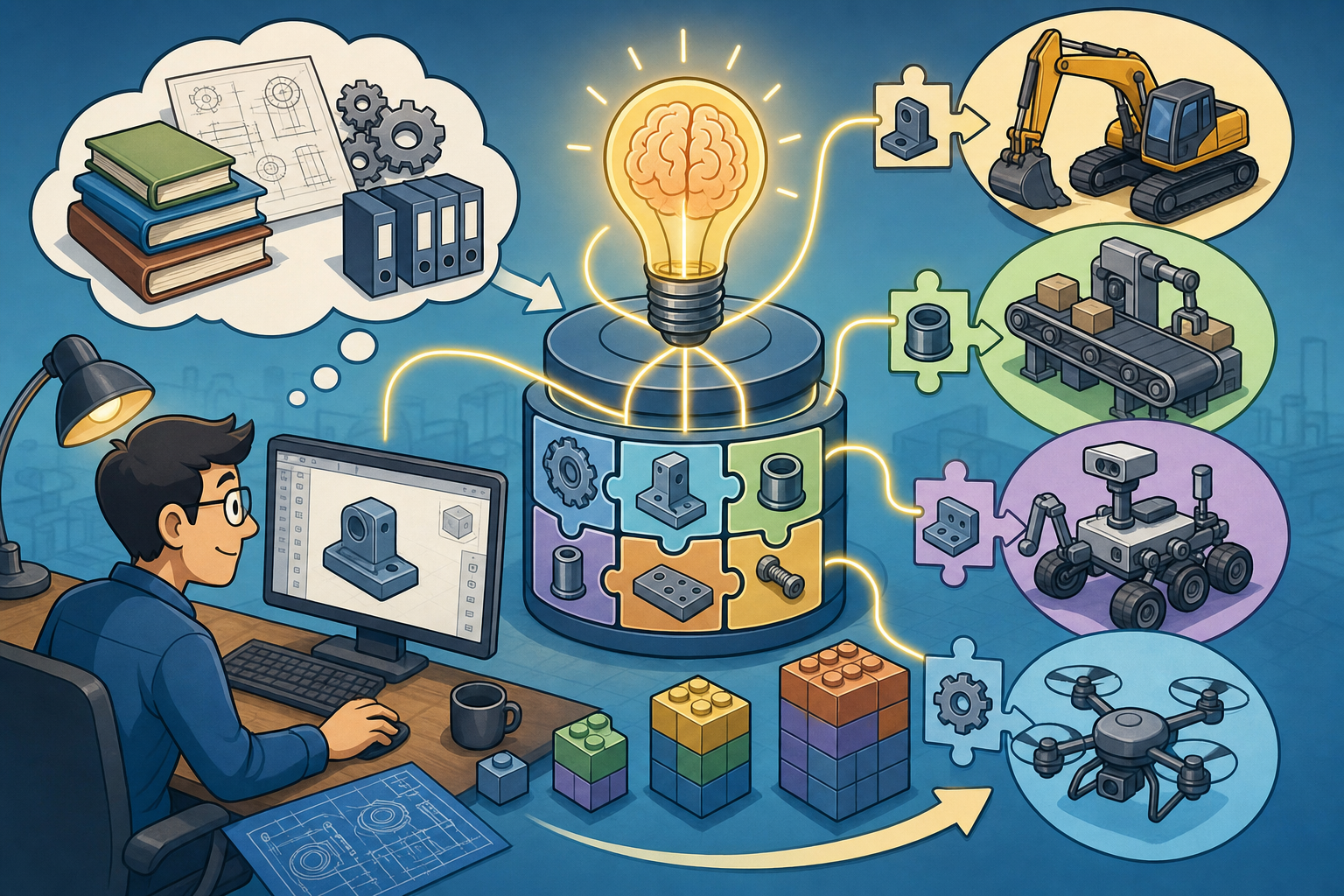
KBE improves reuse by converting past engineering decisions into repeatable processes. Traditional reuse depends heavily on human recognition: an engineer must remember that a similar design exists, locate it, understand it, adapt it, and verify it. KBE changes that pattern by allowing teams to define reusable design knowledge once and apply it many times across new requirements. A validated template for a bolted bracket, for example, can encode load-based sizing, material restrictions, minimum edge distances, preferred fasteners, hole pattern logic, coating selection, and drawing annotations. When a new bracket is required, the engineer enters the load case, mounting envelope, environmental conditions, and production preference; the system generates a compliant variant while preserving the embedded design rules. This approach scales far better than manual copying because the template represents reusable intelligence rather than a static model. It also improves consistency because each generated variant is produced from the same governed logic. As more templates are added, the organization gradually builds a library of engineering capabilities, not merely a library of parts. That distinction is essential for product platforms, configurable systems, and global engineering teams.
Faster Concepts Without Sacrificing Discipline
Concept development often suffers from a tension between speed and rigor. Early design teams want to explore alternatives quickly, but engineering discipline requires adherence to constraints, standards, costs, manufacturing rules, and performance targets. KBE helps resolve this tension by embedding guardrails into reusable design templates. Designers can generate multiple concepts rapidly while the system automatically enforces critical requirements. For example, an industrial machinery team exploring frame layouts can use KBE to vary envelope dimensions, load points, access panels, motor positions, and transport constraints while preserving structural member sizing rules, weld accessibility, lifting provisions, and safety clearances. This enables faster iteration without creating unrealistic concepts that later fail review. It also allows early trade-offs to be more meaningful because each generated option is closer to a viable engineering solution. Instead of spending weeks manually remodeling alternatives, teams can compare weight, cost, stiffness, serviceability, and manufacturability across many validated variants. The result is not only faster CAD output; it is faster convergence toward a robust design direction, supported by **automated engineering validation** from the beginning of development.
- Reusable templates reduce the time required to create first-pass concepts.
- Embedded rules prevent common geometry, sizing, and configuration errors.
- Automated calculations keep early concepts connected to engineering reality.
- Standardized outputs improve communication between design and analysis teams.
- Validated templates make iteration faster without weakening design discipline.
Reducing Errors and Preserving Expert Knowledge
Error reduction is one of the most immediate benefits of KBE, especially in repetitive or variant-rich work. Many engineering mistakes are not caused by lack of competence; they occur because teams must repeatedly apply detailed rules under time pressure. A designer may choose an outdated component, overlook a clearance standard, miss a regional compliance note, reuse a calculation with the wrong boundary condition, or modify a parameter that should have remained linked to another feature. KBE reduces these risks by making critical rules explicit and automatically enforceable. It can warn users when dimensions exceed approved limits, block invalid configurations, update dependent calculations, and ensure that documentation reflects the validated design state. Equally important, KBE preserves expert knowledge in a form that can survive personnel changes. When senior engineers help define rule sets, design templates, and validation procedures, their experience becomes part of the organization’s digital infrastructure. New engineers can then learn from guided workflows rather than only from informal mentoring. This shortens onboarding time and improves confidence because the system explains, constrains, and documents decisions that would otherwise remain hidden in personal experience.
Supporting Variant-Rich Products and Mass Customization
KBE is particularly valuable in industries where products are configurable, modular, or highly variant-rich. Aerospace interiors, automotive platforms, industrial machinery, HVAC systems, construction equipment, modular architecture, and building systems all involve recurring design patterns shaped by changing customer, regulatory, performance, and manufacturing requirements. In these environments, starting from a blank model for each order is inefficient, but copying old designs creates quality and compliance risk. KBE provides a better path by translating customer requirements into validated product definitions. For instance, a modular architectural façade system may need to adapt to building geometry, wind loads, panel dimensions, thermal performance, fire regulations, installation sequences, and local fabrication capabilities. A KBE system can encode those constraints so project-specific variations are generated from approved logic rather than improvised from previous files. This is also the foundation for mass customization. Customers can request individualized products, but engineering does not need to reinvent each solution. Instead, unique requirements are processed through reusable rules, configuration spaces, and validation checks. The outcome is customization with control: each product may be different, but each difference is governed by proven design intelligence.
Aligning Design, Manufacturing, and Compliance
One of the strongest arguments for KBE is that it aligns disciplines that often operate with different priorities and data structures. Design teams focus on function, packaging, aesthetics, and interfaces. Manufacturing teams focus on process capability, tooling, tolerances, assembly sequence, and cost. Compliance teams focus on standards, documentation, traceability, and verification. When these requirements are handled through separate reviews late in development, conflicts appear after significant work has already been completed. KBE moves many of these requirements upstream by embedding manufacturing and compliance knowledge into design generation itself. A generated part can respect machining accessibility, preferred material stock, minimum additive manufacturing wall thickness, inspection datum rules, regional safety standards, and documentation formats from the moment it is created. This reduces late rework and makes downstream processes more predictable. It also improves collaboration because rules are visible and negotiable. If manufacturing capability changes, the governed rule can be updated; if a compliance requirement changes, validation logic can be revised. The design process becomes less dependent on after-the-fact correction and more dependent on shared, structured knowledge.
From Reused Geometry to Reused Intelligence
The Real Value Is Engineering Reasoning
The real value of Knowledge-Based Engineering is not that it makes CAD modeling faster, although it often does. Its deeper contribution is that it enables the reuse of engineering reasoning. Geometry represents a decision that has already been made; KBE captures the conditions under which that decision remains valid and the logic required to make similar decisions again. This distinction matters because modern products are too complex, configurable, and regulated for reuse to depend only on finding similar files. A reused model without reusable reasoning can become a source of hidden risk. A reused rule, calculation, or constraint, by contrast, can generate new geometry that is better suited to the current requirement. This is why organizations should treat KBE as a strategic engineering capability rather than a narrow automation project. The goal is to transform scattered knowledge into governed digital assets that improve speed, quality, consistency, and traceability. When rules, constraints, calculations, and standards are captured properly, design teams move from manually adapting old products to intelligently generating new ones from validated logic.
Preparing for AI-Assisted and Autonomous Workflows
As design software becomes more connected and AI-assisted, KBE will likely become even more important. Artificial intelligence can help search data, suggest alternatives, classify geometry, summarize documentation, generate scripts, or propose design options, but AI needs reliable engineering structure to produce trustworthy results. KBE provides that structure by defining the rules, constraints, and validation criteria that separate acceptable designs from attractive but invalid outputs. In future workflows, an AI assistant may interpret a requirement, locate relevant templates, propose configurations, generate candidate models, and summarize trade-offs. However, the authority for acceptance should come from governed engineering logic: approved standards, verified calculations, manufacturability constraints, and compliance checks. This creates a powerful partnership. AI can expand exploration and reduce manual interaction, while KBE ensures that exploration remains bounded by reliable engineering knowledge. The organizations best prepared for semi-autonomous engineering will not simply have large archives of CAD data. They will have structured knowledge systems that make design intent explicit, machine-readable, and consistently enforceable across tools, teams, and product generations.
- KBE gives AI-assisted design systems reliable constraints and validation rules.
- AI can help discover and interact with knowledge, while KBE governs correctness.
- Reusable engineering logic improves trust in automated design generation.
- Structured rules make design decisions easier to audit and explain.
- Future reuse will depend on activating knowledge, not merely retrieving files.
Building a Practical Path Toward Knowledge Reuse
Organizations do not need to capture every engineering rule at once to benefit from KBE. A practical path begins by identifying repetitive, high-value design tasks where errors, delays, or variant complexity are common. These may include configurable assemblies, frequently resized components, standard structural elements, repeated documentation packages, or product families with many customer options. The next step is to separate stable engineering logic from one-off project decisions. Stable logic can be encoded into templates, calculation workflows, configuration rules, and validation checks. Engineers should also document the source and authority of each rule, whether it comes from standards, test data, manufacturing practice, regulatory requirements, or expert judgment. Governance is essential because unmanaged automation can become just as risky as unmanaged CAD reuse. Rules must be versioned, reviewed, validated, and updated as products, processes, and standards change. The most successful KBE initiatives treat knowledge capture as an engineering discipline, not as an after-hours scripting exercise. They combine domain experts, CAD specialists, analysts, manufacturing engineers, and PLM administrators to create reusable systems that can be trusted over time.
The Future of Design Reuse
The future of design reuse will depend less on finding the right old file and more on activating the right embedded knowledge. As products become more personalized, development cycles become shorter, and design environments become more connected, organizations will need reuse methods that are faster, safer, and more intelligent than manual copying. Knowledge-Based Engineering provides that foundation by converting engineering expertise into repeatable digital logic. It allows teams to reuse rules, constraints, calculations, manufacturing logic, compliance requirements, and configuration knowledge across projects and product generations. This does not eliminate the need for engineers; it elevates their role. Instead of spending time recreating known solutions or checking repeated details manually, engineers can improve rule quality, explore higher-value alternatives, resolve exceptions, and extend product capability. The transition from reused geometry to **reused intelligence** is therefore both technical and cultural. It requires better systems, but also better discipline in how organizations capture, validate, share, and govern knowledge. Companies that make this transition will not merely accelerate modeling; they will create a more resilient engineering memory capable of generating reliable designs from proven logic.
Also in Design News