Your Cart is Empty


Early Cost Estimation in Design Software: Integrating Cost Intelligence into the Digital Thread
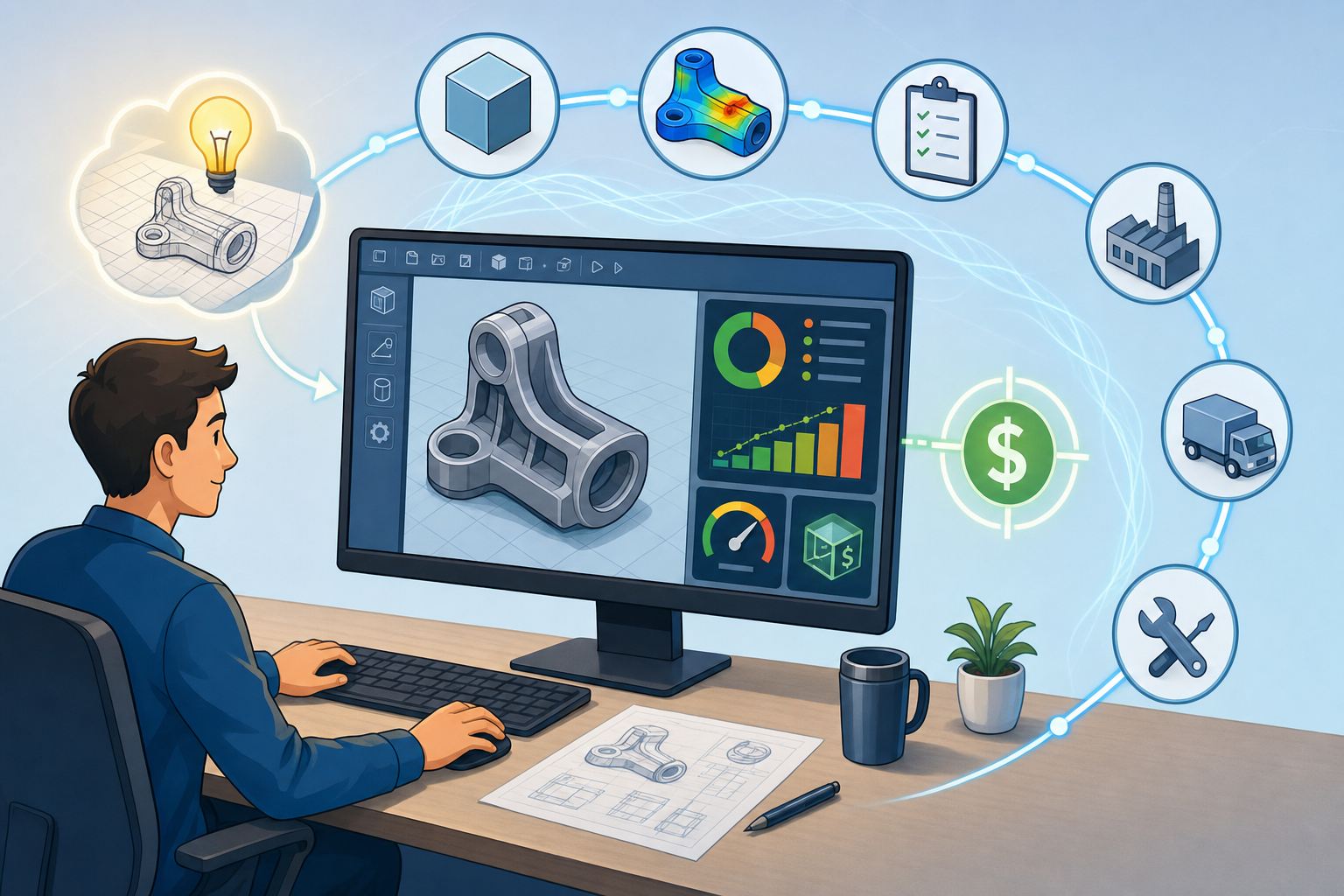


In advanced product development, cost is no longer treated as a downstream accounting output. It is becoming an active design parameter that shapes decisions from the first sketch, the first solid model, and the first manufacturing assumption. As digital engineering environments become more connected, cost estimation tools are being woven directly into modeling, simulation, sourcing, and planning workflows. This shift is changing the role of design software from a system that primarily defines geometry to one that helps teams evaluate feasibility, performance, manufacturability, and business impact at the same time.
Early Cost Visibility as a Design Variable, Not a Late-Stage Report
Why Cost Estimation Is Moving Upstream
Modern design workflows are under pressure to reduce development time while delivering more variation, more customization, and tighter margins. In that environment, waiting until late-stage engineering review or supplier quotation to understand cost is increasingly risky. By the time a product reaches formal costing under a traditional sequence, many foundational decisions have already solidified: material systems, core architecture, manufacturing route, assembly logic, and feature strategy. If cost is too high at that point, teams are forced into reactive redesign, and those redesigns often compromise performance, schedule, or quality. This is why early cost visibility is moving upstream and becoming part of concept development rather than a checkpoint after design completion.
The Weakness of Design First, Cost Later
The older “design first, cost later” process emerged when digital tools were less integrated and engineering data was harder to translate into business intelligence. Designers focused on shape and function, analysts reviewed manufacturability, and procurement later requested pricing. That structure created organizational separation between technical intent and economic reality. It also encouraged a false sense of progress, because a concept could appear mature in CAD while remaining economically unviable. Today, that gap is less acceptable. Organizations want to know not only whether a design can be built, but whether it can be built at the target margin, at the target scale, and within the expected sourcing conditions. This changes the purpose of early design software: geometry is still central, but geometry alone is no longer enough.
How Early Feedback Changes Decisions
When cost feedback appears early, it influences design choices in ways that are both subtle and profound. Material selection becomes a dynamic tradeoff rather than a static specification. A designer may compare aluminum, stainless steel, engineered polymer, and additive-ready alloys not only by stiffness or thermal behavior, but by raw material pricing, machining time, tooling cost, scrap rate, and finish requirements. Geometry decisions also change. Thin walls, undercuts, deep pockets, lattice regions, sharp internal corners, and tight surface transitions all carry manufacturing implications that become visible when costing logic is integrated into the model. Instead of discovering late that a part is expensive because of tool access constraints or support structure overhead, the designer sees those penalties while exploring form.
Manufacturing Strategy Becomes Part of Design Logic
Early cost feedback also transforms manufacturing strategy from a downstream process planning exercise into a design variable. A component can be evaluated as machined, cast, molded, stamped, or additively manufactured while it is still being defined. This matters because cost is not only tied to part geometry, but also to production assumptions such as setup frequency, batch size, tooling amortization, post-processing burden, and inspection requirements. A design team can compare whether a low-volume product should remain CNC-machined, whether a moderate-volume part justifies soft tooling, or whether an internal channel network is economically sensible only through powder bed fusion. In competitive development environments, CAD-integrated costing gives teams the ability to explore these scenarios without exiting the design context, turning commercial awareness into an everyday engineering habit rather than an after-the-fact correction.
How Cost Estimation Tools Connect with Design Software Ecosystems
Integration Across the Digital Thread
Cost estimation tools become most valuable when they are not isolated calculators but connected participants in the broader design software ecosystem. In mature environments, they integrate with CAD for geometry access, with PLM for revision control and part metadata, with ERP for purchasing and inventory signals, with sourcing databases for current material and process rates, and with manufacturing planning systems for routings, machine availability, and work-center assumptions. This level of connectivity allows cost to reflect actual business context instead of generic averages. A part designed in CAD can inherit classification, supplier preferences, approved materials, target region, and expected volume from enterprise systems, making the estimate significantly more relevant than one based only on geometry. The result is a more continuous digital thread in which design intent, operational constraints, and commercial reality inform one another earlier.
Core Data Inputs That Drive Meaningful Estimates
Reliable early-stage estimating depends on combining geometric and process data rather than using only mass or overall dimensions. The most effective tools parse feature-level information and connect it with process logic. Typical cost engines assess variables such as material usage, manufacturability complexity, tolerance bands, expected production volume, and assumptions about machining or additive processes. A robust system may evaluate stock size, removed material volume, tool changes, setup orientation, build chamber utilization, support requirements, finishing steps, and inspection burden. These inputs are especially important because two parts with similar size and weight may have radically different production costs if one contains difficult internal features, unusually tight tolerances, or poor machine accessibility.
Typical Data Considered by Integrated Cost Platforms
To support informed cost-aware design, tools often interpret a combination of technical and operational inputs such as:
- Material usage, including raw stock dimensions, waste factor, density, and scrap recovery assumptions
- Feature complexity, such as holes, ribs, pockets, undercuts, lattices, draft angles, and inaccessible regions
- Tolerances, because tighter dimensional and geometric control frequently increases machine time, inspection, and reject risk
- Production volume, which changes whether fixed tooling or setup costs are economically acceptable
- Machining assumptions, including machine type, spindle capabilities, fixturing strategy, and cycle-time logic
- Additive manufacturing assumptions, including build orientation, support generation, nesting efficiency, and post-processing effort
- Secondary operations like coating, heat treatment, assembly, cleaning, and packaging
- Regional labor and facility rates that alter the economics of the same geometry
What makes these inputs powerful is not simply their existence but their responsiveness. As the model changes, the estimate changes too, allowing cost to behave like a live engineering indicator rather than a static report.
Real-Time Dashboards Inside Modeling Environments
One of the most significant developments in advanced design software is the rise of real-time cost dashboards embedded directly inside the modeling interface. Instead of exporting geometry to a separate system and waiting for analysis, designers can see material cost, estimated cycle time, process suitability, and cost drivers while they are editing features. This shortens the loop between action and understanding. If a wall thickness change increases part stiffness but also raises print time by 18 percent, or if a tighter tolerance on a bore triggers a secondary finishing operation, that consequence can appear immediately in the workspace. Such visibility improves not only speed but also judgment, because designers begin to understand the cost structure behind features rather than treating price as an abstract number handed down by another department.
Parametric Design and Instant Scenario Comparison
Parametric modeling amplifies the value of integrated costing because it enables near-instant comparison across alternatives. A designer can suppress features, swap materials, modify draft, adjust rib spacing, alter internal topology, or resize patterns and immediately compare the cost effect of each option. This turns cost analysis into a comparative design exercise instead of a final verification step. For example, a product housing can be evaluated with three wall thickness strategies, two resin families, and multiple manufacturing approaches in minutes. A bracket may be compared as a machined billet part, a hybrid welded assembly, and a metal additive design with support reduction measures. In all of these cases, the key advantage is not the exactness of the number, but the visibility of the trend. Cost estimation tools become most useful when they help teams answer questions like:
- Which geometry change produces the largest reduction in machine time?
- At what volume does tooling become justified?
- How much cost is added by a tighter tolerance zone?
- Does additive manufacturing remain competitive after post-processing is included?
- Which concept best balances weight, performance, and production economics?
This capability fits naturally into modern digital design, where iteration speed matters as much as final fidelity.
Strategic Benefits and Practical Challenges of Cost-Aware Design
Faster Screening and Fewer Costly Redesigns
The strategic value of cost-aware design begins with faster concept screening. Teams that can estimate cost during concept formation eliminate weak candidates earlier and invest effort in alternatives that have a realistic path to manufacturable, profitable production. This is especially important in industries where many promising concepts fail not because they are technically impossible, but because they cannot meet target economics at the intended scale. By surfacing cost drivers early, integrated tools reduce the likelihood of expensive redesign cycles. Redesign is rarely just a geometric adjustment; it often affects simulation, documentation, tooling strategy, procurement plans, compliance validation, and launch timing. Therefore, avoiding late cost surprises produces a compounding benefit across the entire development process.
Cross-Functional Alignment Improves with Shared Cost Signals
Another major advantage is better alignment between engineering, procurement, and manufacturing. Traditional workflows often generate conflict because each function sees the product through a different lens. Engineering prioritizes performance and technical elegance. Procurement focuses on supplier capability, pricing, and risk. Manufacturing concentrates on process robustness, throughput, and scrap. When cost estimation sits inside the design environment and uses shared assumptions from connected enterprise systems, teams gain a more common frame of reference. A design review can move beyond subjective debate and toward structured tradeoff analysis. Procurement can highlight commercially sensitive materials earlier. Manufacturing can point out high-cost features before process plans are locked. Engineering can defend performance-critical choices with clearer visibility into what they actually cost and why.
Design-to-Cost Becomes More Actionable
This connected approach also strengthens design-to-cost initiatives. Many organizations declare target unit costs early in a program, but without integrated tools those targets remain broad managerial constraints rather than actionable design guidance. Cost-aware platforms make target costing operational by linking product decisions directly to financial consequences. Designers can see whether they are moving toward or away from the allowable cost window as they shape the model. More importantly, they can identify the highest-leverage interventions. In some cases, a material substitution may produce more savings than a geometry simplification. In others, reducing tolerance stringency on a non-critical feature may matter more than reducing mass. The ability to decompose cost into understandable contributors helps teams avoid blunt cost cutting and instead pursue intelligent, performance-conscious optimization.
Advanced Benefits Extend Beyond Unit Price
The broader impact is that cost estimation begins to support strategic product definition rather than only part pricing. It informs decisions about platform reuse, modularity, part consolidation, make-versus-buy logic, and regional production strategy. It can also interact with simulation and sustainability metrics. A topology-optimized part may reduce material use but increase process complexity. A multi-part assembly may be cheap in fabrication but expensive in labor and quality control. An additively manufactured component may reduce tooling investment and accelerate launch but require specialized post-processing. With integrated tools, these tradeoffs become visible early enough to matter. Cost awareness thereby expands the designer’s decision space instead of narrowing it. It does not merely say “this is expensive.” It reveals the structural reason why it is expensive and what kinds of changes might alter that condition.
Early-Stage Assumptions Can Distort Results
Despite these benefits, the practical challenges of cost-aware design are substantial. One of the most important is the inaccuracy of assumptions in early-stage models. At concept phase, geometry is often incomplete, tolerances may be placeholders, process plans are provisional, and production volume may still be uncertain. If a costing tool presents a single precise number without exposing those uncertain assumptions, it can create false confidence. Designers might optimize aggressively around an estimate that later proves structurally wrong because the selected process changed, a supplier imposed different constraints, or a secondary operation became necessary. This is why effective systems must frame estimates as directional and assumption-dependent rather than objective truths. The goal in early design is not exact accounting precision, but structured insight under uncertainty.
Volatility, Geography, and Hidden Costs Complicate Estimation
Supplier price volatility introduces another difficulty. Material markets shift, energy costs fluctuate, and geopolitical changes alter logistics and sourcing stability. Even a well-connected system cannot guarantee that today’s material rate or supplier quote logic will remain valid by the time production launches. Regional manufacturing differences also matter more than many early models capture. A geometry that is economic in one region may be far less attractive in another due to labor rates, machine capability distribution, certification requirements, or transportation overhead. In addition, indirect and lifecycle costs are hard to represent in conventional estimation engines. Tool maintenance, warranty exposure, lead-time risk, quality escapes, serviceability, recyclability, and inventory carrying costs may all affect the true business impact of a design but remain partially invisible in simple per-part calculations.
Why Good Tools Must Support Uncertainty Instead of Pretending Precision
For these reasons, the best cost estimation tools are not those that pretend to eliminate ambiguity, but those that manage it transparently. They should support ranges, confidence levels, sensitivity analysis, and scenario comparison. They should help a team understand which assumptions dominate the estimate and where better data would most improve decision quality. Useful capabilities include:
- Cost bands instead of a single deterministic value
- Sensitivity views showing how volume, material price, or tolerance changes affect outcome
- Scenario comparison for different suppliers, regions, or manufacturing methods
- Traceability from cost result back to geometric and process drivers
- Version-aware estimates linked to design revisions
- Alerts when assumptions no longer match enterprise or sourcing data
This orientation toward uncertainty is essential because design decisions are always made before complete information exists. A costing platform that acknowledges uncertainty can support better decisions than one that offers misleading numerical confidence. In practice, the strongest systems act less like black-box calculators and more like decision-support environments that reveal tradeoffs among form, process, risk, and commercial viability.
Conclusion
From Downstream Checkpoint to Core Design Intelligence
Integrating cost estimation into the early design phase is reshaping how teams evaluate feasibility and make tradeoffs. It changes cost from a retrospective report into a forward-looking design signal that influences materials, features, tolerances, manufacturing route, and platform strategy while alternatives are still fluid. This transformation matters because the economic consequences of design decisions are often locked in long before formal procurement or production planning begins. When cost insight is embedded in the same environments where engineers model geometry and compare concepts, the product definition process becomes more grounded, more iterative, and more resilient. Teams are able to test ideas not only for performance and manufacturability, but also for whether they align with business objectives under real operational constraints.
The Future of Cost-Aware Design Platforms
The most effective platforms will not simply calculate cost. They will help designers understand the relationship between form, manufacturability, risk, and business value. They will connect geometric features to process burdens, enterprise data to design alternatives, and uncertainty to informed judgment rather than false precision. As design software becomes more connected and intelligent, early cost insight will increasingly become a core part of design decision-making rather than a separate downstream exercise. In that future, the competitive advantage will not come from knowing the final cost slightly earlier than everyone else. It will come from using cost intelligence during creation itself, when the most important choices are still open and the greatest leverage still exists.
Also in Design News