Your Cart is Empty


Digital Sculpting in Product Design: AI, Hybrid CAD Workflows, and Manufacturable Form Exploration


Digital Sculpting Enters Product Design
Form Exploration as a Design Method
Digital sculpting matters to product design because it changes the designer’s relationship with form. Instead of beginning with sketches that must later be translated into constrained surfaces, sculpting allows designers to work directly with mass, silhouette, curvature, gesture, and proportion. This is especially valuable when a product must feel soft, adaptive, emotional, or body-aware. Traditional feature-based CAD is excellent for defining dimensions, assemblies, holes, ribs, and mechanical relationships, but it is often less fluid when the early question is not “what is the exact radius?” but “what should this object feel like in the hand?” Digital sculpting answers that question through continuous visual and tactile adjustment. It lets the designer push, pull, smooth, inflate, crease, pinch, and carve virtual material with a degree of immediacy that resembles clay modeling, yet remains editable, scalable, and connected to digital downstream processes. That combination of intuition and computation is why digital sculpting is moving beyond entertainment workflows and becoming a serious tool for advanced product development.
From Characters and Creatures to Designed Objects
For many years, sculpting software was primarily associated with character design, creature modeling, animation, visual effects, and game asset creation. Its strongest identity came from artists who needed expressive faces, anatomical structures, skin folds, armor details, fabric wrinkles, stylized proportions, and imaginary organisms. Those tasks required a modeling language that could handle irregularity and visual nuance more naturally than mechanical CAD. Product design is now discovering that many physical objects require the same type of sensitivity. Wearables must follow the body while communicating identity. Footwear must combine performance geometry with sculptural branding. Consumer electronics need seamless transitions between ergonomic curvature, speaker openings, glass surfaces, and tactile controls. Automotive interiors increasingly depend on emotional surfaces, soft forms, and carefully tuned transitions between display, fabric, leather, plastic, and ambient lighting. Ergonomic tools, medical devices, soft goods, lifestyle products, and personal accessories all benefit from workflows where the design can be shaped around human perception before being translated into engineering logic.
- Wearables require body-conforming forms, expressive surfaces, and high tolerance for customization.
- Footwear benefits from sculpted midsoles, adaptive cushioning zones, and complex texture languages.
- Consumer electronics need refined transitions between organic handling surfaces and precise technical interfaces.
- Automotive interiors combine comfort, brand identity, lighting, texture, and manufacturing constraints.
- Medical devices often demand soft ergonomic geometry wrapped around strict functional requirements.
The Hybrid Workflow Becomes the Default
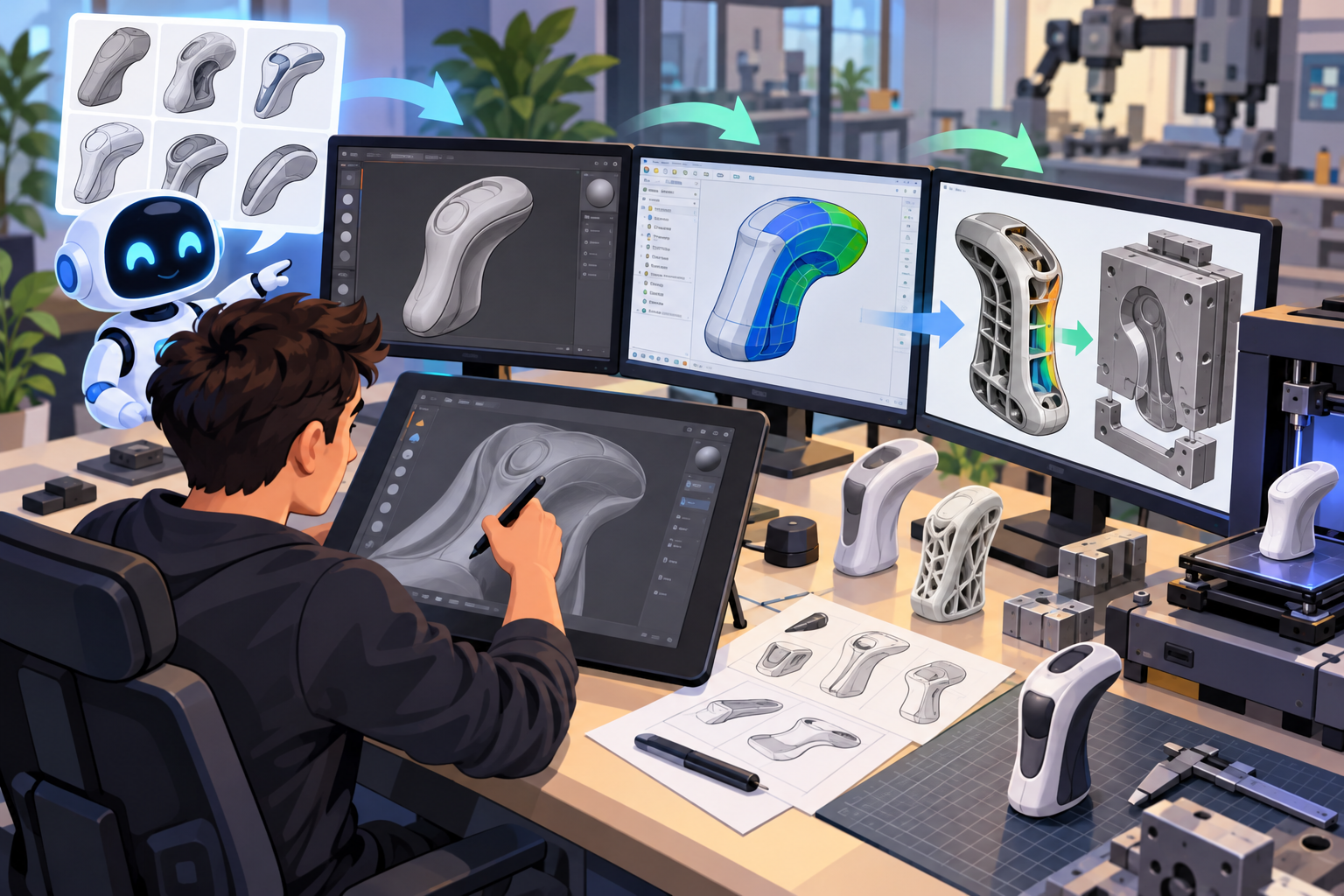
The strongest development is not that sculpting will replace CAD, but that sculpting is becoming one layer inside a broader design-to-production ecosystem. Mature workflows increasingly move between freeform sculpting, subdivision modeling, NURBS surfacing, parametric CAD, simulation, visualization, and manufacturing preparation. A designer might sculpt a wearable device around a body scan, retopologize the form into cleaner subdivision surfaces, convert selected areas into NURBS patches, define mechanical interfaces in parametric CAD, test wall thickness and strain, then prepare the final geometry for injection molding or additive manufacturing. This hybrid method reflects how products are actually conceived: some areas are emotional, some are ergonomic, some are mechanical, and some are purely manufacturable. A single modeling paradigm rarely handles all of these demands elegantly. The future therefore belongs to tools that allow designers to preserve expressive ambiguity early in the process while progressively adding dimensional discipline, material logic, assembly constraints, and production intelligence as the design matures.
The New Sculpting Stack Reshapes Creative Work
AI as a Collaborative Form Generator
The next generation of sculpting tools will be shaped by artificial intelligence, procedural systems, haptics, spatial interfaces, and real-time analysis. AI is especially important because it changes sculpting from a purely manual act of surface manipulation into a collaborative process between designer and computational assistant. Instead of starting from a blank digital sphere, a designer may generate a base form from a sketch, a text prompt, a reference image, a body scan, or a collection of visual constraints. AI can propose proportions, silhouettes, symmetry breaks, ergonomic refinements, anatomical logic, or stylistic alternatives. In product design, this may mean generating five variations of a handheld medical scanner optimized for grip comfort, visual trust, and manufacturable parting direction. In footwear, it may mean producing midsole forms that combine brand language with pressure-map data. The designer remains responsible for judgment, taste, purpose, and refinement, but AI-assisted sculpting accelerates the exploration of form space and makes variation a normal part of the design process rather than an expensive extra step.
Procedural Brushes and Intelligent Detail
Procedural brush systems will also redefine what it means to sculpt detail. Early sculpting tools often required artists to manually carve repeated features, apply alpha textures, or duplicate motifs across surfaces. Procedural brushes can generate controlled complexity while remaining adjustable. A brush may create woven textures, perforation gradients, cellular cushioning, grip ridges, leather grain, muscle-like striation, thermal vents, impact zones, or lattice-inspired patterns. The important distinction is that these details are no longer static decoration; they can be parameterized by curvature, stress direction, contact pressure, airflow, material thickness, or user preference. A designer sculpting a bicycle grip might use a procedural brush that automatically increases surface texture where fingers apply pressure, softens transitions where the palm rests, and preserves clean zones where logos or sensors need to be placed. This points toward a new category of sculpting in which visual detail, performance behavior, and manufacturing strategy are linked instead of separated into different phases of work.
- Prompt-based modeling can generate starting forms from product language, sketches, or performance goals.
- Procedural brushes can place repeatable details while still responding to surface curvature and scale.
- Physics-aware deformation can prevent unrealistic stretching, collapsing, or structurally weak areas.
- AI retopology can help prepare sculpted forms for subdivision, CAD conversion, rendering, or fabrication.
- GPU acceleration enables high-resolution sculpting with immediate material and lighting feedback.
Haptics, VR, and Spatial Computing
Haptic devices, tablets, VR systems, and spatial computing interfaces will make sculpting more tactile and more bodily. Traditional mouse-and-keyboard modeling is precise, but it is also detached from the gestures that many designers use when shaping physical material. Pen tablets already improved this by allowing pressure-sensitive strokes, but haptic arms, gloves, force-feedback styluses, mixed reality headsets, and immersive workspaces can expand sculpting into full body-scale interaction. This matters for objects larger than the hand, including vehicles, furniture, architectural elements, retail environments, characters, and public installations. A designer reviewing an automotive interior could stand inside a virtual cabin and sculpt the wraparound transition from dashboard to door panel while judging reach, sightline, and emotional enclosure at full scale. A furniture designer could inflate, carve, and tension a digital chair surface while sensing approximate resistance. The ambition is not novelty; it is to recover the immediacy of physical making while keeping the benefits of reversible digital design, scalable geometry, and computational evaluation.
Real-Time Feedback as a Design Partner
Real-time feedback will be one of the most decisive changes in advanced sculpting environments. Sculpting has traditionally prioritized visual form, while issues such as thickness, stress, materials, lighting, fit, and manufacturing were addressed later. That separation creates risk because a beautiful sculpt may fail once engineering constraints are applied. Future sculpting tools will increasingly show designers the consequences of their gestures as they work. If a wall becomes too thin for 3D printing, the interface can warn the designer immediately. If a wearable surface creates pressure points on a scanned wrist, an ergonomic heat map can appear directly on the model. If a sculpted consumer device loses visual balance under real product materials, physically based rendering can reveal the change instantly. If a lattice texture becomes impossible to clean, mold, or powder-clear, the software can flag the problem. Real-time manufacturability feedback does not reduce creativity; it prevents wasted exploration and turns constraints into active design information.
Sculpted Form Must Become Manufacturable Geometry
The Gap Between Artistic and Engineering Geometry
The central challenge of digital sculpting in product design is that sculpted models are often visually rich but not immediately production-ready. A sculpted mesh may contain millions of polygons, irregular topology, overlapping internal surfaces, non-uniform density, weak edge flow, and local details that look excellent in rendering but do not translate cleanly into machining, molding, assembly, or inspection. Engineering geometry requires different qualities: controlled dimensions, reliable surfaces, clear boundaries, predictable wall thickness, assembly interfaces, tolerance definition, and manufacturing feasibility. This is the gap between artistic geometry and engineering geometry. In sculpting, the question is often whether the form communicates the right visual and tactile intent. In CAD, the question becomes whether the form can be dimensioned, modified, simulated, produced, assembled, and verified. When design teams ignore this distinction, they face expensive remodeling work late in development. When they manage it well, sculpting becomes an early generator of intent that feeds cleanly into downstream engineering.
Dense Meshes Versus Controlled Surfaces
Dense meshes and clean CAD surfaces operate according to different logics. A sculpted mesh represents form through many small polygons, making it ideal for wrinkles, organic transitions, asymmetry, and rich visual detail. NURBS and parametric CAD represent form through mathematically defined curves, surfaces, features, and constraints, making them ideal for precision, repeatable edits, tooling, and dimensional communication. Product development often requires both. A medical brace may need sculpted comfort surfaces where it touches the body, but it also needs accurate fastener bosses, strap slots, sensor housings, and standardized adjustment features. A pair of headphones may need sculpted ear cushions and flowing exterior shells, but the hinge, driver enclosure, PCB mounts, acoustic chambers, and gasket seats require engineering precision. The workflow problem is not choosing one representation over the other, but preserving design intent as geometry moves between representations. That is why mesh-to-CAD interoperability is becoming a strategic capability rather than a minor file-conversion feature.
- Retopology creates cleaner edge flow so sculpted forms can become subdivision-ready assets.
- Mesh-to-NURBS conversion translates selected sculpted regions into surface patches for CAD workflows.
- Quad-based surfacing helps preserve organic continuity while enabling controlled editing.
- Hybrid mesh/CAD modeling allows freeform bodies and precise mechanical features to coexist.
- Direct modeling on scanned or sculpted geometry supports rapid refinement without rebuilding everything from scratch.
Retopology, Quad Surfacing, and Hybrid Modeling
Emerging workflows for converting sculpted designs into production assets are becoming more sophisticated and less destructive. Retopology remains essential because it transforms chaotic or overly dense mesh data into clean quad-based structures that describe the form with meaningful flow. Good topology follows curvature, deformation zones, seam expectations, and manufacturing logic. Quad-based surfacing can then help translate sculpted shapes into controllable subdivision surfaces, which may be smoothed, edited, and converted into higher-quality surface data. Mesh-to-NURBS conversion is improving, but successful results still depend on intelligent patch layout, curvature continuity, and careful separation between organic zones and engineered features. Hybrid mesh/CAD modeling may be the most practical near-term solution because it allows sculpted regions to remain mesh-based where detail and complexity matter, while parametric CAD features define interfaces, dimensions, and assembly logic. This is particularly powerful for products where the human-facing surface is organic but the internal architecture is mechanical, such as wearables, handheld tools, sports equipment, and medical devices.
Additive Manufacturing Changes the Rules
Additive manufacturing changes the economics and geometry of sculpted design because complexity is no longer automatically a penalty. Traditional manufacturing often requires forms to be simplified for tooling, draft, parting lines, machining access, or assembly. Additive manufacturing allows sculpted complexity, lattice textures, organic transitions, individualized fit, and internal structures to be produced more directly, as long as the geometry respects process-specific constraints such as support strategy, minimum feature size, drainage, powder removal, anisotropy, and post-processing. This makes sculpting especially relevant for products that are customized, ergonomic, lightweight, expressive, or performance-tuned. A custom prosthetic socket can be shaped around a body scan, sculpted for comfort and identity, then engineered for load paths and printable wall thickness. A footwear midsole can be sculpted with zones that visually express cushioning while integrating lattice structures for local performance. Designer furniture can use organic supports that merge structural behavior with visual elegance. Character products, collectibles, robotics shells, and interactive objects can move more directly from sculpted form to physical artifact.
Future-Ready Applications for Sculpting in Design
Body-Centered Products and Personal Fit
One of the most important future applications of sculpting is body-centered design. Products that touch, support, or surround the human body are rarely served well by purely geometric primitives. They depend on pressure, comfort, motion, asymmetry, and emotional acceptance. Custom prosthetics, orthotics, splints, hearing devices, eyewear, sports protection, exoskeleton interfaces, and recovery products can all benefit from sculpting workflows built around scans and ergonomic maps. A designer may begin with a 3D scan of a limb, use sculpting tools to relieve pressure around sensitive areas, add thickness where support is needed, define edge softness, incorporate ventilation patterns, and create an exterior identity that feels personal rather than clinical. AI could suggest comfort refinements based on databases of body geometry, while simulation checks load distribution and additive manufacturing constraints. The result is a workflow where custom ergonomics and expressive form are not competing values. Instead, sculpting becomes the interface through which human variability is translated into manufacturable design.
Footwear, Furniture, and Lifestyle Products
Footwear is particularly aligned with the future of sculpting because it combines performance, fashion, ergonomics, and manufacturing experimentation. Midsoles can be sculpted to express speed, softness, stability, or rebound while embedding structural zones informed by gait data and material simulation. Uppers can integrate organic textures, reinforcement flows, and brand-specific surface languages. Designer furniture offers a similar opportunity. Chairs, stools, lighting, tables, and acoustic objects increasingly explore organic structural forms that would be difficult to model efficiently with conventional CAD alone. Sculpting allows designers to shape comfort, mass, and visual movement before rationalizing geometry for fabrication. Lifestyle products such as luggage, bags, grips, accessories, packaging, and home devices also benefit from sculptural iteration because their success depends on touch and perception as much as function. In these categories, the winning design is often the one that feels inevitable in the hand, natural in use, and emotionally coherent on sight.
Automotive Interiors and Emotional Surfaces
Automotive interiors demonstrate how sculpting can support advanced product visualization, ergonomics, and emotional design at once. The interior of a vehicle is not merely a set of mechanical components; it is an occupied environment filled with surfaces that imply safety, performance, luxury, minimalism, or technological confidence. Sculpting tools can help designers explore dashboard wraps, console transitions, seat bolsters, door panel reliefs, control surrounds, air vent forms, soft-touch zones, and lighting channels with a freedom that traditional CAD can restrict too early. These sculpted surfaces can then be evaluated in real time under different materials, stitching styles, ambient light conditions, occupant positions, and reach envelopes. The strongest future workflow would let teams sculpt at cabin scale, test visibility and comfort immediately, preserve surface continuity, and hand off selected regions for precise engineering development. This matters because automotive design increasingly depends on the integration of physical surfaces with digital displays, sensor systems, sustainable materials, and personalized interior experiences.
Sculpting Becomes a Core Layer of Future Design Software
Creative Freedom With Engineering Intelligence
Digital sculpting is evolving from a niche artistic workflow into a central design capability because it addresses a problem that many design systems have historically struggled with: how to preserve creative fluidity while adding engineering accountability. The future will be defined by hybrid environments where sculpting, CAD, simulation, rendering, materials, topology optimization, scan processing, and manufacturing preparation coexist in the same conceptual workspace. Product designers will benefit from sculpting tools that support expressive exploration while gradually introducing dimensional accuracy, constraint awareness, manufacturability feedback, material intelligence, and CAD interoperability. Character designers will benefit from the same evolution because more of their work now enters physical production pipelines for toys, collectibles, wearables, robotics, animatronics, immersive media artifacts, and interactive installations. The boundary between digital entertainment assets and physical product assets will continue to blur, not because the disciplines are identical, but because both increasingly require expressive geometry that can survive rendering, simulation, fabrication, and real-world use.
- Designers will expect sculpting tools to preserve gesture while adding measurable control.
- Engineering teams will need better translation between sculpted surfaces and tolerance-driven geometry.
- Manufacturers will rely on early feedback for thickness, support strategy, material behavior, and process limits.
- Visualization teams will use sculpted forms with realistic materials and lighting earlier in development.
- AI systems will assist with variation, cleanup, refinement, and compliance with downstream requirements.
The Philosophical Shift in Design Software
The most important shift is philosophical. Design software is moving closer to the fluidity of physical making while retaining the precision of digital engineering. For decades, the digital design process often forced users to choose between expressive freedom and technical control. Sculpting offered freedom but could become difficult to manufacture. CAD offered control but could feel rigid during early form exploration. The next generation of tools will reduce that divide by allowing designers to move continuously between intuition and verification. A surface can begin as a gesture, become a structured subdivision model, receive manufacturability warnings, convert into CAD-ready regions, render with material accuracy, and return to sculpting for refinement without losing its original intent. That is the future of digital sculpting: not simply making more expressive forms, but making expressive forms usable, testable, manufacturable, and intelligent. In that future, sculpting is not an artistic detour before engineering begins; it is one of the core languages through which advanced design will be imagined, evaluated, and produced.
Also in Design News