Your Cart is Empty


Design Software History: Licensing Models in CAD History: From Mainframes to Cloud Platforms
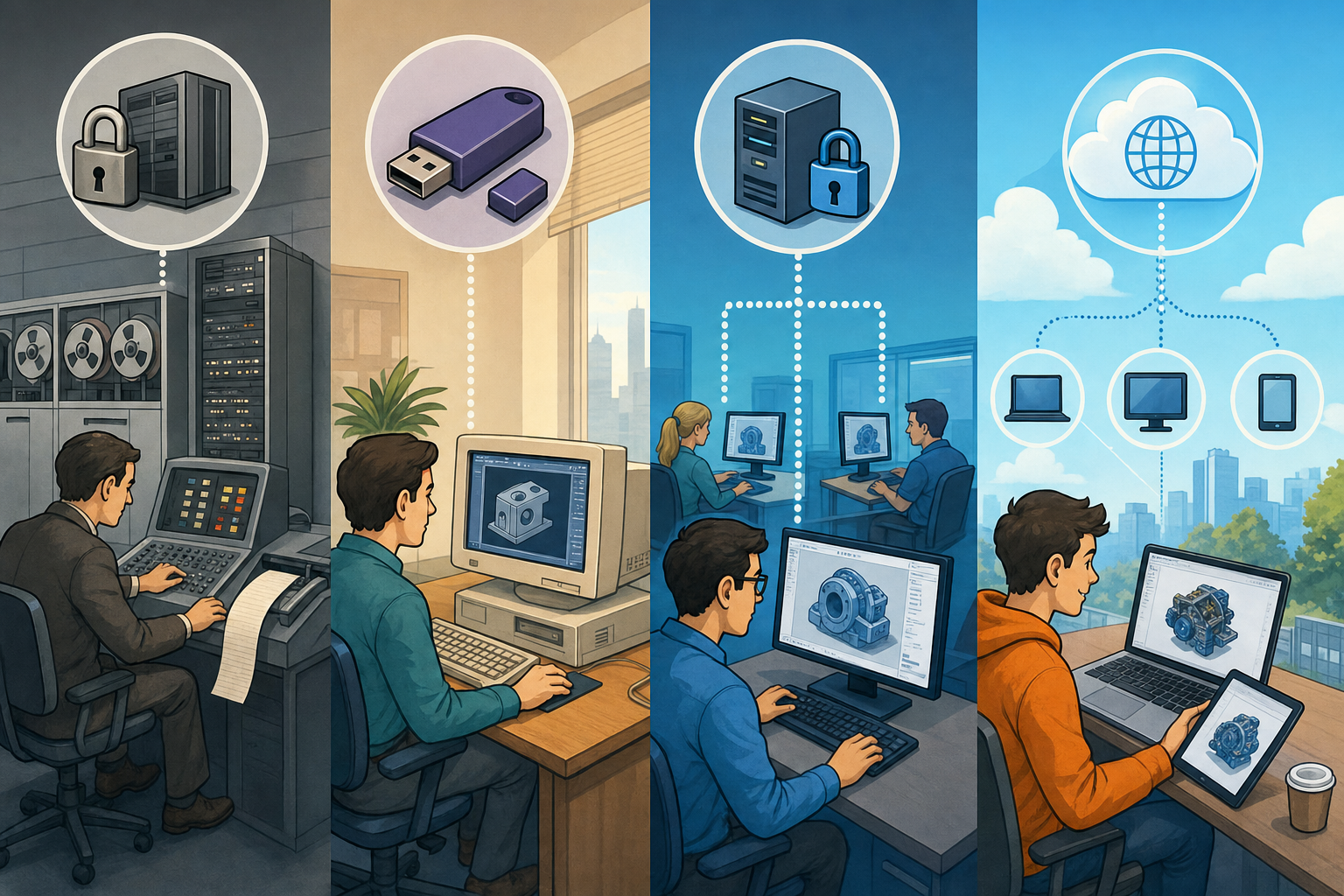


From Mainframes to Workstations: Licensing as Access Control
Computing Scarcity Defined the First Licensing Models
The earliest commercial design software did not resemble a product that could be purchased, installed, and activated in the modern sense. In the 1960s and 1970s, computer-aided design was inseparable from the large, expensive computing environments that made it possible. A firm did not simply buy CAD software; it acquired access to an engineered system composed of processors, storage, terminals, digitizers, plotters, software, maintenance, operator knowledge, and vendor support. IBM mainframes, DEC minicomputers, and specialized graphics terminals provided the computational foundation, while the economics of access were shaped by the cost of every minute of machine time. The “license” was often embedded in the lease or purchase of an entire installation, and the true product was the capability to perform high-value engineering work with scarce computational resources. This made early CAD a form of capital infrastructure rather than a software commodity. Licensing began as access control over rare computing power, not as a lightweight legal agreement between a vendor and an end user.
Turnkey CAD Vendors Sold Capability, Not Just Code
Companies such as Computervision, Intergraph, Applicon, and Calma helped define the first commercial structure of CAD by selling dedicated turnkey systems to aerospace, automotive, electronics, and government-related engineering organizations. Computervision’s CADDS systems, Intergraph’s IGDS environment, Applicon’s drafting and design installations, and Calma’s GDS products were not merely application programs. They were integrated production environments tuned for specific industrial needs, supported by trained personnel and long-term vendor relationships. A customer buying such a system expected custom configuration, on-site support, training classes, hardware maintenance, and technical consultation. Software licensing therefore functioned as part of a broader procurement contract, often involving large capital budgets and executive approval. These systems were expensive because they collapsed many specialized elements into a single negotiated package: graphics hardware, system software, application commands, data translation, plotting output, and workflow integration. The commercial model reflected the reality that early CAD vendors were selling engineering capacity, not a boxed program, and customers treated that capacity as a strategic operational asset.
- Software, hardware, maintenance, and training were typically bundled into one commercial relationship.
- Access depended on terminals, plotters, storage devices, graphics processors, and vendor-managed configurations.
- Customers expected high-touch support because system downtime could interrupt entire engineering departments.
- The license was often less visible than the installation contract, lease agreement, and support obligations surrounding it.
Aerospace and Automotive Customers Shaped the Contractual Logic
Large industrial customers such as Boeing, General Motors, Lockheed, McDonnell Douglas, North American Aviation, Ford, Chrysler, and major defense contractors had a decisive influence on how CAD systems were licensed and supported. These organizations did not want experimental software delivered without guarantees; they required predictable uptime, engineering assistance, drawing output, data accuracy, and compatibility with demanding production processes. Their projects involved aircraft structures, engine components, military systems, automobile bodies, tooling, and manufacturing documentation where software failure could create expensive downstream consequences. As a result, vendor relationships became long-term and deeply technical. Engineers from the vendor side often understood specific customer workflows, while customer CAD administrators became experts in both design practice and system management. Licensing was therefore intertwined with trust, service obligations, and technical accountability. The customer was not merely paying for permission to run a program; it was paying for a vendor’s continued presence in the design process. Early CAD licensing reflected industrial dependency, where access, support, and technical partnership were inseparable.
The Workstation Era Began to Separate Software from the Machine
During the late 1970s and 1980s, the rise of technical workstations from Apollo Computer, Sun Microsystems, Silicon Graphics, Hewlett-Packard, and IBM began to loosen the bond between CAD software and proprietary turnkey hardware. Graphics performance improved, UNIX became a common platform for engineering applications, and vendors could increasingly port software to multiple workstation families. This did not immediately make CAD inexpensive, but it changed the logic of access. The machine was still costly, yet software became a more identifiable asset that could be priced, licensed, maintained, and upgraded independently. Companies such as Dassault Systèmes with CATIA, McDonnell Douglas Automation with Unigraphics, and SDRC with I-DEAS operated in a world where engineering workstations were powerful enough to host serious 3D design and analysis applications. Licensing began to move away from the idea of a single monolithic purchase and toward structured software rights associated with machines, users, modules, and maintenance contracts. This transition created the conditions for the later seat-based and floating-license models that would dominate professional CAD.
The Rise of Seat-Based and Floating Licenses
Permanent Seats Matched the Ownership Culture of Workstations and PCs
As CAD moved from centralized computing rooms to individual engineering desks, the permanent seat license became the commercial model that most closely matched the culture of workstation and personal computer ownership. A company bought a license for a named user, a specific machine, or a designated installation, and that right could often continue indefinitely so long as the hardware and operating system remained compatible. Maintenance was separate, but the core idea was simple: the customer owned a long-term right to use a defined version of the software. This arrangement became especially visible with the growth of PC-based CAD in the 1980s, when Autodesk’s AutoCAD demonstrated that drafting software could reach a much broader market than the older turnkey systems. AutoCAD did not require the same capital commitment as a Computervision or Intergraph installation, and its licensing model supported wide distribution through dealers, resellers, and corporate purchasing departments. Seat-based licensing democratized access by making CAD align with the spread of personal computing across engineering, architecture, and manufacturing offices.
AutoCAD Expanded the Market by Changing the Scale of Access
Autodesk, founded in 1982 by John Walker and a group of collaborators, turned CAD licensing into a mass-market software business in a way that high-end workstation vendors had not. AutoCAD’s early importance was not only technical; it was commercial and cultural. By running on comparatively affordable IBM PC-compatible hardware, AutoCAD made digital drafting available to small architecture practices, machine shops, facilities departments, civil offices, and independent designers who could never have justified a dedicated mainframe or minicomputer-based system. Its licensing model fit the habits of the emerging software market: purchase a copy, install it on a computer, train a user, and expand gradually as the office adopted digital production. The DWG file format became a powerful center of gravity because it allowed drawings to circulate between firms, consultants, and clients. This created a feedback loop in which licensing breadth increased file-format dominance, and file-format dominance increased licensing demand. AutoCAD proved that software access could define an industry standard even when the underlying modeling sophistication differed from high-end mechanical CAD.
- Permanent seats gave companies a clear asset that could be assigned to a workstation or designer.
- Maintenance contracts introduced a predictable annual cost without eliminating the feeling of ownership.
- PC-based licensing allowed smaller firms to enter digital drafting without buying specialized hardware systems.
- Widespread file exchange made the licensed software more valuable because it connected users to a broader ecosystem.
Floating Licenses Turned CAD Access into a Departmental Resource
Floating licenses changed CAD economics by recognizing that not every engineer needed a program open at every moment of the day. Instead of purchasing one license for each designer, a company could buy a pool of licenses shared across a department, geographic site, or network. When a user launched the application, the software checked out a license; when the user exited, that license returned to the pool. This model was especially attractive for expensive tools used intermittently, such as advanced surfacing, finite element analysis, CAM programming, electrical routing, or visualization. License managers such as FLEXlm, created by Globetrotter Software and later known as FlexNet Publisher under Macrovision, Acresso, Flexera Software, and Revenera ownership, became critical infrastructure inside engineering organizations. CAD managers learned to monitor peak usage, denial rates, server reliability, time zones, and module consumption. The floating-license server became an invisible gatekeeper of productivity. Engineering access became measurable, allocatable, and negotiable, turning software licensing into an operational planning problem rather than a simple purchasing transaction.
Premium Parametric CAD Made License Planning More Strategic
PTC’s Pro/ENGINEER, introduced in the late 1980s under the leadership of Samuel Geisberg and the Parametric Technology Corporation team, intensified the strategic importance of licensing because it offered a new model of feature-based, parametric, associative solid modeling at a premium price. Companies adopting Pro/ENGINEER were not simply replacing drafting tools; they were transforming product development around constraints, features, regeneration, assemblies, and drawing associativity. This made licenses more valuable and more disruptive when unavailable. If an engineer could not access a license, product definition work could stop. Similar high-end pressures existed around CATIA from Dassault Systèmes, Unigraphics and later NX from UGS and Siemens, and I-DEAS from SDRC before its integration into the Siemens PLM portfolio. These products supported deeply technical workflows in aerospace, automotive, industrial machinery, and complex manufacturing. Licensing therefore had to account for designers, checkers, analysts, tooling engineers, manufacturing planners, and data managers. The more integrated the software became with the product lifecycle, the more licensing shaped daily engineering rhythm, staffing plans, and departmental budgets.
Modular Licensing Began to Influence Software Architecture
Floating and seat-based licensing encouraged vendors to divide large CAD systems into modules, each associated with a separate commercial entitlement. A base mechanical design license might provide sketching, part modeling, assemblies, and drawings, while additional modules unlocked advanced surfacing, sheet metal, piping, wiring, mold design, rendering, simulation, CAM toolpaths, reverse engineering, or product data management integration. This modularity was attractive because it let vendors price specialized functionality according to customer value, while allowing buyers to avoid paying for every capability at once. Yet it also pushed technical architecture toward commercial segmentation. Features had to be checked, enabled, disabled, bundled, or restricted according to license state. Interface menus, translators, solvers, and computing engines were increasingly tied to entitlement logic. The software’s internal organization and its business packaging began to reinforce each other. The business architecture of CAD started shaping the technical architecture, as vendors designed products not only around engineering workflows but also around differentiated pricing, upgrade paths, and sales strategies.
Maintenance, Modules, and the Business of Lock-In
Maintenance Turned Perpetual Licenses into Recurring Revenue
By the 1990s and 2000s, the license itself was only one part of the commercial relationship. Maintenance contracts became central to the economics of design software because they created recurring revenue long before subscriptions became the dominant software-business language. A customer who purchased a perpetual license often paid an annual maintenance fee for software updates, bug fixes, technical support, new platform compatibility, and sometimes access to knowledge bases or customer portals. Vendors benefited because maintenance smoothed revenue and encouraged customers to remain current. Customers benefited when updates solved production problems, improved translators, supported new operating systems, or added modeling functions that justified the cost. Yet maintenance also became a form of leverage. Falling off maintenance could make future upgrades expensive, limit support options, and freeze a company on an aging software version. In industries where data compatibility and supplier communication mattered, staying current was not merely a preference. Maintenance converted ownership into dependency, because perpetual access to old software did not guarantee participation in the evolving design ecosystem.
Modules Offered Flexibility While Creating Path Dependency
Modular licensing was often presented as a customer-friendly way to buy exactly what was needed, and in many circumstances that was true. A tooling group could purchase mold design, a manufacturing group could add CAM, an analysis team could acquire nonlinear FEA capabilities, and a consumer-product team could license advanced surfacing without forcing every user to pay for those functions. The difficulty appeared when workflows crossed module boundaries. A designer might need surfacing to repair imported geometry, sheet metal tools to flatten a bracket, simulation to validate stiffness, and rendering to communicate with management. Each step could require a different entitlement. In practice, modularity often turned engineering workflows into cost maps where technical decisions were constrained by license availability. Vendors such as Dassault Systèmes, Siemens PLM Software, PTC, Autodesk, SolidWorks Corporation, and later Bentley Systems across infrastructure and building design all developed packaging strategies that reflected market segmentation. The result was a mixed legacy: modules made sophisticated tools commercially viable, but they also made access uneven inside organizations that needed integrated design continuity.
- Advanced surfacing modules supported Class A surfaces, consumer-product styling, and automotive body workflows.
- FEA and simulation modules extended CAD from geometry creation into structural, thermal, motion, and multiphysics evaluation.
- Mold design and sheet metal modules encoded manufacturing knowledge into specialized commands and feature types.
- CAM modules translated modeled geometry into toolpath strategies, post-processed code, and shop-floor machining instructions.
- PDM and PLM integrations connected file control, revision management, approval processes, and product configuration data.
File Formats Reinforced the Economics of Licensing
Licensing lock-in cannot be understood without discussing file formats, because the commercial power of design software often comes from the data it creates. DWG in the AutoCAD world, CATPart and CATProduct in the CATIA world, PRT formats associated with Pro/ENGINEER and later Creo, SLDPRT and SLDASM in SolidWorks, DGN in Bentley MicroStation, and NX part files in the Siemens ecosystem became more than containers for geometry. They held features, histories, constraints, metadata, drawings, assemblies, references, configurations, materials, custom properties, and downstream manufacturing assumptions. Neutral formats such as IGES, STEP, STL, Parasolid XT, ACIS SAT, and later JT helped exchange information, but translation often lost feature intelligence, associativity, constraints, or design intent. This meant that switching software involved far more than buying a new license. A company had to consider legacy data, suppliers, customer requirements, training, macros, templates, PDM vaults, drawing standards, and validation procedures. The cost of switching was embedded in accumulated design information, making file formats and licensing mutually reinforcing instruments of platform loyalty.
SolidWorks Demonstrated a Different Kind of Packaging Pressure
SolidWorks, founded in 1993 by Jon Hirschtick and acquired by Dassault Systèmes in 1997, illustrates how midrange mechanical CAD intensified the relationship between licensing, modules, and market expansion. SolidWorks ran on Microsoft Windows and offered parametric solid modeling at a lower point of entry than traditional high-end UNIX-based systems. Its licensing appealed to machine designers, product developers, smaller manufacturers, and engineering teams that wanted powerful 3D design without the cost and administrative complexity associated with enterprise CAD. Yet SolidWorks also developed layered packages and add-ins for simulation, data management, routing, visualization, electrical design, and manufacturing-related workflows. This reflected a broad industry pattern: once a CAD platform gained a large user base, vendors could expand revenue by attaching specialized capabilities to the core license. Customers benefited from a familiar interface and associative data flow, but they also became more dependent on the platform’s packaging decisions. The midrange CAD revolution lowered the barrier to 3D adoption, while simultaneously proving that modular licensing could scale from elite enterprise installations to mainstream engineering offices.
License Administration Became a Specialized CAD Management Discipline
As licensing grew more complex, CAD administration became a specialized profession requiring technical, financial, and organizational judgment. A CAD manager was no longer responsible only for templates, plotting standards, layer conventions, modeling practices, or user support. The role expanded to include license-server maintenance, vendor negotiations, usage reporting, compliance audits, upgrade timing, module allocation, workstation qualification, and coordination with IT security policies. In larger organizations, the CAD manager had to understand how licenses moved between departments, how global teams interacted across time zones, when contractors needed temporary access, and which projects justified premium modules. FLEXlm logs, denial reports, borrowing rules, dongles, activation servers, and network latency could all affect engineering output. This created an unusual intersection between procurement and design practice. A purchasing decision made months earlier could determine whether an engineer could run a nonlinear simulation on a deadline. Licensing became part of the design process, because access to tools influenced what work could be done, when it could be done, and by whom.
Vendor Goals and Customer Goals Were Never Perfectly Aligned
The recurring tension in design software licensing has always been the difference between what customers want and what vendors need. Customers generally want predictable access, long-term control over data, stable costs, backward compatibility, and freedom to use older versions when projects demand continuity. Vendors want recurring revenue, upgrade adoption, reduced support burden, enforceable compliance, product segmentation, and platform dependence. Neither side is irrational. CAD vendors invest heavily in geometric kernels, constraint solvers, graphics systems, translators, simulation engines, cloud services, and support organizations. Customers invest heavily in training, data creation, standards, approval processes, supplier networks, and institutional knowledge. Conflict emerges because both sides are protecting different forms of capital. Vendors protect intellectual property and future revenue; customers protect operational continuity and design data. This is why licensing debates in CAD have often been more emotional than licensing debates around simpler office software. Design tools sit directly inside revenue-generating engineering work, and disruption can threaten schedules, certifications, manufacturing commitments, and customer deliverables.
Licensing as a Hidden Force in Design Software History
Access to CAD Has Always Reflected the Technology of Its Era
The history of design software licensing is also the history of who could afford advanced design capability. Mainframe leases matched an era when computing power was centralized, rare, and expensive. Turnkey systems matched a period when graphics hardware, plotting, digitizing, and CAD software had to be engineered as an integrated environment. Perpetual licenses matched the rise of workstations and personal computers, where a company could associate a durable software right with a physical machine or an individual user. Floating licenses matched departmental engineering workflows, where expensive tools could be shared across teams instead of duplicated wastefully. Subscriptions and cloud licensing, now increasingly common, match a connected software environment where identity, storage, collaboration, entitlement, updates, and compute services can be managed continuously through online accounts. Each model reflects a technical condition as much as a business preference. Licensing follows infrastructure: when computing is centralized, access is leased; when machines are owned, seats dominate; when networks mature, floating access expands; when software becomes a service, entitlement becomes continuous.
Licensing Influenced Product Modularity and Adoption Patterns
Licensing affected far more than accounting. It shaped how products were divided, how features were introduced, how customers adopted new capabilities, and how vendors justified investment in specialized technologies. Advanced surfacing, simulation, rendering, CAM, PDM, architectural documentation, civil modeling, and visualization often developed as separately licensed modules because vendors needed ways to recover development costs from the users who valued those tools most. This encouraged technical specialization but also fragmented access. A small firm might adopt baseline 3D modeling while postponing simulation. A large manufacturer might license premium modules only for a central expert group. A university might receive discounted access that shaped an entire generation of student expectations. Freelancers and contractors often faced a different reality, where the cost of entry determined which platforms they could realistically offer to clients. The structure of licensing therefore influenced professional formation, supplier ecosystems, and competitive advantage. The people who could afford the tools could build expertise in them, and the people who built expertise helped strengthen the tool’s market position.
- Mainframe and turnkey licensing concentrated design automation in the hands of large industrial organizations.
- PC-based perpetual licenses expanded access to small firms, independent professionals, and regional design offices.
- Floating licenses made expensive functionality practical for departments with intermittent specialized needs.
- Maintenance contracts encouraged continuous upgrade cycles and kept customers tied to vendor roadmaps.
- Subscription and cloud models shift control toward account identity, online services, storage access, and usage entitlements.
Cloud CAD and Browser-Based Collaboration Extend the Same Historical Pattern
Modern cloud CAD, browser-based collaboration, and software-as-a-service platforms appear radically different from the mainframe era, but they continue the same historical negotiation between technical possibility, vendor economics, and practical design work. Systems such as Onshape, founded by former SolidWorks leaders including Jon Hirschtick, John McEleney, and Dave Corcoran, made cloud-native CAD a serious proposition by tying modeling, data management, collaboration, version control, and licensing to online accounts. Autodesk Fusion similarly connected CAD, CAM, simulation, electronics, and cloud services under a modern entitlement model. These platforms reduce installation complexity and make collaboration easier, but they also shift questions of control toward service availability, account status, data residency, export rights, subscription continuity, and vendor policy. The license is no longer a serial number stored in a filing cabinet or a perpetual right tied to a workstation. It is an active relationship mediated by authentication systems, cloud databases, update pipelines, and service terms. Access has become more fluid, but also more dependent on continuous connectivity and vendor-managed infrastructure.
AI-Assisted Design Will Make Licensing Even More Strategic
As AI-assisted design, generative modeling, automated simulation, topology optimization, product visualization, and manufacturing intelligence expand, licensing will become even more important because the cost structure of design software is changing again. Traditional CAD licensing mostly governed access to installed tools and local computation. AI-enabled systems may govern access to trained models, cloud GPUs, proprietary datasets, inference services, design-space exploration engines, and automated documentation workflows. Vendors will likely develop usage-based, credit-based, tiered, or role-based models for functions that consume significant compute resources. This will echo earlier history: scarce resources create access controls, and access controls become licensing models. The new scarcity may not be a mainframe in a computer room; it may be cloud computation, curated engineering data, validated simulation automation, or proprietary AI trained on geometry and manufacturing knowledge. For designers, the central question will remain familiar. Who can use the most advanced capability, under what conditions, at what cost, and with what control over the resulting data? The answer will shape participation in the future design economy.
The Central Lesson Is That Licensing Is Part of Design History
The central historical lesson is that CAD licensing has always been a negotiation between technical possibility, vendor business models, and the practical realities of design work. It is tempting to treat licensing as an administrative topic separate from geometric modeling, solid modeling kernels, constraint systems, rendering engines, or engineering computation, but that separation is misleading. Licensing determined which organizations could access those technologies, how broadly they could deploy them, which specialists could use advanced modules, and how quickly new methods entered professional practice. From IBM mainframes and DEC minicomputers to Apollo, Sun, and SGI workstations; from Computervision, Intergraph, Applicon, and Calma installations to Autodesk AutoCAD, PTC Pro/ENGINEER, Dassault Systèmes CATIA, Siemens NX, and SolidWorks; the business structure of access has shaped the technical culture of design. Licensing is one of the hidden forces in design software history. It has defined not only how software is sold, but who gets to participate in the creation of buildings, machines, vehicles, products, infrastructure, and engineered systems.
Also in Design News