Your Cart is Empty


Design Software History: From Hand-Drawn Perspectives to BIM-Driven Architectural Visualization
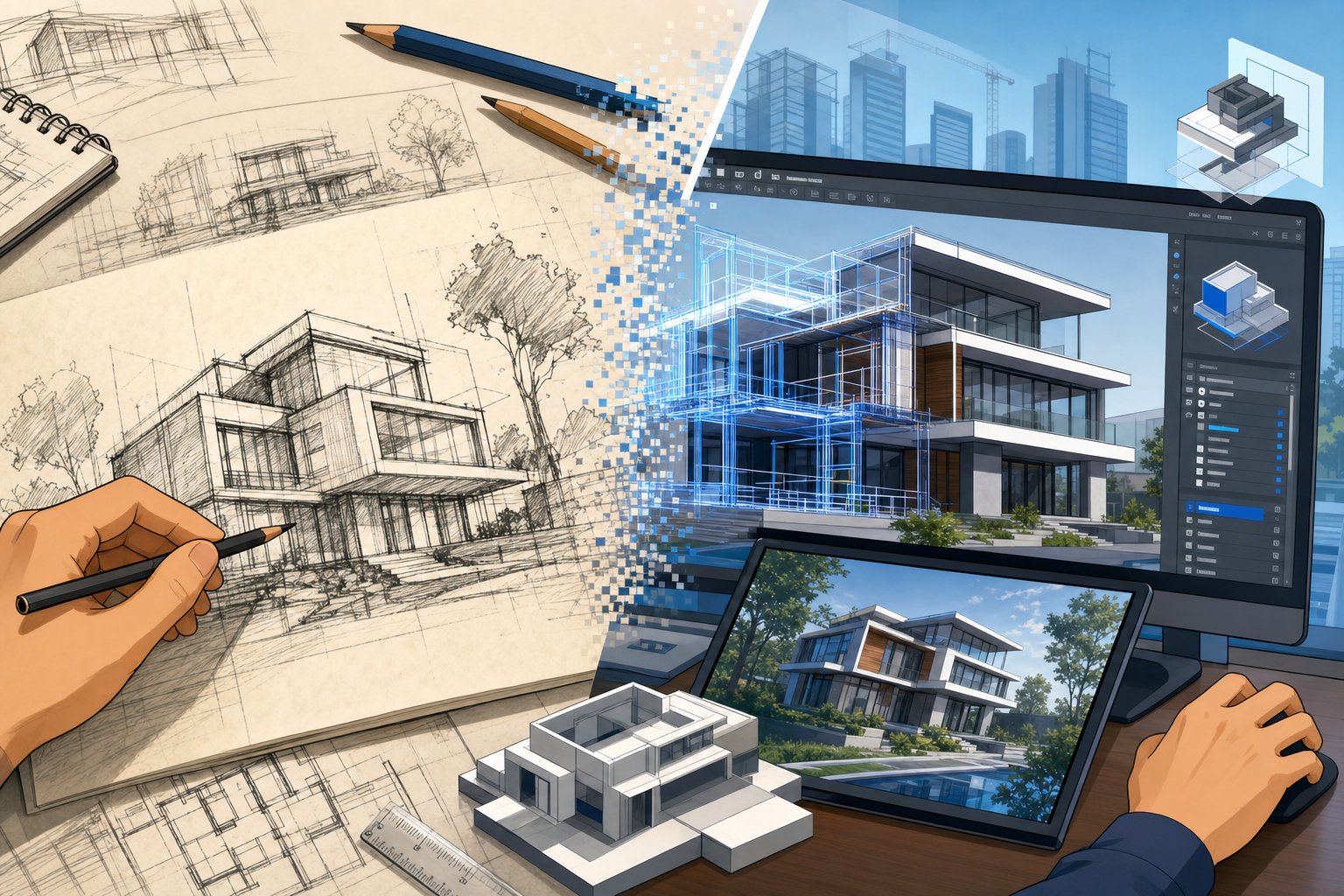


The history of architectural visualization is best understood as a long transition from crafted representation to computationally coordinated imagery. Before building information modeling altered professional practice, architects, illustrators, and specialist visualization studios relied on a mixture of manual perspective, painted atmosphere, physical maquettes, airbrushed elevations, photography, and eventually digital rendering to communicate unbuilt space. What changed over time was not merely the look of images, but the technical relationship between those images and the building information behind them. That shift helps explain why contemporary visualization workflows feel fundamentally different from earlier methods, even when they still pursue the same goals of persuasion, explanation, and spatial anticipation.
Architectural visualization before BIM was a separate representational craft built around drawing, model making, and staged imagery
Perspective, models, and rendered elevations as primary media
Before BIM existed, architectural visualization referred to a family of representational practices used to show what a building might look like before it was built, but these practices were rarely generated from a single coordinated digital source. In nineteenth- and twentieth-century architectural offices, visualization usually meant carefully composed perspective drawings, watercolor renderings, gouache presentation boards, charcoal shadows, colored elevations, and physical models made from basswood, museum board, plaster, acrylic, or metal. These formats served different audiences. A perspective view could sell the emotional promise of a façade or atrium to a client, while a rendered elevation might communicate materials, proportion, and civic presence to planning boards or competition juries. Physical models, especially in the postwar period, played an equally important role because they made massing legible and allowed architects to examine light and composition under controlled conditions. Firms often photographed these models to create images that looked more realistic than drawings while still depending on handcrafted fabrication and staging. The central fact of the pre-BIM era was that representation and construction logic were linked only indirectly. Plans, sections, and details described how to build, while visualization described how the project might be perceived. These outputs could influence one another, but they were usually produced as distinct artifacts, each with its own labor process, techniques, and specialists.
The historical split between documentation and presentation
The separation between design documentation and presentation imagery shaped the organization of architectural labor for decades. Construction drawings were prepared through disciplined drafting conventions in which line weight, notation, dimensions, and sheet coordination mattered more than atmospheric realism. Presentation images followed a different logic. Their purpose was not to specify but to convince, clarify, and dramatize. In practice, this meant that the people best at contract documents were not always the same people best at expressive perspective or image composition. Many firms had dedicated renderers, illustrators, or outside consultants who translated an architect’s design into persuasive visual form. In the era before integrated digital models, every major visualization update required reinterpretation. If a window grid changed in the plan set or a roofline shifted after engineering review, the perspective artist could not simply regenerate a live view from a master model. The image might need to be redrawn, repainted, or rebuilt as a physical model. This split also reflected the technologies available. Orthographic documentation emerged from drafting boards, parallel projection, and later CAD linework, whereas lush imagery depended on media skills, model photography, lens selection, retouching, and an understanding of light and landscape composition. Visualization therefore operated as a semi-autonomous layer on top of architecture, not as an embedded property of a unified design database.
Why visualization remained specialized for so long
Visualization was historically a specialized craft rather than an integrated design workflow because it demanded a combination of skills that architectural training only partially covered. To produce convincing perspectives by hand, one needed control of projection, color, entourage, shadow construction, atmospheric depth, and material suggestion. To produce compelling physical models, one needed fabrication skill, miniature detailing, finishing methods, and sometimes photographic staging. As architecture entered the late twentieth century, these representational demands intensified rather than disappeared. Clients expected more realism, developers wanted marketing imagery, public agencies demanded contextual views, and competition culture rewarded dramatic presentation. Yet the underlying design tools still produced drawings more readily than images. Even when early digital tools appeared, rendering remained computationally expensive and technically complex, often requiring separate software, external service bureaus, and expertise in lighting, surfaces, and file translation. The persistence of specialization also had an economic basis. Firms often found it more efficient to outsource high-end imagery to dedicated visualization studios, where teams focused on image production, compositing, digital painting, and later animation. This arrangement resembled the role that architectural photographers had long played: specialists stepped in when the final representational product required a level of polish beyond the office’s routine production pipeline. Long before BIM promised unity, visualization occupied a distinct cultural space between architecture, graphic design, industrial image making, and computer graphics.
The pre-BIM digital era transformed architectural imagery, but it still preserved a divide between drafting systems and rendering workflows
Early CAD prioritized drafting over visual experience
The first major wave of digital adoption in architecture did not begin with rich visualization but with the automation of drafting. Systems developed in the 1960s and 1970s, influenced by work at places such as MIT and by innovations in computer graphics and interactive design systems, demonstrated that computers could support geometric manipulation, yet the commercial value that reached most architectural offices was primarily in 2D production. Ivan Sutherland’s Sketchpad, created in 1963, is often cited as a foundational breakthrough because it showed how graphical interaction could occur directly on screen, but mainstream practice lagged far behind such research prototypes. When AutoCAD launched in 1982 through Autodesk, founded by John Walker and others, its significance lay in making affordable computer-aided drafting available on personal computers rather than expensive minicomputers or mainframes. For architecture, AutoCAD revolutionized layer control, standardization, editing, plotting, and file exchange, yet it did not initially transform visualization in the richer aesthetic sense. Drawings became easier to revise and reproduce, but the software’s cultural identity remained closely tied to linework, documentation, and orthographic output. Early CAD systems improved efficiency and precision, but they generally treated imagery as secondary. Architects could construct wireframes or hidden-line views, but these were often schematic rather than evocative. As a result, even after CAD became widespread, many offices still prepared presentation renderings separately, sometimes tracing over plotted views, sometimes exporting geometry to specialized rendering applications, and often relying on external illustrators to produce marketable images.
The rise of 3D modeling and architectural rendering tools
During the late 1980s and 1990s, a different software ecosystem began to reshape how architects imagined digital space. Programs such as 3D Studio, originally developed by the Yost Group for Autodesk on DOS before its later evolution into 3ds Max under Kinetix and then Autodesk, brought animation and rendering techniques from computer graphics closer to design practice. Form-Z, created by AutoDesSys under the leadership of Dr. Andreas Lisporkis, became influential because it offered architects and designers a relatively accessible environment for 3D form generation, solid and surface modeling, and presentation-oriented output. ArchiCAD, developed by Graphisoft under the vision of Gábor Bojár in Hungary, was equally significant because it linked 3D building description to documentation earlier than many competitors, even though the industry would only later fully embrace the BIM label. Bentley Systems, founded by Keith Bentley and Barry Bentley, cultivated MicroStation as a robust platform used extensively in architecture and infrastructure, and its 3D capabilities contributed to the gradual normalization of digital model-based visualization. The later emergence of 3ds Max expanded architectural image making further by offering more sophisticated materials, cameras, lighting, and plugin ecosystems. These tools did not eliminate specialized workflows, but they gave architects, visualization consultants, and digital artists a much broader vocabulary for atmospheric images, animated walk-throughs, and photorealistic scenes that far exceeded the representational limits of 2D CAD.
Computer graphics research supplied the realism that architecture adopted
The visual power of pre-BIM digital imagery depended heavily on breakthroughs in computer graphics research, much of it originating outside architecture. Techniques such as ray tracing, associated with early work by Arthur Appel and later popularized by researchers including Turner Whitted, made it possible to simulate reflection, refraction, and shadow behavior with much greater realism than scanline methods alone. Radiosity, developed through research into diffuse interreflection by figures such as Cindy Goral, Donald Greenberg, Michael Cohen, and others, proved especially compelling for architectural scenes because buildings are dominated by soft light bounce across matte surfaces. Texture mapping, introduced in seminal form by Edwin Catmull, made it practical to attach photographic or procedural surface information to geometric models, allowing walls, floors, glazing, foliage, and urban context to appear materially rich without requiring impossibly dense geometry. As hardware improved, GPU acceleration and graphics pipelines developed by companies such as NVIDIA and ATI Technologies, later AMD, shifted rendering previews and viewport interaction from painfully slow to increasingly fluid. The architectural profession benefited from these advances, but usually through software intermediaries. Rendering engines and visualization packages imported methods matured in film, aerospace visualization, and academic graphics, then packaged them for building imagery. This transfer of knowledge changed expectations dramatically. Clients who once accepted line perspectives and painted skies began to expect sunlight studies, reflections in curtain wall systems, nighttime interiors, and lifelike context populated with trees, cars, and people.
Rendering workflows created a new class of digital specialists
As 3D software matured, architectural visualization became more digital but not necessarily more integrated with core design documentation. Instead, the industry developed a layered production chain in which architects modeled buildings in one environment, exported or rebuilt geometry in another, assigned materials in a third, and finalized imagery in compositing tools such as Adobe Photoshop. This pipeline elevated specialist knowledge around polygon management, NURBS or solid conversion, UV mapping, camera setup, radiosity tuning, anti-aliasing, and render farm management. Firms that embraced digital imagery often discovered that software alone did not guarantee persuasive results. Success depended on who understood composition, environmental storytelling, entourage placement, and post-production. That is why many of the most memorable architectural images of the 1990s and early 2000s emerged from dedicated visualization experts rather than general office staff. Well-known rendering practitioners and boutique studios developed repeatable methods for balancing realism and aspiration, often combining CAD exports with manually curated textures, photographic backplates, and digitally painted atmospheres. The software landscape itself encouraged specialization:
- Autodesk strengthened the connection between CAD users and visualization tools through AutoCAD, 3D Studio, and later 3ds Max.
- Graphisoft pushed building-centric modeling through ArchiCAD, anticipating integrated data structures even before BIM became mainstream terminology.
- Bentley Systems supported large-scale and technically complex projects where MicroStation served as a backbone for 2D and 3D production.
- Third-party render technology vendors and hardware manufacturers steadily improved visual fidelity, but often through disconnected add-ons rather than a single coordinated authoring environment.
BIM fundamentally changed architectural visualization by tying imagery to coordinated building information instead of isolated presentation geometry
The BIM model unified views, data, and geometry
The decisive shift introduced by BIM was not simply better three-dimensional modeling, but the creation of a coordinated building model in which geometry, object intelligence, schedules, sections, elevations, quantities, and views were all derived from a shared information structure. This model-based logic had deep roots in earlier research and software experimentation, including Graphisoft’s long commitment to the virtual building concept, but its broad market impact became especially visible through Revit. Revit Technology Corporation was founded by Leonid Raiz and Irwin Jungreis after both had worked at Parametric Technology Corporation, and the company’s software was conceived around parametric change management for buildings. After Autodesk acquired Revit in 2002, the platform became central to BIM adoption across much of the architecture, engineering, and construction industry. What made this important for visualization was that a perspective view no longer had to be a disconnected illustration. It could be another expression of the same underlying model used to produce plans, door schedules, wall types, and sections. If a stair changed, multiple drawings and views could update together. If a façade panel system was revised, the visual image could reflect that coordinated change rather than requiring a separate geometric rebuild. This altered both labor and trust. Visualization began to move closer to the informational heart of the project, gaining credibility not merely as a marketing image but as a model-derived representation linked to material assignments, assemblies, and spatial relationships defined elsewhere in the design environment.
Visualization became part of design coordination instead of a final overlay
Once visualization drew from coordinated building information, its role in practice expanded beyond polished end-stage imagery. Architects could use rendered views earlier and more iteratively because generating them no longer required constructing an entirely separate scene from scratch. That did not eliminate the need for refinement, but it changed the economics of image production. Instead of treating visualization as the final act performed after design decisions had already stabilized, BIM encouraged firms to use visual output during design development, consultant coordination, client workshops, and internal review. The same digital building model could support multiple representational tasks:
- orthographic documentation for construction and permitting
- perspective imagery for client communication and public approval
- material and lighting previews for design validation
- quantity and scheduling data linked to modeled objects
- analytical simulations connected to geometry and assemblies
Real-time rendering and interoperable ecosystems accelerated the transformation
The most visible phase of BIM’s influence on visualization came when model-based authoring environments connected to high-speed rendering systems capable of near-instant feedback. Tools such as Enscape, developed by Enscape GmbH before becoming part of the Chaos group, allowed architects to move directly from BIM applications into real-time navigable scenes with synchronized updates. Twinmotion, originally created by the French company Abvent and later acquired by Epic Games, made it easier to turn design models into interactive, atmospheric presentations using game-engine techniques. Lumion, from Act-3D, became popular because it dramatically lowered the barrier to producing lush exterior and interior scenes from architectural models with extensive asset libraries and fast iteration. V-Ray, developed by Chaos, remained crucial by providing high-end physically based rendering trusted by both architects and visualization specialists, while increasingly interoperating with BIM and CAD ecosystems. These tools changed professional expectations in several ways. First, they reduced the lag between design change and visual feedback. Second, they encouraged architects to evaluate space through movement, immersion, and material response rather than relying only on static images. Third, they made visualization more continuous with the design process itself. A model in Revit, ArchiCAD, Rhino, SketchUp, or other environments could now participate in a richer downstream ecosystem where synchronization, live links, and shared material definitions became standard. The image was no longer a distant derivative; it was part of an active feedback loop.
The companies bridging BIM and visualization redefined industry structure
The contemporary landscape emerged through the interaction of several major companies whose strategies blurred the boundaries between authoring, rendering, collaboration, and immersive presentation. Autodesk shaped the industry not only through Revit and AutoCAD, but also through its long involvement with 3ds Max and cloud-connected services that positioned visualization within broader digital project delivery. Nemetschek, through brands including Graphisoft, Vectorworks, and later connections to visualization-oriented tools, reinforced a different but equally influential vision of model-based design and ecosystem integration. Epic Games brought game engine technology into architectural workflows through Unreal Engine and its acquisition of Twinmotion, accelerating demand for high-fidelity real-time environments, virtual reality, and interactive stakeholder review. Chaos became an essential bridge by bringing production-grade rendering, light simulation credibility, and increasingly unified workflows across V-Ray, Enscape, and related tools. Trimble, through SketchUp and connected construction technologies, also played a major role in making model-based visualization broadly accessible across architecture, interiors, and design-build contexts. These companies did more than produce software features. They restructured expectations about what an architectural model should do. A building model was no longer judged only by whether it could generate plans and sections. It was expected to support:
- high-quality still rendering
- real-time navigation
- virtual and augmented reality experiences
- design option review with rapid material changes
- coordination across consultants and downstream fabrication or construction platforms
- cloud sharing and stakeholder access beyond the design office
Material systems, simulation logic, and immersive review changed what images were for
BIM-era visualization also changed because digital materials and rendering settings became tied more closely to semantically meaningful building objects. A wall, roof, floor, family, or library component was no longer just a graphic symbol or neutral mesh. It carried classification, dimensions, metadata, and often layered material definitions that could feed both technical drawings and visual output. That meant the rendering process increasingly sat alongside simulation and coordination rather than existing apart from them. Daylighting analysis, energy workflows, clash review, and code-related checking all benefited from the presence of a coherent model, and visualization occupied the same informational territory. As immersive review tools matured, clients and project teams came to expect live walkthroughs, instant material swaps, environmental ambiance studies, and collaborative cloud sessions. The social meaning of visualization therefore changed. It was not only the final polished promise of a future building; it became a medium for negotiation, verification, and shared spatial judgment. In the pre-BIM world, a rendering often represented a frozen interpretation created after many design decisions had already been consolidated. In the BIM world, the image increasingly participates in the making of those decisions. This is why the historical importance of BIM cannot be reduced to faster rendering. Its deeper contribution was to collapse old boundaries between representation, information management, and design development, making imagery part of the operational core of architectural practice.
Architectural visualization evolved from handcrafted persuasion to data-rich model expression, and BIM changed the meaning of the image itself
From representation of form to expression of structured intent
The long arc of architectural visualization runs from hand-drawn perspective and meticulously crafted physical models to coordinated digital scenes generated from information-rich building systems. In the early eras, representation depended on highly trained specialists who translated design ideas into persuasive images through drawing, painting, model making, and photographic staging. In the pre-BIM digital period, software dramatically expanded visual possibility through 3D modeling, ray tracing, radiosity, texture mapping, and later hardware-accelerated workflows, yet visualization still often remained separate from the authoring logic of construction documents. What BIM changed was not just speed, convenience, or realism, though it improved all three. BIM altered the relationship between image and project knowledge. A rendered view could now emerge from the same coordinated source as a section, schedule, or material takeoff, making visualization part of a larger system of project intelligence. This transformed architectural imagery from a parallel representational craft into a more deeply integrated form of model expression. The resulting workflows are real-time, immersive, collaborative, and increasingly cloud-based, but they should not be mistaken for a sudden technological break detached from history. They are the latest phase in a much longer evolution of architectural representation, one shaped by manual artistry, drafting systems, computer graphics research, software platform competition, and the persistent desire to make future space visible before it exists.
Also in Design News