Your Cart is Empty


Assembly-Aware Design Software for Cost-Effective Manufacturing
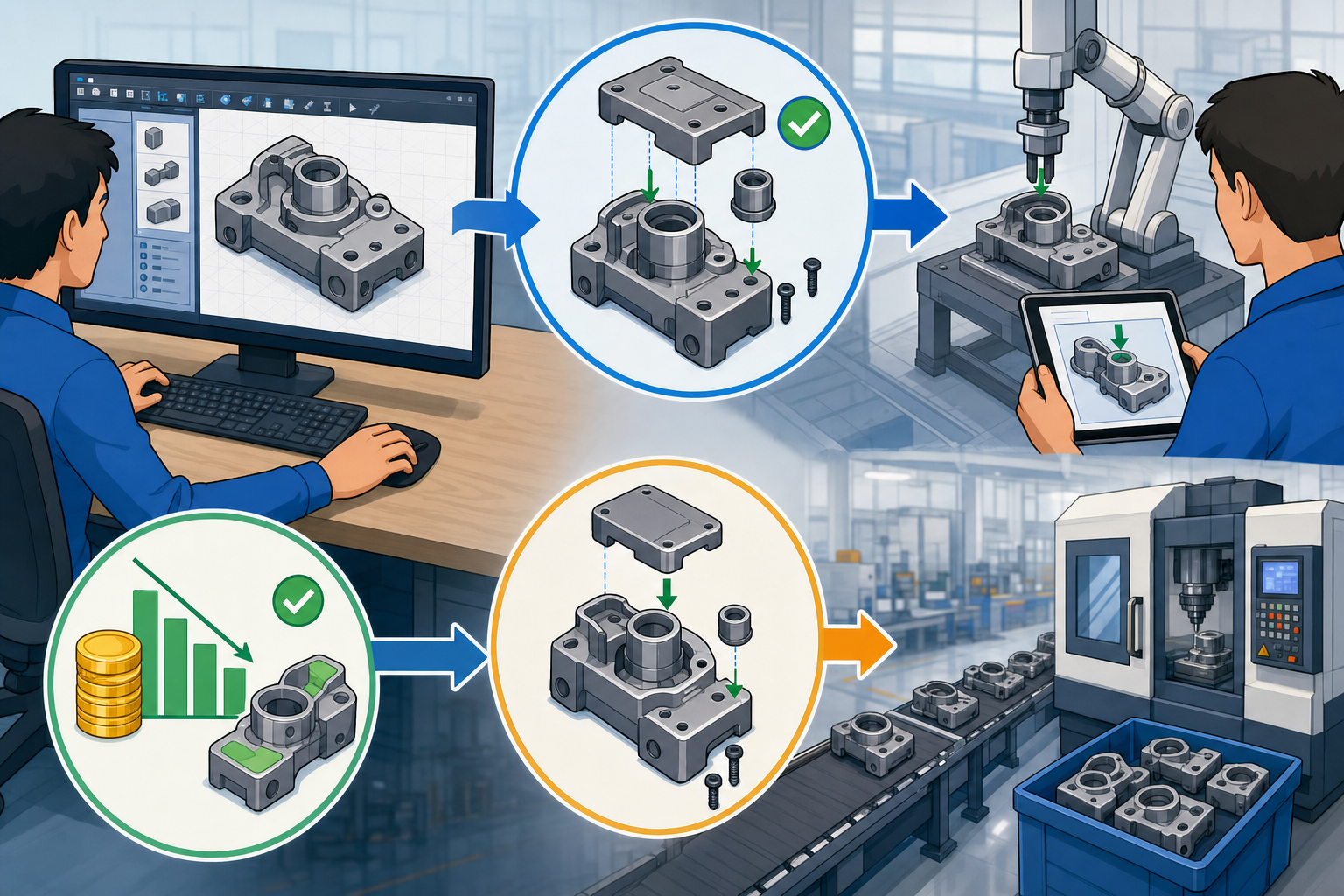


In modern product development, teams rarely lose margin because they forgot how to model a part. They lose margin because products that look elegant on a screen become slow, error-prone, and expensive once hundreds or thousands of assemblies begin moving through production. This is why assembly-aware design has become a strategic concern rather than a manufacturing afterthought. The most advanced design software no longer stops at creating geometry that satisfies functional intent. It increasingly helps engineers understand whether a concept can be built repeatedly, with stable quality, practical labor content, realistic tooling access, and scalable process logic. As product complexity rises and launch windows shrink, the difference between a good design and a buildable design is often the difference between a profitable program and a painful one.
The strategic importance of assembly-aware design in modern product development
Assembly-aware design matters because the economics of a product are often determined less by the cost of individual components than by the effort required to orient, handle, insert, align, fasten, inspect, and rework them. A product can be optimized for material usage and still underperform commercially if it requires too many manual operations, excessive fixturing, difficult access angles, or repeated corrections caused by tolerance sensitivity. In many industries, the most stubborn costs hide in labor time, training burden, line balancing, defect recovery, and throughput instability, all of which are directly influenced by assembly decisions made very early in design. Teams that understand this stop asking only whether a part can be manufactured and start asking whether the entire product architecture supports simple, repeatable build logic. That shift is central to contemporary Design for Assembly, where software is increasingly used to evaluate not just shape and fit, but production behavior. The strategic value is clear: when assembly considerations enter concept development, companies gain leverage over cost, quality, and launch risk while design freedom still exists.
Why optimized part costs can still produce expensive products
A common failure mode in product development is the illusion of savings created by highly optimized component pricing. A sourcing team may succeed in reducing the cost of several parts, yet the total landed cost still rises because the product becomes harder to assemble. That happens when low-cost parts require extra fasteners, introduce awkward orientations, demand special tools, or increase the chance of operator mistakes. The issue is not that part cost reduction is unimportant, but that it is incomplete without assembly context. The most capable teams now track early metrics such as part count, fastener count, assembly sequence complexity, orientation sensitivity, tool access and clearance, and the suitability of each step for human or robotic assembly. These indicators reveal whether a product is accumulating hidden process cost. A design with fewer unique components, better symmetry, self-locating features, and accessible joining methods often outperforms a cheaper-looking alternative because it shortens cycle time and reduces variation. Software that surfaces these metrics early gives decision-makers better visibility into the true cost structure of a design before commitments become expensive.
Functionality versus scalable buildability
There is a profound difference between designing something that works once and designing something that can be built efficiently at scale. Functional success proves that a design can perform its intended task under required conditions. Scalable buildability asks a broader set of questions: can parts be presented consistently, can interfaces tolerate normal variation, can operators assemble the product without hesitation, can automation handle the geometry, and can production maintain quality at target takt time? These concerns are architectural, not merely procedural. A product may pass validation yet still fail operationally because the assembly path is fragile. The strongest design organizations therefore use software to assess whether product architecture naturally supports assembly by minimizing handling ambiguity and reducing dependencies between difficult steps. Good assembly-aware design tends to include:
- self-aligning features that reduce manual correction
- standardized interfaces that support reuse across variants
- joining strategies with clear access and low tool complexity
- symmetrical or orientation-tolerant components that reduce errors
- assembly sequences that avoid rework-prone reversals or hidden operations
Design software’s shift toward assembly intelligence
Design software is changing because product teams need decision support, not just geometry creation. For decades, CAD systems were measured primarily by modeling speed, surfacing quality, and drafting capability. Those remain important, but they no longer define the frontier. The frontier is increasingly about intelligence around manufacturability and assembly. Modern platforms can identify over-constrained assemblies, detect inaccessible fastener locations, simulate insertion paths, evaluate tolerance stack-ups, and connect product structure with downstream planning systems. In effect, software is becoming a medium for exposing production consequences while designers still have room to simplify. This shift is strategic because assembly performance emerges from interactions across parts, not from isolated models. A software environment that understands product architecture can reveal when one design decision increases handling complexity somewhere else. That gives engineering and manufacturing a shared basis for improvement. The result is a more analytical approach to Design for Assembly, where tradeoffs are made using measurable signals instead of intuition alone, and where assembly quality is treated as a design output rather than a shop-floor correction.
Software features that directly support Design for Assembly decisions
Assembly-aware decisions become practical when software translates abstract DFA principles into visible signals inside the design workflow. Engineers do not need generic reminders to simplify products; they need tools that show where complexity resides, how interfaces behave, and which components create avoidable process burden. The best software features for DFA are therefore not cosmetic add-ons. They are mechanisms for exposing architecture weakness, handling ambiguity, and manufacturing risk while the design is still fluid. These tools allow teams to compare concepts on something more meaningful than appearance or theoretical performance. They reveal whether a product can be built with stability, clarity, and speed. Importantly, many of these features are valuable not only for dedicated manufacturing engineers, but also for product designers, systems engineers, sourcing specialists, and quality teams. As digital product definitions become richer, assembly decisions can be informed by kinematics, tolerances, access envelopes, component commonality, and joining logic before expensive tooling or process documentation is created. That is where software begins to function as a genuine DFA partner rather than a passive modeling environment.
Constraint systems as architecture diagnostics
Assembly constraint systems are often viewed as simple positional tools, but in advanced workflows they also act as diagnostics for product architecture. When a digital assembly requires excessive mating definitions, fragile references, or a large number of exceptions to achieve a stable model, that usually signals a real-world complexity problem. Overcomplicated mating logic can indicate that parts lack natural locating features, rely on tight operator judgment, or require sequence-dependent alignment that will be difficult to repeat on the line. Conversely, assemblies that resolve cleanly with limited, intuitive constraints often correspond to designs with clearer physical relationships and better self-location. This is especially useful during concept comparison, where teams can use constraint behavior as an early proxy for assembly stability. Signs of DFA weakness commonly include:
- components that need multiple redundant mates to remain predictable
- features that align only under narrow geometric assumptions
- interfaces that become unstable when related parts are modified
- assemblies that require workaround constraints rather than natural references
Interference, clearance, and practical access analysis
Interference detection is one of the most mature capabilities in design software, yet its value for DFA goes far beyond finding obvious collisions. Advanced teams use interference and clearance analysis to understand whether parts can actually be assembled with realistic tool paths, hand access, insertion margins, and tolerance variation. A design may have no final-state interference and still be difficult to build if a screwdriver cannot approach a fastener normally, if a clip must flex beyond safe limits, or if adjacent geometry obstructs a hand during placement. Clearance analysis becomes even more powerful when paired with service envelopes and tooling volumes, because what matters in assembly is not only static fit but task feasibility. Designers can use these tools to inspect:
- fastener approach paths and required tool swing
- finger clearance for manual placement or cable routing
- space for fixtures, grippers, or robotic end effectors
- gaps needed to avoid cosmetic damage during insertion
- stack-dependent conditions that narrow assembly windows
Motion studies and kinematic simulation for insertion reality
Many assembly problems do not appear in a static model because the issue lies in the path rather than the destination. Motion studies and kinematic simulation address this by showing whether parts can actually be inserted, rotated, compressed, hinged, or locked into place without impossible maneuvers. This matters for products that use snap fits, twist locks, hinged subassemblies, seals, wire routing, or nested components installed through constrained openings. A nominal final arrangement may look correct while the path required to reach it is blocked, ergonomically awkward, or highly sensitive to orientation. Kinematic simulation allows teams to test assembly sequence logic before physical prototypes reveal the problem at much higher cost. It can uncover situations where a part only assembles if another component remains temporarily loose, where a cable bend radius is violated during installation, or where a latch demands more displacement than the surrounding structure permits. In DFA terms, these simulations help validate the difference between theoretical compatibility and executable process logic. They also support more robust communication across engineering and manufacturing, because the assembly path can be reviewed visually rather than inferred from drawings or static screenshots.
Rule-based design checks that catch repeatable DFA risks
Rule-based design checks are becoming increasingly useful because many assembly inefficiencies follow recognizable patterns. Software can now flag conditions associated with avoidable labor burden or error risk, giving teams a structured way to detect common DFA problems. These checks do not replace engineering judgment, but they help prevent recurring oversights from surviving into late development. Particularly valuable rules include detection of unnecessary unique parts, mirrored components that invite handling confusion, hidden fasteners that complicate sequencing, fragile snap features vulnerable to breakage, and poor symmetry that makes part orientation unnecessarily difficult. More sophisticated systems also evaluate whether small components are likely to be dropped or mispicked, whether visual distinction between similar parts is adequate, and whether joining methods align with intended assembly automation. Effective rule frameworks often focus on:
- part uniqueness versus standardization opportunities
- symmetry and orientation clarity during handling
- accessibility of fastening points and latch features
- feature robustness under expected insertion loads
- architectural consistency across variants and product families
BOM intelligence and tolerance analysis as cost controls
Bill of materials awareness is increasingly central to DFA because component variety is a major hidden driver of assembly cost. Every additional unique part can increase procurement complexity, line-side inventory, pick errors, training demands, and revision overhead. BOM-aware design tools help teams see whether variety is justified by function or simply inherited from inconsistent design decisions. They support standardization by revealing where common hardware, shared interfaces, or module reuse could replace special components. In parallel, tolerance analysis features expose stack-up conditions that make assembly slow, force selective fitting, or increase scrap and rework. A product that technically meets dimensions can still be operationally weak if tolerance accumulation narrows the assembly window to the point that operators must force parts, compensate manually, or rely on inspection sorting. Combining BOM intelligence with tolerance analysis gives teams a more realistic picture of cost. It ties product architecture to process capability. This is especially powerful when software can show how reducing component variety and increasing interface robustness can improve line stability at the same time, turning DFA from a simplification exercise into a measurable strategy for labor reduction and quality improvement.
Advanced workflows: using integrated platforms to reduce production cost before tooling begins
The most significant advances in assembly-aware design do not come from isolated software features alone, but from integrated workflows that connect product definition, simulation, manufacturing planning, procurement logic, and human factors evaluation in a shared digital environment. In these workflows, assembly is not reviewed after geometry is complete. It is evaluated continuously as architecture evolves. That integration matters because assembly cost is a systems issue. Part shape, joining strategy, tolerance selection, line balance, tool reach, packaging constraints, and supplier capability all influence one another. When software platforms connect these dimensions early, teams can identify cost drivers before tooling, fixtures, and release cycles harden poor decisions into expensive realities. This is where advanced design organizations create disproportionate value. They use digital continuity to compare concepts not just on performance, but on buildability and launch risk. The goal is not to eliminate all complexity, which is rarely possible, but to ensure that complexity is allocated where it creates customer value rather than where it quietly burdens production. Integrated platforms are increasingly the backbone of that discipline.
Connecting CAD, simulation, and manufacturing planning
When CAD, simulation, and manufacturing planning operate in disconnected silos, assembly problems are usually discovered too late, after assumptions have solidified into architecture. Integrated platforms change this by allowing teams to test assembly implications while concepts are still being shaped. A fastening strategy selected in CAD can immediately be evaluated for access, cycle time, and tooling implications. A tolerance adjustment can be reviewed not only for engineering fit, but also for assembly robustness. A new subassembly split can be assessed in relation to workstation content, line sequencing, and supplier packaging. This connected workflow supports earlier tradeoff decisions around:
- which operations should occur at part, subassembly, or final assembly level
- whether a product is better suited to human, robotic, or hybrid assembly
- how architecture choices influence fixturing and tool investment
- where tolerance relaxation or feature redesign can improve throughput
- how modularization affects both serviceability and production flow
Digital mockups and cross-functional virtual assembly reviews
Digital mockups have evolved from visual coordination tools into high-value environments for virtual assembly review. In a mature workflow, engineering, manufacturing, sourcing, quality, and operations teams can inspect the same product model and discuss not only fit but sequence, accessibility, handling, and standardization. That shared review process is powerful because many assembly risks fall between disciplines. Engineering may understand function, manufacturing may understand line realities, and sourcing may understand hardware standardization opportunities, but without a common digital review context those insights remain fragmented. Virtual assembly reviews help teams resolve questions such as whether a part should be reoriented to improve pick-and-place consistency, whether a hidden fastener is worth the cosmetic benefit, or whether two subassemblies should be combined to reduce handoffs. The quality of these conversations improves when the software environment supports exploded views, path simulation, tooling overlays, and BOM context. Instead of debating abstractly, teams can review the exact digital product and test assumptions before physical builds. This allows assembly-focused decision making to happen at the stage when changes are still relatively inexpensive and strategically meaningful.
Automation and AI for simplification opportunities
Automation and AI are expanding the scope of DFA by helping teams identify simplification opportunities across large assemblies and product families that would be difficult to detect manually. These systems can analyze repeated patterns in structure, joining methods, and component usage to suggest where complexity can be reduced without harming function. Particularly useful applications include recommending opportunities to consolidate parts, replace threaded fasteners with clips or tabs where appropriate, standardize interfaces across product families, and detect assembly sequences that are unnecessarily difficult or order-sensitive. The value of AI in this context is not magical design generation, but scalable pattern recognition. It can highlight architectures that are likely to create labor content or variation based on historical design behavior. Examples of useful AI-assisted guidance include:
- identifying clusters of low-value hardware that may be replaced by integrated features
- finding duplicate part definitions that reflect poor standardization
- ranking assembly steps by predicted difficulty or operator burden
- spotting interface inconsistencies across variants that complicate line setup
- suggesting family-level common parts to reduce inventory and training complexity
Human factors analysis as a core software capability
One of the most important developments in assembly-oriented software is the growing integration of human factors analysis. Even in highly automated environments, people still perform critical tasks in loading, inspection, adjustment, exception handling, and final assembly. A design that ignores human interaction often accumulates hidden costs in fatigue, errors, inconsistent cycle times, and training dependence. Modern software can evaluate reachability, visibility, ergonomic motion, repetitive task burden, posture constraints, and hand clearance within digital assembly scenarios. This allows teams to see whether an operator must twist awkwardly to install a connector, whether a visual confirmation point is obscured, or whether a repeated forceful motion will create long-term strain and throughput variability. Human factors analysis is particularly valuable because many assembly inefficiencies are not binary failures. They are manageable on day one and costly over time. A task that can technically be performed may still be a poor production choice if it slows after operator fatigue sets in or if quality depends on highly experienced labor. By embedding ergonomic and motion analysis into the software workflow, teams make products easier not only to assemble, but to assemble consistently across shifts, sites, and ramp-up conditions.
Visualization and immersive review for hidden assembly risk
Static CAD views often hide assembly risks because they compress three-dimensional task reality into clean snapshots that omit visibility problems, access conflicts, scale perception, and sequence confusion. Product visualization and immersive review tools address this by allowing teams to experience the product in ways that are closer to real assembly conditions. High-fidelity rendering, interactive exploded sequences, virtual reality walkthroughs, and mixed-reality reviews can reveal whether a component is visually distinguishable in a cluttered assembly, whether a tool approach feels intuitive, or whether a robotic path interferes with nearby operations. These tools are especially useful when products contain dense packaging, interior hardware, or multi-step locking actions that are difficult to understand from conventional CAD alone. Their value is not limited to presentation. They help teams detect practical issues such as:
- obscured fastener heads and hidden latch points
- confusing orientation cues for similar-looking parts
- restricted visibility during inspection or final verification
- crowded work zones that increase collision or handling risk
- sequence dependencies that become obvious only in three-dimensional rehearsal
Conclusion
Design for Assembly is rapidly becoming a software-supported discipline rather than a late-stage manufacturing correction. That shift reflects a deeper change in how companies think about product development. The goal is no longer just to create geometry quickly or to verify function in isolation. It is to expose production cost drivers while there is still freedom to change architecture, simplify interfaces, reduce variation, and make assembly logic more robust. The most valuable design environments are therefore not merely faster modelers. They are systems that connect geometry with manufacturability, tolerance behavior, process feasibility, ergonomic burden, and component standardization. When teams use assembly-focused software features early, they can reduce labor time, improve quality, shorten ramp-up to production, and avoid the recurring pattern of solving preventable problems with training, fixturing, or rework. The broader takeaway is significant: the future of design software lies in helping teams design not only what can be made, but what can be assembled simply, reliably, and economically. In that future, assembly intelligence is not an optional enhancement to CAD. It is one of the clearest indicators of whether digital engineering is truly connected to industrial reality.
Also in Design News