Your Cart is Empty


Design Software History: From APT to Adaptive Toolpaths: A Technical History of CAM and the Digital Thread
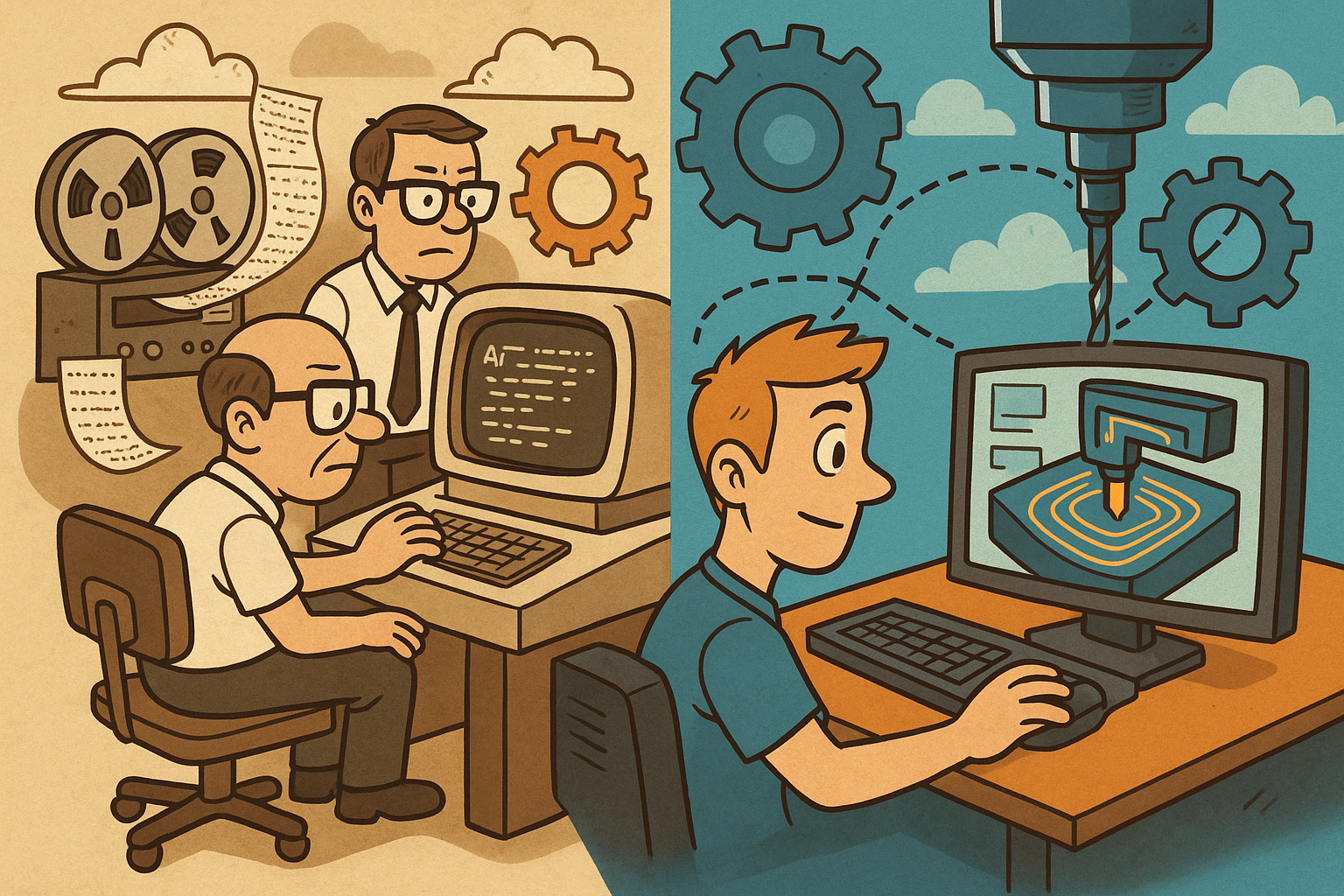


Origins of Computer-Aided Manufacturing (1949–1969): NC, Punch Cards and APT
Parsons, MIT, and the leap to servo-driven geometry
In the late 1940s, John T. Parsons of Parsons Corporation proposed an audacious rethinking of machining: use numeric coordinates derived from design geometry to drive a milling machine, rather than relying on fixtures, cams, or hand-sketched templates. Working with the U.S. Air Force and the Massachusetts Institute of Technology’s Servomechanisms Laboratory—directed by Gordon S. Brown—Parsons targeted the challenge of complex aircraft surfaces. The team modified a Cincinnati Hydrotel mill and, by 1952, demonstrated that closed-loop servos and feedback could translate coordinate lists into accurate, repeatable motion. That demonstration made tangible a core logic still at the heart of modern CAM: reduce the machinist’s manual interpolation and turn geometry into controllable motion. It also exposed limitations in early electronics, memory, and coordinate preparation workflows. Even so, the results were compelling enough for the Air Force and industry to continue funding, particularly where freeform surfaces and tight tolerances justified expensive new methods. The collaboration showed that when design intent is expressed numerically, manufacturing can be systematized, audited, and improved—a conceptual shift that catalyzed the movement from craft “know-how” to codified motion planning and seeded the decades-long evolution toward algorithmic toolpaths.
Punch cards, paper tape, and the first data networks in the shop
Early numerical control was as much an information problem as a motion problem. Programmers encoded coordinates on punch cards or paper tape, which then fed electromechanical readers on the machine tool. This medium constrained program length, demanded error-free transcription, and made late changes cumbersome. As shops acquired multiple machines, a new idea—Direct Numerical Control (DNC)—emerged: one computer serving many NCs via wired links, replacing tape with streams of data. Beyond convenience, DNC began to separate long-horizon programming from real-time execution, foreshadowing today’s networked cells. Yet, variability across controllers remained: format quirks, limited memory, and inconsistent codes meant that portability was fragile. Even so, DNC exposed a systems view of manufacturing data flow and forced early thinking about buffering, synchronization, and logging. Shops learned to stage programs centrally, track revisions, and avoid the waste associated with damaged or misread tapes. The humble paper tape, with its punch patterns and fragility, thus served as a proving ground for the shop-floor communications discipline that would later underpin Ethernet-connected CNCs, shop management software, and the beginnings of a resilient digital thread.
APT, CLDATA, and the birth of abstractions over machine idiosyncrasies
Douglas T. Ross and colleagues at MIT, with sustained Air Force sponsorship, created the language that turned NC from a hardware curiosity into a programmable system: APT (Automatically Programmed Tools). Unlike raw coordinate feeds, APT described geometry and operations in a high-level, human-readable form: points, lines, circles, surfaces, and cutter motions expressed declaratively. Central to APT’s architecture was CLDATA (cutter location data), a machine-agnostic representation of tool center motion. This separation of concerns—defining the part and the desired toolpath logically first, then translating to a specific controller later—made it possible to develop portable programming practices. APT processors computed the tool center path, and later stages transformed it into the machine’s codes and cycles. Vendors and labs proliferated variants and processors; the idea of “postprocessing” starts here. The output could still be enormous—thousands of lines for complex parts—so project teams focused on compact cycles, subroutines, and reusability. APT also forced greater rigor in geometric modeling, feeding into parallel advances by MIT’s Steven A. Coons on surfaces, which ultimately influenced NURBS-based CAD and later solid modeling kernels. In practical terms, APT’s legacy is the enduring principle that geometry-aware programming—backed by explicit data models—can tame machine diversity and scale programming across fleets.
Standards, dialects, and industrialization beyond the lab
As usage spread, the Electronics Industries Association introduced EIA RS‑274—proto G‑code—to standardize machine instructions; ISO 6983 later harmonized international practice. Even within this framework, dialects emerged: Fanuc’s interpretations, Siemens Sinumerik constructs, Heidenhain’s conversational TNC syntax, and cycles that varied by vendor. That diversity created a practical need for configurable posts and on-the-fly adaptation. Meanwhile, industrial players—IBM and General Electric on computing, Cincinnati Milacron on machine tools—brought NC into production settings. Aerospace leaders such as Boeing and Northrop justified early investment by machining wing skins, frames, and freeform fairings with tolerances impossible or uneconomical by manual routes. The pattern repeated: research prototypes became shop-hardened, and, over time, the balance of programming effort to machine time improved. The confluence of standardized instruction sets and robust servo hardware stabilized expectations between programmer and machine. Shops could trust that a CLDATA-driven process would survive translation, and machine-tool builders could innovate in drives and feedback with confidence that language portability—however imperfect—would not be lost. The groundwork was laid for the 1970s–1990s wave: commercial CAM that tightly linked geometry to cutter paths running in mainstream manufacturing.
From Minicomputers to PCs: Commercial CAM Takes Shape (1970s–1990s)
From APT processors to integrated CAM: geometry meets toolpath
The 1970s and 1980s saw the rise of turnkey CAM systems that fused geometry creation with toolpath planning. United Computing’s Unigraphics—later acquired by McDonnell Douglas and eventually part of Siemens as NX—offered 3D modeling and manufacturing modules tightly linked to machining operations. Dassault Systèmes’ CATIA, born within Avions Marcel Dassault as CATI and commercialized from 1981, formalized surfacing for complex aerostructures and tooling, enabling accurate lofting and fairing. SDRC’s I‑DEAS grew out of analysis-driven roots to provide integrated CAD/CAE/CAM. Each product did more than compute coordinates: they defined workflows for part setup, stock, tools, operations, and verification. On minicomputers and early workstations from DEC, IBM, and Sun, these systems handled 2.5D contouring, pocketing, and the first practical 3-axis sculptured surface machining. The provider landscape—United Computing/Unigraphics, Dassault Systèmes, and SDRC I‑DEAS—established an expectation that manufacturing could be driven by a single, geometry-centric database, collapsing handoffs that previously spanned drafting, NC prep, and tape punching. That set the stage for scalable implementation across automotive, aerospace, and industrial equipment manufacturers whose parts demanded consistent, repeatable toolpath strategies.
Postprocessing becomes a discipline—and a market
As controller dialects proliferated, the gap between neutral CL files and machine-executable code widened into a specialty in its own right: postprocessing. Companies such as ICAM Technologies and IMS Software (IMSpost) built configurable post engines that mapped generic toolpaths to controller-specific G‑code/M‑code, cycles, and macros. Beyond mere syntax, robust posts addressed arc linearization, inverse time feeds, coordinate transforms for rotary axes, and machine kinematics constraints. Especially in 4‑ and 5‑axis environments, posts also dealt with tool length compensation, collision-avoidance conventions, and G43/G68/G54 protocol details that could make or break a program. Ecosystems formed around post libraries and services, with OEMs and resellers offering validated posts for common configurations—Fanuc 31i, Siemens 840D, Heidenhain TNC 426/530, Mazak Mazatrol hybrids. The practical upshot was a division of labor: CAD/CAM teams focused on strategy and geometry, while post specialists ensured safe, efficient execution on real iron. This modularization improved reliability and made it realistic to deploy CAM at scale across mixed-controller shops, all while containing the risk of subtle code incompatibilities that could cause scrapped parts or damaged machines.
PC-based CAM and the democratization of NC programming
The late 1980s and 1990s brought CAM to the desktop. Mastercam from CNC Software (founded by Mark and Jack Summers) debuted in 1983, translating minicomputer capabilities into affordable PC-based workflows. Bill Gibbs’s GibbsCAM, SURFCAM from Surfware, Cimatron (Israel), DP Technology’s Esprit, and Pathtrace’s Edgecam (later part of Vero and Hexagon) further opened the market. Their focus: give small and mid-sized manufacturers access to 2.5D milling, turning, drilling cycles, and increasingly capable 3D surfacing without the expense of high-end workstations. Windows GUIs, WYSIWYG backplots, and libraries of toolpath strategies made previously esoteric operations approachable. These vendors also pioneered quick post configuration, community-driven tool libraries, and templates. The period saw strong emphasis on pocketing, contouring with cutter compensation, drilling canned cycles, and simple multi-axis indexing. What PC CAM lacked in integrated enterprise PLM it made up in responsiveness and cost effectiveness, enabling job shops to bid on more complex work with confidence. Over time, capabilities climbed: rest machining, 3D finishing from STL meshes, and basic collision checks arrived, narrowing the gulf between workstation incumbents and agile PC entrants.
Five-axis surfacing, swarf, and early collision control
By the mid-1990s, high-value sectors demanded more than 3-axis sculpting. 5-axis pioneers refined drive/guide surface strategies that balanced smooth tool axis motion with surface finish and machine kinematics limits. Techniques like swarf cutting—tilting the tool so the side of a tapered or straight end mill cuts the wall—yielded accuracy and productivity on thin walls and turbine blades. Early collision checks considered tool, holder, and machine limits, often conservatively, to avoid gouging critical surfaces. CAM developers integrated kinematic solvers for tilt/rotary axes and resolved singularities near gimbal lock. Advanced players, including Unigraphics, CATIA, and later niche specialists, offered tool axis smoothing and lead/lag control. The rise of high-speed spindles and better servo performance encouraged constant-cusp finishing and finer stepovers, bringing aerospace surfacing within greater reach for a broader set of shops. As five-axis grew, postprocessing complexity spiked, but the payoff—shorter setups, fewer refixtures, and improved finishes on freeform geometry—pushed multi-axis from an exotic capability to a strategic differentiator.
File formats and kernels: making geometry portable and machinable
Geometry interchange shaped how CAM matured. IGES, born at NBS (now NIST) around 1979–1980, offered a neutral path to share wireframes and surfaces; STEP (ISO 10303) emerged in the 1990s to provide richer, more consistent product models. On the modeling side, Parasolid (from Shape Data, later Siemens) and ACIS (from Spatial) underwrote a shift to solid modeling and eventually feature-aware machining. Solids improved robustness: closed volumes defined stock and fixtures reliably, helped detect collisions, and enabled booleans for rest material. CAM systems that embedded or licensed Parasolid/ACIS offered tighter integrations between design changes and manufacturing updates. Meanwhile, vendors extended importers to stitch imperfect surfaces, repair gaps, and recognize features across kernels. STEP’s later APs, and in particular the precursors to AP242 with PMI, foreshadowed semantics beyond geometry: tolerances, surface finish, and material data. In sum, neutral formats and industrial-grade kernels became invisible but essential infrastructure: they stabilized workflows across CAD/CAM boundaries and allowed toolpath algorithms to assume good geometry, a prerequisite for the increasingly sophisticated strategies of the 2000s.
The Toolpath Becomes Intelligent: Algorithms, Integration and the Digital Thread (2000s–Today)
High-speed machining and constant engagement redefine roughing
As computing power climbed, CAM vendors revisited roughing. The problem: conventional pocketing produces corner load spikes when the tool dives into uncut material, forcing conservative feeds. New algorithms enforced constant engagement toolpaths via trochoidal and adaptive strategies, keeping chip thickness within limits while maintaining high feed rates. Commercial exemplars include VoluMill (Celeritive), TrueMill (Surfware), iMachining (SolidCAM), Mastercam Dynamic Milling, and HSMWorks’ Adaptive Clearing (later part of Autodesk’s portfolio). These compute-intensive strategies model the in-process stock and steer the tool to avoid burying, using smooth arcs and controlled stepovers to stabilize cutting forces. In practice, high-speed roughing shortened cycle times, extended tool life, and opened hard materials to high-productivity milling on mid-range machines. Shops learned to combine toolpath intelligence with modern carbide, coatings, and high-pressure coolant, making roughing less about horsepower and more about algorithms. The shift also highlighted the importance of accurate machine models and controller capabilities—look-ahead and smoothing—to ensure that planned feedrates could be realized without starving the control or violating jerk limits.
Finishing control: morphs, scallops, rest automation, and segment cutters
With roughing stabilized, attention turned to finishing. CAM moved past simple Z-level passes to morph and flowline strategies that control cusp height across complex patches. Constant scallop finishing matched stepovers to curvature, while automated rest-finishing (restmaterial) targeted cusps left by larger tools, reducing hand blending. Multi-axis tool-axis smoothing improved surface quality and machine wear by minimizing abrupt tilt changes, often via spline-based axis planning. Then came barrel and conical segment cutters—“circle segment” end mills from toolmakers such as Emuge-Franken, Seco, and Sandvik—allowing large effective radii in localized regions. CAM vendors responded with dedicated tool definitions and strategies that exploit these geometries to cut finishing times dramatically on molds, dies, and blades. The modern finishing stack thus combines: adaptive rest, morphing paths aligned to curvature flow, and segment tools that compress passes without sacrificing finish. These gains require precise machine characterization—kinematic limits, dynamic accuracy—and careful post tuning to ensure that the intended smoothness reaches the actual axes without aliasing into faceted motion.
Verification, virtual machining, and controller-aware safety
As programs grew more complex—and more automated—verification became non-negotiable. CGTech’s Vericut and Hexagon’s NCSimul set the standard for material removal simulation, collision detection, and kinematic fidelity at the G-code level. By simulating the exact postprocessed code, including macros and controller cycles, these tools close the loop between planning and execution. Integrated feedback—correlating simulated collisions or gouges with upstream operations—helps programmers adjust toolpaths, posts, or machining parameters before chips fly. Increasingly, CAM vendors and third parties connect posts directly into simulation, so kinematic routing and cycle expansions match reality. Controller features also play a role: Fanuc AI Contour Control (AICC), Heidenhain TNC’s Dynamic Precision options, and Siemens Sinumerik HSC settings provide look-ahead, jerk-limited motion, and smoothing filters that materialize CAM’s intent. Aligning CAM output with controller modes—tangential tolerance ranges, spline vs. linear segments, tiny curves vs. NURBS—has become a best practice. The result is a safer, faster path to first-part success, with fewer surprises and a data trail that supports auditability in regulated industries.
Feature- and knowledge-based machining, MBD/PMI, and tool catalogs
Beyond individual operations, CAM in the 2000s began to encode process knowledge. Feature-based machining—CAMWorks’ Automatic Feature Recognition (AFR), Siemens NX Feature-Based Machining (FBM), and process libraries in Pro/NC—maps recognized holes, pockets, and bosses to templated operations and tooling. The goal is to preserve “tribal knowledge” as explicit, reusable logic. Model-Based Definition (MBD) with Product Manufacturing Information (PMI), especially in STEP AP242, adds semantics: tolerances, GD&T, finishes, and material. CAM and inspection can now pick up these attributes, preselect strategies, and auto-generate inspection paths. Tool data finally standardizes under ISO 13399, with suppliers like Sandvik providing rich catalogs; tool management platforms reference these schemas to ensure consistent geometry, cutting conditions, and presetting data across CAM, presetters, and machines. Together, this ecosystem transforms CAM from code generator to a knowledge system anchored by the product model and populated with validated best practices. The long-term effect: lower variability between programmers, faster setup, and a foundation for closed-loop learning where results feed back into libraries and templates.
Cloud, convergence, and the rise of embeddable toolpath/simulation engines
The last decade has seen convergence across CAD, CAM, CAE, and even ECAD. Autodesk Fusion 360 delivers an integrated environment spanning design through manufacturing and PCB, with CAM that inherited HSMWorks’ adaptive technology. Onshape’s cloud-native CAD hosts an app ecosystem where CAM runs in-browser or as connected services. Under the hood, component providers like ModuleWorks (toolpath and simulation kernels) and MachineWorks (material removal and collision detection) accelerate innovation across many vendors, making advanced algorithms widely available. This componentization brings consistency to capabilities—rest roughing, 5-axis swarf, barrel tool finishing—while allowing vendors to differentiate via UI, templates, and workflow integration. Cloud services add collaboration: shared tool libraries, versioned posts, and lightweight simulation accessible to teams and suppliers. The result is a more connected digital thread that keeps geometry, process plans, and code synchronized. Yet, the old truths remain: posts must remain meticulously tuned, and controller modes must be chosen with intent. Cloud merely shortens the cycle time for sharing, testing, and deploying those refinements across machines and sites.
Beyond subtractive: hybrid, robotics, in-process metrology, and STEP‑NC’s long arc
CAM’s boundaries have expanded. Hybrid additive+subtractive on machines from DMG MORI (LASERTEC), Matsuura (LUMEX), and others are programmed in Siemens NX Hybrid or Autodesk PowerMill, blending deposition with finish machining. Robotic machining—via Dassault Systèmes DELMIA, RoboDK, SprutCAM—applies multi-axis toolpaths to 6‑DOF robots for trimming, milling, and sanding, trading stiffness for reach and cell flexibility. In-process probing from Renishaw tightens loops: on-machine verification, adaptive work offsets, and automatic tool length/diameter updates reduce human intervention. Standards such as MTConnect and QIF link machines, inspection, and MES for near-real-time feedback. Meanwhile, STEP‑NC (ISO 14649/10303‑238) continues to propose semantically rich, feature-based instructions beyond traditional G‑code. Piloted by organizations including STEP Tools, STEP‑NC promises lifecycle traceability, controller-neutral semantics, and embedded tolerances. Adoption has been cyclical—controller compatibility and brownfield realities slow migration—but its vision remains a lodestar: an instruction set where geometric intent, tolerances, and process semantics survive intact from planning to execution. As machine controllers evolve, and as analytics demand richer context, STEP‑NC’s ideas are likely to keep resurfacing—informing how future controls interpret and optimize manufacturing tasks natively.
Conclusion: What the Birth of CAM Teaches the Next Generation
Abstractions, algorithms, and integration turn geometry into productivity
The arc from APT and paper tape to cloud-integrated, simulation-verified workflows underscores a persistent lesson: standards and abstractions unlock scale. APT’s CLDATA pioneered the split between part definition and machine peculiarities; RS‑274 and ISO 6983 stabilized controller expectations; IGES/STEP and industrial kernels made geometry portable and robust. Each step allowed vendors and manufacturers to stack new capabilities on a predictable base. In parallel, algorithms repeatedly converted compute cycles into chips: adaptive engagement stabilized forces; morph/scallop finishing matched aesthetics and tolerance; collision-aware kinematics and G-code simulation reduced risk. When combined with controller innovations—look-ahead, jerk limits, spline support—the whole system delivered consistent gains. Most importantly, integration matured CAM into a knowledge system. MBD/PMI, ISO 13399 tool data, and feature/process libraries encode intent, constraints, and experience, allowing organizations to scale successful patterns across parts, machines, and teams. For new entrants to the field, the takeaway is clear: geometry is necessary but insufficient. It is the orchestration of data models, algorithms, controllers, and verification that converts digital precision into physical reliability and throughput.
What’s next: semantic manufacturing, AI planning, and adaptive, hybrid cells
Looking forward, four vectors are set to extend CAM’s original promise. First, wider STEP‑NC-style semantics—whether via full adoption or pragmatic subsets—can carry feature intent, tolerances, and process choices directly into controllers, yielding native optimization and richer telemetry. Second, AI-assisted process planning will mine libraries and outcomes to propose operations, tools, and parameters tuned to machine capability and material behavior, especially when coupled with reliable simulation. Third, sensor-driven machining—load cells, vibration, spindle power, high-frequency encoders—will support closed-loop adaptation, blending toolpath planning with real-time control to preserve chip thickness and surface integrity across shop-floor variability. Finally, hybrid and robotic workflows will reshape cells: additive preforms finished in situ; robots assisting with fixturing, deburring, or extended-reach milling; and universal inspection woven throughout. To succeed, teams should invest in: clean product data (PMI), curated tool libraries (ISO 13399), validated posts aligned to controller smoothing, and connected verification. With these foundations, the next generation can turn precise geometric intent into robust, automated fabrication that spans disciplines, software, and machines—closing the loop from design to delivery across the evolving digital thread.
Also in Design News