Your Cart is Empty


Design Software History: Educational CAD History: From Sketchpad to Cloud-Based Student Modeling


Educational CAD did not begin as a simple replacement for the drafting board. It began as a difficult, expensive, technically ambitious encounter between design, computation, graphics, and engineering mathematics. Long before students could download professional software on a laptop, they encountered computer-aided design through controlled access to terminals, research laboratories, and highly specialized university projects. The influence of education on CAD history is often underestimated because commercial software companies, industrial users, and famous product launches receive most of the attention. Yet classrooms, campus labs, student teams, and university research groups quietly shaped what CAD became. They trained users, normalized workflows, and made particular modeling philosophies feel natural to entire generations of engineers, architects, and designers.
CAD Entered Education Through Research Infrastructure, Not Ordinary Classrooms
Mainframes, Minicomputers, and the First Design Terminals
Early educational CAD depended on institutions that could afford serious computing infrastructure. In the 1960s and 1970s, this usually meant mainframes, minicomputers, vector displays, light pens, plotters, and later specialized graphics terminals. Universities such as the Massachusetts Institute of Technology, Carnegie Mellon University, Stanford University, and the University of Cambridge were important not because they offered CAD as a routine drafting class, but because they had the technical environment in which interactive graphics could be explored at all. A student did not simply sit down at a personal workstation and launch a modeling program. Access was mediated through research groups, scheduled terminal time, laboratory permissions, and the priorities of faculty members working at the boundary of computer science and engineering. This made early CAD education intellectually rich but socially narrow. The students who encountered it were often graduate students, research assistants, or advanced engineering students working with faculty on computational geometry, mechanical analysis, numerical control, or graphical interaction. In this period, CAD was teachable only where computing itself was teachable at a high technical level, and that fact profoundly shaped its earliest educational identity.
Sketchpad Proved That Graphical Interaction Could Become a Design Language
Ivan Sutherland and the Conceptual Breakthrough
Ivan Sutherland’s Sketchpad, developed at MIT in the early 1960s, remains one of the central events in the history of educational CAD because it demonstrated that a computer could become an interactive design partner rather than a numerical batch-processing machine. Sketchpad ran on the Lincoln TX-2 computer, a machine far removed from everyday classroom technology, but its conceptual importance was enormous. Sutherland showed that a designer could draw with a light pen, manipulate geometric entities, apply constraints, duplicate elements, and treat a drawing as a structured computational object. This was not merely faster drafting. It was a new theory of representation, one in which lines knew something about their relationships to other lines, and geometry could be edited according to rules. Students and researchers who studied Sketchpad saw the foundations of modern parametric and constraint-based design decades before such concepts became common in commercial CAD. The educational impact was therefore not measured by enrollment numbers, but by intellectual transmission. Sketchpad taught the research community that interactive computer graphics could become a language for design reasoning, and that lesson moved through academic papers, laboratories, and later software architectures.
Early CAD Education Focused on Computation More Than Drafting Productivity
Geometry, Analysis, Automation, and Machine Control
The first university CAD teaching environments were rarely organized around the question that later dominated commercial adoption: how quickly can a designer produce drawings? Instead, early coursework and research projects investigated how design information could be represented, transformed, analyzed, and manufactured. Students learned about splines, coordinate systems, transformations, hidden-line removal, finite element methods, optimization, and numerical control. In mechanical engineering departments, CAD was often connected to CAM and the question of how geometry could drive machine tools. In computer science departments, it was tied to data structures, graphics algorithms, user interaction, and symbolic representations of shape. In architecture schools, the concerns included spatial representation, environmental analysis, and eventually building information. This is why early educational CAD belonged more naturally to engineering research and computational theory than to everyday studio or drafting instruction. The software was difficult, the hardware was scarce, and the learning curve was steep. Yet this period established the deep assumption that CAD was not only about documentation. It could be a framework for design automation, engineering computation, and geometric intelligence, an assumption that still underlies advanced CAD, CAE, CAM, BIM, and generative design systems today.
- Computational geometry introduced students to curves, surfaces, intersections, and transformations.
- Interactive graphics connected visual thinking with immediate computational feedback.
- Numerical control linked digital geometry with manufacturing equipment.
- Engineering analysis made CAD part of simulation and performance evaluation.
- Design automation theory encouraged students to think about rules, constraints, and repeatable procedures.
University Labs Turned CAD Into a Multidisciplinary Research Subject
MIT, Carnegie Mellon, Stanford, Cambridge, and the Academic Network
The most influential universities did not simply consume CAD technology; they helped define its research problems. MIT’s long engagement with computer graphics, manufacturing automation, and architectural computation created an intellectual climate in which CAD could be understood as a broad design technology. Carnegie Mellon contributed through computer science, robotics, manufacturing systems, and engineering design research. Stanford’s proximity to Silicon Valley and its strength in computing, graphics, and mechanical design helped connect academic work with emerging commercial software and hardware ecosystems. The University of Cambridge, with figures such as Ian Braid associated with boundary representation research, played a major role in the mathematical and topological foundations of solid modeling. These institutions trained people who later moved into software companies, manufacturing firms, research labs, and teaching positions elsewhere. Their influence therefore spread through graduates as much as through publications. In educational CAD history, this matters because the classroom was never isolated from the research lab. Students learned software concepts from faculty who were still actively inventing the field. The result was a culture in which CAD was treated as a serious intellectual discipline involving mathematics, design methodology, visualization, manufacturing, and computation, not simply as a tool for producing neat drawings.
The PC Era Changed CAD From a Scarce Resource Into a Teachable Skill
Affordable Hardware and the Rise of the Computer Lab
The arrival of affordable personal computers in the 1980s changed the educational trajectory of CAD more dramatically than any single research breakthrough. Before the PC era, CAD was expensive, centralized, and often reserved for advanced users. With the spread of IBM PCs and compatible machines, schools could begin building computer labs that served larger numbers of students. Autodesk’s AutoCAD, released in 1982 by a founding group that included John Walker, became especially important because it ran on comparatively accessible hardware rather than requiring high-end proprietary workstations. AutoCAD was not the most sophisticated CAD system in every technical sense, but its educational importance came from availability, affordability, and adaptability. Schools could justify replacing rows of drafting boards with PC labs because the software prepared students for a visible employment market. This changed the social meaning of CAD education. It was no longer only a research topic for elite laboratories. It became a practical skill that architectural technology students, mechanical design students, civil drafting students, and industrial design students could be expected to learn. The PC era made student CAD adoption scalable, and scalability transformed CAD from a specialized academic subject into a standard component of technical education.
AutoCAD Made Digital Drafting the Gateway to Professional CAD
Why Two-Dimensional CAD Became the First Mass Educational Standard
When many schools first introduced CAD at scale, they used it primarily as digital drafting rather than full three-dimensional design. This was not a failure of ambition; it was a practical bridge between established drawing pedagogy and new computer-based tools. AutoCAD fit this transitional moment very well. Students could learn layers, line types, dimension styles, blocks, plotting, coordinate entry, and editing commands while still producing documents recognizable to instructors trained in manual drafting. Architectural students used it for plans, elevations, and sections. Mechanical students generated orthographic views and detailed part drawings. Civil and surveying programs used it for site plans and infrastructure documentation. The software also taught a discipline of accuracy: snaps, coordinates, object properties, and scale management forced students to think about drawings as structured digital information. Employers reinforced this educational pattern because they needed graduates who could enter offices and contribute immediately. In the 1980s and 1990s, learning AutoCAD became a credential in itself. The result was that digital drafting became the gateway through which millions of students first encountered CAD, even when the deeper future of the industry would eventually move toward solid modeling, parametrics, simulation, and integrated product data.
Employability Turned CAD Software Into a Strategic Educational Requirement
Students Learned Tools Because Employers Expected Them
Student CAD adoption accelerated when software competency became visibly connected to jobs. Mechanical engineering students needed CAD experience for product design, tooling, manufacturing, and machine design roles. Architecture students needed digital drafting, presentation, and later BIM skills to function in professional offices. Industrial design students increasingly needed surface modeling, rendering, and visualization tools to communicate concepts and prepare geometry for prototyping. Civil engineering and construction programs adopted CAD and later BIM workflows because infrastructure firms expected digital files, not hand-drafted sheets. This employability pressure reshaped curricula. A department could not treat CAD as an experimental elective if employers were asking graduates to use AutoCAD, MicroStation, Pro/ENGINEER, CATIA, SolidWorks, or later Revit and Inventor. Software companies recognized the pattern quickly. Students were not merely learners; they were future purchasing influencers, future managers, future consultants, and future standard-setters inside firms. Companies such as Autodesk, PTC, Dassault Systèmes, Bentley Systems, and Siemens PLM Software understood that a student trained on a platform might later advocate for it professionally. Educational licensing therefore became a market-building strategy. The classroom became a place where technical skill, professional identity, and software loyalty were developed at the same time.
- Mechanical engineering programs connected CAD to product design, assemblies, tooling, and manufacturing documentation.
- Architecture programs connected CAD to construction documents, visualization, and office production standards.
- Industrial design programs connected CAD to surfacing, rendering, ergonomics, and prototype communication.
- Civil and construction programs connected CAD to site planning, infrastructure, coordination, and later BIM data.
Educational Licensing Became One of the Industry’s Most Powerful Growth Mechanisms
Why Software Companies Treated Campuses as Future Markets
By the 1990s, educational licensing had become a central competitive instrument in the CAD industry. Autodesk’s broad educational presence helped make AutoCAD a default drafting language across many disciplines. PTC used academic programs to introduce Pro/ENGINEER and its feature-based modeling philosophy to engineering students. Dassault Systèmes promoted CATIA and later SolidWorks through university partnerships, certification programs, and student access initiatives. Bentley Systems built educational pathways around MicroStation and infrastructure design workflows, especially in civil engineering and architecture-related programs. Siemens PLM Software, through Unigraphics and later NX, maintained links to advanced manufacturing, automotive, aerospace, and industrial engineering education. These companies were not being charitable in a simple sense; they understood adoption economics. A professional CAD platform is difficult to replace once a user invests years in its interface, file structures, modeling habits, customization methods, and collaboration workflows. If students learn a system before entering industry, they reduce training costs for employers and increase the perceived legitimacy of that platform. Campus licenses and student editions also shaped faculty behavior by making certain packages easier to teach at scale. In this way, educational access became a quiet but decisive form of market standardization, influencing which tools graduates expected and which tools employers considered safe choices.
Parametric Modeling Taught Students to Think in Design Intent
Pro/ENGINEER and the History-Driven Model
The shift from two-dimensional drafting to three-dimensional parametric modeling changed not only what students produced, but how they were taught to think. PTC Pro/ENGINEER, launched in the late 1980s under the leadership of Samuel Geisberg and the company he founded, Parametric Technology Corporation, introduced many students to feature-based, history-driven solid modeling. Instead of drawing final geometry directly, students constructed sketches, extrusions, cuts, blends, rounds, patterns, and constraints that recorded a sequence of design decisions. The key educational concept was design intent: the idea that a model should be built so it can change predictably when dimensions, relationships, or requirements change. This was a profound pedagogical shift. A poorly constrained sketch or careless parent-child dependency could cause regeneration failures, teaching students that the model was not just a picture but a logical structure. Pro/ENGINEER could be unforgiving, but that severity made it educationally powerful. It trained students to anticipate change, plan feature order, and embed engineering relationships into geometry. In classrooms, parametric modeling made CAD a discipline of reasoning before geometry, and that discipline became central to mechanical engineering design education in the 1990s and early 2000s.
SolidWorks Brought Professional Solid Modeling to a Wider Student Audience
Windows Accessibility and a More Approachable Interface
SolidWorks, founded by Jon Hirschtick and launched commercially in the mid-1990s, became one of the most influential educational CAD platforms because it combined serious parametric solid modeling with the accessibility of Microsoft Windows. At a time when high-end CAD systems often required expensive Unix workstations, SolidWorks ran on hardware that more universities and student teams could realistically support. Its interface was more approachable than many older systems, and its integration of sketching, features, assemblies, drawings, and later simulation made it highly teachable. Dassault Systèmes acquired SolidWorks in 1997, giving the product stronger corporate backing while preserving its educational momentum. For students, SolidWorks often served as the first experience of complete three-dimensional product development: creating parts, assembling mechanisms, assigning materials, generating engineering drawings, running basic finite element checks, and preparing files for machining or additive manufacturing. Its widespread use in Formula SAE, FIRST Robotics, student aerospace teams, and mechanical design courses reinforced a self-sustaining ecosystem. Students learned it because teams used it; teams used it because sponsors, mentors, and universities supported it; employers valued it because graduates were productive. SolidWorks made professional-grade 3D CAD feel learnable, available, and directly connected to hands-on engineering.
High-End Industrial Platforms Exposed Students to Enterprise Workflows
CATIA, Unigraphics/NX, Inventor, and the Scale of Industrial Design
While SolidWorks and AutoCAD reached broad educational audiences, high-end systems such as CATIA, Unigraphics, NX, and later Autodesk Inventor gave students exposure to more complex industrial workflows. CATIA, developed by Dassault Systèmes after origins connected to Dassault Aviation’s need for advanced aircraft design, represented the world of aerospace, automotive surfacing, large assemblies, and rigorous product definition. Unigraphics, associated historically with United Computing, McDonnell Douglas, EDS, UGS, and eventually Siemens, introduced students to advanced manufacturing integration, complex assemblies, tooling, and enterprise product development. NX continued that lineage as a powerful CAD/CAM/CAE platform. Autodesk Inventor, launched in 1999, gave the Autodesk educational base a more direct path into parametric mechanical design after years in which AutoCAD had dominated 2D drafting instruction. These tools taught students that CAD was not limited to isolated part modeling. It involved configuration management, assembly structure, manufacturing strategy, tolerance communication, simulation, and downstream data reuse. Exposure to such platforms also introduced product data management concepts and the reality that engineering design is collaborative, versioned, and organizational. In advanced programs, CAD education became preparation for enterprise engineering systems, not simply individual modeling skill.
Student Design Competitions Made CAD Feel Like Essential Engineering Infrastructure
Collaborative Teams, Deadlines, and Digital Product Development
Student design competitions transformed CAD education because they placed software inside urgent, collaborative, physical projects. Formula SAE teams used CAD to design frames, suspension components, engine packaging, aerodynamic elements, and manufacturing fixtures. FIRST Robotics teams exposed younger students to digital design as part of fast-paced robot development. Solar car teams used CAD for structural design, packaging, composite molds, and aerodynamic refinement. Shell Eco-marathon teams relied on digital modeling to minimize weight, plan drivetrain layouts, and refine vehicle bodies. University aerospace and rocketry teams used CAD for airframes, payload integration, propulsion packaging, recovery systems, and ground support equipment. In these environments, CAD was not an abstract classroom requirement. It was how a team coordinated decisions, communicated with sponsors, generated drawings for machine shops, checked interferences, exported files for CNC cutting or 3D printing, and preserved design knowledge from one student generation to the next. This changed student motivation. A command that seemed tedious in a lecture became meaningful when it prevented a failed assembly before competition. A mating constraint became important when it represented real motion. These competitions showed that CAD is infrastructure for collective engineering work, especially when students must integrate design, analysis, procurement, fabrication, and testing under pressure.
- Formula SAE encouraged integrated mechanical design, packaging, manufacturability, and drawing discipline.
- FIRST Robotics normalized CAD for rapid iteration, mentoring, and team communication.
- Solar car teams connected CAD with lightweight structures, aerodynamics, and energy efficiency.
- Shell Eco-marathon emphasized packaging, weight reduction, and performance-driven vehicle modeling.
- University rocketry teams used CAD to coordinate airframe geometry, payloads, recovery systems, and fabrication data.
Simulation, CAM, and Data Management Expanded What Students Expected CAD to Do
From Drawing Production to Integrated Engineering Computation
As educational CAD matured, students increasingly encountered CAD as a hub for simulation, manufacturing preparation, and data coordination. Parametric sketches and assemblies remained foundational, but curricula expanded to include finite element analysis, motion studies, tolerance analysis, rendering, CAM toolpaths, sheet metal development, mold design, and product data management ideas. SolidWorks Simulation, Autodesk Inventor tools, Fusion 360’s integrated CAD/CAM/CAE environment, Siemens NX, CATIA, and other packages helped make these workflows more visible to students. The educational effect was important: students began to expect geometry to be reusable across many downstream activities. A part model was no longer simply the source of a drawing. It could become the basis for stress analysis, mass-property calculations, 3D printing, CNC machining, assembly validation, exploded-view documentation, and visual presentation. This expectation changed how instructors taught modeling quality. Sloppy geometry could lead to failed meshes, bad toolpaths, misleading renderings, or unusable manufacturing files. Good CAD education therefore had to address modeling strategy, file organization, naming conventions, revision discipline, and design communication. By integrating simulation and manufacturing, educational CAD trained students to see design as a connected digital process rather than a sequence of separate manual tasks.
Cloud-Based CAD Continued the Long History of Expanding Access
Fusion 360, Onshape, and Browser-Based Learning
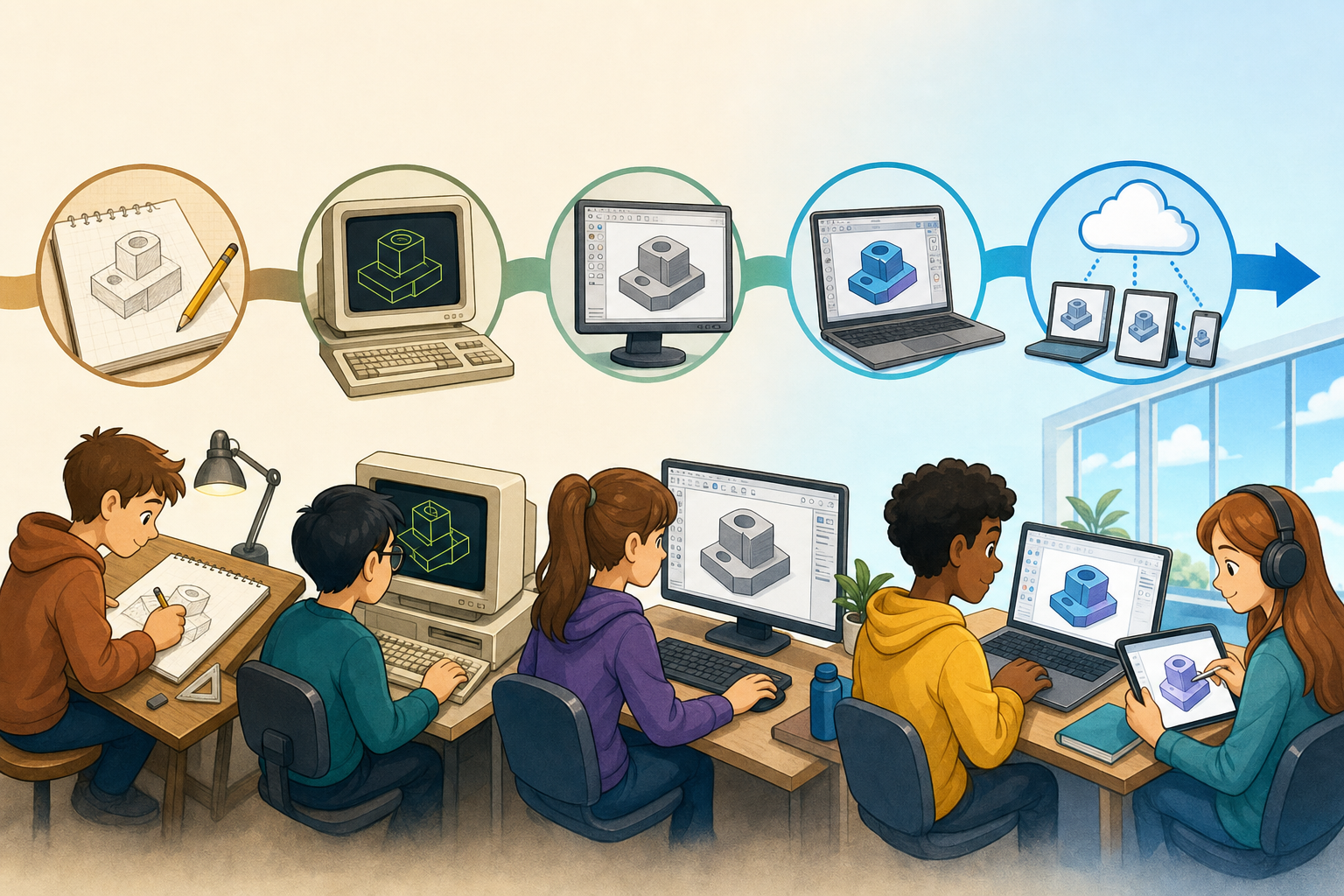
The most recent phase of educational CAD continues the historical movement from scarcity toward access. Early students waited for terminal time in specialized labs. PC-era students used scheduled computer classrooms. Later generations installed student editions on personal laptops. Today, cloud-connected and browser-based platforms reduce many of the older barriers. Autodesk Fusion 360 became influential in education because it combined solid modeling, sculpted forms, assemblies, rendering, simulation, CAM, and additive manufacturing preparation within a relatively accessible ecosystem. Onshape, founded by former SolidWorks leaders including Jon Hirschtick, John McEleney, and others, advanced a cloud-native model in which students could work through a browser, collaborate in real time, manage versions, and avoid many installation problems. SolidWorks for Students, cloud-connected BIM tools, and educational access to Revit, Civil 3D, and other platforms extended the same pattern across engineering, architecture, and construction. The change is not merely technical convenience. Cloud workflows teach students that design data is shared, versioned, continuously updated, and accessible across devices. They also blur the boundary between classroom, dorm room, makerspace, and competition workshop. Modern educational CAD shows that access remains one of the central forces in CAD history, from rare research terminals to browser-based professional modeling environments.
Students Were the Hidden Force Behind CAD Market Formation
Training, Loyalty, and the Software Habits That Follow Graduates
The history of educational CAD is also a history of long-term market formation. The system a student learns often becomes the system that feels natural, efficient, and professionally legitimate years later. This does not mean graduates never change tools, but early training creates habits: sketching conventions, feature strategies, assembly logic, drawing standards, keyboard shortcuts, file management practices, and expectations about how design information should behave. Employers then absorb these habits when they hire graduates, and software companies benefit when their platforms become embedded in curricula. Autodesk, PTC, Dassault Systèmes, Bentley Systems, Siemens, and newer firms such as Onshape’s founding company understood that classrooms were not peripheral markets. They were incubators of future standards. A university lab could influence thousands of careers across decades. A competition team could spread a platform through alumni networks. A generous student license could create familiarity that later shaped purchasing decisions inside an engineering firm or design office. For this reason, students deserve a more prominent place in CAD history. They were not just passive learners of tools created elsewhere. Through adoption, expectation, and professional carryover, students helped decide which CAD systems became culturally dominant.
Educational CAD Changed How Students Learned Design Itself
The Deeper Legacy Beyond Software Training
The most important legacy of educational CAD is not that students learned specific commands or passed software certification exams. It is that CAD changed the intellectual structure of design education. Students learned to think in constraints, features, assemblies, surfaces, versions, simulations, toolpaths, and shared data models. They learned that a drawing might be generated from a model rather than created independently. They learned that a design could be tested before fabrication, revised without starting over, and connected directly to additive manufacturing or CNC production. Architecture students learned that building information could include geometry, quantities, materials, schedules, and coordination data rather than only lines on sheets. Mechanical students learned that geometry could encode intent, motion, mass, interference, and manufacturability. Industrial design students learned that form exploration, rendering, ergonomics, and prototyping could be part of one digital continuum. From Sketchpad’s light pen to AutoCAD labs, from Pro/ENGINEER’s parametric rigor to SolidWorks student teams, from CATIA and NX enterprise workflows to Fusion 360 and Onshape in the cloud, educational CAD has repeatedly expanded what students believe design can be. Its deepest contribution is that software became a medium through which students learned to reason about design, not merely a tool they learned to operate.
Also in Design News