Your Cart is Empty


Rhino 3D Tip: Temporary Geometry for Faster Rhino Modeling
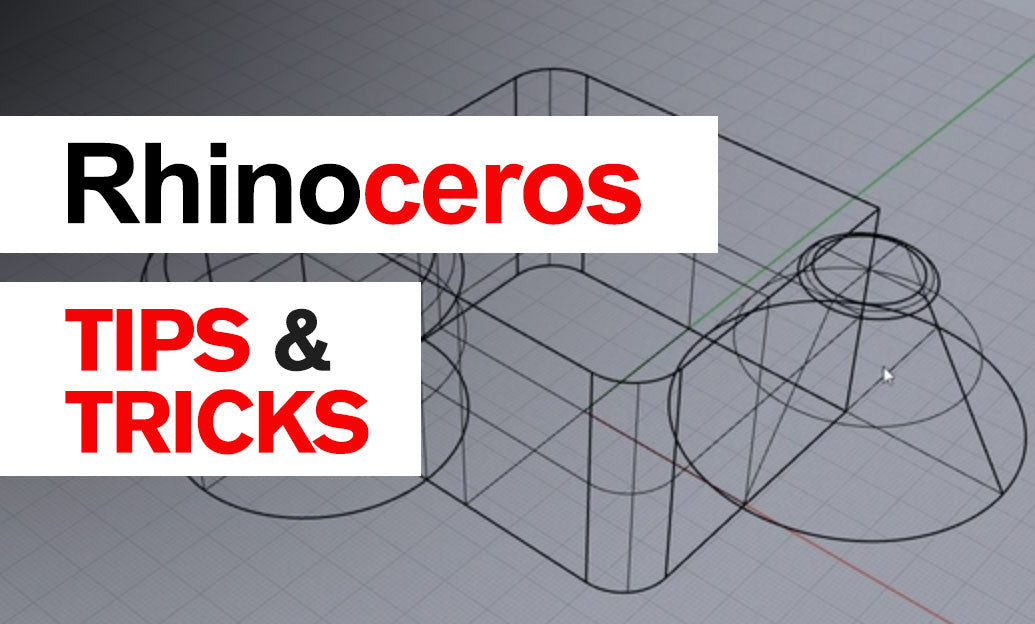

Temporary geometry is one of the fastest ways to model more accurately in Rhino without overcomplicating your file. Topic 140 is all about creating quick helper objects that guide decisions, improve snapping, and keep construction logic visible while you work. The key is to use temporary geometry intentionally, then remove or isolate it once its job is done.
In Rhino, temporary geometry can include:
- Reference lines
- Bounding rectangles
- Construction circles
- Section curves
- Centerlines
- Guide surfaces
- Simple solids used only for alignment or trimming
These objects may never appear in the final model, but they often make the difference between a slow, uncertain workflow and a clean, repeatable one.
Here are a few practical ways to use temporary geometry for speed:
- Establish proportions first: Before building complex curves or surfaces, sketch with lines, polylines, or rectangles to define width, height, offsets, and major break points. This reduces rework later.
- Build snap targets on purpose: If a key point does not exist yet, create a line or circle so Osnaps such as End, Mid, Cen, and Int have something reliable to lock onto.
- Control surface creation: Use temporary profiles and rails to test shape direction before committing to Loft, Sweep, or NetworkSrf.
- Use cutter geometry: Fast booleans and trims often depend on simple helper solids or planes created only to split or remove material.
- Check symmetry and spacing: Draw centerlines and spacing grids to verify balance before duplicating or mirroring objects.
A professional workflow usually depends on organizing temporary geometry so it helps rather than clutters. Try this:
- Place helper objects on a dedicated layer such as _TEMP or Construction
- Assign a distinct color so they are easy to identify
- Lock them when needed to prevent accidental edits
- Hide or purge them once the modeling task is complete
This approach is especially useful in architectural, industrial, and furniture workflows where alignment and proportion matter constantly. If you are exploring advanced Rhino workflows, NOVEDGE offers Rhino tools, training options, and software insights at NOVEDGE Rhino resources.
One of the biggest mistakes users make is trying to model final geometry too early. Instead of forcing a surface to solve every design intent at once, use temporary curves and construction objects to break the task into smaller, controllable decisions. For example:
- Create a bounding box before modeling a product enclosure
- Use section curves to control ergonomic transitions
- Add temporary planes to locate cut lines or panel breaks
- Draw circles and axes first when building revolved forms
Another benefit is cleaner troubleshooting. When something fails, temporary geometry can reveal why:
- Misaligned profiles become obvious
- Rail direction problems are easier to spot
- Inconsistent symmetry is easier to measure
- Offsets and clearances can be verified early
If you want to work faster in Rhino, stop thinking of temporary geometry as extra work. Think of it as lightweight scaffolding for better modeling decisions. It helps you snap faster, evaluate form sooner, and avoid rebuilding later. For Rhino users looking to sharpen everyday production workflows, NOVEDGE is a great place to explore professional software solutions and Rhino-related expertise.
Tip to remember: the fastest modelers are rarely drawing less. They are drawing smarter, and temporary geometry is one of their most effective habits.
You can find all the Rhino products on the NOVEDGE web site at this page.
Also in Design News