Your Cart is Empty


Metadata-Driven Discovery in Engineering: Knowledge Graphs, Hybrid Indexing, and Explainable Search


Why metadata-driven search and discovery matters in engineering
The problem
Engineering organizations operate across a thicket of specialized systems—CAD, PLM/PDM, CAE, CAM, MES, ERP, and test repositories—each optimized locally but rarely harmonized globally. Inside these silos, 3D geometry is richly structured yet often poorly labeled: filenames hide intent, parameters encode decisions implicitly, and drawings bury meaning in notes. The result is predictable friction. Teams reinvent parts because they cannot reliably find or trust what already exists. Duplicate variants accumulate as designers hedge against ambiguity and schedule pressure. Naming conventions drift into tribal dialects, creating islands of vocabulary such as “SS,” “Stainless,” and “AISI 304” that never reconcile. Even when a geometry looks right, it may fail due to missing PMI/GD&T nuance, incompatible tolerances, or a material lot-specific property that lives in a distant QMS.
Meanwhile, security and regulatory constraints harden organizational boundaries. ITAR controls, supplier NDAs, and program confidentiality enforce necessary partitions, but they also suppress legitimate discovery across domains that could have shared a form-fit-function equivalent safely. Engineers navigating this landscape spend disproportionate time on breadcrumb hunting and confidence building, rather than on synthesis and iteration. Worse, the cost of being wrong is high: selecting a near-duplicate that lacks a critical certificate or choosing a geometry that requires re-qualification derails schedules. A metadata-driven search foundation addresses these root causes by elevating signals—geometry signatures, PMI semantics, process history, and business lineage—into a unifying layer that cuts across tools and permissions without violating them, replacing guesswork with explainable evidence at query time.
The opportunity
When teams can reliably discover “what we already have” through a consistent metadata lens, the operating rhythm of engineering changes. The first-order win is accelerated reuse: systems that propose same-as or variant-of candidates at the moment of new-part creation stop proliferation before it starts. The second-order win is prudent selection: search results that highlight approved supplier status, stocked inventory, and proven field performance shift decisions toward lower cost and shorter lead time without compromising intent. A third-order win materializes in quality: surfacing parts whose PMI/GD&T and tolerance stacks align to requirements avoids subtle mismatches that would otherwise appear as escapes in production or service.
Crucially, the opportunity extends to responsible design. With sustainability attributes—embodied carbon, recyclability, and end-of-life pathways—entering the metadata fabric, engineers can filter pragmatically by impact rather than treating climate constraints as afterthoughts. In practice, this looks like search experiences that feel natural in engineering terms while encoding enterprise policy as defaults. Typical queries blend modalities: shape similarity from a dropped STEP model, plus constraints like envelope, mass, and yield strength, plus business filters such as “approved supplier only.” A metadata-first platform that fuses these signals transforms discovery from a tool-specific hunt into a contextual decision aid. The result is faster concept convergence, fewer late surprises, and a clearer audit trail for why a selection was made—because each ranked candidate comes with a transparent, machine-extracted rationale that engineers can trust and challenge.
Expected impact
Organizations deploying a mature, permission-aware metadata stack routinely report measurable shifts in output and risk posture within months. The first visible metric is a drop in net-new part creation as reuse pathways open up and “gatekeeper” checks become part of daily workflows. Programs accelerate not only because engineers stop drawing what already exists, but also because they avoid re-qualification and re-tooling that would have followed a redundant part. A secondary effect is the compression of DFx loops: recognizing manufacturable precedents early reduces iteration cost, while exposing lineage and ECO history lowers change risk by making dependencies explicit.
Leaders can set pragmatic targets to focus teams and secure buy-in:
- 10–30% reduction in net-new part creation within the first year of deployment, sustained as the knowledge base grows.
- Multiple weeks saved per program from avoided re-qualification, tooling, and drawing release cycles.
- Faster DFM/DFAM convergence by discovering manufacturable benchmarks and reusable process parameters.
- Reduced change risk through visibility into part lineage, usage contexts, and ECO/ECR history across assemblies.
- Improved compliance hit rate by biasing toward parts with the right certificates and regulatory fit from the start.
Beyond these near-term KPIs, the cultural impact compounds: engineers develop a reflex to search broadly and evaluate evidence, taxonomy stewards harden semantic foundations, and procurement gains earlier influence on cost and supplier choices—together turning fragmented data into a durable, reusable asset.
Designing the metadata model and pipeline
Canonical entities and relationships as a knowledge graph
The backbone of effective discovery is a knowledge graph that captures engineering reality with the right nouns, verbs, and provenance. At a minimum, represent Part, Revision, Configuration/Option, Assembly/BOM, Feature, Material, Finish/Coating, Manufacturing Process (CNC, MIM, LPBF, FFF, casting), PMI/GD&T, Tolerance Stack, Requirement, Simulation Case, Test Result, Supplier, Certificate (RoHS/REACH/UL/ITAR), Change (ECR/ECO), Nonconformance, Work Instruction, Tool/Fixture, and for additive, Build and Build Slot. These entities should be versioned with immutable IDs and mutable states, and linked by typed relationships: same-as, variant-of, supersedes, used-in, built-with, qualifies, conforms-to, measured-by, tested-in, and affected-by-change. Because engineering semantics emerge from relationships as much as attributes, modeling lineage and context is non-negotiable.
Design the topology for query intent, not just completeness. Engineers ask compositionally: “Find a bracket (Part) used-in an Assembly that conforms-to UL94 V-0, is built-with LPBF on a RenAM 500Q, and is same-as a stocked item.” That query spans graph hops and demands fast joins. Practical graph design patterns include:
- Entity normalization layers to collapse aliases and supplier-specific identifiers into canonical nodes.
- Evidence subgraphs that attach provenance to each assertion (who, when, from which system, with what extractor version).
- Lightweight feature nodes for recognized geometry features so PMI/GD&T can attach at the feature level, not just part level.
This structure turns your metadata into a navigable map where automated reasoning—like asserting variant-of with confidence—can coexist with human governance and override when required.
Core attributes and standards to standardize
Attributes are the measurable anchors that make a graph computable. Standardize geometry signals such as mass properties, envelope dimensions, key datum schemes, and a feature taxonomy (holes, threads, bosses, fillets, lattices, ribs) so that search can be both semantic and numeric. Add a robust shape signature hash for fast similarity prefiltering. For manufacturing, capture process family, machine/cell identity, parameters (layer thickness, build orientation, cutter diameter, step-over), tooling, and cycle time. Materials need grade/standard descriptors, lot/batch IDs, heat treatment, and property ranges with temperature dependencies. Quality and compliance require PMI/GD&T coverage, inspection plan linkage, certificates, and regulatory region scoping. Business data—cost, lead time, MOQ, supplier status, IP sensitivity, lifecycle state—makes results actionable. Sustainability adds embodied carbon, recyclability, toxicity flags, and EOL strategy fields.
Standards bind these attributes to portable meanings. Use STEP AP242 for geometry and PMI exchange, QIF for metrology, ISO 10303 identifiers where possible, and internal URNs for Parts/Revisions to ensure stable cross-system joins. Preserve provenance on every attribute: source system, timestamp, extractor version, and a content hash of contributing files. This allows deterministic diffs, rollback, and audit. Practical normalization techniques include:
- Unit harmonization with rigorous dimensional analysis, not just scalar conversion.
- Controlled vocabularies and curated synonym lists (e.g., “SS,” “Stainless,” “AISI 304”).
- Locale-agnostic numeric parsing and date handling to avoid silent corruption.
The payoff is a substrate where filters, vectors, and graph traversals agree on what a “thing” is and how it can be compared.
Ingestion and normalization pipeline
An effective pipeline respects the heterogeneity of engineering tools while normalizing what matters. Start with connectors for CAD (native + STEP/Parasolid), PLM/PDM, CAE results, CAM toolpaths, MES/ERP work orders, QMS certificates, and IoT telemetry from machines and fielded assets. Implement ETL/ELT stages that map schemas into your canonical model, normalize units, and apply controlled vocabularies. Design for event-driven refresh via PLM webhooks and MES/ERP signals so changes propagate incrementally. For geometry, use incremental diffs where possible: if only a fillet radius changed, avoid reprocessing mesh embeddings for the entire assembly; update affected shape signature segments and PMI hints atomically.
Reliability is a feature. Package extractors with versioned, deterministic behavior and log every assertion as a tuple of (value, units, context, provenance). Build backpressure-aware queues so bursty design releases don’t starve realtime searches. A few pragmatic patterns accelerate time-to-value:
- Bootstrap with “good enough” metadata from STEP and PDFs, then backfill richer CAD-native features as connectors mature.
- Auto-generate thumbnails and lightweight meshes to power visual search and result previews without CAD seats.
- Expose ingestion health dashboards—coverage of key fields, extractor error rates, and stale metadata alerts—so teams can govern quality actively.
Lastly, lean into schema evolution. Engineering vocabularies change; your pipeline should support additive extensions and aliasing to protect historical queries while enabling new attributes to become first-class citizens.
Enrichment, de-duplication, indexing, and access control
Raw ingestion is table stakes; value emerges from enrichment and precise control. Apply automated feature recognition, BOM parsing, and PMI/GD&T extraction to lift semantics from files into structured tags. Use OCR/NLP on drawings to capture notes and specs that designers still rely on. For duplicate detection and shape search, compute geometry signatures with a mix of techniques—Light Field Descriptor, D2 shape distributions, Extended Gaussian Images, ShapeDNA (Laplace–Beltrami eigenvalues), and learned point-cloud or mesh embeddings—so robustness holds across resolution and file noise. Fuse these with text signals (names, notes) and image thumbnails into a unified multi-modal vector embedding that supports nuanced similarity.
De-duplication is a probabilistic endeavor; implement canonicalization that performs fuzzy matching across names, suppliers, and geometry, and asserts same-as/variant-of with confidence scores, routed to human review for edge cases. Indexing should be hybrid: an inverted index for keywords/filters, a vector index for semantic and multi-modal search, and a graph index for lineage and relationship traversals. Make permission-aware search the default: row- and field-level ACLs inherited from PLM guard sensitive data, with secure-by-default result filtering. Performance patterns include stateless APIs, batched re-ranking, approximate nearest-neighbor search for vectors, and caches for thumbnails and lightweight previews. Together, these elements convert heterogeneous data into fast, explainable answers that respect security boundaries while maximizing discoverability for those entitled to see it.
Search and discovery patterns that engineers actually use
Query modalities
Engineers search in the language of intent, constraints, and precedent. A capable system embraces multiple modalities natively. Text queries capture shorthand like “M6 x 1 stainless SHCS,” “IP67 enclosure, UL94 V-0,” or “LPBF Ti-6Al-4V bracket, 200 mm envelope,” where domain jargon and standards are signals, not noise. Shape search lets users drop a STEP/STL or even paste a screenshot to retrieve geometrically similar candidates, with PMI-aware scoring that understands a countersunk hole with M6 x 1 threads is not equivalent to a clearance hole. Constraint search translates design guards into filters: envelope < 120x80x20 mm, mass < 80 g, yield > 400 MPa, flatness ≤ 0.05 mm, surface Ra ≤ 1.6 μm—using normalized units and tolerance semantics. Process-aware filters enable practical selection: additive vs subtractive, machine availability, build orientation constraints, support-free candidates for AM, or cutter reachability for 5-axis milling. Lifecycle and business filters round out decision drivers: approved supplier only, lead time < 10 days, cost < $15, carbon < 5 kg CO2e.
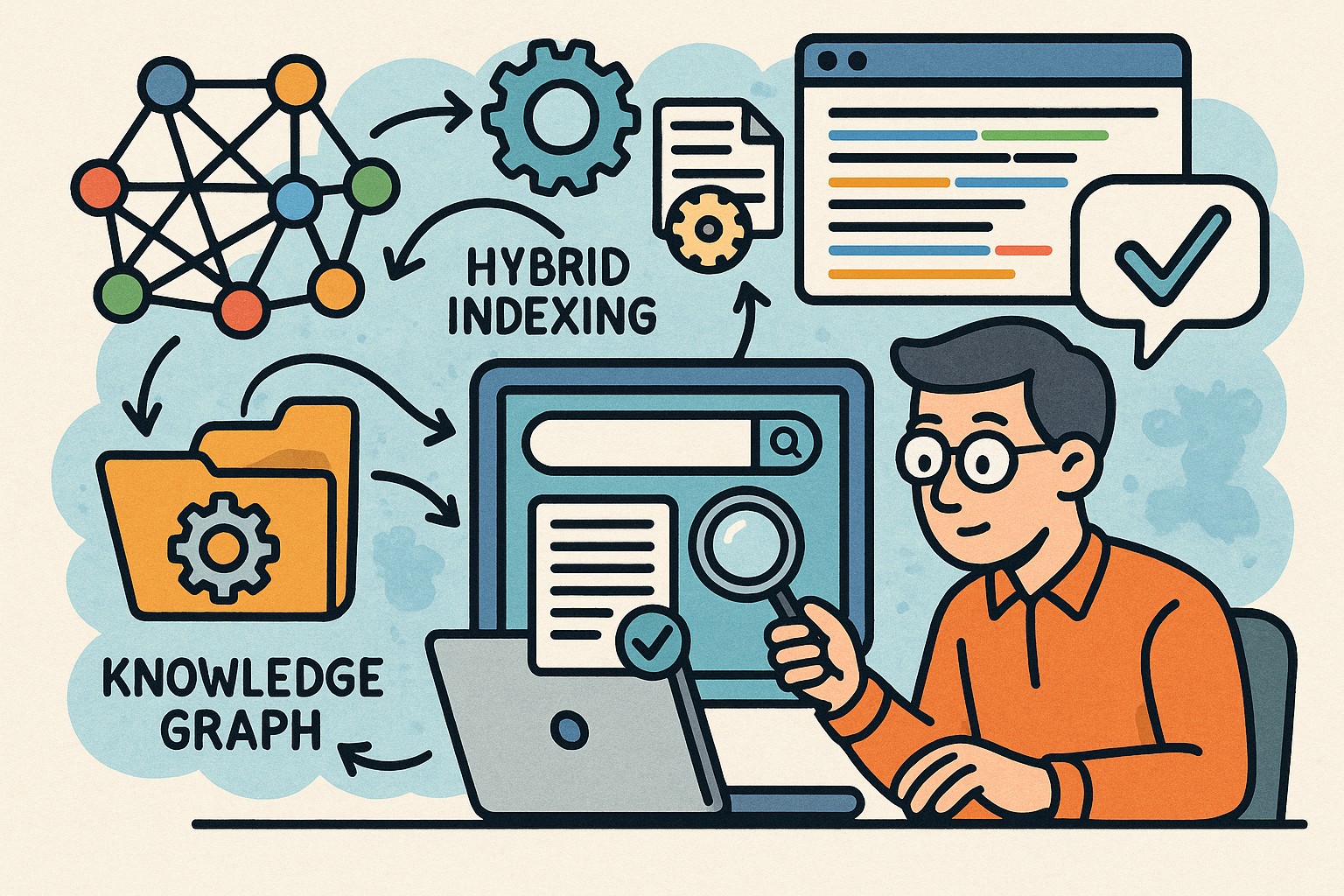
Behind the scenes, a hybrid index orchestrates these modalities. A vector search narrows candidates by semantic match and shape signature proximity; an inverted index enforces exact filters and token matches; a graph hop checks lineage, certificates, and usage contexts. Usability hinges on speed and clarity: instant previews, PMI overlays on thumbnails, and one-click comparison of feature diffs encourage exploration. The system feels like a seasoned colleague: fast with suggestions, explicit about assumptions, and always ready to justify why a candidate is on the list.
Ranking signals and explainability
Ranking in engineering discovery is not a popularity contest; it’s a multi-objective optimization shaped by risk, manufacturability, and business constraints. Useful signals include reuse frequency across programs, field failure rate, manufacturability scores tailored to process families, lead time and cost curves, sustainability impact, regulatory fit, proximity of PMI/GD&T callouts to the query requirements, and geometric similarity confidence. The art lies in blending these signals per persona and intent: a concept engineer may prioritize speed and manufacturability precedent; a sustaining engineer may weight field performance and ECO stability; a compliance manager may bias toward certificate coverage and regulatory region fit.
Explainability converts a plausible ranking into a trusted decision aid. Present concise, evidence-backed reasons like “Shared 87% shape signature; identical M6 x 1 thread + countersink; same flatness callout; stocked at Supplier A; RoHS and REACH certificates current through Q4.” Offer toggles to see which signals dominated the score and links to provenance: the STEP file hash, the QIF inspection plan that verified flatness, the ECO that last changed the tolerance. Useful patterns include:
- Score breakdowns with per-signal contributions and clear units.
- Diff views that align PMI and detected features side-by-side to visualize equivalence and deviation.
- Policy badges that declare “Approved supplier,” “ITAR-restricted,” or “Lifecycle: Obsolete” up front.
By treating ranking and explanation as first-class citizens, you reduce second-guessing, speed up selection, and create audit-ready trails for why a choice was made at the time it mattered.
Embedded workflows
Discovery is only valuable if it intercepts decisions where they happen. Embed a “New part” gatekeeper inside CAD save actions or PLM creation dialogs to suggest same-as/variant-of alternatives proactively. In DFx sidebars, surface closest manufacturable precedents with their process parameters, and for AM, recommend build templates—lattice cell types, orientations, scan strategies—derived from successful builds. Compliance audits become queryable rituals: “Show all parts touching a regulated substance,” “Highlight items missing UL certificates,” or “Assemble an evidence pack” with links to QIF results and supplier attestations. Field service benefits from image-to-part lookup: a mobile photo triggers a multi-modal search to reveal form-fit-function compatible replacements, availability, and approved alternates. At program kickoff, curate starter libraries per domain—fasteners, seals, electrical, brackets—with policy-backed defaults so teams start from parts that are qualified, stocked, and sustainable.
Every embedded touchpoint should return explainable, permission-respecting answers in under a second for common cases. Useful design patterns include:
- Inline comparisons that let users accept a recommended part and auto-populate references, eliminating clerical rework.
- “Why not” hints that show what prevented a candidate from ranking higher (e.g., expired certificate, carbon above policy threshold).
- Soft locks that require a justification to create a new part when viable reuse exists, feeding governance analytics.
The outcome is a culture where search is not a separate step but a continuous assistant, lowering cognitive load while tightening alignment with enterprise standards.
Feedback loops and governance
The best discovery systems learn from use. Capture click-throughs, time-to-selection, reuse outcomes, and explicit thumbs-up/down to fuel relevance tuning. Active learning models can query users selectively—“Is this variant acceptable for your application?”—to refine thresholds for geometric similarity and PMI criticality. Taxonomy stewardship is equally important: domain owners manage controlled vocabularies, merge synonyms, deprecate legacy terms, and approve high-impact ontology changes. Offer self-service tools with guardrails: propose a new attribute, preview its impact on existing queries, and run backfills in a shadow index before promotion. Data quality dashboards highlight coverage gaps for key fields, stale metadata, and suspicious anomalies (e.g., parts with zero mass or negative lead times), while security audits flag overexposed attributes and ACL drift.
Governance should be pragmatic and iterative. Establish lightweight review boards that meet on a cadence to adjudicate same-as/variant-of assertions, approve new standards mappings, and adjust ranking weights in response to outcome metrics. Encourage teams to define “definition of done” checklists that include metadata hygiene: PMI coverage thresholds, certificate links, sustainability fields populated. Over time, this feedback loop converts ad-hoc institutional knowledge into durable, machine-readable signals. The payoff is compounding: better metadata begets better search, which drives more reuse and more feedback, closing a virtuous cycle anchored in metadata-driven search and explainable evidence.
Conclusion
Turning metadata into a reusable asset
Metadata-driven discovery is not an accessory; it’s a force multiplier that turns fragmented engineering data into a reusable enterprise asset. When geometry, PMI/GD&T, process histories, material pedigrees, and business constraints are harmonized and searchable, teams create fewer duplicates, converge designs faster, and reduce compliance risk. Engineers benefit from confident selection—finding “same-as” or “variant-of” candidates that are qualified, stocked, and well-understood. Operations see lead times and costs drop as tooling and re-qualification cycles shrink. Quality and safety improve when search rankings prefer parts with proven field performance, validated inspection plans, and valid certificates. Sustainability stops being an afterthought when embodied carbon and recyclability become first-class filters that shape choices automatically.
The strategic shift is cultural as much as technical. Discovery becomes part of the design reflex; provenance and explainability become social contracts that bind decisions to evidence. By centering on a robust knowledge graph, hybrid indexing, and permission-aware access, organizations align autonomy with governance. The outcome is a system that is hard to game, easy to trust, and continuously improving. In short, metadata transforms engineering data from an archive of past work into a living, navigable memory—one that helps every new program start smarter and finish safer.
Start small, iterate fast
Momentum comes from focus. Pilot on a single product line where reuse potential and risk are both high. Seed the model with 10–15 high-leverage fields—shape signature, PMI coverage, material, process, supplier, cost, lead time—and wire up PLM event hooks so metadata stays fresh. Embed a “prevent proliferation” check at new-part creation to intercept duplicates at the door. Build thin-slice experiences first: a CAD sidebar that shows top-5 reuse candidates with explanations; a PLM widget that flags certificate gaps; a procurement view that filters by approved suppliers and carbon thresholds. Instrument everything. Measure KPIs that matter to decision makers: new-part rate, average search-to-reuse time, lead-time and cost savings, compliance closure time, and CO2e per assembly.
Iterate weekly. Add connectors and attributes in ranked order of impact; refine synonym lists; tune ranking weights with user feedback. Use staged environments—shadow indexes and A/B re-rankers—to validate improvements before promoting them to production. Treat ontology changes like code: review, test, and version. Most importantly, narrate the wins: share stories where a risky re-qualification was avoided or a DFAM path emerged from a discovered precedent. These early, concrete outcomes unlock sponsorship to expand scope methodically.
Build for trust and scale
Trust is earned through transparency, security, and consistent performance. Preserve provenance on every attribute and relationship: log source system, timestamps, extractor versions, and content hashes so any result can be traced and reproduced. Enforce permission-aware search: propagate PLM ACLs to row and field levels, default to least privilege, and make entitlement checks cheap in the hot path. Provide transparent match explanations so users understand why candidates rank and how to challenge them. Architect for growth with a hybrid stack: a graph database for lineage and relational queries, a vector index for multi-modal similarity, and an inverted index for exact filters and facets. Decouple ingestion from serving via streaming pipelines and idempotent upserts to handle bursts without degrading query latency.
Operational excellence matters. Monitor index freshness, tail latencies, and error budgets; precompute popular clusters (e.g., fasteners) for instant response; cache thumbnails and PMI overlays. Bake in disaster recovery for your knowledge graph and embeddings store. Finally, codify governance: lightweight review cadences, clear ownership for taxonomies, and auditable change logs. Scaling discovery safely is not just about handling more data; it is about increasing the surface area of trust without increasing the surface area of risk.
Looking ahead
The frontier of engineering discovery is collaborative and privacy-preserving. Expect federated learning across suppliers and partners, where relevance models improve without sharing raw IP: embeddings and gradients move, CAD never does. Deeper standards alignment will matter: richer STEP AP242 PMI maturity, QIF 3.0 adoption for metrology, and tighter links between simulation standards and manufacturing execution. Multi-modal representations will grow more expressive, blending text, geometry, imagery, and even process telemetry into embeddings that understand how a part is made, not just what it looks like. Governance will remain a living practice as regulations expand—think critical mineral traceability and AI transparency requirements. Continuous stewardship ensures ontologies evolve with products, processes, and policies, keeping discovery accurate, fair, and explainable.
In that future, the organizations that win will be those that treat metadata-driven search as core infrastructure, not a project. They will design for evidence and permission from day one, measure outcomes rather than activity, and embed discovery where decisions happen. When every engineer can ask a precise, multi-modal question and get a fast, justified, and secure answer, innovation compounds—because the path from insight to implementation is no longer blocked by the dark matter of unfindable knowledge.
Also in Design News