Your Cart is Empty


Intelligent Templates in Design Software: Capturing and Reusing Engineering Knowledge
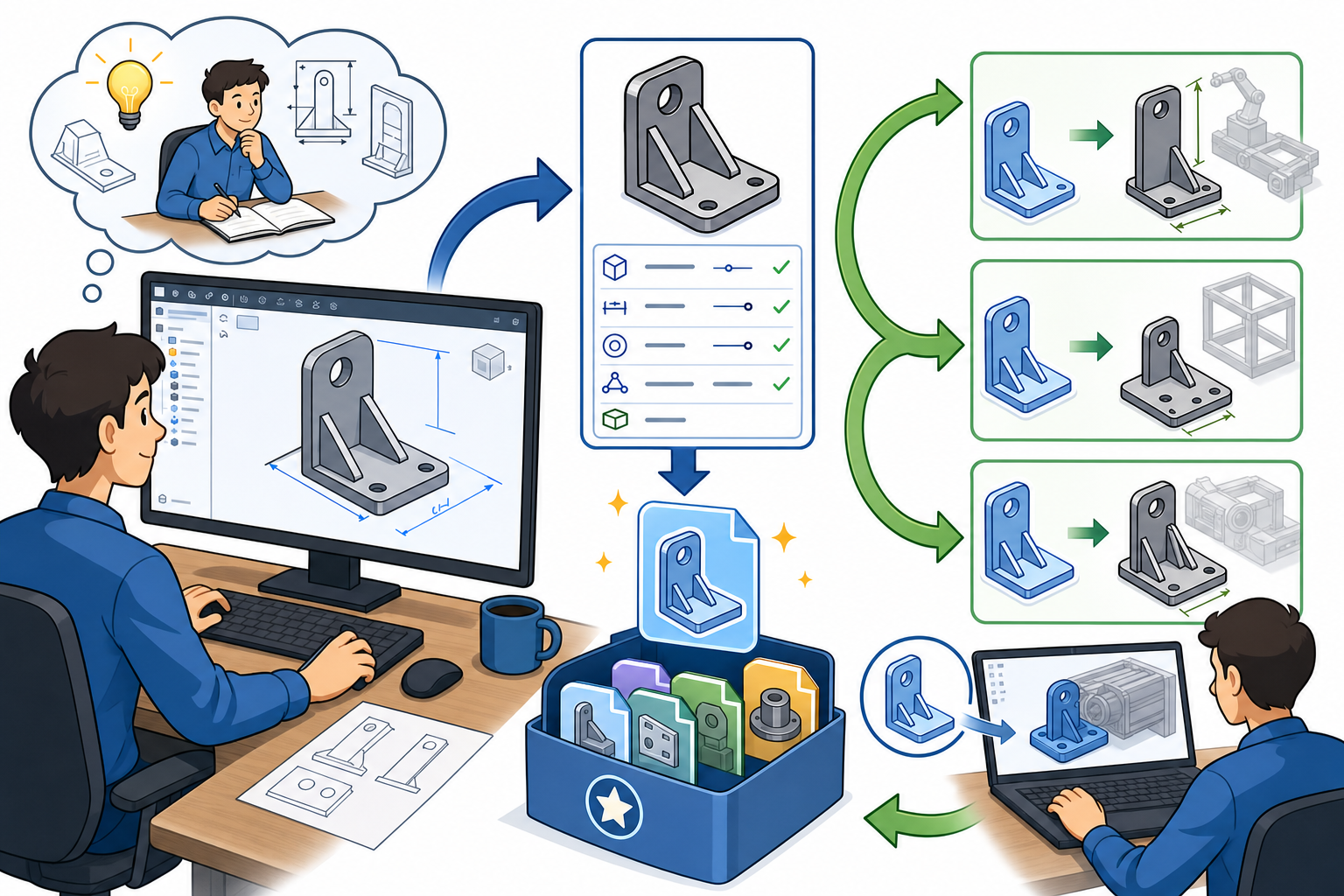


Modern design teams operate in software ecosystems that are more capable than ever, yet many organizations still lose critical engineering knowledge between one project and the next. Models may be geometrically precise, visually rich, and manufacturable, but the reasoning behind them often remains hidden inside the minds of a few experienced specialists. This creates friction across CAD, BIM, visualization, and additive workflows, where speed increasingly depends not just on modeling skill but on the ability to encode and reuse proven decisions. In that context, intelligent templates are becoming far more than productivity shortcuts. They are emerging as structured containers for rules, standards, manufacturing intelligence, and design intent that can be reused across teams, products, and delivery cycles.
Why Design Knowledge Gets Lost in Modern CAD Environments
Contemporary CAD environments are exceptionally strong at capturing geometry, relationships, dimensions, and documentation outputs, yet they are relatively weak at preserving the full context of why a design was built a certain way. A parametric model may contain constraints and features, but those elements do not automatically explain the tradeoffs behind wall thickness selections, fastener spacing, draft angles, room module sizes, or assembly sequencing. As a result, organizations frequently confuse stored geometry with stored knowledge. The file survives, but the expertise that shaped it often does not. This issue becomes more severe when product complexity grows and when design responsibility is distributed across mechanical engineers, industrial designers, analysts, architects, fabrication specialists, and visualization teams using different software platforms and different levels of technical maturity.
The Gap Between Experts and the Wider Team
Within many engineering organizations, a small number of expert modelers become informal custodians of modeling strategy, naming conventions, family logic, feature ordering, and manufacturability judgment. They know when a skeleton model should drive an assembly, when a feature should remain flexible, when a BIM object needs type versus instance parameters, or when a topology should avoid downstream meshing problems. However, much of that expertise is rarely formalized in a reusable structure. Less experienced team members may inherit files without understanding which dimensions are safe to change, which constraints are essential, or which assumptions were tied to tooling, procurement, code compliance, or product performance. The consequence is that teams often spend time recreating decisions that were already solved once, but never encoded in a form that others can reliably apply.
Undocumented Decisions and Their Operational Cost
The hidden cost of undocumented design decisions appears in rework, inconsistency, and schedule drag. When a team cannot tell whether a rib pattern exists for stiffness, mold flow, weight reduction, or assembly clearance, modifications become risky. Engineers either change too little, preserving inefficiencies because they are afraid of breaking intent, or they change too much and create downstream failures in simulation, detailing, procurement, or fabrication. Similar problems occur in architecture when room types are copied without embedded code awareness, and in product visualization when material setups are duplicated without preserving physically plausible values. What begins as a small documentation gap quickly becomes a compounding productivity problem, affecting revision loops, quality checks, data handoffs, and approval cycles across the enterprise.
The Failure of Static Knowledge Containers
Many organizations try to solve this problem through static templates, standards manuals, PDF modeling guidelines, spreadsheet-driven part libraries, and a reliance on mentorship. These tools remain useful, but they are limited because they separate instruction from execution. A standards manual may explain preferred fillet sizes or drawing conventions, but it does not actively prevent a user from violating them. A legacy template may provide a starting model, but if it contains no embedded logic, it quickly drifts from the conditions it was intended to standardize. Tribal knowledge is even less reliable. It tends to accumulate around senior staff, internal habits, and undocumented exceptions, which means it is difficult to search, validate, scale, or audit. In fast-moving development environments, such static systems cannot keep pace with new materials, manufacturing methods, regulatory requirements, and software integration pathways.
Why Intelligent Templates Are Becoming Strategic
This is why intelligent templates are emerging as a strategic layer in design software rather than a convenience feature. Instead of merely supplying default views, title blocks, or starter geometry, intelligent templates capture recurring design logic in a form the software can enforce, adapt, and propagate. They help bridge the gap between expert judgment and repeatable execution by packaging best practices inside parts, assemblies, BIM families, generative setups, rendering scenes, and additive manufacturing presets. When built well, they reduce the exposure of projects to individual memory, make standards operational instead of advisory, and give organizations a way to preserve expertise across personnel changes, geographic distribution, and accelerated product cycles. In effect, they turn institutional know-how into reusable digital infrastructure.
What Makes a Template Intelligent in Advanced Design Workflows
A template becomes intelligent when it does more than save time at the start of a task. The defining characteristic is that it actively carries design intent, governs acceptable variation, and links geometric behavior to real-world requirements. In advanced workflows, this intelligence is expressed through parameter structures, conditional logic, rule-based constraints, metadata schemas, and connections to manufacturing, compliance, and enterprise systems. The template is no longer just a shell. It behaves like a curated system of decisions that helps users produce valid outcomes faster and with fewer opportunities for error. This matters because modern design speed does not come from drawing faster alone; it comes from reducing the need to repeatedly interpret standards, recalculate common decisions, and manually coordinate changes between related design domains.
Embedding Rules, Constraints, and Parameters
The first layer of intelligence is the embedding of rules, constraints, and key parameters directly into reusable assets. In mechanical design, for example, a configurable bracket template might limit hole diameters to approved tooling sizes, constrain flange length based on bend allowances, and preserve minimum edge distances required for structural and manufacturing reliability. In architecture, a room family template might control clearances, fixture spacing, and accessibility dimensions while exposing only the parameters that users are expected to change. In both situations, the template narrows the design space to options that remain technically acceptable. This approach reduces interpretation burden on the user and makes outputs more dependable. It also changes the role of the model from being a passive artifact to being a guided decision environment.
Linking Geometry to Materials, Manufacturing, and Compliance
A more advanced level of intelligence appears when templates connect geometry with material choices, fabrication constraints, and compliance requirements. A molded enclosure template, for instance, can link wall thickness ranges to selected polymers, trigger draft recommendations, and adjust rib proportions to reflect process-specific guidelines. An additive manufacturing template can tie lattice density, overhang thresholds, support strategies, and orientation suggestions to the chosen printer and material. In architectural workflows, facade components can carry fire-rating attributes, thermal values, code classifications, and installation tolerances alongside the geometric model. These relationships are powerful because they make the template act as a compact system of coordinated engineering assumptions rather than as a purely geometric precedent. That reduces the chance that a model looks correct while silently violating manufacturing or regulatory realities.
Automation That Preserves Standards Across Variants
Automation is another essential ingredient. Intelligent templates support the rapid generation of variants while preserving core engineering standards. This is especially important in configurable product lines where dimensions, capacities, finishes, or mounting conditions change frequently, but quality rules should not. Instead of rebuilding each variant manually, users can drive a template through parameter sets, design tables, configuration logic, or scripted interfaces. The resulting variants inherit approved feature strategies, documentation conventions, naming structures, and downstream compatibility assumptions. This allows companies to scale product diversity without increasing design chaos. The goal is not unrestricted flexibility. The goal is controlled flexibility, where automation enables variation only within boundaries that the organization has already validated.
Metadata, Feature Logic, and API-Driven Customization
What truly separates high-value template systems from simple reusable files is their use of metadata, feature logic, and API-driven extensibility. Metadata gives templates organizational memory: part classification, supplier references, approved materials, cost codes, revision behavior, performance targets, print profiles, or rendering tags. Feature logic determines how geometry behaves when conditions change, such as suppressing reinforcement features below certain loads or swapping connection details based on structural type. APIs then extend this framework by allowing templates to query external data, generate options from product configurators, validate inputs against compliance rules, or push outputs into PLM, ERP, CAM, simulation, rendering, and documentation systems. In this sense, the intelligent template becomes a software-mediated bridge between design intent and the broader digital thread. It is not just a reusable beginning; it is an active participant in an integrated workflow.
Practical Applications and Business Impact Across Design Disciplines
The strongest argument for intelligent templates is not theoretical elegance but their practical effect across very different design disciplines. While the implementation details vary between CAD, BIM, additive software, and visualization platforms, the core pattern remains consistent: encode repeated expertise in reusable structures, expose the right variables, constrain the risky ones, and align outputs with downstream production needs. Once organizations adopt this approach, they discover that templates are no longer limited to repetitive components. They become scalable mechanisms for standardizing decision quality, speeding up variation, and stabilizing multidisciplinary collaboration. Their impact is especially visible in domains where teams repeatedly solve similar problems under changing dimensions, materials, regulations, or presentation requirements.
Mechanical Design and Configurable Engineering Assets
In mechanical design, intelligent templates are highly effective for standard parts, assemblies, and configurable product platforms. Consider a sheet metal door assembly used across several equipment sizes. A traditional template might offer a starter model, but an intelligent one can encode bend deductions, hinge placement logic, latch clearances, fastener standards, panel reinforcement criteria, and even manufacturing notes tied to thickness and material selection. The user can then generate multiple door sizes while preserving structural and fabrication intent. Similar strategies apply to frame systems, mounting brackets, hydraulic manifolds, cable routing modules, and machine guards. The template becomes a repeatable engineering asset that accelerates variation while maintaining disciplined feature structure and documentation quality.
Architecture, BIM, and Code-Aware Components
Architecture and BIM workflows benefit in equally significant ways. Reusable room types, facade systems, bathroom pods, stair cores, and furniture families often appear to be ideal candidates for copying, yet uncontrolled copying can spread errors rapidly. An intelligent BIM template can do much more than preload geometry. It can include occupancy assumptions, clearance rules, specification parameters, code-related classifications, energy performance properties, view controls, tagging behavior, and schedule-ready metadata. A facade panel family, for example, may allow variation in module width and finish while preserving anchor spacing constraints, fire-stopping requirements, and thermal assembly definitions. In this context, intelligent templates improve not only modeling speed but also the integrity of schedules, documentation sets, coordination views, and quantity extraction outputs that rely on consistent object intelligence.
Additive Manufacturing Templates for Print-Ready Decisions
Additive manufacturing is an especially compelling environment for this approach because success depends on many interacting decisions that are easy to overlook in a purely geometric workflow. Intelligent templates can encode print orientation preferences, minimum wall thickness values, overhang limits, recommended support strategies, anisotropic strength assumptions, hole compensation factors, shrink allowances, and post-processing notes. For example, a reusable fixture template for powder bed fusion might expose clamping dimensions and contact surfaces to the designer while preserving validated wall rules, escape-hole placement, powder removal logic, and machine envelope checks. This decreases the risk that a nominally acceptable model becomes unprintable, fragile, or unnecessarily expensive. As additive moves from prototyping into production, these encoded rules become a practical way to make process-specific expertise consistently available to non-specialists.
Product Visualization and Review Efficiency
Product visualization teams also gain substantial value from intelligent templates, even though their work is often viewed as downstream from engineering. Reusable scene, material, lighting, and camera setups can be configured so that new products inherit approved visual standards without requiring artists to rebuild presentation conditions for every review. Material templates may include physically based parameter ranges, naming standards, texture resolution rules, and links to approved finish libraries. Scene templates can encode camera focal lengths, turntable motions, HDRI environments, shadow softness, and annotation overlays tailored for stakeholder review. This does not merely save rendering time. It improves consistency in how products are evaluated, reducing confusion caused by changing lighting conditions, unrealistic materials, or uncalibrated scenes. Better visual consistency leads to clearer design discussions and faster alignment between engineering, marketing, procurement, and leadership teams.
Core Business Benefits of Template Intelligence
Across these disciplines, the business impact of intelligent templates is broad and measurable because the same mechanisms that speed up model creation also reduce variation in process quality. The most important benefits typically include:
- Reduced modeling time by eliminating repetitive setup work and by generating validated variants from pre-encoded rules.
- Better design consistency because naming conventions, parameters, manufacturing logic, and compliance requirements are embedded rather than left to interpretation.
- Faster onboarding for new team members since templates guide acceptable changes and expose the intended control points of a model or component.
- More reliable downstream manufacturing and documentation outputs through stronger alignment between geometry, metadata, bills of materials, drawings, schedules, CAM preparation, and print preparation.
- Lower dependence on a few expert users for routine execution, freeing specialists to focus on genuinely novel engineering challenges.
- Improved auditability of design decisions because standards become visible in the structure of the template rather than hidden in personal habits.
Implementation Realities and Organizational Maturity
However, the full business value is realized only when templates are treated as living systems rather than one-time setup files. They require governance, versioning, ownership, feedback loops, and periodic alignment with manufacturing capabilities, code changes, supplier revisions, and new software features. A weakly maintained template library can become another form of technical debt. A strong one becomes a strategic asset. The organizations that benefit most are usually those that establish curation practices around template quality, user permissions, release cycles, and performance metrics. They evaluate not only whether a template exists, but whether it prevents errors, accelerates reviews, improves data consistency, and increases confidence in downstream execution. That mindset is what elevates template work from administrative support to a core component of digital design operations.
Conclusion
Intelligent templates are evolving from simple time-saving conveniences into robust platforms for capturing and distributing institutional expertise. Their significance lies in the fact that they make design knowledge reusable, scalable, and less dependent on individual experts who happen to know how a model should behave. In environments where products, buildings, and visual assets are becoming more complex while timelines become shorter, that capability is strategically important. By embedding rules, constraints, metadata, and process-aware logic into reusable design assets, organizations create a practical mechanism for preserving quality while still enabling speed. The result is not only faster modeling, but more disciplined variation, more reliable outputs, and a stronger foundation for collaboration across engineering, manufacturing, architecture, and visualization teams.
The Strategic Direction of Connected Design Systems
As CAD, BIM, rendering, simulation, PLM, and additive manufacturing software become more interconnected, intelligent templates will likely become one of the primary mechanisms for building resilient digital workflows. They sit at a productive intersection between human expertise and software automation, turning recurrent decisions into reusable operational logic. Organizations that invest in template intelligence can improve development speed without sacrificing manufacturability, documentation quality, or compliance confidence. More importantly, they create a design environment where knowledge survives personnel turnover, scales across teams, and remains enforceable as complexity grows. That is the deeper promise of the intelligent template: not merely faster starts, but a more durable and intelligent design process from concept to delivery.
Also in Design News