Your Cart is Empty


Geometry Kernels: The Hidden Foundation of Modern CAD Performance
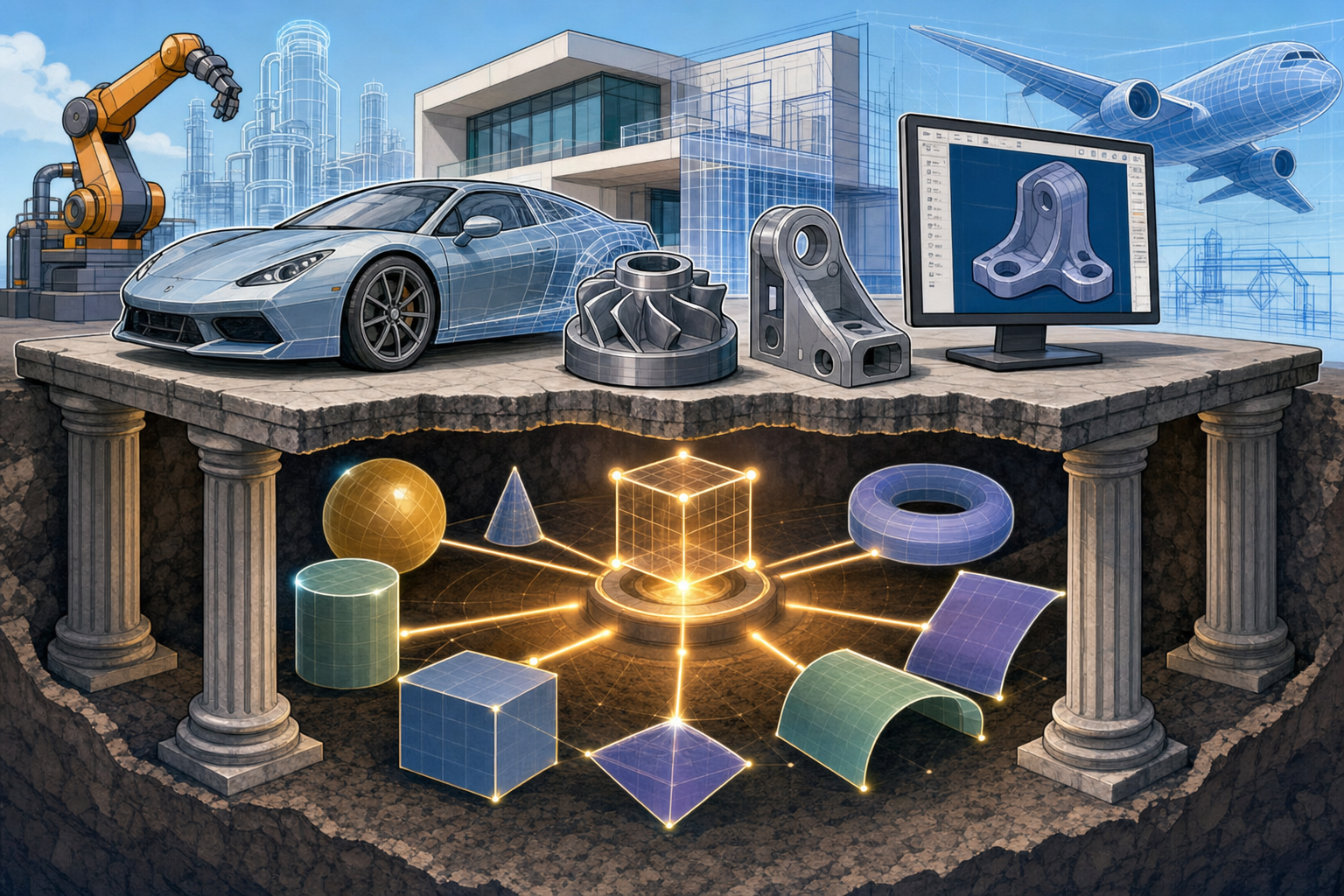


The Kernel Is the Mathematical Core Beneath Every CAD Decision
From visible shapes to computable geometry
Modern CAD performance is often judged by how quickly a model rotates on screen, how smoothly shaded surfaces appear, or how responsive the viewport feels while zooming into a dense assembly. Those qualities matter, but they represent only the visible layer of the system. Beneath the interface is the geometry kernel, the mathematical engine responsible for defining, calculating, validating, and updating the actual design. It is the part of the software that decides whether a solid is truly closed, whether two surfaces intersect correctly, whether a fillet can propagate across a chain of edges, and whether a shell operation produces manufacturable geometry instead of a broken body. In practical terms, the kernel is where design intent becomes computational reality. It manages solid and surface modeling, Boolean operations, offsets, blends, intersections, topology, and the persistent relationships between edges, faces, bodies, components, and assemblies. Without a robust kernel, even the most elegant interface becomes a fragile wrapper around unreliable geometry.
Why mathematical reliability is more important than visual speed
The kernel defines CAD behavior at a deeper level than graphics acceleration because it determines whether the model can survive change. A viewport may remain fluid because the graphics system is displaying cached tessellations, lightweight representations, or GPU-optimized meshes, yet the model may still struggle when a feature is edited, a face is offset, or an imported STEP file is repaired. This distinction is critical for engineering and design teams. A system can appear responsive during navigation while becoming slow or unstable during rebuilds, model healing, interference checks, mass property calculations, or simulation preparation. True performance is therefore not just about frames per second; it is about how efficiently the CAD platform computes and maintains valid geometric relationships. The real test appears when a design changes late in development, when hundreds of dependent features must update, or when a complex assembly must be analyzed without hours of cleanup. In those moments, the kernel is no longer hidden technology. It becomes the practical limit of productivity.
- Viewport speed affects how quickly users inspect geometry.
- Kernel speed affects how reliably users create, edit, validate, and reuse geometry.
- Graphics performance improves perception; kernel performance improves design confidence.
- A fast interface cannot compensate for fragile Boolean operations, unstable topology, or failed rebuilds.
Legacy Kernels Are Being Pressured by New Forms of Design Complexity
Design geometry is no longer limited to clean mechanical solids
Traditional CAD kernels were developed in an era when most production geometry consisted of precise prismatic parts, conventional machined features, well-defined assemblies, and surfaces that could be represented through relatively predictable mathematical structures. That world still exists, but it is no longer the full design environment. Today, CAD systems must handle massive machinery assemblies, architectural freeform envelopes, topology-optimized brackets, scanned organic parts, medical implants derived from anatomical data, consumer products shaped by subdivision surfaces, and additive manufacturing components filled with lattices or internal flow channels. These new geometries expose weaknesses in older modeling foundations, particularly when operations require repeated offsetting, trimming, face merging, or tolerance reconciliation. A legacy kernel may be able to calculate a simple rectangular pocket with ease, yet fail when asked to blend a complex transition across hundreds of uneven edges. The pressure is not simply about larger file sizes; it is about the increasing mathematical diversity of design information entering the CAD workspace.
Modern workflows demand deeper geometric intelligence
The most demanding geometry now often comes from processes that did not dominate earlier CAD development. Generative design can create branching forms with variable thicknesses and thousands of small transitions. Additive manufacturing enables porous structures, graded infills, conformal cooling channels, and components whose internal geometry may be as important as the external skin. Reverse engineering introduces scanned meshes full of holes, non-uniform density, overlapping triangles, and ambiguous surfaces. Cloud collaboration introduces another layer of complexity because multiple users may be editing related parts, reviewing assemblies, or triggering updates from different locations. Each of these workflows requires more than conventional solid modeling. They require a kernel that can interpret imperfect data, maintain design intent across hybrid representations, and update geometry without forcing users into constant manual repair. The next breakthrough in CAD may therefore come less from a new toolbar or modeling command and more from deeper geometric intelligence hidden beneath the workspace.
- Larger assemblies increase the need for smarter dependency management and partial loading.
- Freeform surfaces demand more stable trimming, blending, and intersection algorithms.
- Additive parts require support for lattices, internal structures, and non-traditional material distributions.
- Generative outputs require geometry simplification, conversion, validation, and manufacturability checks.
- Collaborative design requires kernels capable of resolving changes without corrupting model history.
Next-Generation Kernels Are Built Around Robustness, Parallelism, and Hybrid Geometry
Robust tolerance handling is becoming a core requirement
A defining feature of next-generation geometry kernels is improved tolerance robustness. In ideal mathematical space, surfaces meet perfectly, edges resolve cleanly, and solids close without ambiguity. In industrial reality, imported geometry often contains tiny gaps, overlapping faces, misaligned vertices, sliver surfaces, inconsistent units, and tolerance mismatches inherited from translation between CAD systems. Older kernels frequently treat these imperfections as user problems, requiring designers to spend hours stitching surfaces, deleting faces, extending boundaries, and rebuilding features. Newer kernels are expected to do more of this work automatically. They must recognize when two nearly coincident edges should be treated as connected, when a small gap can be healed without changing design intent, and when a non-manifold condition requires explicit user intervention. This does not mean the kernel ignores accuracy; it means it manages uncertainty intelligently. The best systems preserve precision where it matters while providing enough geometric flexibility to make real-world interoperability practical rather than painful.
Parallel computation changes the economics of geometric operations
Another shift is the move toward better parallel processing across multi-core CPUs and cloud infrastructure. Many geometric operations have historically been difficult to parallelize because topology, feature order, and dependency chains create sequential relationships. However, modern kernels are increasingly designed to identify independent calculations, divide complex intersection tasks, distribute tessellation, evaluate multiple parts of an assembly simultaneously, and offload compute-heavy operations to cloud services when appropriate. This matters because design models are expanding faster than single-threaded performance can comfortably support. A complex interference analysis across a large assembly, a high-resolution section cut through a building model, or a mass property update over thousands of parts can become substantially more responsive when the kernel uses available compute resources intelligently. In cloud-native CAD, this becomes even more significant. Geometry operations are no longer tied exclusively to the workstation under the user’s desk. They can be distributed, cached, recomputed, and synchronized across infrastructure designed for scalable computation.
- Multi-core execution can accelerate independent part updates and geometry validation.
- Cloud compute can support expensive operations such as large Boolean evaluations or assembly-wide checks.
- Incremental regeneration can reduce unnecessary recalculation in parametric histories.
- Server-side geometry services can keep collaboration sessions synchronized across multiple users.
Hybrid Modeling Is Redefining What a CAD Model Can Contain
Boundary representation is no longer the only dominant format
For decades, precise CAD modeling has depended heavily on boundary representation, commonly called B-rep, where solids are described through faces, edges, vertices, and topological connections. B-rep remains essential because it supports accurate machining, drawing generation, dimensional inspection, and many forms of engineering analysis. Yet modern design increasingly requires B-rep geometry to coexist with meshes, subdivision surfaces, implicit fields, and voxel-based structures. A scanned object may arrive as an STL or OBJ mesh. A sculpted consumer product may be easier to shape with subdivision surfaces. A lattice may be more efficiently described through an implicit field rather than millions of explicit surfaces. A graded material region may align more naturally with a voxel or field-based representation. A next-generation kernel must therefore operate in a mixed geometry environment, where different representations are not treated as disconnected file types but as interoperable design entities that can be measured, trimmed, converted, visualized, simulated, and manufactured within a coherent workflow.
Mixed geometry enables workflows that traditional CAD struggles to support
The practical consequence of hybrid modeling is that designers can stop forcing every form into a single representation too early. In reverse engineering, a scanned mesh can remain available as a reference while critical mounting features are rebuilt as precise solids. In medical device design, anatomical surfaces can guide engineered interfaces without requiring every organic detail to become a clean parametric feature. In aerospace lightweighting, simulation-derived shapes can be refined into manufacturable solids while retaining performance-driven geometry. In footwear and consumer products, organic exterior forms can coexist with precise internal mechanical structures. In architectural design, freeform panels, structural nodes, and fabrication details may need different geometric descriptions within the same project. Additive manufacturing intensifies this need because the final component may include smooth exterior B-rep surfaces, internal lattices, material gradients, and support features that are better handled through alternate representations. The future CAD kernel is therefore not just a calculator of exact surfaces; it is a translator, validator, and optimizer of design intent.
- B-rep supports precise solids, drawings, manufacturing features, and parametric modeling.
- Meshes support scanning, visualization, generative outputs, and faceted manufacturing exchange.
- Subdivision surfaces support organic shape exploration and smooth conceptual forms.
- Implicit fields support lattices, smooth blends, graded structures, and complex internal regions.
- Voxel structures support volumetric design, material variation, and advanced additive workflows.
Geometric Healing Is Becoming a Productivity Multiplier
Automatic repair reduces the hidden cost of interoperability
One of the most valuable but least glamorous capabilities of an advanced kernel is geometric healing. In many organizations, a significant amount of design time is lost not to creative modeling, but to repairing imported files so they can be used downstream. A supplier sends a STEP file with missing faces. A legacy IGES model contains trimmed surfaces that do not stitch cleanly. An STL scan has holes, self-intersections, and inconsistent normals. A native CAD translation preserves visual appearance but breaks feature identity or produces unstable topology. A strong kernel can automatically identify gaps, overlaps, non-manifold edges, sliver faces, small discontinuities, tolerance conflicts, and orientation errors. More importantly, it can decide which repairs are safe and which require user review. This distinction matters because aggressive automatic repair can distort engineering intent, while weak repair tools leave users trapped in manual cleanup. The ideal system makes imported geometry more usable without converting every translation problem into a redesign task.
Healing improves simulation, machining, printing, and visualization readiness
Geometric healing also improves the reliability of downstream processes. Finite element analysis depends on solids and surfaces that can be meshed consistently. Computational fluid dynamics requires watertight flow volumes, clean boundary regions, and reliable face definitions for boundary conditions. CAM toolpaths depend on stable edges, accurate surface normals, and predictable face continuity. Rendering and product visualization benefit from cleaner tessellation, reduced surface artifacts, and coherent material assignments. Additive manufacturing workflows require closed geometry, appropriate wall thicknesses, valid lattice connectivity, and internal structures that do not create impossible print regions. When the kernel handles healing effectively, designers no longer need to maintain separate “engineering,” “analysis,” and “manufacturing” versions of the same model with different repairs applied manually. Instead, the CAD model becomes a more trustworthy source of truth. This has a direct operational impact: fewer failed meshing attempts, fewer unexpected toolpath errors, fewer print preparation issues, and less time spent diagnosing geometry defects that should have been resolved at the modeling foundation.
- Cleaner solids reduce FEA meshing failures and improve boundary condition assignment.
- Watertight volumes improve CFD setup and reduce manual surface sealing.
- Stable topology improves CAM toolpath generation and manufacturing repeatability.
- Valid internal structures improve additive manufacturing preparation and print reliability.
- Better tessellation improves rendering quality and product visualization consistency.
Everyday CAD Performance Improves When the Kernel Handles Change Gracefully
Feature rebuilds reveal the real strength of the modeling engine
For everyday users, kernel innovation becomes visible when routine modeling operations stop failing unpredictably. Faster feature rebuilds are one obvious improvement, especially in parametric models with long history trees and many dependent references. A hole pattern updates without forcing the entire model to regenerate unnecessarily. A fillet survives a dimensional change because the kernel can reinterpret adjacent faces and propagate the blend across altered topology. A shell operation completes even when wall thickness varies near complex internal ribs. Imported assemblies open without requiring extensive manual simplification. Section views update quickly enough to support design discussion rather than interrupt it. These improvements are not superficial conveniences; they change user behavior. When designers trust that the model will survive edits, they are more willing to explore alternatives, adjust proportions, change manufacturing assumptions, and refine performance features. In contrast, fragile kernels produce defensive modeling habits, where users avoid advanced operations because they fear breaking an unstable feature tree.
Reliable advanced operations reduce modeling hesitation
Fillets, blends, offsets, shells, trims, and Booleans are often where CAD systems reveal their limitations. These commands seem ordinary, but mathematically they are among the most difficult because they require the kernel to calculate relationships between surfaces, edges, curvature, intersections, and topological changes. A simple Boolean cut through a rectangular block is easy; a Boolean operation between organic surfaces, thin ribs, and imported bodies is far more demanding. Offset operations can fail when surfaces converge, self-intersect, or create regions too small to resolve under the active tolerance. Shelling can break when internal offsets collide or when details are thinner than the requested wall. Better kernels detect these risks earlier, offer partial results more intelligently, preserve more stable references, and recover from local failures without discarding the entire operation. The result is a modeling experience that feels less brittle. Users still need skill, but they spend less time fighting the mathematical engine and more time controlling design outcomes.
- More reliable fillets reduce time spent editing edge chains manually.
- Stronger shelling improves plastic part, cast part, and lightweight enclosure design.
- Resilient Booleans improve tooling, fixture, mold, and architectural massing workflows.
- Stable offsets improve surface thickening, clearance design, and manufacturing allowances.
- Faster regeneration improves late-stage design iteration when many features depend on each other.
Large Assemblies Benefit from Smarter Geometry Management
Assembly performance depends on more than loading fewer triangles
Large assembly performance is often discussed in terms of lightweight graphics modes, simplified representations, and display states. Those tools help, but they address only part of the challenge. A large assembly is not merely a visual dataset; it is a network of geometric dependencies, constraints, part relationships, material properties, interference possibilities, and update pathways. When one component changes, the system may need to determine which mates, derived features, drawings, mass properties, clearances, and dependent components are affected. A next-generation kernel can improve this process by tracking dependencies more precisely, loading only the necessary geometric detail, and maintaining lightweight representations that preserve meaningful design context rather than stripping models into visual shells. This is especially important when teams work with assemblies containing thousands or millions of parts, supplier models of varying quality, or multi-discipline designs that combine mechanical, electrical, fluid, and structural systems. The goal is not simply to open the file; it is to keep the assembly computationally usable.
Partial loading and update propagation are strategic capabilities
Smarter loading allows users to work on the relevant portion of an assembly without paying the full computational cost of every hidden detail. For example, a designer evaluating a bracket interface may need accurate mounting faces, envelope geometry, and clearance zones, but not the complete internal feature history of every nearby component. A kernel that supports hierarchical representations can provide enough precision for decision-making while reserving full geometry calculation for operations that require it. Similarly, efficient update propagation prevents small changes from triggering unnecessary rebuilds throughout the entire assembly. If a supplier enclosure changes only in exterior cosmetic surfaces, the system should not recalculate unrelated internal mechanisms. If a hole location changes, the kernel should identify exactly which fasteners, patterns, mates, and interference checks are affected. These capabilities are increasingly important in cloud and collaborative environments, where multiple contributors may be reviewing or editing related geometry. Strong assembly intelligence turns large-model performance from a survival exercise into a design advantage.
- Partial geometry loading reduces memory consumption while preserving design context.
- Hierarchical representations allow accurate work at different levels of detail.
- Dependency tracking prevents unnecessary rebuilds after local changes.
- Assembly-aware kernels improve interference checks, clearance analysis, and mass updates.
- Collaborative environments benefit when changes can be isolated, merged, and validated intelligently.
Simulation and Manufacturing Gain from Cleaner, More Stable Geometry
Better geometry reduces preparation time before analysis
Simulation workflows are highly sensitive to the quality of underlying geometry. Before a model can be analyzed, it often needs simplification, defeaturing, gap closure, volume extraction, midsurface creation, mesh control assignment, or boundary region identification. When the CAD kernel maintains cleaner solids and more reliable surfaces, this preparation becomes faster and less error-prone. A model with tiny sliver faces, ambiguous intersections, open edges, or unstable topology can consume hours before the first solver run begins. Better kernels reduce this friction by preserving face identity, supporting cleaner defeaturing, and improving the reliability of geometry-to-mesh translation. The benefit is not merely convenience; it affects engineering decision speed. If teams can move from design change to simulation feedback more quickly, they can evaluate more alternatives and make better-informed tradeoffs. The connection between kernel quality and engineering computation is therefore direct. A robust model is not just easier to draw; it is easier to test, optimize, and validate.
Manufacturing depends on stable edges, faces, and internal structures
Manufacturing workflows also benefit from kernel improvements because toolpaths, molds, fixtures, inspection routines, and additive build preparations all rely on stable geometric definitions. In CAM, a face that changes identity after a minor design edit can break machining operations or force toolpath reassignment. An edge that disappears due to tolerance reconciliation can alter a chamfer strategy. A surface with poor continuity can create inefficient finishing passes or visible artifacts. Additive manufacturing introduces even more demanding requirements because parts may include complex internal channels, lattice structures, variable wall thickness, and regions that cannot be inspected visually after production. Kernels that manage lattices, implicit fields, and graded structures more effectively allow additive workflows to become more integrated with design rather than remaining isolated in specialized preparation tools. This is essential for moving additive manufacturing from experimental geometry toward repeatable engineering production. Strong kernel foundations help ensure that what is modeled, analyzed, sliced, printed, inspected, and visualized remains geometrically consistent across each stage.
- Cleaner geometry improves mesh generation and reduces solver setup interruptions.
- Stable face identity improves CAM associativity after design changes.
- Better surface continuity improves machining quality and visual finish.
- Support for complex internal geometry strengthens additive manufacturing workflows.
- Consistent geometric definitions reduce downstream rework across engineering tools.
Cloud and Collaborative CAD Make Kernel Intelligence Even More Important
Distributed computation expands what CAD can calculate interactively
Cloud-native CAD changes expectations about where and how geometry is calculated. In desktop-centered workflows, the workstation must handle nearly every modeling operation, although some tasks may be accelerated by local hardware. In cloud-centered workflows, geometry operations can be distributed across scalable infrastructure, cached for multiple participants, and recomputed as needed without forcing every user to own the same hardware profile. This opens new possibilities for complex Boolean operations, high-resolution mass property calculations, automated geometry validation, assembly-wide interference detection, and real-time visualization of design alternatives. However, distributing geometry computation is not trivial. The kernel must manage consistency, version control, latency, permissions, and change resolution while keeping the user experience coherent. If cloud computation introduces unpredictable delays or conflicting geometry states, collaboration suffers. A strong kernel architecture can separate lightweight interaction from deeper computation, allowing users to review, edit, and validate complex geometry with fewer interruptions. In this sense, cloud CAD does not reduce the importance of the kernel; it raises the standard for kernel design.
Concurrent design requires geometry that can survive shared editing
Real-time collaboration becomes powerful only when the underlying geometry system can manage concurrent changes intelligently. If one user edits a mounting feature while another adjusts the enclosing surface, the CAD platform must understand which references are affected, which constraints remain valid, and which conflicts require resolution. This is more sophisticated than simply syncing files. It requires a granular understanding of topology, feature dependencies, model history, and transaction states. A collaborative kernel must support partial updates, rollback, branching, merging, and validation without corrupting geometry or breaking the model for every participant. It must also provide lightweight enough representations for design review while preserving enough fidelity for engineering decisions. When this works well, teams can review design changes in real time, evaluate alternatives during discussions, and avoid the slow rhythm of file checkout, manual merge, and delayed validation. The result is a shift from document-centered CAD toward shared computational design environments, where geometry updates are fast, lightweight, and reliable.
- Cloud compute can accelerate expensive geometry operations beyond local workstation limits.
- Shared models require precise tracking of topology, dependencies, and edit transactions.
- Real-time review depends on lightweight representations linked to accurate underlying geometry.
- Collaborative editing requires conflict detection at the feature and geometry level.
- Reliable synchronization turns CAD from a file exchange process into a shared design workspace.
Kernel Capability Should Become a Serious Software Evaluation Criterion
Teams should evaluate the modeling engine, not just the interface
When organizations compare CAD platforms, they often focus on licensing costs, user interface familiarity, available commands, data management features, rendering tools, or compatibility with existing file formats. Those criteria matter, but kernel capability should be evaluated with equal seriousness because it defines the ceiling of what the software can reliably accomplish. A platform may demonstrate well during simple modeling tasks yet struggle with the real geometry a team uses every day, such as supplier assemblies, imported surfaces, scan-based references, topology-optimized outputs, architectural freeform panels, or additive structures. Teams should test how the system handles problematic STEP, IGES, STL, OBJ, and native CAD imports. They should examine whether advanced operations fail frequently, whether fillets rebuild after dimensional edits, whether hybrid models remain manageable, and whether large assemblies retain performance without excessive simplification. The best evaluation is not a scripted demonstration; it is a practical stress test using representative geometry, downstream workflows, and late-stage design changes that reflect actual production pressure.
Important questions reveal the true strength of the platform
Design and engineering teams can make better software decisions by asking questions that expose kernel maturity. How well does the platform repair imported geometry without distorting design intent? Can precise solids, scanned meshes, subdivision surfaces, and implicit structures coexist in the same workflow? Does the system preserve face and edge identity well enough for associative simulation and manufacturing operations? Can large assemblies load partially while retaining accurate references for clearance checks and design reviews? How often do shells, offsets, Booleans, and complex fillets fail during normal modeling? Can the model flow cleanly into FEA, CFD, CAM, additive preparation, rendering, and metrology tools without repeated manual cleanup? These questions shift evaluation from feature count to computational trust. The issue is not whether the software has a command for a particular operation. The issue is whether the command works reliably on the messy, hybrid, high-consequence geometry that modern design requires. Kernel quality is therefore not an abstract technical detail; it is a daily productivity factor.
- Test imported models from suppliers, customers, and legacy archives.
- Evaluate advanced operations such as shelling, offsetting, blending, and Boolean modeling.
- Check whether hybrid geometry can be edited, measured, converted, and manufactured.
- Validate downstream transfer into simulation, manufacturing, and visualization tools.
- Measure how the system behaves after late-stage design changes rather than only during initial modeling.
Geometry Kernels Are the Hidden Frontier of Design Software
The next era of CAD will be defined by deeper computational foundations
Next-generation geometry kernels will increasingly define what design software can achieve. Their impact will not be limited to speed, although faster rebuilds, smoother assembly handling, and more responsive operations will remain important. The deeper value is robustness: models that survive change, imported data that becomes usable faster, simulations that start from cleaner geometry, manufacturing workflows that preserve stable definitions, and additive processes that can handle complex internal structures without constant translation problems. As design moves toward organic forms, scan-driven input, generative exploration, cloud collaboration, and advanced manufacturing, the kernel becomes the strategic foundation connecting each stage. It determines whether new design ideas can be represented faithfully, modified confidently, analyzed accurately, and produced reliably. The geometry kernel is no longer just a hidden technical layer buried beneath the workspace. It is becoming the foundation for a new definition of CAD performance, where performance means not only faster computation, but greater freedom to model, analyze, manufacture, visualize, and iterate without interruption.
Also in Design News