Your Cart is Empty


Encoding Circularity into CAD and PLM Systems
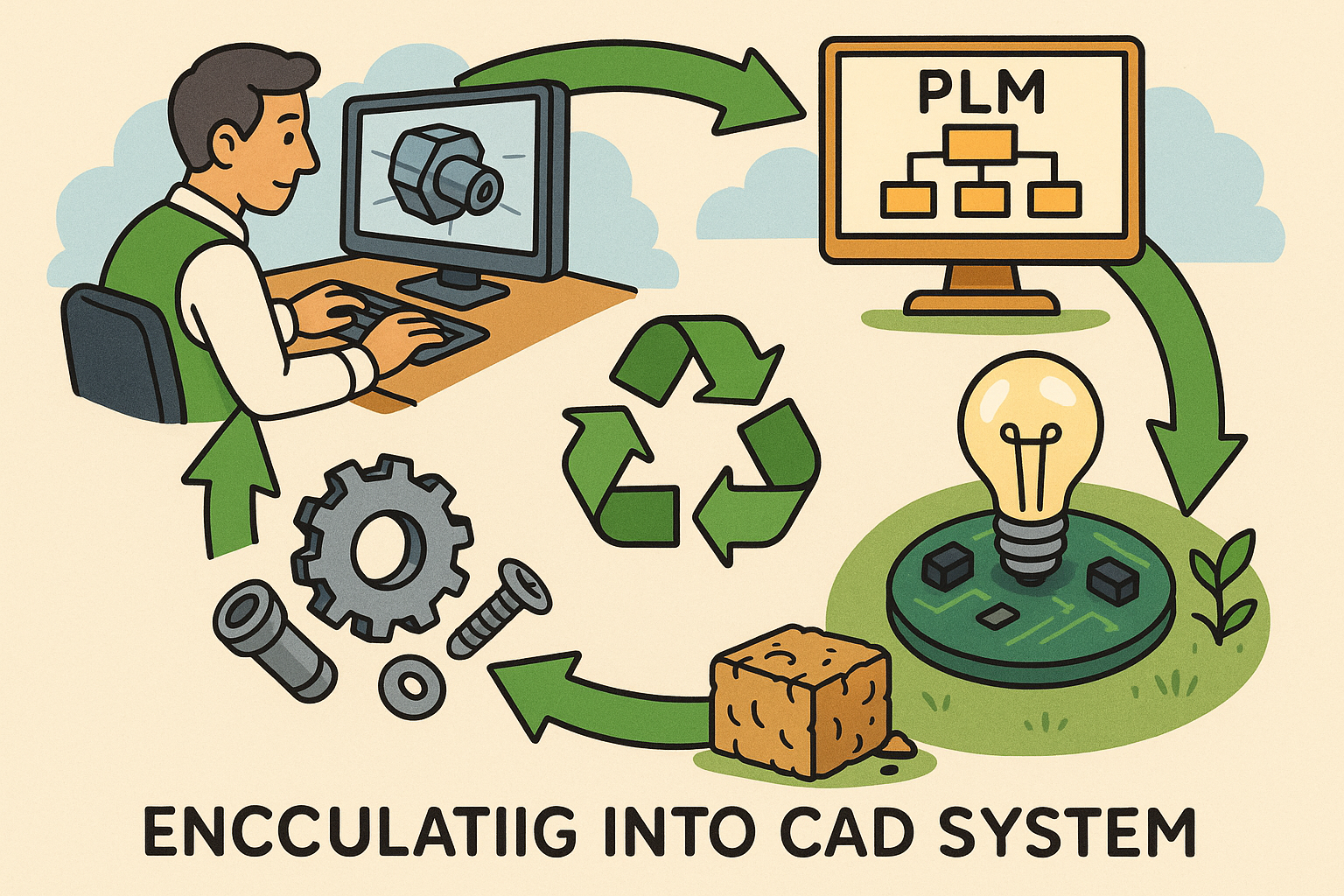


Why circularity must be encoded in design software
Strategic drivers
Design software is crossing a new threshold where circularity is no longer an optional overlay but a native capability. The shift is propelled by synchronized pressure from regulation, markets, and engineering realities. On the regulatory front, the EU’s Ecodesign for Sustainable Products Regulation and the Digital Product Passport (DPP) will require product data transparency down to material composition, repairability, and recovery pathways. Right‑to‑Repair rules, WEEE/ELV/Battery directives, and evolving Extended Producer Responsibility (EPR) schemes are converting post‑sale obligations into design‑time requirements. The implication is clear: if a CAD or PLM system cannot express disassembly logic, material provenance, and serviceability in the model, compliance becomes fragile and manual, risking penalties and launch delays. Market dynamics compound the urgency. Circularity unlocks secondary revenue via core returns and spares, hedges supply risk through recycled feedstocks, and creates brand differentiation in regions where sustainability is premium shelf space. Engineering teams, meanwhile, recognize the cost discipline embedded in standardized fasteners, modularity, and reduced part variety.
When these forces are encoded directly into authoring tools, choices that once appeared cost‑neutral become financially, legally, and operationally distinct. Software that can estimate disassembly time, score fastener taxonomy, flag hazardous substances, or simulate recovery value transforms circularity from a late‑stage audit to an early‑stage design objective. That shift shortens iteration loops, aligns procurement and service, and gives program leaders traceable metrics to steer trade‑offs. To make this tangible, design environments must present circularity data alongside mass, strength, tolerances, and cost, with dashboards that persist across versions and integrate with downstream operations—from repair bay tablets to recycler intake portals.
- Regulatory: ESPR and DPP readiness baked into models; automated RoHS/REACH checks.
- Market: Core‑return economics, recycled content sourcing, and eco‑label credibility.
- Engineering: Fastener standardization, modularity, and service simplification for cost avoidance.
Decisions to surface early
Circular outcomes are set in motion by early choices the moment teams sketch joints, specify adhesives, or assign coatings. Software must surface these decisions where they happen. The most critical is joining strategy: reversible versus permanent. Flagging screw types, torque ranges, and expected service cycles next to a design feature can reveal whether a future technician can open a module without damage. Adhesive selection needs structured attributes for debonding agents and temperature profiles, with rule checks that compare adhesive choices to substrate compatibility and planned service environments. Material purity and compatibility matter equally. Fillers, colorants, flame retardants, and plating often determine whether mechanical recycling is viable or if chemical routes are necessary; encoding these as machine‑readable material passport fields lets the system forecast recyclability and contamination risks at the part and assembly levels.
Access paths frequently decide real‑world repairability. CAD should visualize tool reach cones, bend radii for cables and hoses, and keep‑out zones for labels or NFC tags, then warn when fasteners are placed in obstructed or captive locations. Module boundaries and interface standards define upgradability and harvesting: persistent interface control documents, FRU tags, and parametric connector envelopes ensure modules can be swapped across product generations. In practice, early prompts might include: “Is this joint reversible?” “What is the maximum allowed adhesive bead length per module?” “Does this coating block spectral sorting?” “Are two tools sufficient to service the unit?” Bringing these prompts to the modeling canvas reframes circularity from a review checklist into an interactive design constraint—guiding part count, stack‑up strategy, and packaging from day one.
- Joining methods: Reversible joints, adhesive attributes, heat/solvent debonding options.
- Material compatibility: Fillers, colorants, coatings, plating, interface metallurgy.
- Service access: Tool clearance, fastener count/location, cable/hose bend allowances.
- Module boundaries: Interface standards, common connectors, FRU partitions for upgrade cycles.
Embedded KPIs and dashboards
Metrics translate intent into accountable decisions, and circularity requires a curated KPI stack visible at design time. A remanufacturability index blends joint reversibility, access time, and module independence into a single score. A disassembly time estimate paired with toolpath simulation ties geometry to labor cost, while a fastener taxonomy score penalizes non‑standard hardware. Material‑centric KPIs include recycled content percentage, overall recyclability, a material purity score, and hazardous substance flags that reference RoHS, REACH, and local variants. Inventory‑linked metrics—spare‑part commonality, total part count, and a serviceability rating—turn engineering decisions into MRO outcomes. Economic KPIs such as core‑return value estimate credit per returned unit using grading assumptions and logistics costs.
Dashboards should be version‑aware and diffable. As designers adjust a joint or choose a coating, the panel updates CO2e, water, and energy in an LCA snapshot and reveals how the change impacts recovery value and service time. Importantly, these KPIs are not static report outputs; they are constraints and targets that drive optimization. For example, “Reduce disassembly time by 20% without increasing mass,” or “Achieve 30% recycled content with specified tensile floor.” When exposed via APIs, purchasing systems can trade off alternates to maintain KPI targets as suppliers shift. Over time, telemetry from the field—actual disassembly times, failure modes, and recovery purity—feeds back to refine weights, thresholds, and alerts, closing the loop between design assumptions and real outcomes.
- Design-time KPIs: Remanufacturability index, disassembly time and cost, fastener taxonomy.
- Material KPIs: Recycled content %, recyclability %, purity scores, RoHS/REACH flags.
- Service and economics: Spare commonality, part count, serviceability, core‑return value.
- Environmental: LCA snapshots (CO2e, water, energy) tied to each design iteration.
Core software features that enable remanufacturing and material recovery
Disassembly-aware modeling
Disassembly must be as first‑class as assembly. Joint features in CAD should carry attributes for reversibility, tool type, torque, expected service cycles, and debonding method. With that metadata, the system can generate automatic disassembly sequences optimized for minimal tool changes or posture flips, simulate ergonomics and collision risks, and produce time and cost estimates. Alerts should fire when unique fasteners proliferate or when a fastening point is occluded by later‑installed parts. Designers benefit from heuristics that propose substituting uncommon screws with platform standards, replacing continuous adhesive beads with discrete pads, or introducing clip‑fit designs that meet load requirements but halve service steps.
Toolpath simulation extends beyond machining; it includes screwdriver trajectories, bit swaps, and cable release motions. If the screwdriver cannot align within torque spec due to enclosure interference, the model flags the issue and suggests chamfers or alternate fastener axes. For adhesives, parametric definitions should include bead width, cure profile, and activation energy, allowing downstream service documentation to specify heating pads or solvent application times. The modeling stack should also export machine‑readable sequences to author service content without manual re‑work. When paired with standard time data, these sequences turn design deltas into immediately visible labor impacts, enabling teams to pick configurations that balance stiffness, sealing, and service speed with quantitative rigor.
- Joint attributes: Reversible/permanent, tool type, torque, service cycles, debonding.
- Automation: Disassembly sequencing, toolpath simulation, labor and cost estimation.
- Heuristics: Minimize unique fasteners/adhesives; flag inaccessible or captive fixings.
Circular BOM and lifecycle states
A conventional BOM is linear; a circular BOM encodes loops. Parts travel through states—new, remanufactured, refurbished, harvested, and recycled—with rules for transitions. CAD/PLM needs explicit fields for core classification and grading (A/B/C), serialization to link physical cores to digital twins, and routing metadata for reverse logistics. An alternates matrix must exist at the item level, allowing planners to source a new component, a reman equivalent, or a recycled‑content variant subject to procurement constraints and certification. Such a matrix becomes essential when regulations require minimum recycled content or when supply volatility makes alternates the only viable path to schedule adherence.
Lifecycle states should carry cost models, warranty implications, quality gates, and testing plans. A harvested subassembly might demand additional inspection steps and may modify torque specs due to thread insert reuse; these conditions must flow back to service procedures and MBD/PMI. The circular BOM acts as the single source of truth for both forward and reverse flows, aligning MRO stocking policies with design intent and easing compliance reporting. Critically, analytics operating on this BOM can predict core‑return yield by geography, estimate reman capacity shortfalls, and advise design teams to adjust standardization targets on upcoming revisions. With APIs, external partners can advertise available reman stock, and the system can automatically propose alternates that preserve KPI targets while cutting lead time and embodied emissions.
- Lifecycle states: New, reman, refurbished, harvested, recycled; rules for transitions.
- Core metadata: Classification, grading, serialization, reverse logistics routing.
- Alternates matrix: New vs. reman vs. recycled‑content with procurement constraints.
Material intelligence
Materials drive both engineering performance and end‑of‑life options. A robust system maintains material passports that list composition, additives, coatings, recycling pathways, contamination risks, and emissions factors. Compatibility matrices should model multi‑material separation rules and indicate when mechanical recycling is feasible versus when solvent or pyrolysis routes are required. Designers can then pick pigments, flame retardants, and plating stacks with explicit feedback on sorting detectability and recyclate quality. Property envelopes for recyclates acknowledge variability: instead of a single tensile value, the design allowable is a band whose bounds vary by supplier lot and processing history.
With variability‑aware allowables, CAD can run sensitivity studies: Will a clip retain force if recycled PA66 GF30 varies by ±15% in modulus? If not, the tool suggests ribs, fillets, or a different clip geometry. Repair overlays can define permissible weld builds or non‑structural cosmetic fills, including heat‑affected zone constraints and post‑process anneals. When a coating improves corrosion resistance but blocks NIR sorting, the passport flags the conflict and offers alternate coatings or tags the part for chemical recycling with cost and CO2e comparisons. By exposing this intelligence in a single pane of glass, designers no longer need to chase PDFs or supplier emails; the system renders circularity and performance as a coupled optimization problem, unlocking choices that meet spec while future‑proofing recovery.
- Passports: Composition, additives, coatings, recycling pathways, contamination risks.
- Compatibility: Multi‑material separation, mechanical vs. chemical recycling routes.
- Recyclate allowables: Variability‑aware properties and repair overlay definitions.
Repairability assistants
Repairability is won or lost in millimeters and minutes. Assistants in CAD should perform access analysis using tool reach cones, defined bit lengths, and torque clearances, plus bend radii and strain limits for cables and hoses. Automated checks catch screws shadowed by brackets, connectors that cannot be decoupled without over‑bending, and labels obscuring critical fasteners. From MBD/PMI, the system can auto‑generate service procedures with callouts, torque specs, consumables, and a picklist of FRUs. A “two‑tool” heuristic pushes designs to be serviceable with the most common drivers, while standardization suggestions cluster spares across variants to drive stocking efficiency and reduce obsolescence.
Where possible, the assistant should simulate time‑on‑task using standard operations—open, remove screws, release latch, unplug harness, extract module—and estimate consumables and tool changes. Field‑replaceable unit tagging turns modules into contract objects with defined SLAs, enabling precise warranty planning and technician training. For each suggested design change, the assistant should present quantified trade‑offs: “Shifting fastener by 8 mm clears driver path, reduces disassembly by 42 seconds, negligible stiffness impact.” Over successive revisions, the repairability assistant learns from telemetry—actual service times, tool breakage rates, typical failure nodes—and adapts thresholds and heuristics to the product family and geography, ensuring recommendations remain grounded in real‑world practice rather than theoretical geometry alone.
- Access checks: Tool reach, torque alignment, cable bend radii, label keep‑outs.
- Auto‑procedures: Service steps, torque specs, parts lists from MBD/PMI.
- Standardization: Spare clustering, FRU tagging, two‑tool service goals.
Marking and identity
Identity is the backbone of circularity. Authoring tools should natively support DPP payload creation and embed it into model‑derived artifacts—QR, NFC, or laser‑mark features—along with geometry for durable labeling and keep‑out zones that respect aesthetics and service access. The payload links to the PLM item, version, and configuration, exposing only the scope appropriate for the audience: technicians, recyclers, or consumers. Beneath visible marks, digital watermarking binds provenance to a part or material batch, resisting repainting or abrasion. Unique identifiers tie components to certificates for recycled content, rework histories, and inspection records, guaranteeing that claims survive custody transfers.
Mark placement must be intentional. The system should verify that marks are scannable after typical wear, that they do not disrupt RF performance or sealing, and that they are accessible without full disassembly. For tiny parts, embedded micro‑marks or carrier tags on subassemblies can maintain identity without burdening operations. Once the marking scheme is baked into a template, derivative designs inherit identity structures automatically, and work instructions include mark inspection. When integrated with supply and service systems, identity unlocks automated RMA triage, dynamic service bulletins based on serial ranges, and recycler workflows that route parts to the correct recovery stream. In essence, identity turns a static model into a living node in the circular network, enabling data to follow matter from cradle through multiple loops.
- DPP authoring: Structured payloads mapped to QR/NFC/laser marks and keep‑out zones.
- Provenance: Digital watermarking, UID linkage to PLM and certificates.
- Operationalization: Scannability checks, RF/sealing verification, inherited templates.
End-of-life planning tools
End‑of‑life is a design variable, not a postscript. Scenario modeling lets teams compare targeted disassembly to bulk shredding, balancing recovery revenue against labor and logistics. With material passports and joint metadata, the tool forecasts material purity and contamination risk under each scenario, and pairs that with market price sensitivity to project revenue bands. Designers can see, for example, that adding a snap‑fit to liberate an aluminum heat sink increases dismantling time by 90 seconds but yields a tenfold recovery margin at current scrap prices—data that transforms a rule‑of‑thumb into a quantified trade‑off.
These tools should also model region‑specific constraints: labor rates, EPR fees, waste permits, and infrastructure availability for chemical recycling. A packaging variant that is optimal in one region may be suboptimal elsewhere due to recovery infrastructure gaps. With this visibility, the system can recommend modular splits that align with local recovery capabilities or propose label materials that survive wash lines. Over time, outcomes feed machine learning models that improve purity forecasts and adjust thresholds for recommending targeted disassembly. When tied to procurement, end‑of‑life modeling can even influence supplier selection—preferring materials with verified take‑back channels when economics and compliance align—ensuring every part carries a credible exit plan from its first CAD revision.
- Scenario modeling: Targeted disassembly vs. shredding with time and revenue estimates.
- Purity forecasts: Contamination modeling linked to joint types and coatings.
- Regionalization: Labor rates, infrastructure, and regulatory fees drive recommendations.
Additive and restoration workflows
Additive repair turns scrap into stock. CAD should include features for cladding and build‑up on worn surfaces, remachining allowances, blend radii management, and heat‑affected zone control. Templates driven by nondestructive testing (NDT) findings can auto‑parameterize repair volumes and define deposition strategies compatible with thermal budgets and residual stress limits. Scan‑to‑part alignment supports automated surfacing, allowing technicians to register damage maps to nominal geometry and generate toolpaths that minimize material while restoring functionally critical datums. For complex geometry, the system can propose lattice infills to lighten repairs without compromising stiffness.
Restoration workflows should extend into inspection plans and recertification documentation. If a bearing seat is rebuilt, the model automatically updates tolerances for post‑machining, prescribes measurement routines, and logs serial‑level changes. Material passports record the filler wire or powder lot, shielding gas, and heat treatment, bridging physical work to digital traceability. Economically, additive repair libraries capture the lessons of repeated fixes, offering parameter sets for common damage classes and materials. For example, a nickel superalloy vane may carry a predefined overlay recipe tuned for hot corrosion, including interpass temperature checks and shot peening. By fusing scan data, process parameters, and inspection into one closed workflow, software elevates repair from artisanal craft to a controlled, auditable industrial process that aligns with warranty and safety obligations.
- CAD repair features: Cladding, remachining allowances, blend radii, HAZ management.
- NDT integration: Templates linked to scan‑to‑part alignment and automated surfacing.
- Traceability: Filler lots, heat treatments, recertification plans embedded in the model.
Compliance automation
Compliance must be automatic, not artisanal. With substance data embedded in material passports and parts, the system can generate Bill of Substances and SCIP submissions, map declarations to IPC‑1752A/IEC 62474 schemas, and manage region‑specific reporting nuances. EPR fee estimation ties directly to BOM content, weights, and target markets, giving program managers real‑time cost visibility as designs change. For recycled content claims, audit trails bind supplier certificates to item revisions and serial ranges, with sampling plans and lab results stored alongside the model. Remanufacture certifications are similarly linked, tracking inspection steps and replaced components to defend warranty positions and meet regulatory definitions of “remanufactured.”
Automation should also include forward‑looking alerts. If a pigment is heading toward a restriction, the rules engine flags affected parts, proposes alternates, and simulates KPI impacts—recyclability, CO2e, and cost. A compliance dashboard shows coverage gaps, expiring certificates, and testing queues, integrated with purchasing to block PO release when evidence is stale. Because regulations evolve, the rule base must be updatable without software releases, consuming machine‑readable regulations or curated partner content. Ultimately, compliance automation reframes regulation from friction to foresight: rather than discovering misalignment at gate reviews, teams design with live regulatory context, cutting rework and shielding launch schedules from late surprises.
- Automated reporting: BoS/SCIP from embedded data; IPC‑1752A/IEC 62474 mapping.
- EPR visibility: Fee estimation tied to BOM, geography, and mass.
- Audit trails: Recycled content claims and reman certifications bound to revisions and serials.
Data models and interoperability patterns for a circular digital thread
Semantic extensions and schemas
Interoperability turns features into ecosystems. STEP AP242/ISO 10303 provides a backbone for 3D and PMI, but circularity calls for semantic extensions: attributes for joint reversibility, disassembly sequences, material passports, and DPP payloads. In the built environment, IFC property sets can be extended for building products to include service intervals, reversible fastening, and deconstruction instructions. PMI annotations should include service specs—torque, lubricant, sequence—and disassembly cues like access arrows and hazard notes. For materials, MatML and ECLASS classifications carry composition and hazard facts while linking to IPC‑1752A/IEC 62474 declarations for substances of concern. LCA connections must reference external datasets like ecoinvent via stable identifiers and allocation rules to keep snapshots auditable across versions.
To avoid vendor lock‑in, these schemas need open documentation and conversion toolchains. A DPP schema with access tiers lets the same model travel to suppliers, technicians, and recyclers with appropriate payloads while excluding IP‑sensitive details. Aligning identifiers across schemas—part numbers, material IDs, lot codes—prevents stranded data. When every entity (part, joint, material, procedure) has a globally unique, resolvable ID, digital twins can be stitched post‑hoc across PLM, MES, MRO, and recycler systems. In practice, the goal is a minimal, composable set of extensions that any CAD/PLM vendor can implement and that downstream tools can consume without bespoke parsers, preserving the fidelity of circular metadata from design through multiple lifecycles.
- Standards: STEP AP242 with circular attributes; IFC Psets for building deconstruction.
- Annotations: Service PMI and disassembly cues; MatML/ECLASS for material detail.
- Substances and LCA: IPC‑1752A/IEC 62474 linkage; ecoinvent‑referenced LCA snapshots.
Disassembly and service structures
Assembly trees are not disassembly trees. CAD/PLM must host explicit disassembly structures that reflect service reality: modules removed in order, consumables replaced, and safety interlocks. These trees complement, not replace, assembly structures, and can be exported to S1000D or ATA iSpec 2200 for work instruction publication. Tooling libraries—bits, drivers, fixtures—should include standard operation times and ergonomic limits, enabling consistency across products and vendors. Embedding operation times into the service structure allows accurate labor planning and comparison across design alternatives without rebuilding process models in separate tools.
Reusability is paramount. Common service operations should be parametrized and referenced by many parts, so a torque procedure or latch release is authored once and inherited across assemblies, with local overrides for variation. The service structure also hosts safety information—ESD precautions, lockout procedures—and dynamically adapts to configuration by serial. By structuring service content as data rather than documents, updates propagate reliably to field portals, and feedback returns in a form machines can analyze. This structure becomes a nexus where design choices, tooling constraints, labor estimates, and safety converge into a living artifact—shortening the loop from CAD edits to technician steps and error‑proofing maintenance across geographies.
- Parallel trees: Disassembly structures distinct from assembly structures.
- Standard assets: Tooling libraries and operation times as reusable components.
- Structured output: S1000D/iSpec exports feeding authoring and field systems.
Provenance and telemetry
Claims require evidence. The circular thread binds material lots, recycled content certificates, and chain‑of‑custody events to parts via immutable links. As items traverse suppliers, each handoff is recorded with time, location, and quality data, forming a verifiable trail for audits and customer assurance. In the field, telemetry closes the learning loop: failure modes, repair logs, and time‑to‑disassemble metrics feed back to the CAD environment and adjust design rules, KPIs, and heuristics. If a latch breaks at a high rate under a specific climate profile, the system correlates failures with materials, geometries, and assembly process variations, suggesting targeted redesigns or supplier shifts.
Granularity matters. Serial‑level telemetry should combine edge‑captured data (tool torques, fastener counts) with technician inputs and photos, embedding them as structured events rather than freeform notes. Analytics aggregate across fleets to reveal whether disassembly time predictions matched reality, which materials contaminated streams, and where training or tooling gaps exist. This provenance‑telemetry fabric enables trust: recycled content claims are defensible, reman certifications are traceable, and design guidance reflects operational truth. Over time, models can learn to predict likely recovery grades at RMA intake and pre‑stage spares or repair overlays, compressing cycle times and inventory exposure while reinforcing the economic backbone of circularity.
- Certificates: Recycled content and lot data bound to parts and revisions.
- Chain of custody: Supplier events with time, location, and quality records.
- Field feedback: Failure modes, repair logs, disassembly times inform design rules.
API and event-driven integration
Circular ecosystems are eventful. Real‑time validators watch for DfD violations, material conflicts, and regulatory risks as models evolve. When a designer adds an adhesive, an event pings the rules engine, which responds with warnings or approvals based on temperature limits and debonding provisions. Procurement and MRO systems subscribe to a change stream that reflects alternates, lifecycle states, and updated service steps; when a reman stock becomes available or a supplier’s recycled‑content certification lapses, subscribers receive actionable events to replan sourcing or block orders. Event payloads include scoped geometry, disassembly limits, and KPI diffs, enabling downstream automation without human triage.
APIs must respect access scopes and performance. Lightweight endpoints deliver just the data needed—tool paths for a step, PMI for a joint, a DPP subset for a recycler—without exposing sensitive IP. Webhooks and message buses orchestrate integrations across PLM, ERP, MES, MRO, and recycling partners, while idempotent updates prevent duplicate actions. Validation services should be hot‑swappable to reflect regulatory changes and internal policy shifts. With this architecture, circularity ceases to be a siloed initiative; it becomes a capability embedded across operations, continuously adapting to supply disruptions, policy updates, and field realities.
- Validators: Real‑time DfD, material compatibility, and regulatory rule checks.
- Subscribers: Procurement and MRO react to design events, alternates, and availability.
- Scoped data: Access‑controlled payloads deliver only what each role requires.
Visualization and exchange
Service teams and recyclers need clarity without CAD heft. Visual formats like USD or glTF, extended with circular metadata, can carry exploded views, sequences, PMI callouts, and DPP subsets in lightweight packages. Service‑friendly viewers filter to the steps relevant to a task, show live tool alignment cones, and animate disassembly while suppressing IP‑sensitive internals. For recyclers, a stripped view highlights materials, coatings, and joint types, with a purity forecast and debonding recommendations. Secure sharing controls which attributes travel—public DPP vs. private inspection data—and watermarks viewers to deter leakage.
Exchange is bidirectional. Field annotations and timing overlays recorded in viewers sync back to PLM, updating disassembly times and flagging pain points. In design reviews, stakeholders can toggle KPI layers—remanufacturability score, recyclability %, core value—directly on geometry, linking metrics to features. By converging visualization and data, exchange formats become more than presentation; they are operational tools that maintain continuity of meaning across roles and software. This is where the circular digital thread becomes visible: geometry, identity, service, and material intelligence coexisting in accessible views that accelerate training, reduce errors, and translate design intent into hands‑on outcomes.
- Lightweight views: USD/glTF with circular metadata for service and recycling.
- Access‑scoped sharing: Exclude IP‑heavy geometry; include DPP and task data.
- Feedback loop: Viewer annotations sync to PLM to refine times and instructions.
Conclusion
From first-class modeling to measurable progress
The path to circular products runs through the modeling kernel and the data spine that surrounds it. Treat circularity as a first‑class concern in CAD/PLM: encode disassembly logic, material intelligence, and lifecycle states into parts and assemblies rather than burying them in PDFs and after‑action reports. Prioritize the features that redirect early decisions—disassembly‑aware joints, circular BOMs, repairability assistants, and DPP‑ready markings—because these shape geometry, interfaces, and supply options before tooling and contracts harden. Build a robust digital thread using standardized schemas, provenance links, and event‑driven integrations so design, supply, service, and recovery operate from the same facts and react to changes together. Start with a disciplined KPI set and a pilot on one product family. Use live dashboards to track remanufacturability, disassembly time, fastener taxonomy, recycled content, and LCA snapshots at each iteration. As field telemetry arrives—true service times, failure patterns, recovery purity—update rules and thresholds to reflect reality, not assumptions. The destination is a design system where circular performance is engineered with the same rigor as strength or cost, where identity travels with matter, and where software continuously converts constraints into creativity. When circularity is intrinsic to tools and data, products become platforms for multiple lives, and sustainability aligns naturally with resilience, profitability, and customer trust.
Also in Design News