Your Cart is Empty


Design Software History: Simulation-Driven Design: The Long Convergence of CAD, CAE, and Digital Prototyping
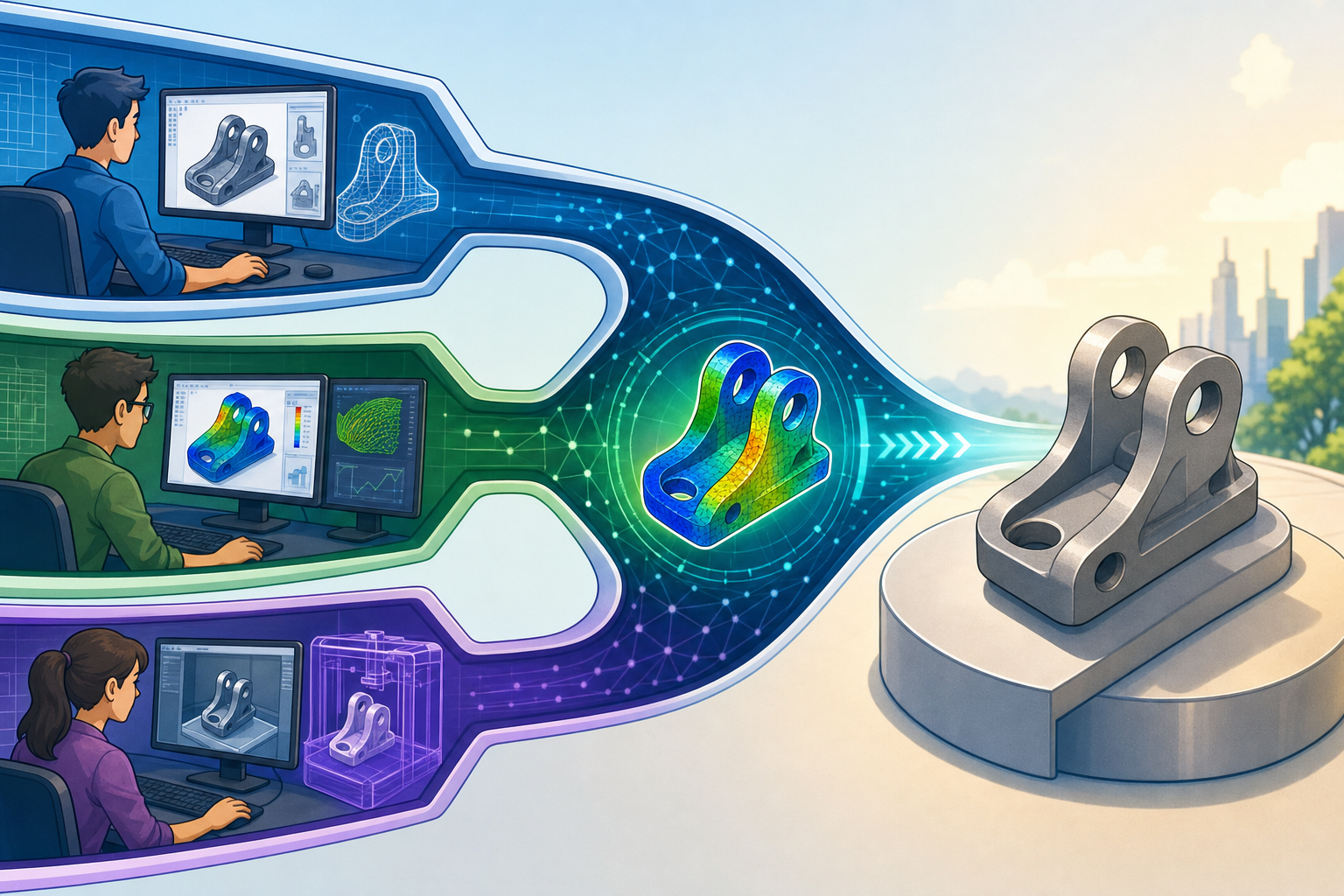


Simulation-driven design is often presented as a recent revolution, yet its deeper history reveals something more interesting: it is the latest phase in a long campaign to connect geometry, engineering knowledge, and computation inside the same working environment. The central historical point is that today’s workflows did not suddenly replace earlier design practice with an entirely new logic. They extended a much older ambition within engineering software: moving analysis earlier in the design process, reducing the gap between geometry creation and performance prediction, and turning CAD models from static documentation into active decision-making tools. What now appears as a seamless loop among modeling, analysis, optimization, and digital prototyping was built gradually through decades of work in finite element analysis, geometric and solid modeling, parametric design, and optimization. This continuity can be traced through the strategies of companies such as SDRC, PTC, Dassault Systèmes, Siemens, Autodesk, ANSYS, and MSC Software, as well as through research universities and aerospace programs that repeatedly forced software developers to confront the mismatch between idealized mathematics and industrial engineering reality.
Why the Historical Continuity Matters
To understand the present, it is necessary to see that simulation-driven design emerged not as a clean break from CAD and CAE history, but as a continuation of earlier integration efforts that had been underway for decades. The modern promise of performance-aware design depends on technologies that matured separately before they were meaningfully connected. Among the most important were:
- Finite element analysis, which provided a computational way to estimate structural, thermal, and other physical behaviors.
- Geometric and solid modeling, which gave designers digital control over shape, topology, and engineering representation.
- Parametric and feature-based design, which made geometry more editable, structured, and associative.
- Optimization methods, which transformed simulation from a checking activity into a search process.
- Digital prototyping, which reframed CAD models as testable surrogates for physical artifacts.
The significance of these developments lies in their convergence. For much of the twentieth century, analysis specialists and designers worked in different technical cultures, using different software and even different conceptions of what a model was for. The eventual union of these domains changed engineering practice because it redefined the CAD model itself. Instead of serving mainly as drafting output or product definition, the model increasingly became a site where decisions about strength, weight, manufacturability, thermal behavior, motion, and lifecycle performance could be explored before hardware existed. That transition sits at the heart of the design software story.
The Long Prehistory of Separation Between Design and Analysis
Mainframe Computation and Specialist Workflows
The prehistory of simulation-driven design begins in a world where engineering computation and interactive CAD developed on largely separate tracks. In the 1950s and 1960s, computer-based engineering analysis was already becoming vital in high-stakes domains, especially aerospace and defense, where structural reliability, vibration behavior, and material efficiency were matters of cost, safety, and strategic importance. But these early tools did not resemble modern designer-facing applications. They ran on mainframes, required specialized numerical knowledge, and were operated by experts who understood discretization, matrix assembly, boundary conditions, and solver limitations. In that environment, analysis was not part of everyday design iteration. It was a specialized computational service. Much of the momentum came from aircraft and missile development programs, as well as from research institutions and universities that were advancing numerical methods under government-funded pressure to solve large structural problems. The rise of the finite element method was central here. Pioneering figures such as Ray W. Clough, who helped formalize the term “finite element,” and important contributions from engineers including John Argyris, Olgierd Zienkiewicz, and others shaped the mathematical basis for computational structural analysis. Yet these methods lived in a computational culture very different from the one that would later define CAD.
Interactive Geometry Without Integrated Performance
At the same time, another historical thread was emerging around interactive computer graphics and geometric modeling. Systems such as Sketchpad, developed by Ivan Sutherland at MIT in the early 1960s, demonstrated that computers could support direct graphical interaction with geometry. Sketchpad was a landmark because it introduced ideas that would later become foundational to CAD: constraints, hierarchical structures, and interactive manipulation of shapes. But it did not yet solve the integration problem between geometry and analysis. The challenge was deeper than interface sophistication. CAD culture emphasized shape definition, drafting convenience, and eventually product configuration, while CAE culture emphasized meshing, numerical stability, solver performance, and physical fidelity. These different priorities produced different data structures, different user communities, and different workflows. Geometry suitable for design was often ambiguous, incomplete, or topologically inconsistent from an analyst’s point of view. Analysts needed idealizations, clean surfaces, simplified midsurfaces, material regions, and meshable boundaries; designers needed practical freedom to define and edit the artifact as it was being conceived. This technical divide mattered because it forced organizations into a sequential process: designers created geometry, then analysts translated or rebuilt it, then simulation results came back only after major decisions had already solidified. Companies such as MSC Software, originally tied to the commercialization and practical deployment of NASTRAN-related technology, helped make CAE workable in industrial settings, but that still did not erase the separation. Simulation informed design, but it rarely drove design from the beginning.
The Technical Divide That Slowed Early Integration
Different Model Philosophies and Different Data Problems
The historical gap between CAD and CAE was not merely organizational inconvenience; it reflected a profound mismatch in representation. Early CAD systems were built to define geometry for drafting, documentation, and eventually manufacturing preparation. Their central concern was the accurate description of curves, surfaces, dimensions, and later volumes in forms that engineers and technicians could review, annotate, and release. CAE systems, by contrast, needed computational models that could be discretized into elements and nodes, solved efficiently, and trusted numerically. A designer’s fillet, tiny feature, or surface irregularity might be harmless or even essential in a drawing context, while the same detail could wreck meshing quality, increase solve time dramatically, or introduce misleading stress concentrations in an analysis context. The software infrastructures that supported these activities therefore evolved around different assumptions. CAD data often had to be exported and reshaped; CAE teams often recreated models from scratch in simplified form; and every translation step risked introducing errors, lost associativity, and delay. This fragility became a major historical constraint on engineering iteration because digital models could not yet move fluidly across tools and disciplines.
Why the Divide Shaped Engineering Culture
The consequences of this divide extended into project structure, professional identities, and product timelines. Designers and analysts frequently belonged to different departments and used different software environments, often even on different hardware platforms. A typical workflow involved design release, geometry cleanup, mesh generation, analysis setup, solver execution, result interpretation, and then a delayed feedback cycle to design. That sequence meant performance evaluation commonly occurred after foundational design decisions had been made. If analysis uncovered a critical weakness, teams might still hesitate to make major changes because downstream documentation, tooling assumptions, or release schedules were already advanced. This historical pattern explains why integrated simulation later appeared so transformative: it promised not simply faster analysis but earlier influence over engineering choice. Several recurring obstacles defined the era:
- Fragile data exchange among incompatible file formats and kernels.
- Manual preprocessing steps that required specialist judgment.
- Geometry that was valid for drafting but poor for direct meshing.
- Slow computational turnaround on expensive hardware.
- Limited associativity between design changes and analytical models.
Because of these constraints, analysis was often used as a validation gate rather than a creative guide. Historically, this is the world from which simulation-driven design emerged. The later push toward integration was less a sudden invention than a long attempt to remove these bottlenecks one by one.
The Integration Era and the Rise of Digital Prototyping
Parametrics, Features, and Structured Geometry
The 1980s, 1990s, and 2000s introduced the first serious and commercially consequential attempts to close the loop between CAD and CAE. A central reason was that CAD systems themselves became richer, more structured, and more computationally meaningful. The spread of parametric solid modeling changed the status of geometry. Instead of isolated shapes or drafting entities, engineers increasingly worked with editable models defined by dimensions, constraints, topological relationships, and feature histories. This structure gave software something it could preserve across revisions. Feature-based design further strengthened the chain of associativity by linking geometry changes to downstream operations such as assemblies, manufacturing planning, and eventually analytical interpretation. Better kernels and data models also mattered enormously. Boundary representation techniques, robust topology handling, and improved commercial kernels allowed systems to maintain more coherent definitions of edges, faces, and volumes, reducing the pain of moving from design geometry into simulation workflows. These advances did not solve interoperability overnight, but they made the dream of repeatable design-analysis iteration much more realistic because models could be updated without being completely rebuilt for every engineering change.
The Companies That Built the Bridge
Several companies played especially important roles in this historical convergence. SDRC, through products such as I-DEAS, became an important bridge between design and analysis, particularly in industries that needed stronger digital continuity between engineering intent and performance evaluation. SDRC understood earlier than many competitors that product development software had to encompass more than drafting; it had to support a connected engineering process. PTC, founded by Samuel Geisberg and others, pushed this logic further with Pro/ENGINEER, which made associativity and design intent central concepts in mechanical CAD. By embedding parametric relationships deeply into the modeling process, PTC created an environment in which geometry changes could propagate in a more structured way, helping downstream simulation become more iterative rather than episodic. Dassault Systèmes, with CATIA, became enormously influential in aerospace and automotive workflows, where the cost of physical prototyping and the complexity of assemblies made digital continuity especially valuable. Unigraphics, later part of Siemens NX, also advanced the integration of design, manufacturing, and simulation in a tighter enterprise framework. Autodesk popularized the language of digital prototyping for broader engineering markets, helping normalize the idea that a digital model should support more than drafting and should contribute to engineering decisions before physical fabrication.
Simulation-Driven Design as a Gradual Historical Shift
No Single Breakthrough, but an Accumulation of Capabilities
The emergence of simulation-driven design is best understood as a gradual historical shift enabled by the accumulation of associativity, parametrics, better kernels, and improved interoperability rather than by any single decisive invention. That distinction matters because it helps explain why the transition unfolded unevenly across industries and software ecosystems. Aerospace and automotive organizations, already accustomed to high-end integrated workflows, often adopted linked design-analysis processes earlier because their economic incentives were strong and their engineering complexity demanded them. Smaller firms and broader mechanical markets followed as software became more accessible, hardware became cheaper, and user interfaces improved. The key transformation was that CAD systems became sufficiently rich to support iterative evaluation. Once geometry existed as a structured and reusable model rather than a one-time drawing artifact, software developers could build stronger connections from design modifications to meshing, solver setup, and result interpretation. This did not eliminate expert analysis, but it created a spectrum of simulation usage, from quick early checks by designers to highly detailed validation studies by specialists. The practical meaning of simulation-driven design therefore emerged from a changing infrastructure as much as from a changing philosophy.
Digital Prototyping and Broader Market Adoption
By the late 1990s and 2000s, the term digital prototyping captured an important transitional moment in the history of design software. It suggested that a product could be modeled, assembled, checked, and evaluated in digital form before committing to expensive physical prototypes. This vision depended on much more than attractive visualization. It required CAD models that could carry enough information to support kinematics, tolerancing, structural estimation, manufacturability review, and design comparison. Companies such as Autodesk helped package this vision for a wider audience, while higher-end platforms from Dassault Systèmes, Siemens, and PTC were deepening integration in enterprise settings. The historical significance of this era can be summarized through several converging changes:
- Geometry became more structured through parametric and feature-based modeling.
- Analytical workflows became less isolated from mainstream design tools.
- Digital models gained value as reusable engineering assets rather than static outputs.
- Interoperability improved enough to support iterative loops instead of one-way transfers.
- Manufacturing, assembly, and analysis increasingly shared a common digital foundation.
This is the point at which the old division between “draw first, analyze later” began to weaken seriously. Simulation was no longer only a downstream checkpoint. It was becoming a practical participant in design iteration.
From Validation to Guidance in the Design Process
The Conceptual Shift in Engineering Decision-Making
The most important conceptual transformation in the history of simulation-driven design was the movement from validation to guidance. In the older model, engineers designed a part or system and then simulated it afterward to confirm whether it would survive expected loads or satisfy other requirements. In the newer model that emerged through the 1990s and 2000s, engineers simulated during design, using intermediate results to refine geometry before freezing it. In the current model, increasingly visible across many software platforms, simulation guides design choices from the beginning by shaping which options are even considered promising. This progression reflects a major redefinition of what analysis is for. It is no longer only a gatekeeper of correctness; it is an input to creativity, tradeoff management, and concept exploration. The change became possible because computing resources improved dramatically, allowing faster solvers and broader deployment. At the same time, meshing technology advanced through automation, adaptive strategies, and smarter preprocessing, reducing one of the longest-standing barriers between CAD and CAE. Solver technology from firms such as ANSYS and MSC Software became more robust, while interfaces grew more approachable for users who were not full-time analysts. The result was not the disappearance of expertise, but the widening of access to analytical insight during earlier design stages.
Embedded Tools, Optimization, and Performance Inputs
As simulation migrated closer to design creation, software interfaces increasingly embedded analysis capabilities directly inside design environments. Lightweight structural, thermal, motion, and fluid approximations could now be launched without leaving the CAD context entirely. This historical development changed user expectations. Designers who once relied exclusively on specialists for performance feedback could now perform quick assessments themselves, identify obvious weaknesses, and compare alternatives before escalation to advanced CAE teams. Optimization tools pushed the trend even further by treating performance targets as inputs rather than outputs. Instead of asking whether a fixed geometry would pass, engineers could ask software to search for dimensions, shapes, and layouts that would satisfy constraints on weight, stiffness, frequency response, thermal behavior, or material usage. This laid the groundwork for topological optimization and later generative design approaches. Important enabling trends included:
- Cheaper computing and multicore processing.
- More automated meshing and preprocessing.
- Improved solver speed and numerical robustness.
- Interfaces designed for non-specialist engineers.
- Optimization frameworks that linked geometry variation to performance metrics.
Historically, these changes marked the moment when analysis stopped being merely retrospective. It became prospective. Software could now suggest, rank, and evolve possibilities based on predicted behavior, making performance-aware design a normal expectation rather than an elite capability.
How Integration Changed Engineering Organizations and Product Development
New Users, New Team Structures, New Timing
One of the broader implications of simulation-driven design was that it changed who could use analysis tools and when they could use them. In the earlier era, CAE remained concentrated in the hands of numerical specialists because the workflow required deep knowledge of meshing strategy, idealization technique, solver controls, and result interpretation. As software became more integrated and more automated, some forms of analysis moved closer to design engineers, project engineers, and multidisciplinary product teams. This did not make specialist analysts obsolete. Instead, it redistributed analytical labor. Routine checks and early-stage comparisons could happen inside design groups, while advanced nonlinear, transient, contact, fatigue, or multiphysics work remained in expert hands. That redistribution altered team structure and development timing. Organizations could identify problems earlier, reduce some prototype cycles, and make performance tradeoffs before release schedules hardened. In historical terms, the shift echoed the old ambition to move analysis upstream, but now with much stronger software support. The engineering process became less linear and more iterative because geometry, simulation, and redesign could occur in tighter loops. This had consequences for management as well as for software architecture, since product development increasingly depended on shared digital models whose meaning crossed disciplinary boundaries.
Foundations for Digital Twins and AI-Assisted Engineering
The long convergence of CAD and CAE also laid the conceptual and technical groundwork for later developments such as digital twins, multidisciplinary optimization, and AI-assisted engineering. Once a digital model became a reusable engineering asset rather than a static description, it could serve as the basis for connecting design assumptions, manufacturing data, operational feedback, and maintenance history. The idea of the digital twin depends heavily on this earlier history: without the hard-won integration of geometry, materials, simulation, and system behavior, there would be little foundation for a living computational counterpart to a physical product. Similarly, multidisciplinary optimization became more feasible as software platforms improved their ability to coordinate structural, thermal, fluid, and motion analyses around shared geometry. Research universities and aerospace programs remained important in this transition because many of the hardest integration problems still involved advanced mathematics, reduced-order modeling, uncertainty quantification, and high-performance computing. Today’s interest in AI-assisted engineering extends the same trend. Machine learning models, surrogate models, and data-driven optimization are not replacing CAD/CAE history; they are building on it. Their value depends on the existence of integrated digital representations, simulation pipelines, and parametric relationships established over decades of software evolution.
The Convergence Story That Explains the Present and the Next Phase
CAD Became More Analytical and CAE Became More Accessible
The most accurate way to narrate the history of simulation-driven design is as a story of convergence. CAD became more analytical as models acquired parameters, features, topological structure, and downstream associativity. CAE became more accessible as preprocessing improved, computational costs fell, interfaces became more navigable, and software vendors packaged analytical capabilities for wider engineering audiences. Design software evolved from shape-making tools into systems increasingly aware of performance, manufacturability, and lifecycle behavior. That transformation did not happen because one company solved everything at once. It emerged through overlapping contributions from firms such as SDRC, PTC, Dassault Systèmes, Siemens, Autodesk, ANSYS, and MSC Software, along with decades of academic and aerospace research that kept pushing numerical methods and engineering representation forward. The historical continuity matters because it reveals that today’s simulation-rich workflows are rooted in older unresolved problems: how to connect geometry to physics, how to preserve engineering intent across revisions, and how to make computation useful before decisions are locked in. In that sense, present-day practice still carries the DNA of earlier CAD/CAE integration efforts.
The Forward Path Still Follows an Old Ambition
The next phase of design software will likely deepen this established trajectory through cloud computing, real-time simulation, larger optimization spaces, and more extensive AI support, but its roots remain firmly planted in decades of CAD/CAE history. Cloud platforms promise scalable solve capacity and broader collaboration; real-time and near-real-time feedback aim to compress the delay between modeling and performance insight; AI tools increasingly assist with meshing, surrogate prediction, and design exploration. Yet the historical logic remains the same as it was in the earliest integration efforts: reduce the distance between model creation and engineering understanding. The enduring ambition can be stated simply through three converging developments that now define modern engineering software:
- CAD becoming more analytical, with geometry tied more directly to simulation, manufacturing, and systems behavior.
- CAE becoming more accessible, allowing earlier and broader use without abandoning specialist rigor where needed.
- Design software becoming performance-aware, so that digital models function as decision-making tools rather than mere documentation.
Seen historically, simulation-driven design is not a sudden invention of the twenty-first century. It is the mature form of a long-running effort to connect shape, mathematics, and engineering judgment inside a common digital process. That is the real story: not rupture, but convergence.
Also in Design News