Your Cart is Empty


Context-Aware CAD: Relationship-Driven Design for Product Families
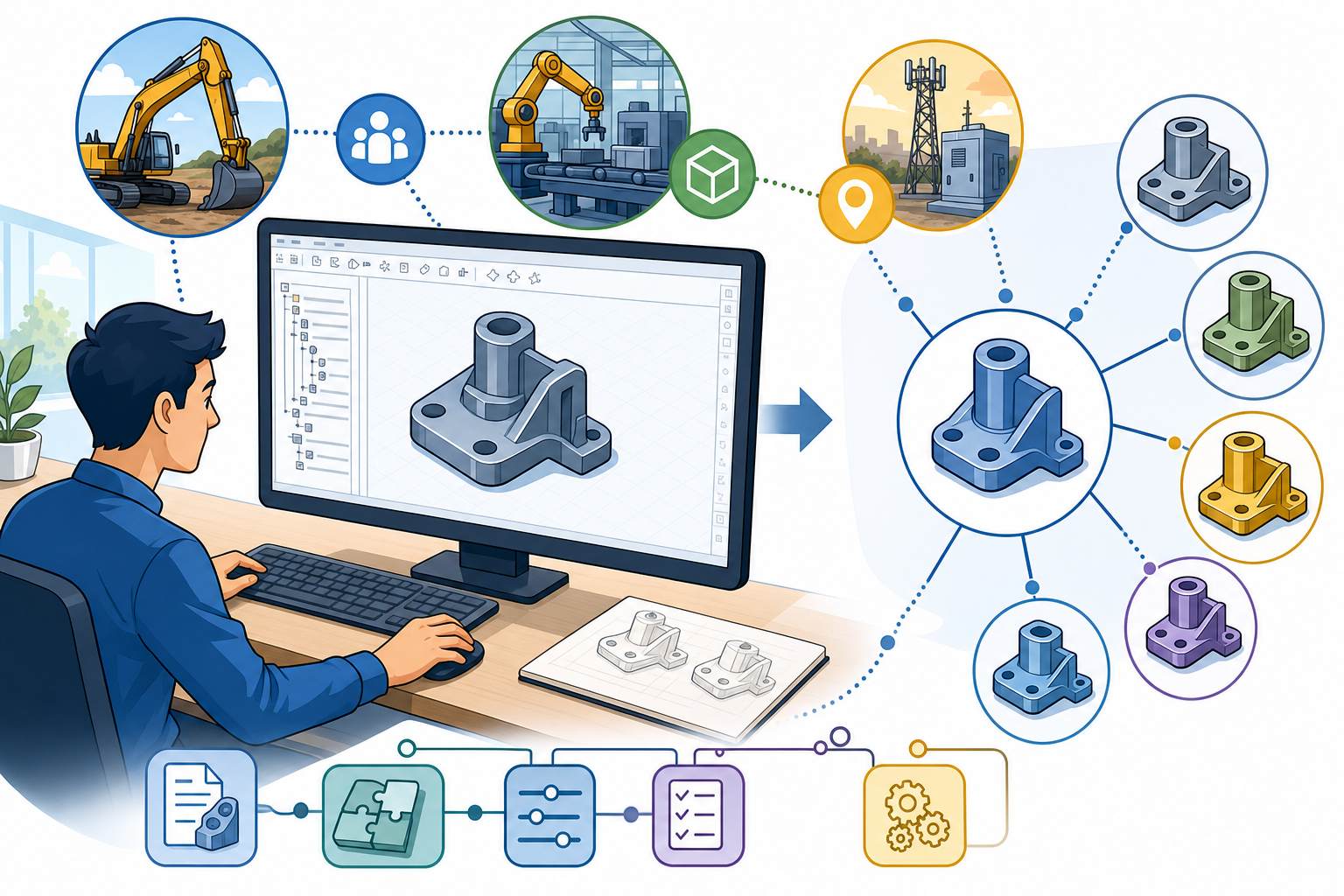


Context-aware design tools are becoming strategically important because engineering teams are no longer working on isolated parts in relatively stable product lines. They are managing complex assemblies, repeated variants, region-specific configurations, software-enabled products, and manufacturing constraints that change throughout development. In that environment, the cost of treating CAD as a pure geometry editor becomes visible in every engineering change order, every broken reference in an assembly, and every delayed release caused by a misaligned configuration. Modern product development demands tools that can interpret what a component means inside a larger system, not just what it looks like in a model tree. That shift is reshaping the role of design software from a drafting and modeling instrument into an operational layer for design logic, product structure, and lifecycle consistency. The strategic importance comes from one central reality: organizations need design environments that reduce interpretation gaps between engineering intent, configuration control, and downstream execution.
What context-aware design means in modern CAD and product development platforms
Context-aware design in modern CAD and product development platforms refers to software behavior that interprets geometry in relation to assemblies, dependencies, usage conditions, configuration rules, and lifecycle data instead of treating every feature as an independent edit. In practical terms, a hole pattern is not merely a set of circles extruded through a plate; it may represent a fastening interface shared across a product family, linked to a mating component, controlled by a platform standard, and constrained by manufacturing process capability. A bracket is not simply a solid body with parameters; it may be recognized as a load-bearing member used across multiple variants, associated with interchangeable hardware, and tied to a service access envelope. Context awareness appears when design tools can reason about those relationships, preserve them during change, and expose them as actionable logic.
Beyond isolated geometry
Traditional CAD systems excel at creating and editing shape. They often struggle, however, when change must propagate through families of products without breaking intent. Context-aware systems improve this by capturing semantics around the model. They connect design elements to larger structures such as:
- assembly roles and mating conditions
- variant-defining parameters
- functional interfaces between subsystems
- material, process, and tolerance constraints
- reuse rules across platforms and derivative products
In a mature implementation, the software can infer when an edit is local, when it affects a shared platform element, and when it creates a mismatch across variants. That interpretation turns design data into a system of relationships rather than a collection of shapes. The result is a significantly more resilient development environment, especially when teams need to maintain coherence across many versions of a product while still moving quickly.
Why software is shifting from geometry editing to relationship-driven product understanding
The transition from geometry editing to relationship-driven product understanding is rooted in the economic realities of modern engineering. Products are more configurable, more interdisciplinary, and more tightly constrained by manufacturing, supply chain, compliance, and service considerations than in previous generations of CAD use. A model that only stores dimensions and feature history cannot reliably support decisions that depend on assembly logic, commonality targets, modular reuse, or production readiness. This is why advanced platforms are evolving to understand assemblies, part relationships, product families, configuration logic, and downstream manufacturing implications as first-class entities rather than external documentation. Software is becoming responsible for preserving not just form, but intent and consequence.
What the software increasingly understands
Modern systems are moving toward a representation of design where relationships are computable. That includes the ability to track and reason about:
- which parts are structurally or functionally dependent on one another
- which interfaces must remain stable across a product family
- which components are optional, interchangeable, or market-specific
- which dimensions are driven by assembly envelopes or mating conditions
- which changes create downstream manufacturing conflicts
A clear example is a configurable enclosure family used across several power ratings. In a traditional workflow, each enclosure size might be managed through copied models and manual edits. In a context-aware system, the enclosure is understood as a member of a product family with governed interfaces, shared fastener strategy, mounting logic, airflow requirements, and production constraints. If the team changes wall thickness policy to match a molding process update, the software can identify affected variants and preserve critical mounting interfaces. This reduces rework because the system has some awareness of why the geometry is shaped the way it is and where that logic must continue to hold.
Market forces driving the rise of context-aware design environments
Several market forces are converging to make context-aware design tools not merely attractive, but necessary. The first is growing product complexity. Mechatronic integration, embedded intelligence, tighter packaging, sustainability targets, and certification requirements all increase the number of dependencies that must remain coherent during design evolution. The second is mass customization. Companies are trying to derive many customer-ready variants from common platforms while avoiding a combinatorial explosion of engineering effort. The third is the reality of distributed engineering teams, where contributors work across time zones, supplier networks, and organizational boundaries. The fourth is relentless pressure to reduce rework and shorten engineering change cycles. Each of these forces punishes workflows that rely on human memory to maintain product logic and rewards systems that can formalize and preserve relationships.
The business pressure behind technical change
The most significant strategic pressure is that engineering errors now propagate faster and cost more to resolve. A change made without family context can break shared tooling assumptions. A dimension corrected in one variant may create a mismatch in another. A substitute component approved by sourcing may violate service access or clash with neighboring parts in some configurations. Context-aware systems are being adopted because they reduce the distance between design action and systemic understanding. They support organizations facing challenges such as:
- high variant counts with low allowable error rates
- platform strategies that depend on part commonality
- frequent late-stage changes driven by supply or manufacturing realities
- collaboration across CAD, PDM, PLM, and ERP environments
- the need to align design data with service and lifecycle planning
In this sense, context awareness is not simply an interface improvement or a convenience feature. It is a way of encoding organizational knowledge inside the design environment so that product structure, dependency, and intent can survive scale. As product portfolios become broader and more dynamic, this capability shifts from advanced option to competitive requirement.
How context-aware systems work at the technical level inside assemblies and product families
Context-aware systems rely on a stack of technical foundations that give software the ability to interpret design meaning beyond explicit geometry. Among the most important are semantic modeling, feature recognition, constraint graphs, metadata-driven relationships, and rules-based configurators. Together, these mechanisms turn a CAD model into something closer to a queryable design network. Geometry remains essential, but it is surrounded by descriptors that define what a feature does, how a part behaves in an assembly, which family rules it belongs to, and what other objects depend on it. The software can then evaluate the implications of changes with far more precision than a traditional file-based modeling approach. What makes this especially powerful is that these computational structures can span multiple product variants, enabling logic continuity across an entire family rather than only within a single model.
Semantic modeling and feature recognition
Semantic modeling assigns meaning to geometric entities. Instead of storing only edges, faces, and feature operations, the system can identify a region as a mounting interface, sealing surface, datum scheme, structural rib, or service clearance zone. Feature recognition extends this by detecting patterns and intent in existing geometry, including imported or legacy parts. For example, a system may recognize hole arrays, bosses, flanges, pockets, or machined interfaces and classify them according to reusable design constructs. This becomes useful when integrating legacy assets into a family architecture, because the software can recover intent from geometry that was not originally authored in a context-aware environment.
Constraint graphs, metadata, and configuration rules
Constraint graphs represent dependencies between model elements, parts, assemblies, and parameters as a network rather than a simple procedural history. If one interface controls the location of several subordinate components, the graph shows that relationship explicitly. Metadata-driven relationships add another layer by associating parts with information such as product line membership, approved process, interchangeability class, revision behavior, and service role. Rules-based configurators then use those relationships to instantiate valid variants. A simplified configuration logic set might include conditions such as:
- if enclosure size increases, select reinforced hinge pattern
- if region equals outdoor market, apply sealed connector family
- if motor option changes, update cooling duct and bracket spacing
- if service access class is restricted, preserve removal clearance envelope
These mechanisms allow the system to understand that product variation is not random parameter substitution. It is structured behavior governed by engineering intent, family rules, and operational constraints.
Interpreting design intent beyond isolated parts
One of the most meaningful advances in context-aware design is the ability of software to interpret design intent beyond isolated parts. In many assemblies, the true logic of a design resides not in a single component but in how multiple components relate to one another. A connector bracket may exist only to maintain alignment with a cable route and access corridor. A housing flange pattern may be designed to match a gasket, a torque sequence, and a service tool path. Traditional part-centric modeling can represent these conditions, but it often cannot reason about them. Context-aware systems are designed to recognize and preserve mating logic, repeated subassemblies, interchangeable components, and behavioral consistency across variants. That gives engineering teams a better way to maintain coherence when assemblies evolve over time.
Mating logic, repeated modules, and interchangeability
Inside assemblies, a context-aware platform can identify patterns such as recurring fastener schemes, mirrored support structures, standard module insertion points, and interface-compatible substitutes. This matters because many engineering decisions are made at the assembly level rather than at the feature level. The software can track whether a component participates in a standardized mounting scheme, whether a subassembly is reused in multiple products, or whether alternative components are functionally interchangeable but dimensionally conditional. It can also preserve behaviors such as motion constraints, access zones, and allowable orientation changes when a part is swapped or resized. Typical examples include:
- recognizing a sensor module as a repeated subassembly across three product tiers
- identifying two fan units as interchangeable only when bracket depth exceeds a threshold
- preserving fixed mating references while allowing variant-specific envelope growth
- detecting that a housing edit invalidates a downstream sealing interface
This approach enables the software to support intent-driven changes. Instead of simply reporting broken references after an edit, it can evaluate whether the edit remains compatible with the larger system role of the part. That distinction is crucial in family-based design, where preserving behavior often matters more than preserving exact geometry.
Traditional parametric modeling versus context-aware modeling in product family development
Traditional parametric modeling and context-aware modeling are not opposites, but they solve different levels of the problem. Parametric modeling is highly effective for defining geometry through dimensions, equations, and ordered features. It works well when the design scope is limited and dependencies remain local. However, as soon as product development expands into families, derivative platforms, and modular architectures, pure parametrics can become fragile. Model trees grow difficult to maintain, references break under variant pressure, and copied files proliferate because teams lack a reliable mechanism for governing shared intent across multiple products. Context-aware modeling builds on parametric foundations but extends them into relationships among parts, assemblies, templates, options, and lifecycle rules. It is less about controlling a shape and more about controlling a system of valid design outcomes.
Where the difference becomes operationally important
In a traditional parametric workflow, a family of products is often managed through one of three imperfect methods: large top-level models with many suppression states, duplicated files with local edits, or spreadsheet-driven parameter sets that still require manual validation. All three can work, but they struggle as complexity increases. Context-aware modeling behaves differently because it understands product logic as a managed structure. The distinction can be summarized through practical contrasts:
- parametric modeling captures dimension logic; context-aware modeling captures dimension logic plus family intent
- parametric systems modify features; context-aware systems evaluate feature changes against assembly roles and configuration rules
- traditional workflows often duplicate variants; context-aware workflows generate or govern variants from shared structures
- parametric change may preserve geometry validity; context-aware change aims to preserve system validity
For a company building a modular equipment line, this difference is decisive. The engineering challenge is not merely resizing a panel or moving a hole. It is ensuring that across all configurations, common modules remain compatible, manufacturing choices remain valid, and service access stays within requirement. Context-aware modeling is designed to make those relational outcomes visible and manageable.
Where context-aware tools deliver the most value in engineering workflows
Context-aware tools deliver the most value where the cost of inconsistency is high and where designs are repeatedly adapted rather than created from scratch. This includes variant design, platform engineering, modular product architecture, engineering change order management, and reuse of legacy designs. In each of these areas, the challenge is not only generating geometry but preserving structured relationships while designs evolve. Variant design benefits because shared interfaces and option rules can remain stable while dimensions, materials, or features vary. Platform engineering benefits because common subsystems can be governed as reusable assets rather than repeatedly copied and edited. Modular architecture gains from explicit interface ownership and compatibility logic. ECO management improves because the software can identify ripple effects across assemblies and family members. Legacy reuse becomes more reliable because recognized features and metadata can convert old models into semantically useful assets.
High-impact application areas
The strongest operational gains usually appear in workflows where design reuse and controlled variation intersect. Teams often see value when using context-aware tools for:
- product families with many market, performance, or packaging variants
- platform designs that share chassis, enclosures, connectors, or control modules
- modular systems requiring stable mechanical and electrical interfaces
- ECO analysis where one changed part may affect several assemblies
- migration of legacy libraries into reusable, governed component sets
A practical example is a manufacturer maintaining a configurable machine frame across multiple load classes and regional compliance options. With conventional workflows, a frame update can trigger weeks of verification because dependent brackets, guards, cable supports, and service clearances must all be checked separately. A context-aware environment reduces this effort by tracking interface dependencies, repeated assemblies, and allowable substitutions. The value is not in automating everything blindly. It lies in concentrating engineering attention where intent is ambiguous and allowing the system to manage predictable relational behavior elsewhere.
Measurable benefits for speed, consistency, and manufacturability
The measurable benefits of context-aware design tools are most visible in update speed, error reduction, assembly consistency, design reuse, and alignment with manufacturing and service requirements. Faster updates across product lines occur because one governed change can be evaluated against all related variants and assemblies without relying entirely on manual search. Fewer configuration errors appear because rules and metadata reduce the chance of invalid combinations entering the model. Improved consistency in assemblies comes from preserving mating schemes, interface logic, and family standards through change. Better design reuse emerges when the system can identify and classify interchangeable or repeated components instead of leaving engineers to rediscover them. Stronger alignment with manufacturing and service requirements is achieved when process constraints, access envelopes, and approved part relationships are embedded in the design context rather than checked only at release time.
How benefits show up in real engineering metrics
Organizations evaluating these systems often look for improvements in operational indicators such as:
- reduced time to propagate approved changes across variants
- lower incidence of invalid configurations entering release workflows
- fewer assembly-level collisions or interface mismatches after revisions
- higher reuse rates for standard modules and family components
- earlier detection of manufacturing or serviceability conflicts
These gains matter because they affect not only design productivity but also business responsiveness. When a supply constraint demands a substitute component, a context-aware system can more quickly determine where that component is valid. When manufacturing updates a process window, related features and family members can be identified with less guesswork. When service engineering requests improved access, the implications for neighboring modules become more transparent. The cumulative effect is a design process that spends less time reconstructing intent after every change and more time optimizing the product itself. That is why design reuse and configuration control are becoming central value propositions rather than secondary software features.
Organizational changes required to make context-aware design successful
Adopting context-aware design tools is not only a software decision; it requires organizational changes in how teams structure data, define standards, and express design intent. These systems become effective only when the underlying information architecture is disciplined enough to support relational reasoning. Cleaner data structures are necessary so that assemblies, modules, and interfaces are represented consistently. Standardized naming and metadata are essential because the software cannot reliably infer roles, interchangeability, and family membership from inconsistent labels. Tighter CAD-PDM-PLM integration is required so that configuration logic, revision states, and product structures remain synchronized rather than fragmented across tools. Most importantly, teams must change how they define design intent. Instead of encoding intent informally in expert habits or spreadsheet notes, they must represent it as explicit rules, metadata, interface definitions, and controlled family structures.
What teams usually need to standardize
The organizational groundwork often includes a combination of data governance, process design, and design methodology updates. Typical areas of focus include:
- standard part and assembly naming conventions
- metadata schemas for family role, interface class, and approved substitutes
- clear ownership of platform modules and shared interfaces
- revision and effectivity rules aligned across CAD, PDM, and PLM
- explicit templates for variant logic and configuration constraints
These changes can feel demanding because they expose inconsistencies that were previously absorbed by experienced engineers. Yet that is precisely the point. Context-aware environments work best when organizational knowledge becomes structured enough for software to participate in decision support. The payoff is a more scalable engineering process. Teams gain the ability to onboard new contributors faster, maintain larger variant portfolios with less confusion, and reduce dependency on tribal knowledge. In that sense, the transition is as much about maturing engineering operations as it is about upgrading design software. The tool becomes more intelligent only when the organization becomes more explicit about how products are actually defined.
Why context-aware design tools point toward more intelligent design environments
Context-aware design tools represent a major step toward more intelligent design environments because they shift the software’s role from shape manipulation to relationship reasoning. Their greatest advantage is not simply automation, and not merely faster feature editing. It is the ability of the system to understand how parts, assemblies, variants, and lifecycle requirements connect across a product landscape. That understanding allows changes to be evaluated in terms of platform impact, interface stability, manufacturing compatibility, and family coherence rather than only local geometry validity. As engineering organizations continue to manage broader product portfolios, greater customization pressure, and tighter integration with manufacturing and service, this relational intelligence will become increasingly decisive. The future of design software will likely depend on how well it can reason about systems, not just model parts.
The forward direction for design platforms
The next phase of design software will likely deepen this trajectory through richer semantic representations, stronger integration with simulation and manufacturing data, and more adaptive rule systems that can support engineering decisions earlier in development. The core idea will remain consistent: a model is valuable not only because it defines geometry, but because it captures why that geometry exists, how it behaves in an assembly, and where it belongs in a family of products. When software can maintain that web of meaning, engineering teams gain a more resilient foundation for innovation. They can change products faster without losing coherence. They can reuse knowledge without freezing flexibility. They can align design intent with execution more reliably. That is why context-aware design tools matter strategically. They are moving the industry toward software that understands products as systems of relationships, and that is a far more powerful proposition than geometry alone.
Also in Design News