Your Cart is Empty


Design Software History: Shape Grammars in Architectural Design: Origins, Theory, and Software Legacy


From Linguistics to Architecture: The Birth of Shape Grammars
A Minimal Beginning for a Radical Idea
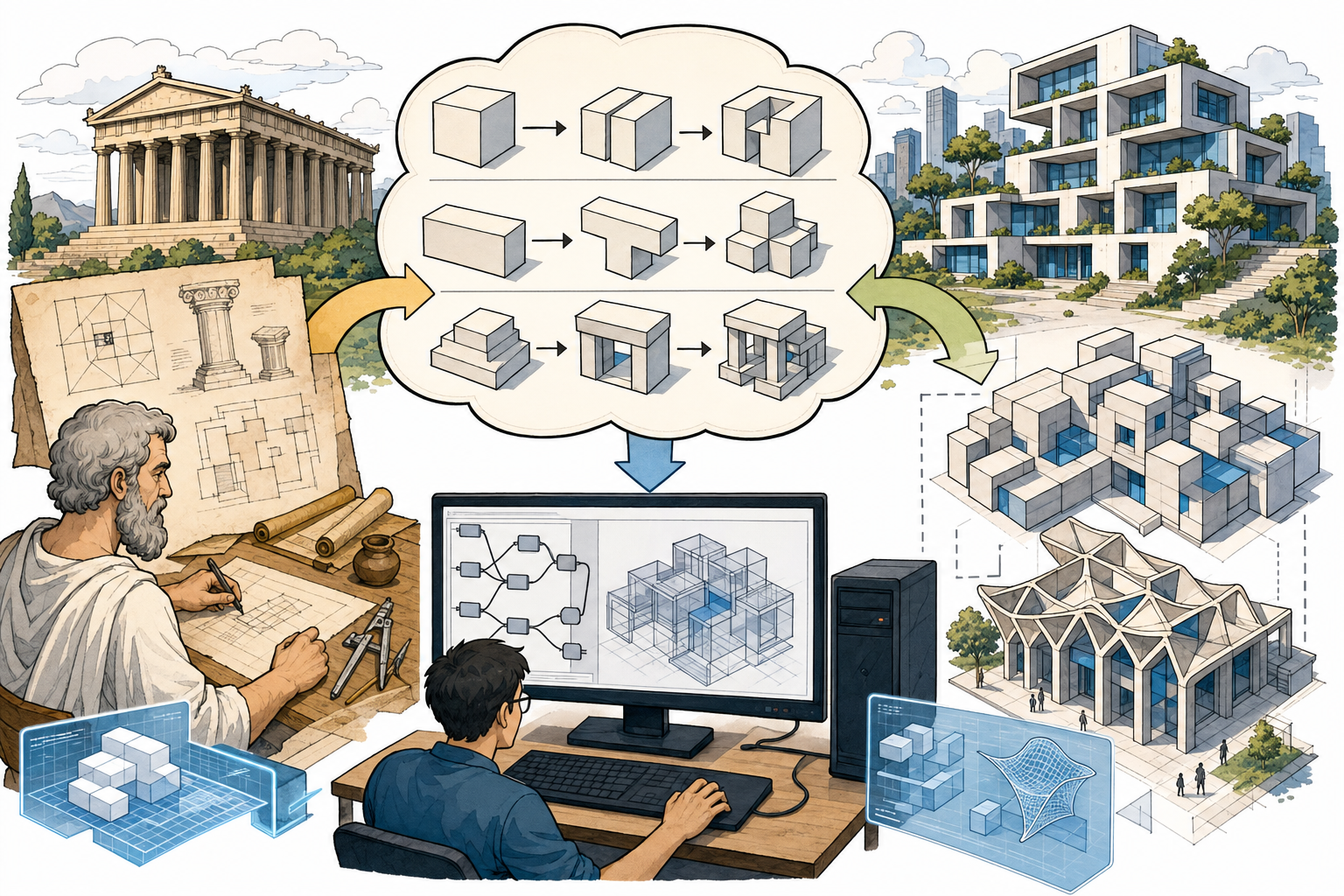
Shape grammars entered architectural thought as a deceptively simple proposition: designs could be generated by rules that act directly on visual forms. Unlike textual grammars, programming languages, or numerical optimization schemes, shape grammars treated lines, planes, boundaries, symmetries, and spatial arrangements as the material of computation. A grammar began with an initial shape and proceeded through a sequence of transformations, each rule recognizing part of a configuration and replacing, extending, dividing, mirroring, rotating, or otherwise modifying it. This mattered because architecture had long been discussed through style, taste, proportion, precedent, and composition, but not usually as a system of explicit visual operations. The great conceptual leap was that a villa plan, a lattice screen, a façade rhythm, or an urban block could be understood not only as a finished object, but as the visible trace of a generative process. In that sense, shape grammars were among the earliest serious attempts to make architectural creativity computational without reducing it to mere drafting.
From Chomsky’s Formal Grammars to Visual Computation
The intellectual background of shape grammars is often linked to Noam Chomsky’s work on formal grammars in linguistics, especially the idea that a complex language can be described through systems of production rules. Chomsky’s grammars explained how sentences could be generated from symbols according to formal constraints, and this provided a powerful metaphor for design researchers working in the late 1960s and early 1970s. George Stiny and James Gips transformed that metaphor into something more visual and architectural. Their 1972 work, commonly associated with “Shape Grammars and the Generative Specification of Painting and Sculpture,” argued that rules need not manipulate abstract symbols alone; they could manipulate shapes embedded in space. This was a decisive departure from ordinary symbolic computation. In a shape grammar, a line might be found as part of a larger line, a triangle might emerge from a configuration of intersecting strokes, and a subdivision might be recognized after earlier transformations created it. The grammar was not merely about naming pieces; it was about seeing relations.
Rules That Operate on What Designers See
The foundational idea was concise but profound: a design can be described as a starting shape plus a sequence of transformation rules. Yet the consequences of that idea were unusually rich because rules operated visually and spatially rather than only symbolically. In conventional programming, an object is typically identified by a variable, class, coordinate value, or data structure. In shape grammar theory, a rule may apply wherever a matching shape is perceived within a larger configuration, even if that shape was not explicitly stored as a separate object. This quality produced the famous issue of emergence, one of the most intellectually fertile and technically difficult aspects of the field. A designer might draw several lines for one reason and later discover that those lines also form a square, an axis, a boundary, or a proportional subdivision. Shape grammars embraced that ambiguity. They suggested that design intelligence often lies in recognizing new forms inside existing forms, something commercial drafting systems were never originally designed to support.
Why Architecture Was an Ideal Testing Ground
Architecture became an ideal domain for shape grammars because buildings are highly rule-bound yet rarely mechanical in a trivial sense. Classical architecture depends on orders, axes, bays, proportional systems, hierarchies, and symmetries. Vernacular architecture depends on repeatable spatial customs, construction constraints, climate responses, and craft traditions. Modern architecture often uses grids, modules, circulation diagrams, structural rhythms, and envelope systems. Shape grammars offered a way to describe these patterns without treating them as fixed templates. George Stiny’s later studies of Palladian villas, Chinese lattice designs, and other historical design languages showed that the method could expose deep compositional logics beneath apparently individual works. The attraction for architects was not simply automation, but explanation. A grammar could show how many members of a design family were related, how variation could occur without losing identity, and how historical styles might be reconstructed as operational systems. William J. Mitchell’s broader influence was crucial here, because his work connected computational design theory with architectural practice, education, representation, and emerging digital tools.
- George Stiny and James Gips established the theoretical basis for rules acting on shapes rather than only symbols.
- Noam Chomsky’s formal grammar theory provided an important intellectual precedent, even though shape grammars moved beyond language into visual form.
- William J. Mitchell helped position computational design as a serious architectural discourse, not merely a technical extension of drafting.
- Palladian villas and Chinese lattice designs became important examples because they showed how style could be analyzed as generative structure.
Shape Grammars as a Theory of Architectural Style
Style as a Rule System Rather Than a Label
Before shape grammars, architectural style was usually described through history, visual comparison, authorship, cultural context, material practice, and critical interpretation. A historian might describe Palladian architecture through symmetry, proportional room arrangements, temple fronts, central halls, and carefully ordered façades. A shape grammar researcher asked a different question: could those characteristics be encoded as rules that generate recognizable members of the same design family? This question transformed style from a label into a procedure. A Palladian villa could be studied as a system of proportional and spatial transformations, beginning from an organizing grid or central volume, then applying rules for room placement, axis formation, portico addition, stair positioning, and façade articulation. The point was not to claim that Andrea Palladio himself designed like a computer. Rather, the claim was that the resulting architectural language contained enough regularity to be described computationally. In this sense, shape grammars gave architectural style an operational definition: style became what a rule system could generate, constrain, recognize, and vary.
The Difference from Conventional CAD
The contrast with conventional CAD systems is essential to understanding why shape grammars were historically important. AutoCAD, introduced by Autodesk in 1982, became immensely influential because it digitized drafting practices around lines, arcs, layers, blocks, coordinates, dimensions, and plotted documentation. Early CAD improved precision, speed, revision control, and reproducibility, but it did not fundamentally ask where a design language came from. It represented decisions after they were made. Shape grammars, by contrast, focused on generation and design logic. They were less interested in drawing a wall line efficiently than in explaining why a wall might appear at that position within a family of possible plans. Later BIM systems such as Autodesk Revit shifted the industry from drafting primitives toward building objects with parametric relationships, but even BIM typically encodes construction components rather than visual emergence. Shape grammar theory therefore occupied a different intellectual territory. It treated architectural drawings not as static documentation, but as evolving fields in which new shapes, alignments, and spaces could be discovered through rule application.
Core Research Themes in Architectural Grammars
The research themes that developed around shape grammars were technically demanding and philosophically provocative. Rule application was central: a rule had to identify a subshape and transform it in a way that preserved or changed the design language. Spatial decomposition addressed how a whole could be divided into parts, whether rooms, bays, modules, structural zones, or façade fields. Symmetry and transformation linked the method to mathematics, geometry, and architectural composition, especially through reflection, rotation, translation, scaling, and proportional subdivision. Emergent shapes became especially important because they showed why shape grammars were not simply diagrammatic programming. If a configuration could contain unanticipated recognizable forms, then design computation had to account for perception, not only data storage. Researchers also studied design families and variation, asking how many different buildings could belong to the same language while maintaining recognizable identity. These themes remain visible in contemporary computational design: the persistent interest in systems, constraints, transformations, and alternatives owes much to early grammar-based thinking.
- Rule application defines how one spatial configuration is transformed into another.
- Spatial decomposition explains how wholes are divided into meaningful architectural parts.
- Symmetry and transformation connect design generation with geometry and proportion.
- Emergent shapes reveal forms that appear within larger configurations without being separately predeclared.
- Design families and variation explain how related buildings can differ while retaining a shared language.
Academic Contributors and Historical Appeal
Several academic figures shaped the development and interpretation of shape grammars in architecture. George Stiny remained the central theorist, not only because of the original work with James Gips, but because of his sustained investigations into calculation with shapes, visual ambiguity, and historical design languages. James Gips contributed to the early formalization that made the field intellectually credible beyond architectural intuition. William J. Mitchell helped connect these ideas to the broader evolution of computer-aided architectural design, particularly through his writing on design representation, logic, and digital practice. Terry Knight became especially important in the development of shape grammar theory and design education, showing how grammars could be used to teach students about rule systems, visual composition, and creative variation. José Duarte later advanced important work applying shape grammars to housing and architectural customization, connecting theoretical grammars to practical questions of adaptable design. Architectural historians found the method intriguing because it promised to reveal hidden compositional systems behind buildings, bridging historical analysis and computational generation without dismissing cultural meaning.
From Academic Concept to Design Software Influence
Why Shape Grammars Did Not Become Mainstream CAD
Shape grammars did not become mainstream CAD as a simple, direct software feature because the technical foundations of commercial CAD evolved in another direction. Early CAD companies built systems around drawing primitives, coordinate geometry, plotted output, file exchange, layers, blocks, and later object-based building models. These priorities matched the urgent professional needs of architects, engineers, manufacturers, and contractors: produce accurate drawings, manage revisions, coordinate documentation, and communicate geometry reliably. Shape grammar systems required something much more complex: recognition of subshapes, spatial relationships, transformations, ambiguity, and emergence. A CAD line segment might be stored as an entity with endpoints, but a shape grammar may need to see that several unrelated line segments also form a rectangle or suggest a latent axis. That kind of recognition is difficult to implement robustly in commercial software, especially when users expect predictability. The very qualities that made shape grammars powerful in design theory, particularly ambiguity and emergence, made them troublesome in production systems where repeatable behavior, documentation standards, and liability-sensitive precision were paramount.
The Indirect Influence on Software Culture
The influence of shape grammars was therefore more indirect, but deeply significant. They helped legitimize the idea that design software could generate form rather than merely record it. This idea slowly reappeared in parametric modeling, generative design, rule-based systems, procedural modeling, and computational design environments. In a parametric model, geometry changes according to relationships and constraints; in a grammar, geometry changes through rule application. These are not identical methods, but they share a rejection of fixed drafting as the sole purpose of design software. The same is true of generative design systems, which produce alternatives according to goals, constraints, or encoded procedures. Shape grammar theory anticipated the modern belief that a designer might define a design space rather than a single artifact. It also helped preserve attention to visual logic at a time when some computational methods leaned heavily toward numerical optimization. The legacy of shape grammars survives wherever architects use rules to produce families of forms rather than isolated drawings.
Connections to Later Tools and Platforms
Several later software platforms reflect grammar-like thinking even when they do not explicitly identify themselves as shape grammar systems. Bentley GenerativeComponents, associated with computational design workflows in the 2000s, allowed architects and engineers to define associative relationships among geometric elements, making it possible to generate variations through dependencies rather than manual redrawing. Autodesk Revit introduced a BIM environment where building components carry parameters and relationships, while Dynamo extended Revit through visual programming that can automate placement, transformation, and pattern generation. Rhino, developed by Robert McNeel & Associates, became a central geometric modeling environment for architects, and Grasshopper transformed it into a widely adopted visual computation platform. SideFX Houdini, originally known for procedural effects in media production, became increasingly relevant to architectural workflows because its node-based procedural logic can generate complex spatial systems, façades, landscapes, and urban forms. Esri CityEngine is particularly close to grammar-based design because it uses rule-based procedural modeling, especially through CGA rules, to generate urban environments and architectural masses from encoded spatial instructions.
- Bentley GenerativeComponents advanced associative and parametric design workflows for architecture and engineering.
- Autodesk Revit and Dynamo brought object-based modeling and visual programming into mainstream building design practice.
- Rhino and Grasshopper made computational design accessible to a large architectural community through flexible geometry and visual algorithms.
- SideFX Houdini demonstrated the power of procedural systems for architectural form, façades, environments, and urban-scale generation.
- Esri CityEngine remains one of the clearest commercial relatives of grammar-based design because of its explicit rule-based procedural modeling approach.
Architectural Applications of Grammar-Based Thinking
The architectural applications of grammar-based thinking are broad because buildings and cities are full of repeatable but variable structures. Housing layout generation is a natural domain: rooms, corridors, service zones, structural grids, daylight requirements, and user preferences can be organized through rules that produce multiple possible plans. Façade systems are equally suitable because they involve bays, panels, openings, shading devices, symmetry, rhythm, and local variation within an overall order. Urban morphology also benefits from grammar-like logic, since streets, parcels, blocks, setbacks, building heights, and public spaces often develop through procedural constraints rather than one-off decisions. Historic preservation and reconstruction can use grammar-based analysis to infer missing patterns, reconstruct likely configurations, or understand how a damaged or incomplete design belongs to a broader language. Mass customization in architecture also reflects this lineage: instead of producing one standard building or one bespoke object, designers can define controlled variation. In each of these applications, shape grammar thinking supports a shift from drawing individual outcomes to defining systems of possible outcomes.
The Persistent Problem of Emergence
Why Recognition Is Harder Than Drawing
One of the reasons shape grammars remain intellectually distinctive is that they expose a deep difference between drawing geometry and recognizing geometry. A computer can store a line, circle, spline, extrusion, or mesh face with precision, but recognition is a more difficult matter. Human designers see alignments, implied centers, nested figures, partial symmetries, proportional echoes, and incomplete patterns almost effortlessly. A shape grammar that aspires to operate visually must in some way imitate this perceptual flexibility. If a rule can apply to a square, should it also apply to a square embedded inside a larger grid? If a diagonal appears as part of two overlapping triangles, which triangle is the “real” one? If a façade contains a rhythm of windows interrupted by a door, does the rhythm continue through the interruption as an implied rule? These questions show why shape grammars were never merely another data model. They challenged the assumptions of CAD by insisting that what a drawing means may exceed what the software explicitly stores.
Ambiguity as a Design Strength
Commercial software usually tries to reduce ambiguity because ambiguity creates errors, unpredictable results, and support problems. Shape grammar theory, however, treats ambiguity as a source of design possibility. The same configuration can support multiple readings, and each reading may permit a different rule application. This resembles actual design practice more closely than many deterministic systems do. Architects frequently reinterpret a sketch: a circulation line becomes an axis, a structural grid becomes a façade rhythm, a courtyard becomes an organizing void, or an accidental alignment becomes a compositional device. Early sketching is productive precisely because marks are not yet overdetermined. Shape grammars gave formal language to this phenomenon by allowing shapes to emerge from other shapes without requiring every possible part to be named in advance. That is why the theory remains provocative in an era of BIM databases and parametric dependency graphs. A BIM object model is powerful when a wall is a wall and a door is a door, but shape grammar reminds us that design often begins before categories become stable.
The Relevance to AI-Assisted Design
The contemporary rise of AI-assisted design makes the older theoretical questions surrounding shape grammars newly relevant. Machine learning systems can generate plans, images, massing alternatives, and façade options, but they often struggle to explain their outputs in terms architects can inspect, modify, and trust. Shape grammars offer a contrasting tradition: generation through explicit rules that can be read, debated, revised, and historically interpreted. This does not mean that future design software must return to 1970s formalism. Rather, it suggests that the most useful design intelligence may combine statistical learning with interpretable visual rules. An AI system might learn patterns from large architectural datasets, but a grammar-like layer could constrain those patterns according to cultural style, spatial syntax, construction logic, or preservation requirements. The continuing relevance of George Stiny’s work lies partly in this insistence that computation need not be blind numerical processing. Rules can be visual, historical, and compositional. They can embody design knowledge in a form that is both generative and open to criticism.
Conclusion: Why Shape Grammars Still Matter
A Different Vision of Design Software
Shape grammars occupy a fascinating place in design software history because they were not merely a missing CAD feature or an academic curiosity. They represented a different way of thinking about what design software could be. Most commercial systems began by asking how computers could assist existing tasks: drafting, modeling, documenting, rendering, coordinating, simulating, and fabricating. Shape grammars asked a more fundamental question: what if the computer could participate in the logic of form generation itself? That question was ahead of its time, not because computers eventually “solved” creativity, but because the field recognized that design is procedural, visual, cultural, and rule-bound in subtle ways. The work of George Stiny, James Gips, William J. Mitchell, Terry Knight, José Duarte, and others showed that architectural form could be studied as a living language of transformations. Their ideas helped establish the intellectual foundation for later developments in parametric design, procedural modeling, and rule-based generation, even where direct technical continuity is difficult to trace.
Three Lasting Contributions
The lasting importance of shape grammars can be summarized through three major contributions. First, they showed that architectural style could be computationally described without reducing style to a checklist of decorative features. A style could be a system of possible transformations, not merely a catalog of appearances. Second, they helped establish rule-based generation as a serious design method, opening the door to later computational practices in which architects define relationships, constraints, and procedures rather than manually drafting every outcome. Third, they anticipated today’s interest in generative, parametric, and AI-assisted design by arguing that design alternatives can emerge from formal systems. These contributions remain important because architecture still struggles to balance automation with judgment. Software can generate thousands of options, but those options matter only when they participate in meaningful design languages. Shape grammars remind us that generation is not valuable simply because it produces more forms; it is valuable when it clarifies the rules, histories, and intentions behind form.
- They computationally described style as a generative system rather than a static historical category.
- They legitimized rule-based generation as a creative method for architectural design research and education.
- They anticipated contemporary computational practice, including parametric modeling, procedural urbanism, and AI-assisted design exploration.
The Enduring Historical Lesson
As architectural software moves further toward automation, optimization, machine learning, and integrated digital delivery, shape grammars offer an important historical lesson. Not all design rules are numerical constraints, performance targets, or database parameters. Some rules are visual, cultural, historical, and perceptual. A Palladian plan, a Chinese lattice, a housing layout, or a façade rhythm may contain forms of intelligence that are not fully captured by energy metrics, structural efficiency, or cost optimization. The history of shape grammars demonstrates that some of the most powerful ideas in design software did not begin as commercial tools. They began as attempts to understand creativity itself: how designers see, transform, reinterpret, repeat, and vary visual forms. That is why shape grammars still matter. They stand at the intersection of mathematics, architecture, computation, history, and perception, reminding us that the future of design software should not be measured only by speed or automation, but also by its ability to preserve and extend the richness of design thinking.
Also in Design News