Your Cart is Empty


Design Software History: Generative Design's Roots in Optimization and Topology Optimization
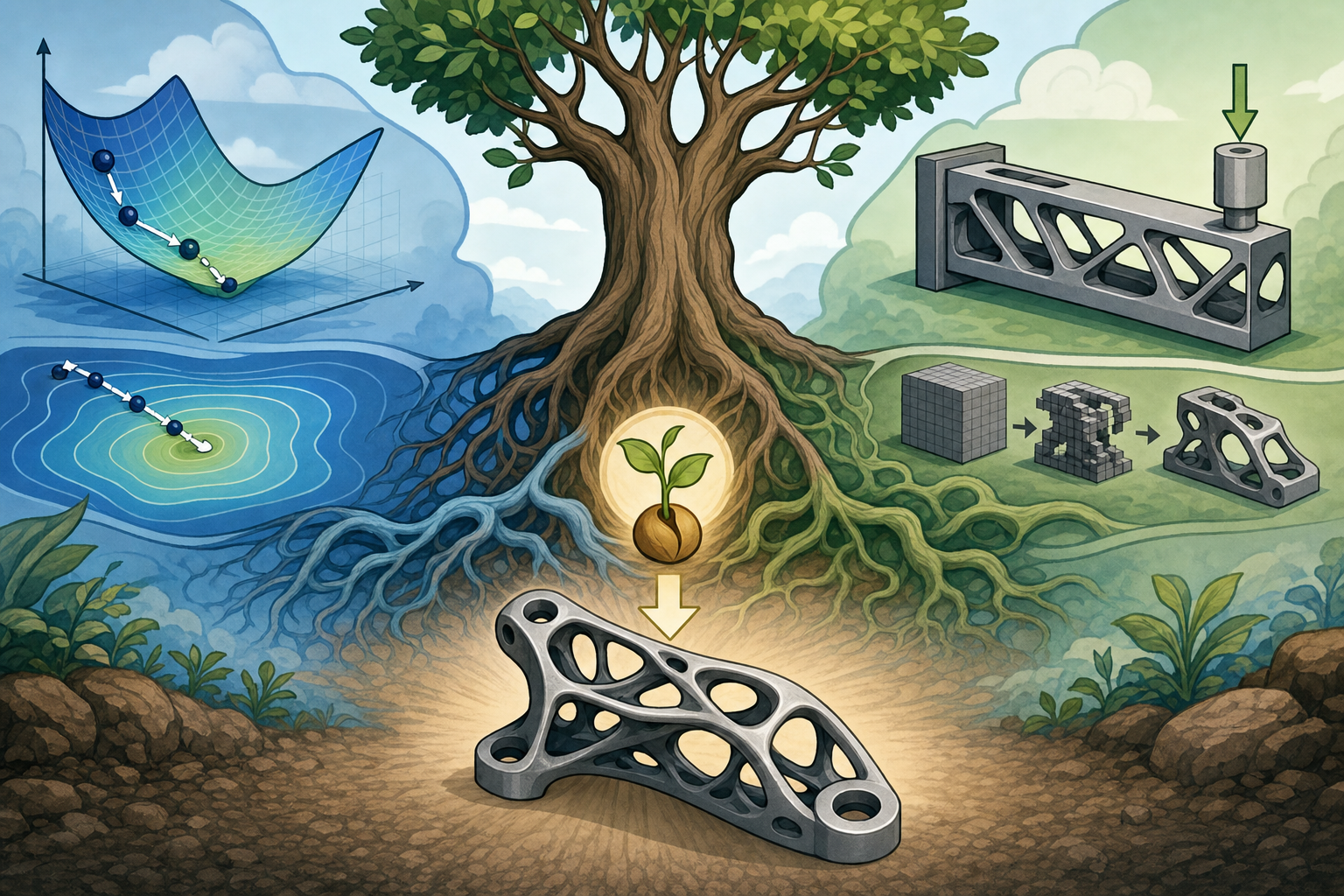


From Mathematical Optimization to Engineering Design
The Engineering Question Behind Generative Design
Generative design did not begin as a fashionable claim about machine creativity, nor did it emerge fully formed from contemporary artificial intelligence. Its deeper origin was a persistent engineering question: how can a computer search through many possible designs faster, more consistently, and more exhaustively than a human designer can manually model them? Long before the phrase generative design became common in CAD marketing, engineers, mathematicians, and operations researchers were already asking whether design could be formulated as a problem of variables, constraints, objectives, and trade-offs. The designer would not merely draw geometry; the designer would define what the object must do, what it must avoid, and what limits it must respect. The computer would then evaluate possibilities. That change sounds simple, but it represented a profound shift in the philosophy of design software, because it moved computation from passive assistance toward active exploration. Rather than using software only to document a chosen form, engineers began imagining software that could participate in the search for form itself.
Optimization Before CAD Geometry Became the Center
The intellectual roots of this idea reach into mid-20th-century mathematical optimization, especially linear programming, operations research, numerical analysis, and structural mechanics. George Dantzig’s development of the simplex method in the late 1940s at the RAND Corporation and the United States Air Force is one of the central landmarks, because it demonstrated that large allocation and planning problems could be transformed into computable mathematical procedures. Dantzig was not designing aircraft brackets or architectural components in the modern CAD sense, but his work helped establish a culture in which complex decision spaces could be systematically searched. Operations research groups working after World War II applied these ideas to logistics, scheduling, production planning, and resource allocation, while engineering analysts applied numerical methods to stress, vibration, heat transfer, and structural efficiency. Early computers were expensive, room-sized calculation engines, so their first role in engineering was not elegant visual modeling. Their role was arithmetic power: solving systems of equations, iterating approximations, and producing results that would have been painfully slow by hand.
- Linear programming showed that practical problems could be expressed as objectives and constraints.
- Operations research provided a disciplined vocabulary for trade-offs, feasibility, and optimality.
- Structural engineering computation supplied the mechanical questions that later design software would automate.
- Numerical methods made iterative search possible before interactive CAD modeling was mature.
From Analysis of a Form to Discovery of a Form
The early history of CAD followed a different but eventually converging path. Systems such as Ivan Sutherland’s Sketchpad at MIT in 1963 showed that computers could support interactive graphical construction, constraints, and geometric relationships. Later commercial CAD systems from companies such as Computervision, Applicon, Intergraph, and eventually Dassault Systèmes, PTC, Siemens, Autodesk, and others turned computer graphics into industrial drafting and modeling infrastructure. Yet traditional CAD was largely descriptive: the human designer decided what a part should look like, then used software to represent it accurately. Optimization research asked a more unsettling question: could software help discover what the part should look like before the designer committed to a geometry? This is the essential historical divide. Simulation asks, “Will this design work?” Optimization asks, “What design works best under these constraints?” In simulation, geometry comes first and performance evaluation follows. In optimization, performance targets, loads, materials, manufacturing limits, and boundary conditions may guide the creation or transformation of geometry itself.
The Language of Objectives, Constraints, and Variables
This distinction gave design software a new grammar. A design could be treated as a set of variables: thicknesses, radii, hole positions, material densities, beam cross-sections, shell dimensions, lattice parameters, or surface boundaries. It could be governed by constraints: maximum displacement, allowable stress, vibration frequency, buckling resistance, thermal performance, cost, mass, manufacturability, or safety factor. It could then be judged by objectives: minimize weight, maximize stiffness, reduce pressure drop, improve heat exchange, lower material usage, or satisfy several competing goals at once. This structure was familiar to mathematical programming researchers but alien to many drafting-centered workflows. It required engineers to think less like geometric authors and more like problem formulators. In that sense, generative design is historically closer to optimization and simulation than to artistic automation. It is not simply a computer inventing shapes. It is a computer exploring a mathematically framed design space according to rules, penalties, target functions, and engineering evidence generated through repeated calculation.
Topology Optimization and the Search for Better Structures
Beyond Size and Shape Optimization
Topology optimization became one of the most important technical ancestors of modern generative design because it changed what could be optimized. Earlier structural optimization methods often focused on size optimization, where the dimensions of known elements were adjusted: a beam became thicker or thinner, a shell changed gauge, a rib changed depth, or a truss member changed cross-sectional area. Shape optimization moved further by changing boundaries, curves, and profiles while preserving the general layout of the design. Topology optimization went deeper still. It asked where material should exist at all. Instead of merely refining an existing arrangement, it allowed the computational process to alter the pattern of material and void inside a defined design space. That step was historically important because it made optimization visually dramatic. The output no longer resembled a polished version of the engineer’s first sketch. It could look like a branching bone, a root system, a coral-like lattice, or an asymmetric web following hidden stress pathways through space.
Bendsøe, Kikuchi, and the Modern Formulation
A landmark moment came in 1988 when Martin P. Bendsøe and Noboru Kikuchi published influential work that helped define the modern topology optimization problem using homogenization methods. Bendsøe, associated with the Technical University of Denmark, became one of the field’s defining figures, while Kikuchi at the University of Michigan contributed to the bridge between mathematical methods and engineering mechanics. Their work did not appear from nowhere; it built on structural optimization, variational methods, continuum mechanics, and finite element computation. But it gave researchers a powerful formulation for treating material distribution as the design problem itself. Later, Ole Sigmund, also at the Technical University of Denmark, became a crucial contributor through influential research, educational explanations, and benchmark examples that made topology optimization more widely understandable and implementable. Sigmund’s work on methods such as SIMP, the Solid Isotropic Material with Penalization approach, became especially important because it offered a practical way to drive material density toward solid or void states inside finite element models.
- Size optimization changes dimensions within an already chosen structural layout.
- Shape optimization moves boundaries while retaining the basic topology of the part.
- Topology optimization changes the material layout, allowing holes, branches, and new load paths to emerge.
- SIMP methods helped make density-based topology optimization practical for engineering computation.
How the Material Removal Logic Works
The basic idea can be explained without reducing its mathematical sophistication. The engineer begins with a design region, sometimes called the design space, that is initially filled with material or represented as a field of possible material density. The engineer then defines non-design regions that must remain untouched, such as mounting holes, bearing interfaces, sealing surfaces, or connection pads. Loads, supports, symmetry conditions, manufacturing limits, and objectives are applied. The software divides the domain into finite elements, calculates how the structure carries load, and progressively penalizes inefficient material. Material that contributes little to stiffness or strength may be removed or reduced, while material that carries critical load paths is preserved. The resulting structure can be extremely efficient because it is not constrained by the visual conventions of machined blocks, plates, or standard ribs. The algorithm is not imitating nature in a poetic sense, although the results may look natural. It is following energy, compliance, stress, or related mechanical measures through computational iteration.
Why the Results Looked Strange to Engineers
For many engineers trained in drafting rooms and machine shops, early topology optimization outputs looked strange, even suspicious. Traditional manufacturing rewarded straight cuts, flat faces, prismatic stock, accessible tools, uniform wall thicknesses, and features that could be dimensioned cleanly on drawings. Topology optimization often produced curved, branching members and complex internal voids that seemed closer to trabecular bone than to milled aluminum. These forms were mathematically meaningful because they aligned material with the paths where force actually traveled, but they were awkward to manufacture by conventional means. A machinist with a three-axis mill could not easily create a deeply organic truss hidden inside an enclosed volume. A casting engineer might appreciate the continuity but still worry about tooling, draft angles, cores, shrinkage, and inspection. This disconnect created a historical lag: the mathematics could propose efficient forms before factories could conveniently make them. That gap between computational possibility and manufacturing reality is one reason topology optimization remained, for many years, more influential in specialized engineering than in everyday product development.
From Research Code to Commercial Design Software
Migration from Universities to Engineering Platforms
The movement from research code to commercial software required much more than clever algorithms. It demanded robust finite element solvers, interfaces that practicing engineers could trust, geometry pipelines that connected analysis mesh results back to CAD, and organizations willing to redesign their workflows around iterative computation. Academic prototypes could demonstrate ideas, but aerospace, automotive, defense, and high-performance mechanical engineering teams needed reliability, traceability, documentation, and integration with existing analysis procedures. These industries had strong incentives because weight reduction, stiffness improvement, vibration control, and material savings could produce large economic or performance benefits. A lighter aircraft component could reduce fuel consumption; a stiffer vehicle structure could improve handling or crash performance; a defense application could benefit from specialized load paths and mass reduction. In these environments, optimization did not have to replace human engineering judgment. It became part of a disciplined loop in which analysts used computation to expose options that would be difficult to invent manually, then interpreted, simplified, validated, and redesigned those outputs for production.
Altair, MSC, and the CAE-Centered Lineage
Altair played a central role in the commercialization of structural optimization, especially through OptiStruct, which became one of the most recognized industrial tools for topology optimization and related methods. Founded in 1985 by James R. Scapa, George Christ, and Mark Kistner, Altair grew around simulation, optimization, and engineering software rather than conventional drafting. That background mattered because topology optimization was fundamentally tied to analysis loops. MSC Software, whose history includes NASTRAN and a long association with finite element analysis in aerospace and mechanical engineering, also belongs in this lineage because commercial structural optimization depended on mature simulation workflows. NASTRAN itself originated in the late 1960s through NASA-supported development and became a cornerstone of structural analysis. Companies such as Dassault Systèmes, Siemens, PTC, and Autodesk later integrated optimization capabilities into broader CAD and CAE environments, but the technical culture behind generative design was strongly shaped by CAE specialists. The real engine of generative design was repeated simulation, not merely parametric modeling or graphical variation.
- Altair OptiStruct helped establish topology optimization as a practical industrial engineering tool.
- MSC Software contributed to structural analysis workflows that made optimization credible in demanding industries.
- Dassault Systèmes connected optimization to broader 3D design and simulation environments through the CATIA and SIMULIA ecosystem.
- Siemens advanced integrated CAD, CAE, and lifecycle workflows through NX, Simcenter, and related technologies.
- PTC linked parametric modeling traditions with simulation-driven design through Creo and associated extensions.
- Autodesk popularized the language of generative design for many designers through Fusion 360.
Finite Element Analysis as the Computational Backbone
Finite element analysis supplied the computational backbone because every candidate design had to be evaluated against physical behavior. In structural problems, the software needed to know how a proposed distribution of material responded to loads and supports. That meant solving large systems of equations describing displacement, strain, stress, and energy across a discretized model. Optimization then wrapped around that solver, modifying design variables and running another analysis. The process could repeat dozens, hundreds, or thousands of times depending on the method and complexity. This is why generative design belongs as much to the history of CAE as to the history of CAD. CAD systems traditionally emphasized geometric precision, feature history, drawings, assemblies, and manufacturable definition. Optimization emphasized the loop: propose, analyze, evaluate, update, repeat. When these worlds merged, design software became more than a modeling surface. It became a search environment where geometry was shaped by evidence from simulation. That merger required advances in meshing, solver performance, sensitivity analysis, constraint handling, and result interpretation.
The Manufacturing Bottleneck Before Additive Processes
For decades, the biggest obstacle was not whether optimization could find interesting forms, but whether industry could manufacture them economically. Conventional CNC machining is extraordinarily powerful, but it has preferences. It favors stock material, tool access, fixturing, cutter reach, stable setups, recognizable pockets, fillets, holes, and surfaces that can be generated by subtractive tool motion. Many optimized structures violated these assumptions by placing material only where physically useful, leaving voids and undercuts where tools could not reach. Casting offered greater geometric freedom, especially for complex structural shapes, but it introduced its own constraints: mold parting lines, draft, cores, gating, shrinkage, porosity risk, minimum section thickness, tooling cost, and quality inspection. Forging and stamping imposed still different limits. Consequently, engineers often used topology optimization as a guide rather than as direct geometry. They would study the computed load paths, then remodel a manufacturable approximation using ribs, bosses, webs, shells, and machined features. The optimized output functioned as insight, not always as a production-ready part.
Additive Manufacturing Changed the Practical Imagination
Additive manufacturing changed the practical imagination because it reduced the penalty for geometric complexity. Powder bed fusion, directed energy deposition, binder jetting, stereolithography, selective laser sintering, and other processes each have limitations, but they made it realistic to produce structures with organic branches, internal channels, graded thicknesses, lattice regions, and irregular load paths that would be impossible or uneconomical by traditional machining. Aerospace engineers, medical implant designers, motorsport teams, and advanced product developers quickly recognized the connection between topology optimization and 3D printing. Lightweight brackets, heat exchangers, orthopedic implants, and fluid manifolds became emblematic of this new relationship because they benefited from weight reduction, functional integration, and complex internal geometry. Companies such as GE Additive, EOS, 3D Systems, Stratasys, Renishaw, Materialise, and Desktop Metal helped industrialize different parts of this ecosystem. Additive manufacturing did not remove engineering discipline; it added new constraints involving supports, residual stress, build orientation, powder removal, surface finish, qualification, and inspection. But it made simulation-driven geometry far more credible as manufacturable geometry.
Conclusion: Generative Design as the Meeting Point of CAD, CAE, and Manufacturing
A Convergence Built Over Decades
Generative design emerged from decades of optimization research, not suddenly from modern AI. Its history combines mathematical programming, structural optimization, finite element analysis, CAD geometry, additive manufacturing, and cloud computing. Each stream solved part of the puzzle. Mathematical optimization provided the concepts of objectives, constraints, variables, feasibility, and convergence. Structural optimization showed how those ideas could apply to load-bearing forms. Finite element analysis supplied numerical evidence about whether changing geometry helped or harmed performance. CAD provided the geometric language needed to define, edit, communicate, and manufacture designs. Additive manufacturing widened the range of shapes that could plausibly leave the computer screen and become physical objects. Cloud computing later made large design-space exploration more accessible by distributing computation across scalable infrastructure. The modern user may see a polished interface that produces multiple design alternatives, but underneath that interface is a historical stack of engineering computation. The novelty is not only visual output; it is the integration of many older technologies into a more active design workflow.
The Philosophical Change in Design Software
The major change was philosophical. CAD began largely as a tool for documenting human intent, replacing manual drafting with digital lines, surfaces, solids, features, assemblies, and drawings. Over time it became parametric, associative, constraint-based, and integrated with product lifecycle management, but the central assumption often remained that the human designer chose the form. Generative design altered the relationship. Software became a participant in proposing alternatives, especially when the designer defined goals rather than prescribing every piece of geometry. This does not make the engineer irrelevant. In fact, it often demands more expertise, because the quality of the outcome depends heavily on how the problem is formulated: what loads are included, what constraints are realistic, which manufacturing process is assumed, how safety factors are handled, and how results are validated. Generative design transfers effort from manual modeling toward problem definition, interpretation, and decision-making. That transfer is one of the most important historical consequences of the field, because it changes what expertise looks like inside design organizations.
- The designer defines requirements, constraints, and acceptable trade-offs.
- The software searches alternatives through simulation, optimization, or rule-based exploration.
- The engineer evaluates outputs for performance, manufacturability, cost, safety, and maintainability.
- The final geometry usually requires refinement, validation, documentation, and production planning.
The Modern Software Landscape
The contemporary software landscape reflects this convergence. Autodesk Fusion 360 popularized the term generative design for many users by presenting cloud-based exploration of manufacturing-aware alternatives inside an accessible CAD/CAM environment. Siemens has pursued related directions through NX, Simcenter, and broader digital industry workflows where simulation, manufacturing planning, and lifecycle data are connected. Dassault Systèmes has linked design exploration with CATIA, SIMULIA, and the 3DEXPERIENCE platform, emphasizing enterprise-scale integration of modeling, analysis, and collaboration. PTC has advanced simulation-driven design inside Creo, including generative and real-time analysis capabilities shaped by its long parametric modeling heritage. Altair continues to represent the CAE-driven tradition through optimization and simulation platforms, while nTopology has become especially influential in advanced geometry, implicit modeling, lattices, field-driven design, and additive manufacturing preparation. These companies do not all use the same vocabulary or technical approach, but they share an underlying direction: design software is becoming less about isolated geometry creation and more about computational exploration constrained by physics, manufacturing, and performance goals.
The Historical Insight That Matters Most
The central historical insight is that generative design is not simply about producing unusual shapes. The bone-like brackets, branching supports, lattice interiors, and sculptural mechanical forms are visually memorable, but the deeper transformation lies elsewhere. Generative design represents a shift from drawing tools to search systems, from geometry documentation to engineering exploration, and from a single modeled answer to a field of evaluated possibilities. Its roots in George Dantzig’s optimization culture, finite element analysis, Bendsøe and Kikuchi’s topology optimization formulations, Ole Sigmund’s practical and educational influence, Altair’s commercialization of structural optimization, and the CAD platforms of Autodesk, Siemens, Dassault Systèmes, PTC, and others reveal a long technical evolution rather than a short-lived software trend. The field matters because it changes the role of the computer in design history. The computer is no longer only a fast drafting table, a numerical calculator, or a realistic renderer. It has become a structured search partner that helps explore what engineering geometry could become under the combined pressure of physics, constraints, manufacturing, and human judgment.
Also in Design News