Your Cart is Empty


Design Review Data Management in CAD, BIM, and Visualization Workflows
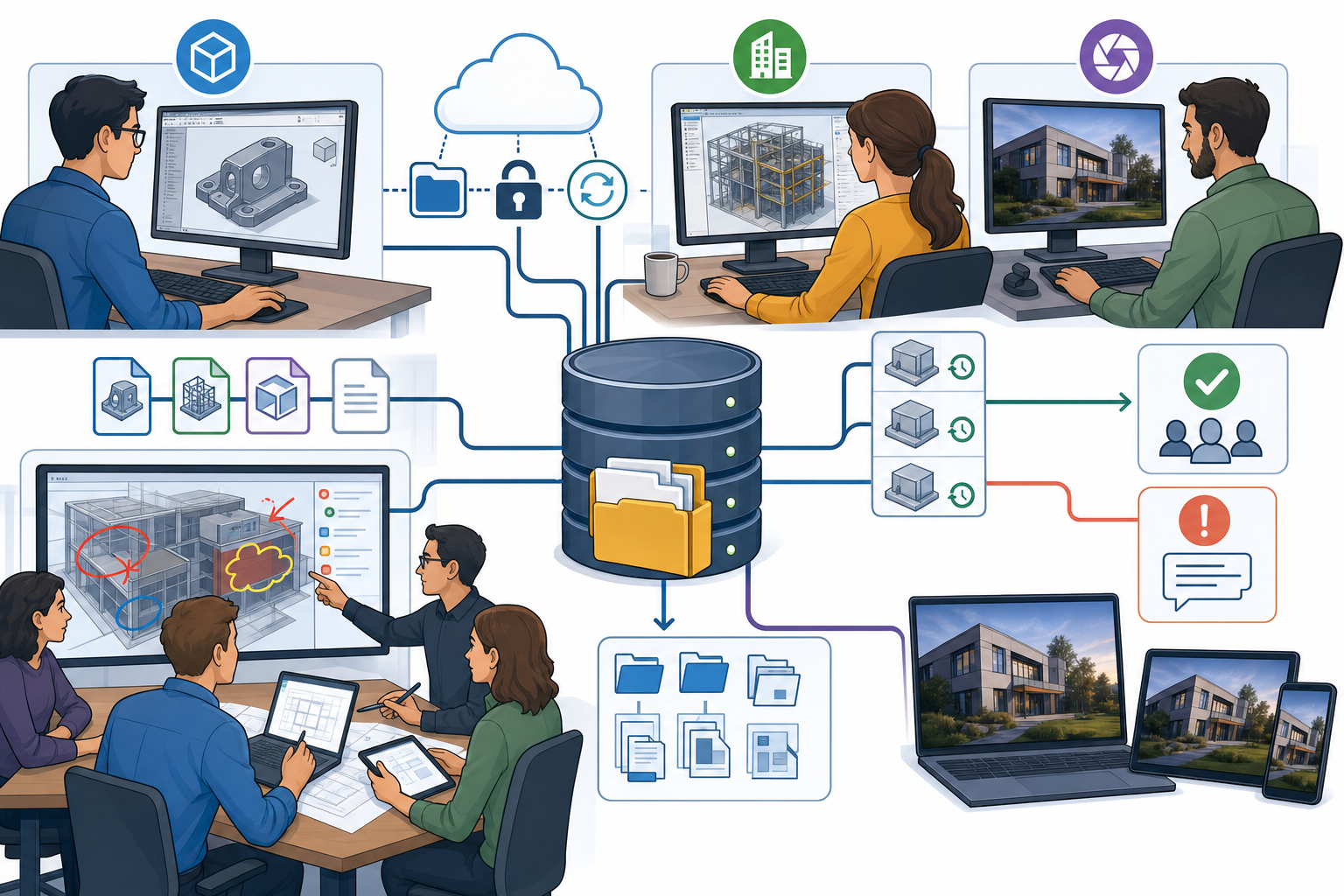


Why Design Review Is Becoming a Data Problem
Review Is No Longer Confined to the Meeting Room
Design review used to be treated as a scheduled event: gather stakeholders, display drawings or models, collect comments, assign a few actions, and move on. That model now struggles because design activity has become continuous, distributed, simulation-driven, and highly dependent on rapidly changing digital assets. A mechanical assembly may evolve hourly in cloud CAD, a building information model may receive input from architects, structural engineers, contractors, and sustainability consultants across time zones, and a product visualization team may generate multiple material, lighting, and configuration variants before engineering has frozen the geometry. In this environment, review is no longer a meeting; it is a software-mediated decision process. The real challenge is not simply seeing the model together, but preserving the meaning of every comment, every rejected alternative, every tolerance concern, and every approval condition as the design changes. When feedback is detached from the model and treated as conversation rather than structured data, organizations lose the ability to understand how and why the design reached its current state.
Fragmented Feedback Creates Fragmented Accountability
The most common failure in traditional review workflows is not lack of communication; it is lack of durable context. A reviewer may identify a clearance issue in a 3D model, but the comment is sent by email with a screenshot that does not specify the exact model version. Another stakeholder may add a markup to a PDF export, while a project manager records the decision in meeting minutes stored in a separate document repository. A supplier may raise manufacturability concerns in a spreadsheet, while a simulation engineer documents stress concentration risks inside an analysis report. Each of these artifacts may be useful on its own, but together they form a fragmented decision trail that is difficult to audit, automate, or learn from. The cost appears later, when teams ask basic questions such as who requested a geometry change, whether an issue was actually resolved, why a specific material was chosen, or whether a compliance comment applied to the current revision or an obsolete one. The review process then becomes dependent on institutional memory instead of traceable design intelligence.
The Review Object Is Becoming More Complex
Modern review is not only about geometry; it is about the relationship between geometry, requirements, performance evidence, cost targets, supply constraints, regulatory obligations, user experience, carbon impact, and manufacturing readiness. A design comment that says “increase thickness here” is incomplete unless the system can connect it to the affected surface, the structural requirement it supports, the simulation result that justifies it, the mass penalty it introduces, and the downstream tooling implication it may create. Similarly, a BIM coordination note about moving a duct is not merely a visual issue; it may affect fire rating, ceiling height, prefabrication sequencing, acoustic performance, and maintenance clearance. As models become richer, review comments must become richer as well. Advanced teams increasingly need review environments that know who commented, what object was affected, which version was active, what discipline owns the response, what evidence supports the decision, and whether the issue is unresolved, approved, deferred, or superseded by a later design move.
From Visual Feedback to Structured Design Intelligence
The transition now underway can be described as a movement from visual feedback toward structured design intelligence. Visual feedback tells a designer that something may be wrong; structured intelligence captures the issue in a way that software can sort, query, validate, summarize, and connect to other consequences. This is where design review begins to resemble a data problem. A comment is not just text; it has authorship, timestamp, object reference, spatial location, severity, discipline category, lifecycle stage, approval state, and dependency links. When review systems capture these attributes consistently, they enable much more advanced workflows. Teams can filter unresolved safety concerns, identify all comments tied to a supplier constraint, compare review density across subsystems, or determine whether late-stage changes are concentrated around certain requirements. The practical value is substantial because review data becomes reusable knowledge rather than one-time conversation. Instead of asking people to remember why a decision happened, the software can present the chain of reasoning, affected assets, and unresolved uncertainties directly inside the design environment.
- Comment authorship: identifies who raised the issue and who approved the resolution.
- Geometry association: links feedback to faces, features, parts, assemblies, spaces, or BIM elements.
- Version awareness: records which model state the comment refers to.
- Resolution status: distinguishes open, rejected, deferred, superseded, and approved decisions.
- Decision rationale: captures the evidence or constraint that drove the final outcome.
Annotation as a Connected Layer Over the Design Model
Annotations Are Becoming Intelligent Design Objects
In many current tools, annotations still behave like digital versions of sticky notes: useful, visible, and easy to create, but limited in their relationship to the model. The next generation of review environments will treat annotations as intelligent objects that live as a connected layer over CAD, BIM, mesh, visualization, and simulation data. An annotation attached to a fillet, facade panel, bracket, printed lattice, or MEP component should carry persistent identity, not merely screen coordinates. It should understand whether it refers to a face, a feature, a component instance, a requirement, a drawing dimension, a manufacturing operation, or a construction sequence. This shift is especially important as teams move between parametric CAD, direct modeling, generative design outputs, scan-derived geometry, real-time rendering platforms, and immersive review environments. A comment that survives only in one viewport is too fragile. A useful annotation must remain meaningful across model states, display modes, downstream exports, and collaborative platforms, becoming part of the digital thread rather than a temporary overlay.
3D Markups Need Spatial and Semantic Persistence
Spatial persistence means the annotation stays attached to the intended design object even when geometry is updated. Semantic persistence means the system understands why the annotation exists and what type of issue it represents. For example, if a reviewer marks a small radius as a potential machining problem, the annotation should not only point to the edge; it should also carry a manufacturing tag, a severity level, a recommended minimum tool radius, and a link to the relevant machining constraint. If a sustainability consultant flags a material region, the annotation should know whether the concern relates to embodied carbon, recyclability, volatile organic compounds, or end-of-life disassembly. In architectural design, an annotation attached to a room boundary might relate to code compliance, accessibility, daylight availability, or equipment clearance. This combination of location and meaning is what allows review data to become computationally useful. Without semantic structure, annotations remain human-readable but machine-opaque, limiting their value for analytics, automation, and AI-assisted decision support.
Input Methods Will Broaden Beyond Text Markups
The annotation layer will also become more multimodal. Design feedback is often easier to express through voice, gesture, sketch, augmented reality, video capture, or immersive walkthrough than through typed comments. A manufacturing engineer standing near a shop-floor fixture may record a voice note while pointing to a problematic assembly sequence in AR. An architect may sketch daylight concerns over a real-time visualized interior. A surgeon reviewing a custom medical device may use a pen stroke over a 3D anatomical model to explain ergonomic reach. A product designer may record a short turntable video identifying reflection quality, parting line visibility, or color mismatch across materials. The future review platform must convert these varied inputs into structured, searchable, model-linked annotations. That does not mean eliminating human nuance; it means preserving nuance while adding metadata. A voice note can be transcribed, tagged, assigned, and linked to geometry. A video annotation can be indexed to a model state, camera position, and affected component. A sketch can become a spatially anchored issue with ownership and resolution status.
- Voice annotations: useful for fast expert feedback during walkthroughs, shop-floor reviews, or field inspections.
- Sketch markups: effective for proposing shape changes, clearances, motion paths, and interface adjustments.
- AR annotations: valuable when comparing digital intent with physical prototypes, construction progress, or installed equipment.
- Video feedback: powerful for product visualization, animation review, assembly sequencing, and experiential evaluation.
- Semantic tags: essential for classifying issues by cost, safety, compliance, sustainability, ergonomics, or manufacturability.
The Hard Problem: Maintaining Annotation Accuracy
The most difficult technical challenge is maintaining accuracy when the underlying model changes. Parametric edits can rename topology, suppress features, reorder history, replace components, or regenerate faces in ways that break naive annotation references. In BIM, elements may be split, merged, demolished, phased, or reclassified. In additive manufacturing workflows, lattice regions, supports, orientation changes, and compensation geometry may evolve across build-preparation iterations. If the review system cannot determine whether an annotation still points to the correct object, it risks creating false confidence. A comment may appear resolved simply because the geometry disappeared, or it may remain attached to a nearby but incorrect surface after regeneration. Advanced tools need robust reference strategies that combine persistent IDs, geometric similarity, feature intent, assembly hierarchy, spatial coordinates, and change-detection algorithms. They should also expose uncertainty. If a markup cannot be confidently reattached after an update, the platform should flag it as potentially orphaned rather than silently misplacing it. In high-stakes design environments, inaccurate feedback can be more dangerous than missing feedback.
Practical Implications for CAD, BIM, and Visualization Teams
For CAD teams, connected annotations can reduce the gap between design critique and engineering action. A tolerance concern can be linked directly to the feature tree, a drawing dimension, or a manufacturing process note. For BIM teams, connected comments can bring coordination, code review, and constructability feedback into proximity with the objects they affect, reducing ambiguity between visual markup and model responsibility. For product visualization teams, annotations can clarify whether feedback concerns design intent, material assignment, lighting, camera treatment, animation timing, or marketing interpretation. The practical rule is simple: feedback should be captured as close as possible to the asset it affects, with enough structure to remain meaningful when the asset evolves. This approach reduces rework because designers do not waste time interpreting ambiguous screenshots or reconstructing meeting conversations. It also strengthens decision quality because reviewers can see the full context of an issue, including previous comments, related constraints, and the status of dependent changes. The annotation layer becomes not decoration, but a working interface for design governance.
Tracking Decisions Across Versions, Disciplines, and Stakeholders
Review History Must Become Version-Aware
Version awareness is one of the defining requirements of future design review software. In fast-moving projects, feedback without version context is often unreliable. A reviewer may approve a housing layout in one iteration, but a later edit to wall thickness, fastening strategy, or internal component position may invalidate that approval. A lighting designer may approve a rendered material under one geometry configuration, only to find that a subdivision or bevel change alters highlight behavior. A structural engineer may close a coordination issue after a beam moves, but a subsequent architectural adjustment may reintroduce the conflict. Review systems must therefore treat approvals and comments as conditional on specific model states. Version-aware review history allows teams to ask whether an issue was resolved in the current version, whether it reappeared after a merge, or whether an approval is no longer valid because a dependent object changed. This is the difference between static documentation and living traceability, where decisions remain connected to the evolving design rather than frozen in disconnected archives.
Ownership and Priority Create Actionable Feedback
Tracking decisions also requires clear ownership. A comment that does not identify a responsible person, discipline, or role is easy to acknowledge and easier to ignore. Advanced review systems should allow issues to be assigned to owners, routed through approval stages, prioritized according to risk, and connected to deadlines or project milestones. Priority should not be a vague label; it should reflect impact on safety, compliance, cost, schedule, user experience, manufacturing readiness, or downstream dependency. A low-visibility issue may be high priority if it affects certification, tooling, or procurement. Conversely, a highly visible aesthetic concern may be lower priority if it belongs to an exploratory visualization phase. Ownership and priority transform review from passive commentary into operational workflow. They also help teams distinguish between open discussion and committed action. When a decision requires engineering change, procurement validation, simulation rerun, or client approval, the review environment should make that chain explicit. Otherwise, teams confuse agreement in conversation with completion in execution.
- Assigned owner: identifies who must respond or coordinate the resolution.
- Approval state: shows whether the item is proposed, under review, accepted, rejected, deferred, or superseded.
- Priority level: communicates urgency and potential impact.
- Due date or milestone: connects the issue to delivery planning.
- Dependency links: reveal related requirements, simulations, suppliers, drawings, or manufacturing constraints.
Asynchronous Teams Need Stronger Decision Infrastructure
Distributed design teams make tracking even more important because decisions happen asynchronously. A designer in one region may upload a model revision while a supplier in another region comments on tooling feasibility, and a simulation analyst may later discover that the change invalidated a previous result. Without a shared decision infrastructure, asynchronous collaboration can create parallel realities: different stakeholders believe different things are approved, unresolved, or obsolete. The solution is not more meetings; it is a review system that maintains a common state of truth. Each stakeholder should be able to see the latest relevant model, the open issues they own, the approvals that depend on their input, and the decisions that have been made since their last interaction. Notifications alone are insufficient because they often increase noise. What teams need is contextual signal: what changed, why it matters to my discipline, what action is required, and what evidence is available. This is where review software becomes a coordination mechanism rather than a comment repository.
Review Is Merging with PLM and Requirements Management
The boundary between design review, product lifecycle management, and requirements management is becoming thinner. A high-quality review environment should link comments not only to model geometry but also to engineering requirements, bill of materials items, supplier quotes, simulation results, inspection plans, sustainability targets, and manufacturing constraints. If a reviewer asks to reduce part count, the system should be able to show affected BOM items, assembly labor implications, procurement dependencies, and possible serviceability trade-offs. If a BIM reviewer flags an egress issue, the comment should connect to code requirements, occupancy assumptions, design alternatives, and approval documentation. If an additive manufacturing engineer identifies support-removal difficulty, the issue should connect to build orientation, material behavior, post-processing access, and surface finish targets. This integrated approach makes review part of the broader lifecycle intelligence system. Decisions are no longer isolated design opinions; they become linked nodes in a network of requirements, constraints, evidence, and outcomes. That network is essential for developing products and buildings under increasing complexity and accountability.
Simulation and Manufacturing Feedback Must Be Traceable
Simulation validation and manufacturing readiness checks are especially important because they often reveal issues that are invisible in ordinary visual review. A part may look acceptable but fail fatigue criteria, exceed thermal limits, require impossible tool access, or create unacceptable support structures in additive manufacturing. A building system may appear coordinated but fail pressure loss, acoustic, structural, or energy performance targets. Future review platforms should allow simulation results and manufacturability feedback to enter the same issue-tracking environment as design comments. When an analyst flags a stress concentration, the comment should reference the load case, mesh version, boundary conditions, solver result, and affected geometry. When a manufacturing engineer flags a casting, machining, molding, or printing constraint, the issue should link to process assumptions, supplier capability, cost impact, and required design change. This traceability reduces the risk of treating simulation and manufacturing as separate validation gates at the end of design. Instead, they become continuous contributors to review, helping teams make better decisions earlier.
From Markup Tools to Decision Intelligence
Analytics Will Reveal Patterns Humans Miss
The future of design review is not simply better annotation; it is better decision intelligence. Once comments, markups, approvals, and rationale are captured as structured data, analytics can reveal patterns that are difficult to detect through manual review. A platform may identify that a specific subsystem repeatedly attracts late-stage manufacturability comments, suggesting that design rules or supplier constraints are not being considered early enough. It may show that certain approval workflows consistently stall at the same discipline, indicating overloaded reviewers or unclear responsibility. It may highlight unresolved conflicts where one stakeholder approved a change for cost reduction while another rejected it for performance reasons. It may detect components with unusually high review density, frequent version churn, or decisions made with limited supporting evidence. These insights move review from reactive issue management to proactive process improvement. Instead of merely asking whether the current design is acceptable, organizations can ask whether their review process is producing reliable decisions, whether risk is accumulating in specific areas, and whether recurring problems are being learned from.
AI Will Summarize, Classify, and Recommend
Artificial intelligence will play a major role, but its value will depend on the quality of the underlying review data. AI assistants can summarize long comment threads, classify issues by discipline, detect duplicate feedback, extract action items from voice notes, and recommend owners based on previous project patterns. More advanced systems may compare current geometry against known design rules, flag components that resemble previously problematic configurations, or suggest that a simulation should be rerun because a dependent feature changed. In architectural workflows, AI may help identify review comments related to accessibility, egress, daylight, or embodied carbon and connect them to relevant model elements. In product development, it may detect unresolved conflicts between cost targets and performance requirements. However, AI should not be treated as a replacement for engineering judgment or design responsibility. Its strongest role is to reduce cognitive load, expose hidden relationships, and help teams navigate the accumulated complexity of review history. The goal is AI-assisted design governance, not automated decision-making without accountability.
- Repeated issue detection: identifies recurring problems across components, disciplines, or lifecycle phases.
- Conflict recognition: highlights decisions that appear inconsistent or unresolved.
- Risk ranking: prioritizes issues based on safety, performance, compliance, cost, and schedule impact.
- Approval bottleneck analysis: reveals where reviews slow down or lose ownership.
- Evidence checking: flags decisions made without linked requirements, simulations, or rationale.
The Advanced Review Environment Is a Strategic Layer
The most advanced review environments will combine visual context, structured feedback, version control, traceability, analytics, and AI-assisted summarization in a single workflow layer. This layer will sit above individual authoring tools without replacing them, connecting CAD, BIM, simulation, visualization, PLM, and manufacturing systems into a coherent decision environment. Designers will still model geometry, engineers will still validate performance, architects will still coordinate spatial intent, and manufacturers will still assess feasibility. What changes is that the reasoning connecting those activities becomes visible and recoverable. A stakeholder will be able to select a component, element, or assembly and see not only what it is, but what has been debated, approved, rejected, deferred, simulated, costed, and changed around it. This is strategically important because organizations increasingly compete on their ability to make complex decisions quickly without losing quality or accountability. Review software therefore becomes more than a collaboration convenience; it becomes part of the organization’s design memory and operational intelligence.
Understanding Why a Design Changed
Ultimately, the central question for future design review is not “what changed?” but “why did it change, and did the decision improve the design?” Version comparison can show that a wall moved, a rib thickened, a material changed, or a component was replaced. Decision intelligence explains the reason: the wall moved to satisfy accessibility clearance, the rib thickened to meet fatigue performance, the material changed to reduce embodied carbon, or the component was replaced because supplier lead time threatened the schedule. It also preserves the trade-offs, such as increased mass, reduced cost, higher recyclability, improved service access, or changed visual character. This level of understanding is essential in design environments where decisions accumulate quickly and no single person can hold the full context. The future review platform will act as a navigable memory of intent, evidence, responsibility, and outcome. Teams that build this capability will not merely review designs more efficiently; they will design with greater awareness of consequence, history, and purpose.
The Practical Direction for Design Teams
For teams preparing for this shift, the practical direction is to stop treating review artifacts as disposable communication and begin treating them as structured design assets. That means creating consistent categories for comments, linking feedback to model objects wherever possible, assigning explicit ownership, recording rationales for major decisions, and maintaining version-aware histories. It also means choosing tools and workflows that can connect annotation, issue tracking, requirements, simulation, procurement, and manufacturing feedback rather than isolating them in separate channels. The cultural change is as important as the software change. Review participants must understand that a useful comment is not only clear to another person today, but also traceable to a future stakeholder months or years later. As design complexity increases, organizations will need review systems that preserve judgment, not just geometry. The teams that succeed will be those that transform markup into knowledge, knowledge into decisions, and decisions into measurable improvements in product, building, and system performance.
Also in Design News