Your Cart is Empty


Design Software History: From Scripting to Visual Programming: Grasshopper and the Rise of Computational Design


Before Grasshopper: Computational Design as a Specialist Practice
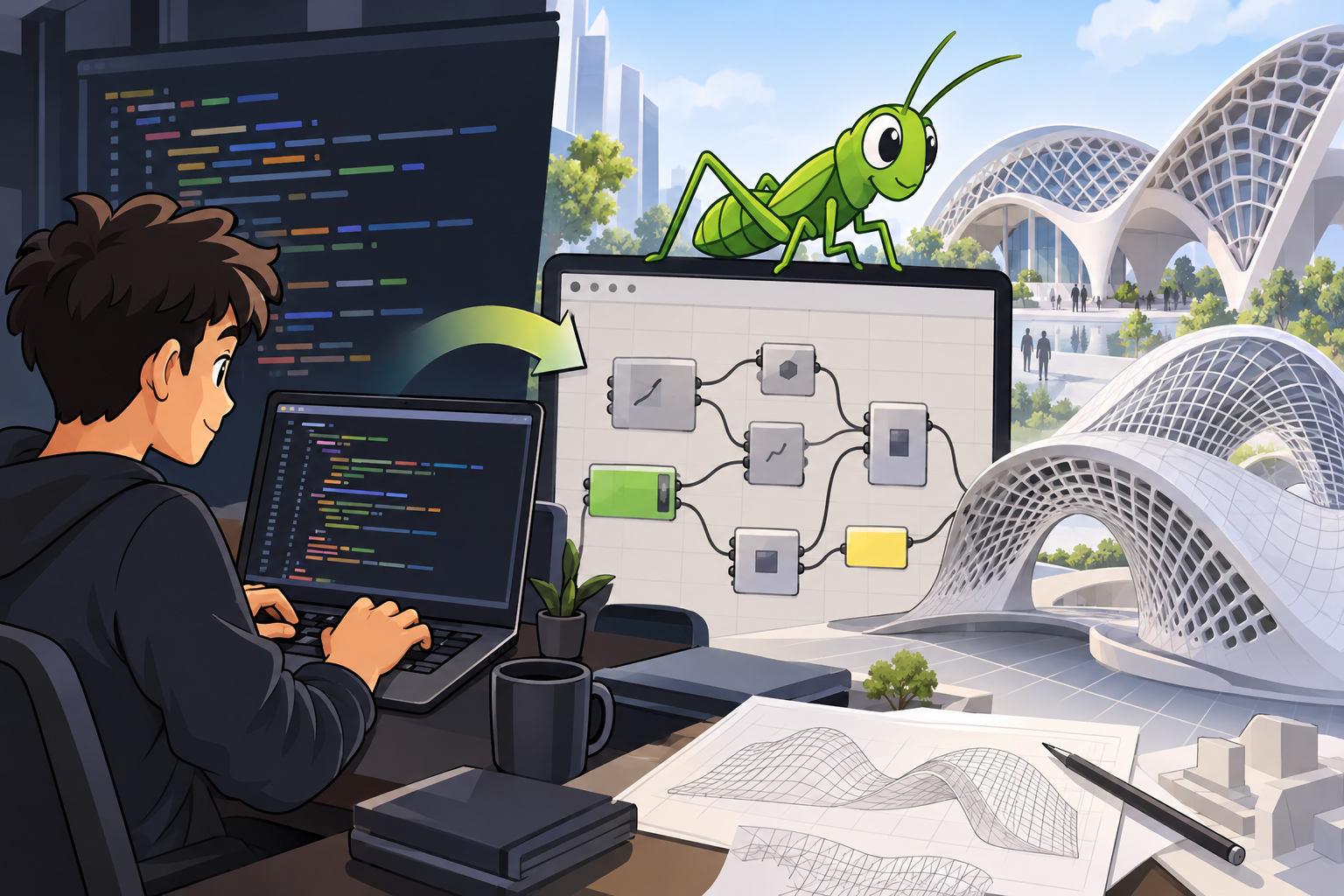
The programming threshold before visual parametrics
Before Grasshopper became a common part of architectural vocabulary, computational design already existed, but it belonged to a comparatively small group of technically confident designers, researchers, and digitally adventurous offices. Architects who wanted to move beyond conventional CAD drawing often had to work through AutoLISP in AutoCAD, MEL scripting in Autodesk Maya, Processing sketches, early RhinoScript routines, or specialized parametric environments such as GenerativeComponents from Bentley Systems. These tools were powerful, but they demanded a willingness to think in loops, variables, syntax, functions, object references, and debugging procedures. For many designers trained primarily through drawing, model making, visual composition, and material reasoning, that requirement created a cultural barrier as much as a technical one. The designer who could write code was often treated as a rare hybrid figure, positioned somewhere between architect, software developer, geometry specialist, and digital fabrication researcher. Computational design was therefore not absent from practice before Grasshopper; rather, it was unevenly distributed, concentrated in certain schools, research groups, and firms that had the resources or intellectual culture to cultivate scripting expertise.
Rhino as fertile ground for experimentation
The rise of Rhinoceros 3D was essential to this story because Rhino offered a different kind of modeling culture from the large, expensive, highly structured CAD systems that dominated many engineering and architectural workflows. Developed by Robert McNeel & Associates, Rhino became especially influential because it made flexible NURBS modeling accessible to architects, industrial designers, boat designers, jewelry designers, product developers, and experimental form-makers. Its geometry engine supported free-form curves and surfaces without forcing the user into the rigid hierarchies associated with many mechanical CAD packages or building documentation platforms. Rhino was comparatively affordable, tolerant of experimentation, and supported a plug-in architecture that encouraged outside developers to extend the software. This openness mattered profoundly. It allowed designers to treat Rhino not merely as a modeling application but as a programmable geometric laboratory. With RhinoScript, users could automate repetitive tasks, generate families of forms, manipulate curves and surfaces through mathematical rules, and build customized workflows tailored to fabrication, panelization, or analysis. In the years before Grasshopper, this combination of affordability, geometric flexibility, and scriptability made Rhino one of the most important platforms for early computational design experimentation.
The intellectual culture around algorithmic form
The pre-Grasshopper era was also shaped by an architectural discourse that increasingly valued differentiation, continuity, variation, and rule-based form generation. Figures such as Greg Lynn helped popularize the language of animation, splines, blobs, and topological continuity in architectural design, linking formal experimentation to digital modeling environments and new concepts of geometry. Patrik Schumacher, through the theoretical framing associated with Zaha Hadid Architects, argued for parametricism as a style and design logic based on associative relationships, fields, gradients, and continuously differentiated systems. Mark Burry’s work on the Sagrada Família demonstrated how advanced geometry, computation, and fabrication could be brought into dialogue with architectural heritage and construction complexity. Achim Menges explored material behavior, morphology, robotics, and computational form-finding, while Neri Oxman advanced a research culture that connected design computation with material ecology, digital fabrication, and biological inspiration. Firms such as Foster + Partners, Zaha Hadid Architects, and Arup developed internal expertise around performance, geometry rationalization, digital analysis, and fabrication coordination. Yet even in these influential circles, the computational designer was frequently a specialized participant, not the default identity of the architect.
Why the specialist model mattered
The central limitation of the pre-Grasshopper world was not that computational design lacked power, but that the power was often locked behind conventional programming interfaces or proprietary workflows. A designer using AutoLISP needed to understand how AutoCAD stored and interpreted entities; a Maya MEL user needed to understand scene graphs, procedural commands, and a scripting culture born from animation and visual effects; a Processing user needed to think through Java-like code structures; a RhinoScript user had to manage geometry objects, arrays, and procedural logic in textual form. Those who mastered these tools gained enormous control, but the learning process filtered out many talented designers who were conceptually interested in computation but not ready to become conventional programmers. This produced a separation between design intuition and computational execution. One group could imagine the spatial system; another might have to implement it. The great shift introduced by Grasshopper was that it reduced this separation. It did not eliminate the need for logic, rigor, or mathematical thinking, but it translated algorithmic relationships into a visual medium that architects could inspect, revise, and share more naturally.
- Before Grasshopper, computational work often depended on text-based scripting and specialist expertise.
- Rhino’s NURBS modeling, affordability, and plug-in culture made it a natural platform for experimentation.
- Architectural discourse around parametricism, digital fabrication, and performative geometry prepared the field for a more accessible tool.
- The crucial change was cultural: computational design became reachable to designers who did not identify as programmers.
The Arrival of Grasshopper and the Visual Programming Shift
From Explicit History to Grasshopper
Grasshopper emerged inside the Rhino ecosystem through the work of David Rutten at Robert McNeel & Associates, and its early name, Explicit History, reveals much about its original conceptual ambition. The idea was not simply to automate Rhino commands. It was to make the sequence of geometric dependencies explicit, editable, and persistent. In conventional direct modeling, a designer might draw a curve, extrude it, trim a surface, adjust control points, and then repeat the process manually if the initial assumption changed. The history of decisions existed mainly in the designer’s memory or in the final geometry’s visible outcome. Explicit History proposed that the relationships behind the geometry could become a live structure. When the tool evolved into Grasshopper, this idea became far more than a technical feature. It became a visual programming environment tuned to the way designers explore geometry. It allowed the procedural construction of points, lines, curves, surfaces, meshes, transformations, and data relationships while keeping the result directly connected to Rhino’s modeling space.
Nodes, wires, and visible logic
What made Grasshopper different from earlier scripting environments was not that it removed logic, but that it made logic visible. Instead of writing code line by line, users constructed definitions from components connected by wires. A number slider could feed a radius into a circle component; a series component could generate a sequence of values; those values could place points, divide curves, generate surfaces, orient panels, or control transformations. The designer could see the dependency chain at a glance, inspect where data was moving, and change a parameter without rebuilding the model. This created a powerful association between visual programming and design iteration. Geometry became the visible consequence of a computational graph rather than a fixed artifact. The screen was split between the Rhino viewport, where form appeared, and the Grasshopper canvas, where the logic of that form could be assembled and revised. In that dual environment, design became a conversation between spatial intuition and procedural structure, with neither side fully subordinated to the other.
A new vocabulary for designers
Grasshopper introduced designers to a vocabulary that became central to contemporary computational practice: sliders, components, wires, lists, branches, grafting, flattening, data trees, domains, remapping, attractors, solvers, clusters, and definitions. These terms were not merely interface details; they changed how architects described design problems. A façade was no longer only a composition of panels but a system of surfaces, subdivisions, normals, apertures, gradients, constraints, and fabrication labels. A canopy could be described through control curves, relaxation forces, mesh subdivision, structural depth, and environmental response. Lists and data trees were especially important because they forced designers to confront the structure of information behind geometry. Many new users discovered that producing a parametric model was not simply a matter of connecting a few components; it required understanding how data was organized, matched, repeated, sorted, and transformed. This made Grasshopper educationally powerful. It taught computational thinking through geometry rather than through abstract programming exercises. The user learned about algorithms by watching points, curves, panels, and surfaces respond in real time.
Exploration instead of fixed modeling
The live nature of Grasshopper altered the tempo of design exploration. In traditional CAD workflows, changing a major geometric assumption could require extensive remodeling, which discouraged broad exploration once a model became detailed. Grasshopper encouraged the opposite behavior. Because parameters could remain adjustable, designers could test variations rapidly: panel depth, perforation diameter, curve tension, tower twist, shading density, structural spacing, solar orientation, or fabrication tolerance. This did not automatically produce better architecture, but it changed what designers could afford to investigate. Iteration became technically inexpensive, even if judgment remained difficult. The most important design object was often no longer the single final form but the procedural system capable of generating many related forms. This distinction reshaped practice. Grasshopper supported work in form generation, parametric façades, structural patterns, panelization, environmental analysis, robotic toolpaths, CNC preparation, and assembly logic because it linked geometry to adjustable rules. It turned computation into an active design medium, not just an automation layer added after design decisions had already been made.
- Grasshopper was created by David Rutten at Robert McNeel & Associates and grew from the project known as Explicit History.
- Its node-and-wire interface made dependencies visible and editable without requiring line-by-line coding.
- Data trees, sliders, and components became part of the everyday language of computational architecture.
- The tool encouraged open-ended exploration by keeping geometry connected to live parameters and procedural relationships.
How Grasshopper Changed Design Culture, Education, and Practice
The Grasshopper definition as a design artifact
Grasshopper’s greatest effect was not confined to software technique; it changed the culture of design communication. The “Grasshopper definition” became a new kind of architectural artifact, existing somewhere between a drawing, a model, a script, and an argument. A definition could encode a geometric idea, a fabrication sequence, an environmental response, or a method for rationalizing complex surfaces. This artifact could be shared, modified, annotated, criticized, and reused, enabling a form of collaboration that differed from the exchange of static drawings or finished CAD files. It exposed the logic of a design rather than only its appearance. Within schools and offices, one designer could open another’s definition and trace how input curves became panels, how panels became numbers, how numbers became labels, and how labels could drive fabrication. This made computational authorship more collective. It also made design reasoning more inspectable, because the relationships behind a form could be examined on the canvas. Grasshopper therefore helped transform computational design from an expert subculture into a broader shared language.
Education and peer-learning culture
In architecture schools, Grasshopper changed what students expected to learn alongside drawing, modeling, history, structures, and environmental systems. Parametric relationships became part of studio culture. Students learned to think about systems, rules, variation, constraints, fields, populations, and performance criteria. A wall could be understood as a repeating assembly driven by solar exposure; a roof could be a relaxed mesh responding to supports and loads; an urban massing study could be generated by density targets, circulation paths, setbacks, and daylight rules. The educational ecosystem around Grasshopper was amplified by tutorials, forums, downloadable definitions, and a generous community of users who shared techniques openly. Websites, workshops, university labs, and online discussions taught not only commands but conceptual habits. The most successful learners did not simply copy definitions; they developed the ability to diagnose data structures, restructure lists, isolate errors, and translate a design intention into a procedural sequence. In this sense, Grasshopper became one of the most influential pedagogical tools in architectural computation because it joined visual feedback with algorithmic discipline.
Professional workflows and production constraints
In professional practice, Grasshopper became valuable because it could bridge design ambition with production constraints. Complex geometry is rarely difficult only because it looks unusual; it is difficult because it must be rationalized, analyzed, documented, fabricated, transported, assembled, and maintained. Grasshopper allowed firms to build workflows that connected early geometric intent to downstream requirements. A design team could generate façade panels from a base surface, classify them by curvature, control aperture sizes, assign identifiers, export cut files, and coordinate with consultants. Engineers could evaluate structural patterns, test member spacing, compare performance metrics, or link geometry with external analysis tools. Fabricators could translate surface logic into CNC cutting paths, robotic fabrication instructions, or panel assembly diagrams. Environmental designers could connect geometry with daylight, radiation, thermal, or airflow analysis. This was especially significant in multidisciplinary environments such as Foster + Partners, Zaha Hadid Architects, Arup, and many smaller research-driven studios where architectural form, engineering performance, and fabrication logic had to be negotiated continuously. Grasshopper did not solve all coordination problems, but it gave teams a flexible computational layer for managing them.
The plug-in ecosystem as collective invention
The strength of Grasshopper also came from its expanding ecosystem of plug-ins, many of which were created by independent developers, researchers, and specialist practitioners. Kangaroo, developed by Daniel Piker, brought physics-based simulation into the Grasshopper environment and became widely used for form-finding, relaxation, tensile behavior, collision, and interactive constraint solving. Galapagos introduced evolutionary solving, allowing users to define a fitness goal and search a design space through iterative optimization. Ladybug and Honeybee connected Grasshopper workflows to environmental analysis, weather data, daylight simulation, energy modeling, and climate-based design thinking. Karamba3D brought structural analysis into the parametric workflow, helping architects and engineers study load paths, member sizing, and structural behavior at early design stages. Weaverbird supported mesh subdivision and smoothing, making it influential for designers exploring mesh-based morphology. Human UI, Elefront, and numerous other extensions improved user interfaces, data management, object attributes, documentation workflows, and connections to fabrication or BIM environments. This plug-in culture became a form of distributed research and development in which the community continuously expanded what Grasshopper could do.
Shared computation without universal software development
The deeper cultural achievement of Grasshopper was that it allowed more people to participate in computation without requiring everyone to become a traditional software developer. This distinction is critical. Grasshopper did not remove the need for expertise; advanced work still requires mathematical understanding, geometric literacy, data management, and sometimes conventional coding in C#, Python, or VB.NET. However, it created a broad middle ground between manual modeling and professional software engineering. Architects, engineers, façade consultants, industrial designers, landscape architects, urban analysts, and fabrication specialists could meet on a shared visual platform. They could prototype, test, and communicate procedural ideas with enough precision to influence real projects and enough immediacy to remain connected to design intuition. This changed professional identity. The computational designer was no longer necessarily the isolated script author working behind the scenes; computation became part of studio conversation, review culture, and production planning. Grasshopper normalized the idea that design intelligence could be encoded, inspected, adjusted, and exchanged through networks of geometric and logical relationships.
- Kangaroo expanded Grasshopper into physics-based form-finding and constraint solving.
- Galapagos made evolutionary search accessible to designers experimenting with optimization.
- Ladybug and Honeybee connected architectural geometry with climate, daylight, and energy analysis.
- Karamba3D helped integrate structural reasoning into early parametric exploration.
- Weaverbird, Human UI, Elefront, and other extensions strengthened mesh modeling, interface design, data control, and production workflows.
Conclusion: Grasshopper’s Legacy in Computational Design
Changing expectations of design software
Grasshopper changed what designers expected from design software. After its rise, it became harder to accept tools that treated geometry as isolated objects with limited procedural intelligence. Designers increasingly expected software to be programmable, extensible, open to external data, and capable of maintaining relationships between decisions. Parametric modeling no longer meant only a feature tree in mechanical CAD or a family editor in a building information modeling system; it came to mean a network of visible dependencies that could connect inputs, transformations, analyses, and outputs. This shift affected how architects thought about modeling itself. A model was not simply a digital representation of a proposed object. It could be a generator of alternatives, a testing environment, a coordination framework, and a bridge to fabrication. Grasshopper helped make procedural, iterative, and data-driven design feel normal rather than exotic. It also helped designers recognize that geometry and information are inseparable in contemporary practice, because every curve, panel, surface, and component can carry data, constraints, and downstream consequences.
Influence on BIM, generative design, and visual scripting
The broader historical importance of Grasshopper can be seen in the way visual scripting spread across the design software landscape. Dynamo for Autodesk Revit brought node-based procedural thinking into BIM workflows, allowing architects and engineers to automate Revit tasks, manipulate elements, manage data, and build computational processes within a documentation-centered platform. Marionette in Vectorworks reflected a similar desire to make algorithmic design accessible through visual networks. Other 3D and design platforms adopted node-based procedural systems for modeling, materials, animation, simulation, and fabrication workflows. Although each environment has its own technical priorities, Grasshopper demonstrated that designers would embrace visual programming when it was connected to meaningful geometry, immediate feedback, and practical outputs. It also influenced expectations around generative design, where large populations of alternatives can be searched, evaluated, and compared according to performance or constraint criteria. Grasshopper’s legacy is visible whenever a designer expects to connect geometry to analysis, connect analysis to optimization, and connect optimization to fabrication or documentation through a flexible computational graph.
Why the legacy is cultural as much as technical
Grasshopper’s importance lies not only in what it allowed software to do, but in who it allowed to participate. It lowered the threshold between design intuition and algorithmic logic, giving architects and designers a way to think procedurally without beginning with a blank code editor. That mattered because the history of design software is not only a history of algorithms, kernels, interfaces, file formats, or modeling paradigms; it is also a history of access. When a tool changes who can experiment, who can communicate, and who can build shared methods, it changes the discipline itself. Grasshopper made computation visible, debatable, and teachable. It connected formal exploration with environmental analysis, structural reasoning, optimization, and fabrication. It gave offices and schools a common medium for discussing relationships rather than only shapes. Its continuing influence is found in the expectation that design tools should support openness, iteration, and extensibility. By making algorithmic thinking part of ordinary creative practice, Grasshopper reshaped architectural culture and secured its place as one of the defining developments in the history of computational design.
- Grasshopper helped normalize visual programming as a standard part of architectural computation.
- It reframed parametric modeling as a network of relationships rather than a narrow CAD feature.
- It influenced later tools such as Dynamo for Autodesk Revit and Marionette in Vectorworks.
- Its most significant contribution was expanding participation in computational design across education, practice, engineering, and fabrication.
Also in Design News