Your Cart is Empty


Design Software History: From Plaster to Pixels: CAD/CAM, Computational Geometry, and Additive Manufacturing in Orthotics and Prosthetics
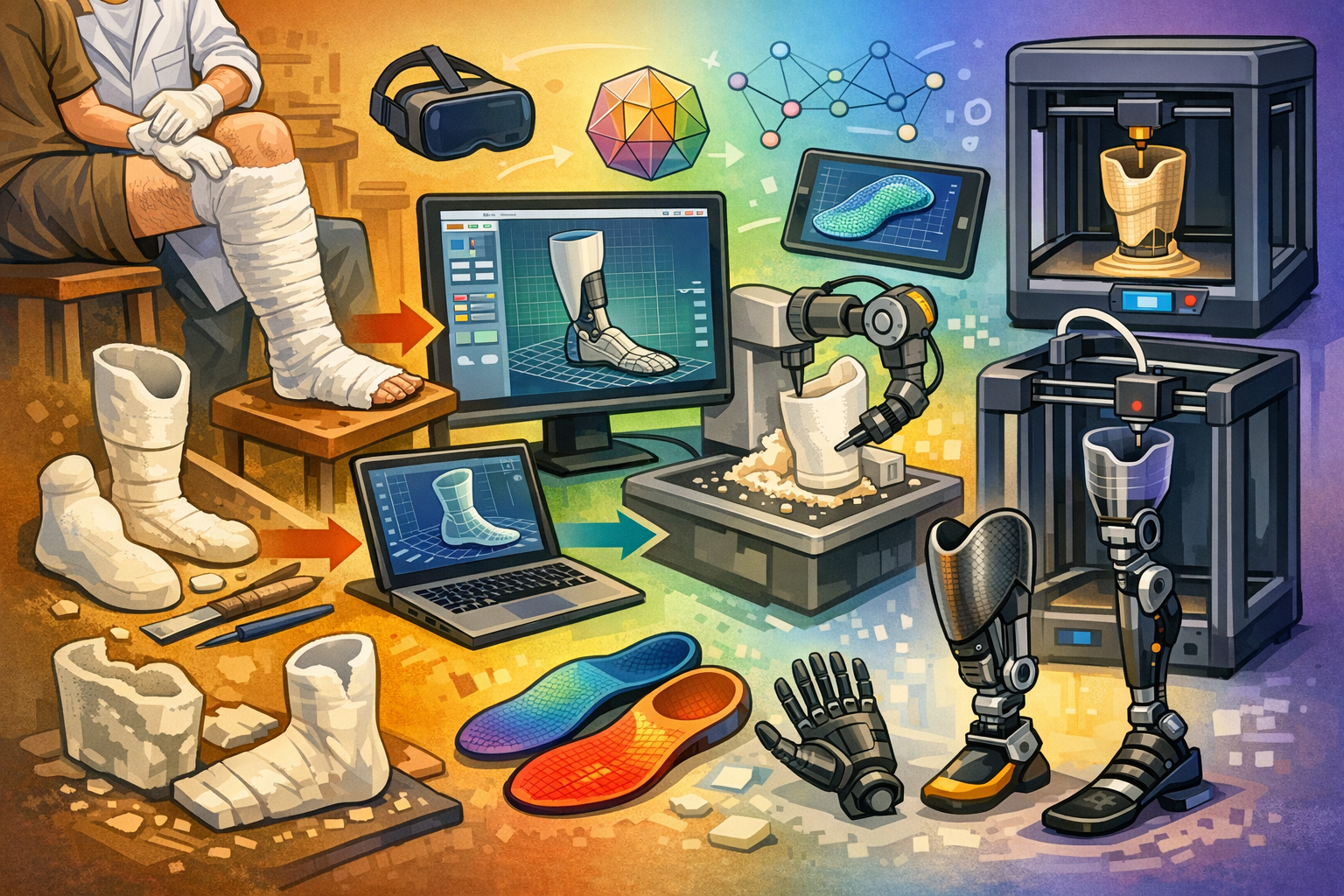


Across orthotics and prosthetics, the shift from hand-shaped plaster to computationally orchestrated geometry has redefined how clinicians translate anatomy, biomechanics, and materials into devices people rely on daily. What began as careful artisanry around a cast has become a pipeline where scans, meshes, templates, and toolpaths carry the craft forward with new repeatability and documentation. The history of this migration is not just a chronology of scanners and software; it is a story about encoding tacit clinical knowledge into digital operations that respect tissue, gait, and comfort while scaling production. It is also a story about how **CAD/CAM in O&P** acted as a proving ground for ideas in human-centered modeling, verification, and data governance long before “mass personalization” became a buzzword. The trajectory from contact digitizers to mobile LiDAR, from foam carvers to powder-bed fusion, and from freehand rectification to **template-driven, auditable edits** offers lessons for the wider design software community: listen to clinicians, make geometry robust, and keep outcomes measurable. With that framing, we can trace how the field moved from plaster to pixels, how its computational core matured, and how additive reshaped both business models and aesthetics—before asking what comes next for custom-fit devices and the tools that make them.
From Plaster to Pixels: Early O&P CAD/CAM (1980s–2000s)
From hand casting to digital capture
By the late 1980s, prosthetists and orthotists were exploring ways to accelerate and standardize what had long been a manual sequence: plaster casting, measurement verification, hand rectification to redistribute pressure, and fabrication of a positive model for lamination or thermoforming. Early digital capture hinged on contact digitizers—mechanical arms and articulated trackers like Polhemus systems—capable of probing residual limbs, spines, and cranial contours. While slow, these tools translated a trained craftsperson’s palpation path into points and curves, introducing the idea that **anatomical landmarks** and relief zones could become data, not just marks on a cast. Mechanical “tracer” rigs adapted from pattern-making were common in workshops that already carved foam positives, bridging the tactile world and the emerging coordinate space. As costs fell and computing power rose, non-contact approaches arrived: line-laser triangulation and early structured-light scanners captured surfaces faster and with better coverage, minimizing patient discomfort and movement artifacts. These systems were hardly push-button; calibration drift, shiny skin, and hair confounded accuracy, and scanners had to be paired with fixtures, targets, or practice-specific workflows. Still, they reframed clinical time: if capture could be quick and repeatable, more of the day could focus on **digital rectification** rules, component selection, and patient counseling—laying groundwork for software that would encode much of what lived in a seasoned practitioner’s hands and memory.
Software pioneers and end-to-end workflows
As scanning matured, dedicated O&P software emerged to integrate capture, rectification, and manufacturing. Vorum’s Canfit O&P suite, founded in Vancouver, provided an early end-to-end vision: import points or a mesh, identify bony prominences, apply rule-based reductions and pads, and send a positive model to a carver. Ohio WillowWood’s OMEGA system became synonymous with integrated scanning and rectification in North America, unifying handheld scanners, limb templates (transtibial, transfemoral), and socket shaping into a cohesive pipeline backed by training programs. In Europe, Rodin4D’s platform specialized in orthotics workflows—especially scoliosis TLSOs—where templated trimlines and derotation strategies could be applied consistently across clinics. Delcam’s Ortho tools, building on the company’s strength in CAM and reverse engineering, represented a bridge to broader manufacturing ecosystems and later informed Autodesk’s push into medical/orthotics toolchains after its acquisition of Delcam. Seattle Systems and several early adopters experimented with digitized rectification, testing how far standard templates could go before clinician overrides were needed for comfort or pathology-specific needs. The common denominator was a UX shift: instead of CAD metaphors like sketches and feature trees, interfaces adopted brushes, push/pull regions, and sliders mapped to anatomical outcomes. That ethos—reduce cognitive load, encode typical edits, and visualize pressure-relevant volume changes—was a defining contribution of O&P to design software at large, positioning clinical knowledge as a first-class computational object.
CAM integration and the shop floor
Parallel to software, CAM reshaped fabrication. Clinics and central fabrication labs adopted 3- to 7-axis foam carvers designed to machine large, organic shapes quickly and safely. Toolpath strategies emphasized long, continuous sweeps and light radial engagement suited to low-density foams, reducing chatter and preserving surface fidelity before lamination or thermoforming. Where subtractive manufacturing fell short—deep channels, undercuts, or thin trimlines—hybrid workflows combined carving with hand finishing, preserving the artisan’s touch without sacrificing repeatability. Importantly, industrial prosthetics OEMs like Össur, Ottobock, and Blatchford began aligning pyramid adapters, tube clamps, and foot components with digital workflows: libraries of alignment jigs, mounting hole patterns, and recommended offsets migrated into software presets, encouraging safer and more consistent assembly. Meanwhile, academia supplied biomechanical underpinnings. Pressure mapping on early instrumented sockets and studies of soft-tissue behavior informed digital rectification rules and, crucially, their limits. Researchers highlighted how sensitive comfort is to small geometric changes—emphasizing the need for **robust mesh processing**, accurate landmarking, and audit trails that would allow clinicians to trace which digital actions led to which pressure outcomes. By the 2000s, the scaffolding was clear: scan, rectify with encoded knowledge, carve or vacuum-form, and document decisions—ready for the next wave of computation and regulation.
The Computational Core of Custom Fit: Geometry, UX and Biomechanics
Scan processing: registration, cleanup, and fidelity to anatomy
Modern O&P begins with reliable surface data. Multi-scan merges and patient movement require algorithms like **iterative closest point (ICP)** and feature-based registration to align partial captures into a watertight whole. The challenge is that the “truth” a clinician cares about—bony landmarks, tendinous edges, and weight-bearing contours—is often the first to blur under aggressive smoothing. Mesh cleanup pipelines therefore pair outlier rejection and hole filling with Laplacian or Poisson smoothing that selectively preserves curvature at landmarks. Some platforms include landmark-aware smoothing that attenuates on tagged regions so that the medial tibial flare or fibular head stays sharp while noise elsewhere is damped. Surface normals must be corrected for stable offsetting later, and mesh decimation must balance file size with edge-lengths small enough to represent critical trimline details. In clinics where CT or MRI informs osseointegration or complex reconstructions, segmentation accuracy propagates downstream; suites like Materialise Mimics and 3-matic emphasize label map fidelity and morphometric validation so that NURBS reconstructions or high-resolution meshes remain anatomically faithful. With handheld scanners, drift correction and elasticity compensation (to mitigate soft tissue compression from contact) help ensure that a scan reflects typical load states, not an artifact of capture. The goal is a **clean, landmark-true mesh** that supports predictable rectification, offsetting, and cutting, without forcing clinicians to fight the geometry before they can apply their expertise.
Rectification templates and constraint-driven deformations
Digital rectification encodes clinical heuristics into reusable templates: pads, reliefs, and volume reductions parameterized for transtibial, transfemoral, and TLSO use. Instead of treating a socket as a free-form sculpt, software tags anatomical landmarks—patellar tendon, adductor longus, greater trochanter, ASIS/PSIS—and then binds deformations to constraints: reduce X% over patellar tendon, add Y mm clearance at tibial crest, maintain smooth transitions at Z curvature. Constraint solvers propagate these changes while minimizing distortion and maintaining thickness targets. Libraries of templates evolve over time and can be hospital- or clinician-specific, capturing institutional style while producing consistent outcomes and repeatable documentation. UX metaphors are deliberately tactile: brush tools inflate/deflate volumes with falloff controls tied to anatomical context; sliders modulate reduction magnitudes with live color maps previewing pressure implications; and “one-click” rectifications apply default templates that can be refined. The most successful systems support granular auditing: which template version, which parameter deltas, which manual brushes—and correlate these with fitting results to refine defaults. In scoliosis bracing, TLSO templates encode derotation strategies and trimlines for Rigo-Chêneau or Boston-style approaches, turning historically variable craftsmanship into **guided, evidence-aware edits**. In lower-limb prosthetics, alignment considerations—pyramid adapter position and socket flexion—can be previewed virtually, tying geometry to gait mechanics even before a check socket is fabricated.
Modeling paradigms, manufacturability, and validation
Once rectified, geometry must become manufacturable. O&P straddles multiple paradigms: mesh-first workflows (STL/OBJ/PLY) remain common for carving and printing, while NURBS reconstructions enable parametric trimlines, fillets, and fitments that blend with hardware catalogs. Voxel and sculpting systems like Geomagic Freeform (originating at SensAble and later part of 3D Systems) excel where organic shaping and quick edits dominate—smoothing don/doff regions, softening edges, and blending localized pads. For surgical planning or osseointegrated implants, pipelines from CT/MRI to CAD via Materialise Mimics and 3-matic support lattice infills, fixation features, and regulatory-grade auditability. Across these toolchains, **robust offsets and thickness control** are pivotal: sockets and braces need variable-thickness shells with local reinforcements at mechanical hotspots and predictable, comfortable lips at trimlines. Boolean operations insert ventilation, sensor mounts, and cable pathways; filleting and edge conditioning mitigate chafing. Early finite element analysis (FEA) evaluated residuum–socket contact pressures, but results hinged on soft-tissue constitutive models and friction at liner interfaces—parameters that remain open research. Nevertheless, alignment previews and simple kinematic checks, integrated with gait data, let clinicians iterate before committing to fabrication. Clinician-centered UX ties all of this together: template libraries reduce setup friction; gesture-like brushes support nuance; and outcome tracking—linking scans, rectification deltas, and post-fit adjustments—builds a learning loop that elevates consistency and supports reimbursement documentation.
Additive Manufacturing and Mass Personalization (2010s–2020s)
Materials, processes, and orthotic geometry at print scale
By the 2010s, additive manufacturing brought production-grade polymers and new design degrees of freedom to O&P. Selective Laser Sintering (SLS) and Multi Jet Fusion (MJF) in PA12/PA11 produced durable sockets and orthoses with consistent isotropy and biocompatibility credentials, while carbon-fiber–reinforced nylons offered higher stiffness for low-profile braces and structural shells. Designers exploited **graded thickness and surface texturing** to tune comfort, breathability, and weight reduction: micro-dimples for airflow under liners, flexible hinges at malleoli, and ribbing to stiffen along load paths. Post-processing matured as well: bead blasting, dyeing, and sealants addressed porosity and hygiene; threaded inserts and bonded bushings extended life for repeated donning/doffing. On the CAM side, nesting and orientation strategies became domain-specific: sockets oriented to minimize stair-step artifacts on trimlines, TLSOs positioned to reduce support scarring on patient-facing interiors, and heat maps of risk for anisotropic weakness used to drive part placement. The old distinction between positive carving and layup began to blur as direct-printed shells met or exceeded performance expectations for certain indications. Nonetheless, many clinics kept hybrid pipelines—printing check sockets or definitive orthoses while carving positives for laminations that demanded particular composite stacks. The result was a flexible production architecture where the same digital twin could yield different downstream processes depending on durability, cost, turnaround, and local regulatory preferences.
Platforms, personalization, and research-to-market bridges
Digital-native providers reframed how clinics and patients interact with devices. UNYQ popularized consumer-facing aesthetics with customizable fairings and colorways, following in the spirit of earlier Bespoke work that made **personalization a visible virtue** rather than a hidden step. ProsFit, Andiamo, and Spentys pursued full-digital socket and orthosis pipelines, emphasizing cloud-based records, print-ready geometry, and logistics that abstract away local manufacturing constraints. Mecuris signaled a SaaS turn with a cloud design platform that streamlined scan intake, templated rectification, and printable outputs—even if its eventual closure highlighted the difficulty of reconciling regulatory overhead, unit economics, and clinical variability. In parallel, open-source and bionic initiatives broadened participation: e-NABLE mobilized volunteers to assemble low-cost upper-limb devices using commodity printers, while Open Bionics advanced lightweight, powered hands with a strong emphasis on industrial design and user identity. At the high end, MIT’s Biomechatronics group led by Hugh Herr showcased how powered ankles and knees benefit from integrated digital fit workflows, and Ottobock’s acquisition of BionX (formerly BiOM) linked mechatronics with industrial distribution and clinical service models. These shifts did more than add new products; they normalized software-mediated collaboration between clinic, lab, and OEM, and they pressured legacy tools to speak cloud, track outcomes, and expose APIs for scheduling, quoting, and compliance without buried spreadsheets and ad hoc file naming conventions.
Scanning goes mobile and computation scales in the cloud
Hardware democratization broadened access to capture. Structure Sensor, iPad LiDAR, and smartphone photogrammetry lowered the barrier to entry for clinics and even home assessments under telemedicine constraints. While not a replacement for high-fidelity Artec or Creaform handhelds in every use case, these tools were “good enough” for many workflows when paired with smart registration, drift correction, and QA overlays. Cloud services stepped in to automate segmentation from noisy captures, propose rectification starting points, and generate **quality assurance reports** with heat maps of deviation from prior fits. The best systems combined lightweight on-device preprocessing with server-side heavy lifting—feature detection, curvature analysis, and template matching across large datasets—so clinicians saw fast previews and could drill into details on demand. Interoperability improved as pipelines evolved from STL/OBJ dumps to 3MF packages embedding units, colors, and labels, enabling traceable meta-tags for patient IDs, device class, and print parameters. On the back end, automated nesting, orientation heuristics, and load balancing across printer fleets cut lead times and stabilized costs. In clinics, web viewers with markup supported quick iteration: a prosthetist could circle a region needing more clearance and tag it to a parameter in the rectification template, keeping human intent coupled to machine-executed geometry changes and ensuring that the next iteration reflects domain knowledge rather than isolated mesh edits.
Advanced lattice design, compliance, and visualization for co-design
Lattice and triply periodic minimal surface (TPMS) design tools—nTopology, Materialise 3-matic, and others—gave clinicians and designers new levers for comfort and airflow. Compliant liners could incorporate **spatially graded lattices** that cushion bony prominences while preserving structure elsewhere, and perforations could be shaped to avoid stress concentrators. Automated scaffolding and thick-to-thin transitions relied on numerically robust offsetting and boolean operations—areas where O&P’s demands pushed general-purpose CAD beyond its usual mechanical assumptions. Compliance and standards moved center stage: ISO 10328 structural testing guided acceptance criteria; FDA and EU MDR pathways for custom-made devices enforced traceable manufacturing histories; and HIPAA/GDPR shaped secure data flows with encryption, access logs, and retention policies. File formats matured with 3MF carrying device metadata, material calls, and labels through to the printer’s slicer, reducing mismatch risks. Visualization entered the clinic experience: real-time renderers like KeyShot and V-Ray integrations produced convincing previews of textures, colors, and patterns, improving patient buy-in and letting co-design sessions translate identity into form. Web-based collaboration matured from passive viewers to comment-threaded markups bound to geometry, so that a lab technician, clinician, and patient liaison could converge quickly on decisions with an auditable trail. The net effect was a practical synthesis of computation, compliance, and communication—turning personalization from a heroic craft into an industrializable, patient-centered service.
Conclusion: What Prosthetics Teaches CAD—and What Comes Next
Core lessons for design software
Orthotics and prosthetics demonstrates that putting clinicians at the center changes everything about CAD. Interfaces must start with anatomy and outcome—not sketches and datums—and must encode tacit rectification knowledge into **templates, guided edits, and defaults** that are easy to audit and refine. Robust mesh processing is non-negotiable: registration that respects landmarks, smoothing that preserves salient curvature, and offsetting that survives noise determine whether a device is comfortable and safe. Evidence is the currency of trust, so systems must link rectification deltas to pressure maps, gait outcomes, and fitting notes, with analytics that elevate patterns from individual craftsmanship to institutional memory. When these principles align, repeatability improves without erasing the clinician’s judgment; the software becomes an extension of the craft rather than a replacement. The historical arc—from contact digitizers and foam carvers to latticed, direct-printed shells with embedded metadata—also underscores that geometry kernels and file formats must evolve with the domain: trimlines, perforations, and graded thicknesses stress robustness differently than blocky mechanical parts. Finally, the field shows how visual fidelity matters in healthcare: believable renderings and clear, patient-facing configurators reduce anxiety, boost adherence, and turn customization into a shared, informed choice rather than a black box behind a lab door.
Ongoing challenges and the roadblocks to velocity
Despite progress, several technical and systemic hurdles persist. Biomechanical simulation is hampered by uncertainties in soft-tissue constitutive models and liner–socket friction; small errors in these inputs can yield large swings in predicted pressure, limiting in-silico confidence. Long-term durability under sweat, heat, and repetitive donning/doffing remains difficult to forecast without expensive testing, complicating comparisons between laminated composites and printed polymers or lattices. On the policy and economics fronts, reimbursement frameworks and regulatory guidance can trail technical capability, slowing adoption even when devices perform well clinically. Data governance continues to challenge distributed, cloud-enabled pipelines: ensuring provenance from scan through rectification to print, with tamper-evident logs and privacy-preserving access, is essential for audits and patient trust. Clinics also struggle with training and change management—moving from ad hoc practices to parameterized templates requires time and thoughtful onboarding. Yet these challenges are tractable. Clear audit trails, versioned templates, and linked outcome analytics can align payers, regulators, and providers; standardized metadata in **3MF with medical profiles** can reduce interop risks; and curated datasets for model validation can narrow simulation uncertainty. The discipline’s maturity suggests the remaining barriers are less about invention than about integration, incentives, and education at scale.
Likely trajectories and broader impact
The next phase points toward AI-assisted rectification and fit prediction trained on large, anonymized datasets—systems that recommend initial reductions, highlight outlier anatomies, and learn from post-fit outcomes via active learning loops. Sensor-in-the-loop feedback, drawing from embedded pressure, temperature, and activity data, will update digital twins of limbs and devices so adjustments can be planned proactively rather than reactively, with **real-time, clinic-ready FEA and optimization** running on mobile and cloud hardware for same-day delivery. Standards will converge: richer PMI/metadata within 3MF, profiles specific to medical devices, and API-level compliance hooks will enable interoperable, verifiable, and reimbursable custom devices that move smoothly across vendors and geographies. Beyond O&P, these methods will radiate into dentistry, orthopedic bracing and implants, and wearable medicals, where comfort, safety, and identity all matter. The enduring lesson is that mass personalization in safety-critical contexts cannot be an afterthought bolted onto general-purpose CAD; it must be grounded in domain-specific geometry operations, clinician-first UX, and outcome-aware analytics. Prosthetics and orthotics has already charted that path—from the first **digital rectification** of a plaster cast to today’s latticed, metadata-rich devices—and its influence will continue to inform how design software democratizes complex customization without compromising rigor, empathy, or accountability.
Also in Design News