Your Cart is Empty


Design Software History: From Feature-Based Pioneers to Cloud-Native DAGs: Evolution of the CAD History Tree (1980s–Present)
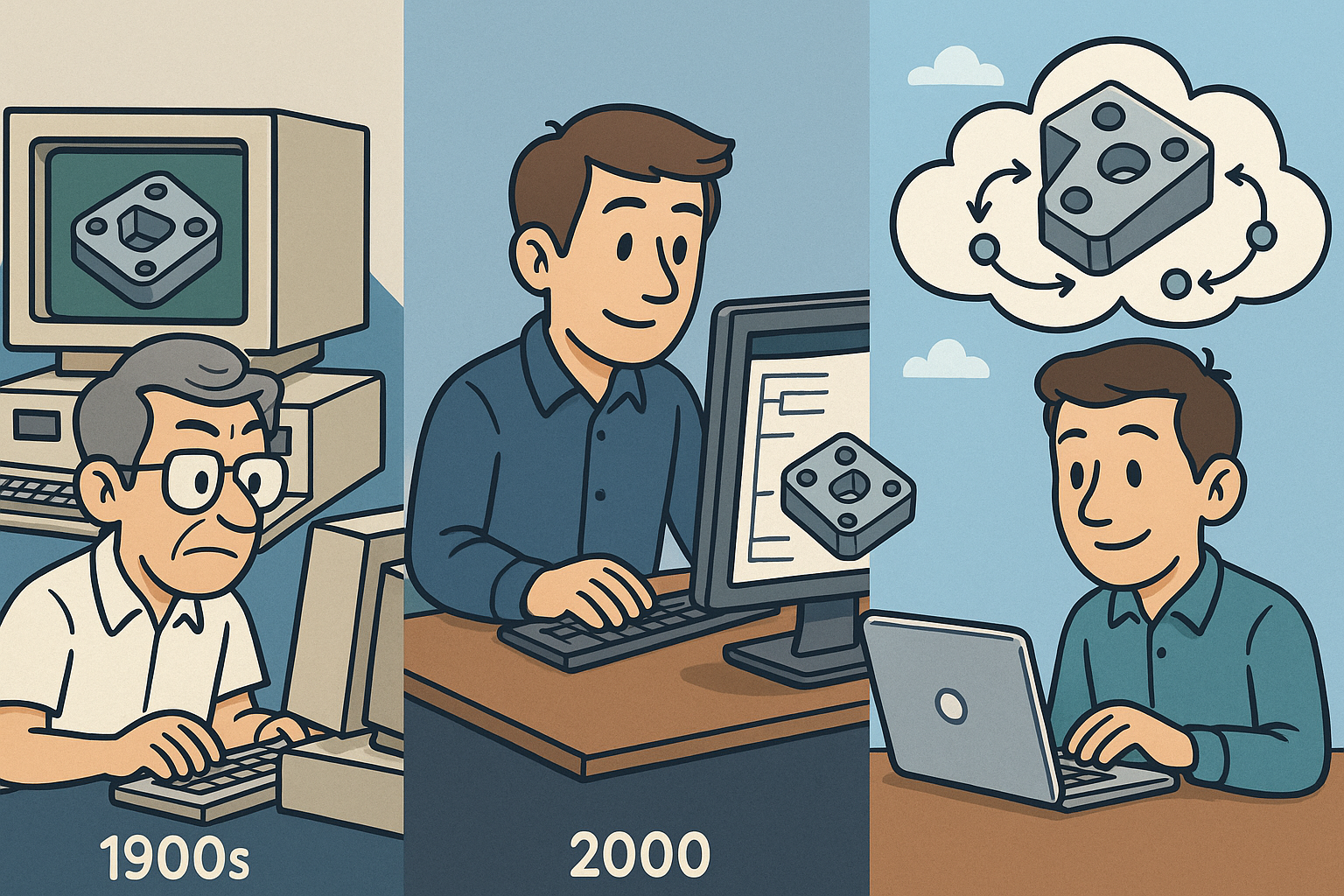


From feature-based pioneers to the canonical “history tree” (1980s–mid 1990s)
Pro/ENGINEER crystallizes feature-based, order-dependent modeling
The late 1980s saw the convergence of years of geometric modeling research into a usable paradigm: the feature-based, parametric history tree. At its center stood Pro/ENGINEER from PTC, founded by Sam Geisberg, which shipped around 1987–1988 and codified a modeling method that serialized a true dependency graph into a consumable, linear timeline. The concept was deceptively simple—place datums, sketch profiles, create features, and pattern them—yet radical in its insistence that order matters. Pro/ENGINEER’s “regeneration” processed parents before children so the system could derive each step’s geometry from the prior steps, catching conflicts early and propagating changes consistently across the model. The Menu Manager era user experience may feel austere by contemporary standards, but the architecture underneath established bedrock ideas such as Family Tables for configurable part variants and constraint-driven assembly “mates” that fused geometry and intent.
- Linear regeneration: a serialized execution of dependencies, offering deterministic update behavior and predictable failure points.
- Datums-first discipline: reference planes, axes, and points provide a stable coordinate framework to host sketches and features.
- Parametric assemblies: constraint “mates” captured functional relationships between parts, not merely spatial coincidence.
- Configurable variants: Family Tables formalized variant management, foreshadowing later mass-configuration techniques.
Pro/ENGINEER’s insistence on explicit constraints and regeneration order taught practitioners that the model tree is not a passive log of geometry but an executable narrative of decisions. The approach rewarded rigor: careful datum planning, sketch constraint hygiene, and feature sequencing that minimized brittle downstream dependencies. It also exposed designers to the inevitable consequences of a living model—rebuilding costs, edit cascades, and the need for a mentally tractable “history tree” that conveys why each feature exists, not just what it looks like.
Contemporary influences and competitors shape early expectations
While PTC’s architecture became emblematic, the wider landscape actively explored similar ideas. SDRC’s I‑DEAS, Unigraphics (which later evolved into Siemens NX), CADDS from Computervision, and CATIA V4 from Dassault Systèmes each experimented with features, constraints, and varying user interface conventions. Among the intellectual roots, MIT’s David Gossard and colleagues in the 1980s advanced parametric and constraint-based design concepts whose techniques would migrate from academia into shipping products. Early geometric constraint solvers began to mature, enabling naïve sketches to be stabilized through dimensional and geometric relations, though solver robustness varied widely across tools.
By the early 1990s, this ferment yielded converging expectations. Users demanded a balance between precise boundary representation (B‑rep) kernels and higher-level feature semantics, both reconciled in a single workflow that told a reproducible story. The UIs were diverse—Menu Manager in PTC; layered command trees and icons in Unigraphics; textual menus and function keys in CADDS—but they all worked to express and edit a model’s structure. Importantly, these tools began the practice of persistent references—edges, faces, and datum entities that could be targeted by later operations—laying groundwork for the thorny “topological naming” problem that would haunt the industry for decades.
Early lessons that defined the mental model of design intent
The first generation of feature-modeling systems delivered more than a set of commands; they provided a mental model of design intent. The tree captured the decisions and the constraints that drove geometry, asserting that a model is not just a static shape but a set of relationships that should survive change. This separated “what” from “why,” encouraging designers to think about sequencing: build from stable references outward, propagate critical dimensions early, and isolate volatile details toward the end to protect them from upstream edits. The corollary was performance and predictability: feature regeneration time balloons if a late-stage change forces broad recomputation, and a careless reference (for example, selecting a decorative edge instead of a robust datum) can fracture the model when topology shifts.
- Intent over appearance: place controlling geometry and dimensions where they reflect functional requirements, not cosmetic outcomes.
- Sequence as strategy: arrange the tree to minimize destructive ripple effects and shorten regeneration chains.
- Reference hygiene: prefer stable datums and sketches; avoid fragile face/edge selections that might vanish after edits.
Equally important, assembly-level parametrics emerged in parallel, where mates encoded functional interfaces between parts and subassemblies. This recognized that design is inherently hierarchical, and that the tree’s semantics needed to extend beyond a single part. The premise of a traceable, ordered narrative—datums, sketches, features, and constraints—would become the lingua franca for mechanical CAD through the 1990s and beyond, even as UIs and kernels evolved.
Desktop standardization and UX convergence (mid 1990s–2000s)
SolidWorks and the FeatureManager turn history into a friendly desktop metaphor
With the arrival of SolidWorks in 1995, founded by Jon Hirschtick with engineering leadership from Mike Payne, feature history stepped onto the Windows desktop and into a more approachable user experience. The FeatureManager tree introduced visible rollback, drag‑and‑drop reordering, right‑click “Edit Definition,” and suppression states in a compact outline view. Folders and feature naming made the tree navigable at a glance, while the Parent/Child and Rebuild tools helped diagnose dependency snarls. The Design Table, powered by Microsoft Excel, democratized configuration creation for mass variants without forcing users into arcane parameter scripts. PDMWorks wrapped this with lightweight versioning and check‑in/out behavior suited to teams not yet ready for heavy PLM.
- Rollback bar to isolate upstream construction and experiment safely with alternative sequences.
- Drag‑and‑drop reorder to test dependency permutations without rewriting features.
- Suppression and folders to tame complexity, enabling scenario testing and tree hygiene.
Under the hood, the 1997 work by Vladimir Kripac at SolidWorks spotlighted the persistent naming challenge—how to robustly track faces and edges when topology changes. Though no single vendor solved it definitively, articulating the problem framed the industry’s long-term robustness agenda. SolidWorks’ blend of visual feedback, discoverable commands, and integration with familiar desktop metaphors set a UX bar that rivals would match or adapt during the following decade, pushing the “history tree” from power-user artifact to everyday design instrument.
CATIA V5 and the Specification Tree merge parametrics with knowledge and enterprise
When Dassault Systèmes transitioned from CATIA V4 to CATIA V5 in the late 1990s, the Specification Tree embodied a broad, multi-workbench approach to parametrics. Features in Part Design, Generative Shape Design, and Assembly Design could interoperate under a single hierarchical outline. Knowledgeware introduced rule-based design where formulas, checks, and design tables enforced standards and relationships, and PowerCopies packaged complex feature sets for reuse across parts. CATIA’s strong assembly and in-context capabilities encouraged designers to capture interfaces and envelopes explicitly, making the tree not only a linear sequence but a container for corporate standards and reusable templates.
Crucially, Dassault’s PLM offerings—ENOVIA and SMARTEAM—pushed tree semantics into enterprise governance. Instead of treating a part tree as a private artifact, V5 integrated meta-information, lifecycle states, and configuration rules at scale. The result was a model that could serve multiple stakeholders, from design to manufacturing planning, and a lineage that could be audited and traced. This elevated the history tree from a designer’s local scaffold to an ingredient in a wider digital thread, where persistence, traceability, and semantics mattered as much as geometry.
Autodesk Inventor and Solid Edge codify consistent trees and adaptive behaviors
Autodesk entered the parametric arena with Inventor (1999), pairing a Browser tree with a Parameters table that exposed names, equations, and units as first-class objects. iParts and iAssemblies made families of parts and assemblies straightforward, while Adaptivity allowed geometry to respond to changes elsewhere—bridging intent across components. In parallel, Solid Edge, launched by Intergraph in 1995 and later under UGS and Siemens, offered the PathFinder tree, formalizing a consistent metaphor across parts, assemblies, and drawings. This consistency was more than stylistic: it meant that learning the tree in one context paid dividends across the entire product development environment.
Both products reinforced the notion that a robust tree makes dependencies explicit. Inventor’s parameter table cultivated a habit of naming and structuring design drivers rather than burying them in sketches. Solid Edge’s clarity around relationships and its steadfast part/assembly/drawing triad taught users to traverse complexity methodically. These systems helped move the industry beyond idiosyncratic command sequences toward recognizable patterns of setup, build, and manage. The result was a sector-wide consolidation of expectations: the history tree is the control room, and the parameters are the controls.
Kernel and solver foundations set robustness expectations
Underneath every friendly tree sits a kernel and a solver, and the 1990s–2000s saw consolidation around Parasolid (Siemens) and ACIS (Spatial) for B‑rep operations. This standardization improved the predictability of extrusions, blends, patterns, and Boolean operations, enabling higher-level features to be expressed with fewer surprises. In the 2D space, maturing geometric constraint solvers—D-Cubed components would later be associated with many vendors—reduced the frequency of “red” sketch failures. Vendors layered robustness strategies on top: inference of intent in sketches, proactive dimensioning hints, and better error messaging to avoid dead ends.
These underpinnings gave users confidence that the semantics of the tree could be trusted. They also made it feasible to invest in larger models and assemblies, since fundamental operations were more stable and performance characteristics better understood. The enduring challenge remained persistent naming: when features altered topology (e.g., a split face became two faces), identifying “the same” face for downstream references was nontrivial. Still, wider kernel adoption and improved solvers set a baseline that let UX innovations shine without being undermined by unpredictable geometry.
UX patterns become industry norms
By the mid-2000s, a consistent vocabulary for tree interaction had emerged across major tools. Designers could expand nodes, see icons and color states that communicated health and suppression, and apply surgical edits or sweeping refactors with intent. Naming and grouping conventions promoted clarity in the face of complexity, while increasing transparency around dependencies reduced the guesswork associated with refactoring.
- Navigable dependencies: expandable nodes, parent/child visualizers, and context “Show Parents/Children.”
- Granular control: per-feature edit, rollback, suppress, and reorder to localize change without collateral damage.
- Refactor tools: datum strategy overhauls, feature grouping, configurations, and design tables for global adjustments.
- Consistent semantics: similar tree metaphors across parts, assemblies, and drawings lowered cognitive switching costs.
The lesson was that UI affordances and modeling discipline are inseparable. A clear tree and well-designed controls trained users to think in dependencies and failure modes, not just in shapes. Even as kernels and solvers stabilized, the industry recognized that the history tree is a user interface to a graph—and the better that interface, the more resilient the model and the team working on it.
The tree under pressure: robustness, direct modeling, and cloud-native graphs (2007–present)
Pain points in mature trees expose fragility and scale limits
As assemblies grew and interdependencies multiplied, the fault lines in traditional trees became more visible. Edits frequently triggered topological naming instabilities, where downstream features lost track of faces and edges after a seemingly innocuous change. Long regeneration chains punished late-stage modifications and obscured the true cost of edits. External references, especially in-context links across parts and subassemblies, could become brittle, introducing circular dependencies or making parts overly sensitive to unrelated changes elsewhere in the project. The result was a perception that history offered power at the cost of fragility.
- Regeneration latency in mega-assemblies made exploration expensive and sometimes discouraged needed refactoring.
- Opaque histories hampered collaboration; teammates struggled to predict knock-on effects without laborious audits.
- PDM friction emerged because linear trees didn’t map cleanly to branching, merging, and multiuser workflows.
These stresses weren’t merely technical; they were organizational. Distributed teams, concurrent design, and supplier integration demanded a model of history that could accommodate branching timelines and variant exploration without duplicating files or corrupting references. Teams needed visibility into dependency graphs and the ability to quarantine risky edits. In short, the status quo had to evolve: history needed to remain the narrative of intent but become more resilient, more transparent, and more collaborative.
Direct and hybrid modeling blend agility with intent
In 2007, SpaceClaim, led by Mike Payne and Blake Courter, mainstreamed the idea that users often want to push and pull geometry directly without negotiating a history tree. The “direct modeling” approach favored fast local changes, face edits, and feature inference over explicit, ordered features. Siemens responded with Synchronous Technology in Solid Edge and NX, combining direct manipulation with constraints to extract design intent from geometry on the fly. PTC brought Flexible Modeling into Creo, offering a safety valve for late-stage edits when the original history was either inaccessible or too brittle to touch.
- Localize change by editing faces and regions directly, with smart recognition of patterns and symmetry.
- Retain intent through constraints that survive direct edits, preserving critical dimensions and relationships.
- Hybrid workflows that use history for structured design and direct tools for rescue, cleanup, and what-if exploration.
The lesson from this period was nuanced: designers value history when capturing design intent, but they crave agility when adapting to new information or integrating external geometry. Vendors converged on hybrid strategies that treat the tree as a flexible asset rather than a rigid script, allowing teams to mix parametric structure with opportunistic direct edits—without losing the benefits of either.
Cloud and collaboration recast history as a versioned, shared graph
Cloud-native platforms reimagined what “history” means in collaborative design. Onshape, founded by Jon Hirschtick, Mike Payne, Dave Corcoran, and Scott Harris (with the company acquired by PTC in 2019), anchored its model in server-side regeneration and a first-class version/branch graph. The linear feature list still exists for parts, but it cohabits with a project-level DAG where versions, branches, and merges are navigable like a modern VCS. Simultaneous multiuser editing, permissioned sharing, and audit trails made the tree not merely a personal artifact but a collaborative ledger. Onshape’s FeatureScript empowered teams to define custom features that integrate seamlessly into the timeline, extending the language of the tree to domain-specific constructs.
Autodesk Fusion 360 offered its own take: a visible timeline that can be toggled on or off, letting users combine parametric and direct paradigms. Fusion’s hybrid of T‑Splines and B‑rep encouraged freeform and precise workflows in a single environment, while tight CAM and CAE integration highlighted cross-domain dependencies in the tree—toolpaths, simulation studies, and manufacturing setups that are sensitive to geometric updates. In both products, the shift was clear: history is no longer an isolated, linear script; it is a shared, versioned record that tracks not only geometry but also configuration decisions and team intent.
Graph-first thinking permeates mainstream UIs and adjacent domains
As teams wrestled with complex dependencies, mainstream CAD expanded its visualization of graphs. NX, Creo, and CATIA all enhanced dependency browsers, in-context modeling visualizers, and “Show Parents/Children” tools to make relationships explicit. The goal was to give designers a lens through which they could see, navigate, and edit the underlying DAG instead of guessing causality from a flat tree. Outside mechanical CAD, node-based systems exploded in popularity: Grasshopper for Rhino (Robert McNeel & Associates) and Dynamo for Revit (Autodesk) showed how explicit graphs democratize parametrics and computational design. These tools let users wire nodes representing geometry, logic, and data, blurring the boundaries between modeling, programming, and analysis.
The cultural effect has been profound. Mechanical CAD users have grown comfortable with graph-derived metaphors—visual dependency networks, rule nodes, and parametric dataflows—without abandoning the clarity of a linear history tree. Vendors increasingly offer bridge features: parameter linking across models, graph inspectors inside part studios, and APIs that expose the dependency structure. The notion that “history” is just a list of features is giving way to a broader view: it is the visible cross-section of a larger graph that ties together geometry, parameters, rules, and collaborators.
Conclusion
What endured across four decades
Despite waves of innovation, the linear history tree remains the clearest expression of design intent and order. Its rollback and stepwise execution provide a safe sandbox for exploration, and its granular controls—edit, suppress, reorder, rename—let designers localize change with confidence. The tree’s readability makes it a shared language: engineers can review sequencing choices, manufacturing can inspect controlling dimensions, and managers can trace decisions. Standardized UX patterns, influenced by SolidWorks’ FeatureManager, CATIA’s Specification Tree, Inventor’s Browser, and Solid Edge’s PathFinder, have lowered cognitive load and reduced the friction of switching tools. The end result is a modeling culture that treats the tree as an executable narrative rather than a static artifact, with consistent semantics across parts, assemblies, and, increasingly, downstream deliverables.
- Rollback and regenerate as essential feedback loops for safe iteration.
- Discoverable controls like drag-reorder, suppression, and context edit as everyday tools of trade.
- Shared readability so multiple stakeholders can interpret and audit modeling decisions quickly.
That durability matters because design problems still revolve around intent, constraints, and change. The tree’s enduring value is not nostalgia—it is the right level of abstraction for many mechanical problems, a balance between expressive power and interpretability that continues to guide modern workflows and education.
What evolved in response to robustness and collaboration challenges
The last 15 years transformed how the industry thinks about resilience and teamwork. Direct modeling, whether via SpaceClaim’s push‑pull, Siemens’ Synchronous Technology, or PTC Creo’s Flexible Modeling, answered a pragmatic need: fast, local changes without wrestling the original script. Persistent naming research—pioneered in part by the attention Vladimir Kripac brought to the problem—has informed kernels and application strategies that reduce the breakage of downstream references. Cloud-native environments such as Onshape reframed history as a versioned graph, borrowing the branching and merging semantics from software development to reflect the realities of concurrent design. Fusion 360’s cross-domain integrations demonstrated that the tree must encompass not just shape but the broader ecosystem of CAM, CAE, and data.
This evolution reframes the history tree as part of a spectrum: from strict, ordered features for intent capture to freeform edits for agility. Teams now expect dependency browsers, graph inspectors, and APIs that expose structure. They also expect that configurations, rules, and corporate standards can be embedded, aligning history with enterprise governance and the digital thread that connects design to manufacturing and service.
What’s next: from semantic DAGs to intelligent, self-healing histories
The next frontier will make the implicit graph explicit, intelligent, and more semantically rich. As designs knit together mechanical, electrical, and software elements, simple linear trees strain to convey causality. Expect interfaces that visualize—and let users edit—full dependency DAGs, not just linear sequences, with semantic nodes representing requirements, processes, and manufacturing context.
- Explicit DAG visualizations that allow filtering by domain (geometry, parameters, rules, manufacturing) and by impact scope.
- Semantic features tied to requirements, tolerances, and process plans, not just shape—think PMI-first features and MBD-aware nodes.
- ML-assisted diagnostics to predict failure-prone references, propose robust alternatives, and auto-repair broken chains.
- Per-feature provenance that logs author, rationale, and performance impact, supporting audits and sustainability metrics.
- Bridges to node-graph systems so parametric trees and tools like Grasshopper/Dynamo coexist and exchange structure bidirectionally.
On the standards front, richer STEP (e.g., AP242) and QIF ecosystems will help carry semantics across tools without flattening the history. Kernel work will continue to chip away at topological naming fragility, perhaps with hybrid identifiers that combine geometric signatures with graph context. And cloud platforms will push server-side regeneration and analytics that spotlight hotspots—features that dominate rebuild time or influence many dependents—guiding refactors before they become liabilities. The goal is unchanged: keep history as the narrative of intent, but evolve it into a living, intelligible, and resilient graph that serves the entire product lifecycle.
Also in Design News