Your Cart is Empty


Design Software History: Evolution of Multi-Body Modeling in CAD: Historical Challenges, Innovations, and Future Trends in Design Software
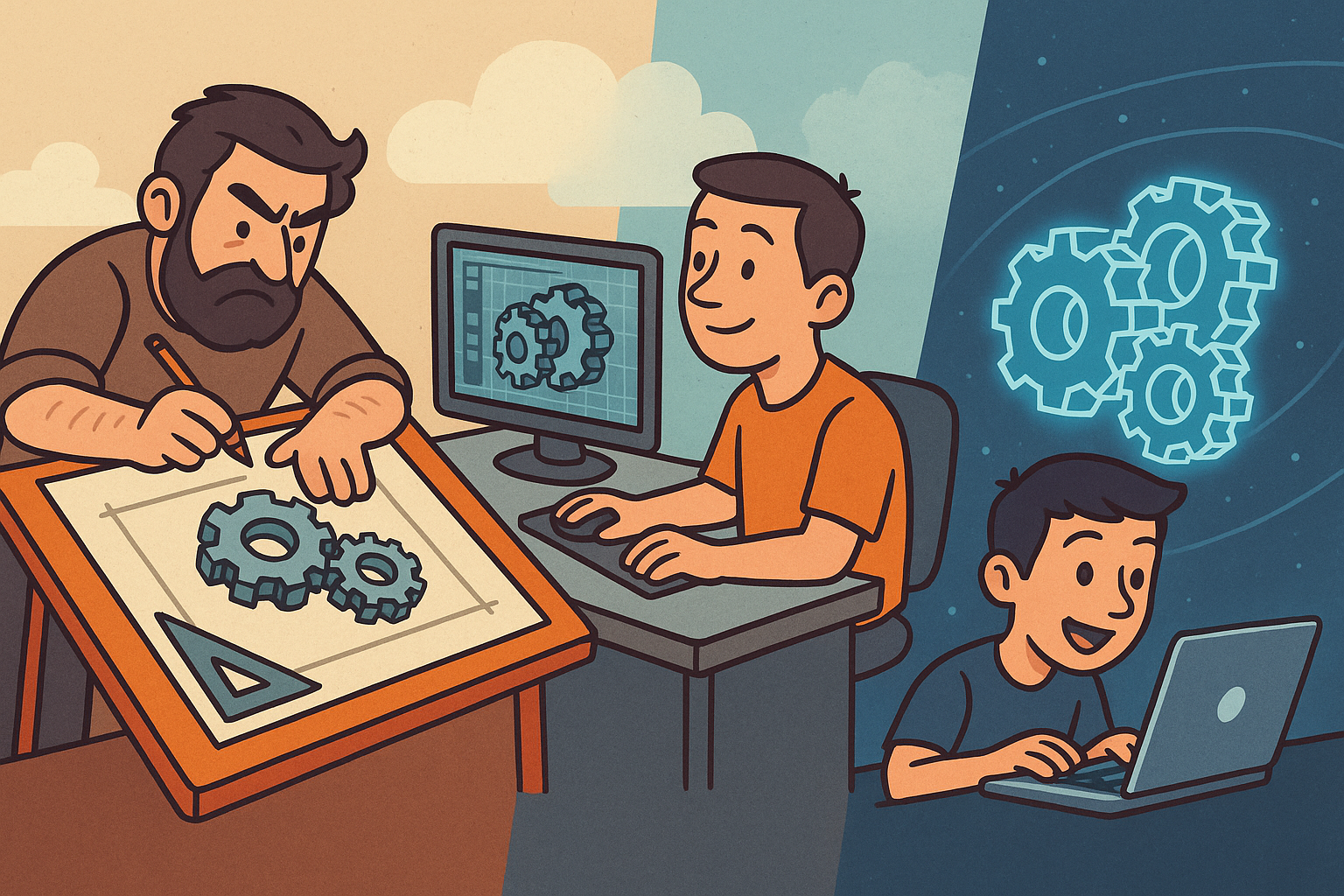


Origins and Early Developments
The evolution of multi-body modeling in computer-aided design systems is a journey that began with a foundational need to represent complex assemblies in a digital format. In the earliest days, engineers and researchers faced daunting challenges in accurately capturing interactions between multiple components. The significance of multi-body modeling was immediately apparent as traditional 2D representations proved insufficient for grasping the intricate relationships inherent in three-dimensional designs. Early CAD pioneers, working in environments with limited computational power, had to innovate ways of representing not only the individual parts of a design but also the interactions between them. Multi-body modeling emerged as a critical discipline, providing systematic methods to handle the geometry, motion, and interpenetration of various bodies within a single coherent system.
Early Challenges in Complex Assemblies
One of the most formidable challenges in early multi-body systems was the representation of complex assemblies where interactions between components could lead to interference and inaccuracies. Engineers had to ensure that moving parts would not collide in unexpected ways, often relying on manual verification and rudimentary simulation tools. Key difficulties included:- The representation of joint constraints and motion transfer, ensuring each component maintained a realistic relationship with others.
- The need to accurately depict assembly hierarchies, where individual small components contributed to the operation of larger units.
- A limited understanding of how computational geometry could be applied to manage and simulate these interactions in a virtual space.
Influence of Mathematical Models and Computational Geometry
Early multi-body approaches drew heavily on advancements in mathematical models and computational geometry. Researchers adopted techniques from classical mechanics and numerical methods to develop algorithms capable of handling the dynamics of multi-body systems. Mathematical models provided a framework for understanding the complex interactions between components, paving the way for robust algorithms that would eventually form the backbone of modern CAD systems. Computational geometry methods were critical in managing spatial relationships, intersections, and the partitioning of space into meaningful segments that could be manipulated digitally. Academic institutions and early corporate research labs worked tirelessly to refine these theories, ensuring they were adaptable to the specific needs of design and manufacturing. The legacy of these early developments is still visible today in how modern systems use advanced geometric modeling techniques to simulate everything from mechanical movement to stress analysis.Key Innovations and Technological Milestones
The transformation of multi-body modeling from a theoretical concept into a practical tool for design was marked by a series of key innovations and technological breakthroughs. In this period, critical advancements were driven by new algorithmic strategies that allowed these systems to become more robust and reliable. Early CAD pioneers, including both academic researchers and professionals working at emerging technology companies, played a significant role. Many laboratories at universities such as MIT and Stanford, for instance, were central to exploring how robust algorithms could simplify the complexities of multi-body interactions. Furthermore, companies like Intergraph, Computervision, and CATIA emerged as industry leaders, each contributing unique innovations that would shape the future. The triumphs in solid modeling and geometric modeling techniques provided the necessary scaffold for moving from simple 2D sketches to fully realized 3D simulations that underpin modern design practices.
Breakthroughs in Algorithm Development
Fundamental to these innovations was the development of algorithms that could efficiently process and simulate multi-body interactions. These algorithms were responsible for resolving spatial conflicts between bodies, optimizing the storage and management of geometric data, and ensuring that dynamic simulations were as accurate as possible. Several breakthroughs stand out in this journey:- Robust collision detection algorithms ensured that multi-body systems could predict and manage unwanted contacts between moving parts.
- Constraint solving methodologies enabled more precise control over how individual components moved relative to each other.
- Advanced data structures enhanced the speed and accuracy of rendering complex assemblies, thereby reducing computational overhead.
Evolution of Solid and Geometric Modeling Techniques
The progress in algorithm development was paralleled by significant strides in the evolution of solid and geometric modeling techniques. Early implementations of these techniques often revolved around wireframe models and basic surface representations, but over time, the industry saw the advent of more sophisticated methods such as boundary representation (B-rep), constructive solid geometry (CSG), and non-uniform rational basis splines (NURBS). Solid modeling provided designers with the ability to simulate the physical properties of components, bridging the gap between numerical computation and tangible engineering practices. As the field matured, the integration of these advanced modeling techniques enabled practitioners to perform simulated stress tests, factor in real-world manufacturing constraints, and innovate with new materials. The integration of technology from academic research into real-world products was a pivotal moment that democratized access to high-fidelity 3D modeling tools, laying the groundwork for the sophisticated systems used today.Impact on Industries and Design Practices
The development of multi-body modeling has had a transformative effect on several key industries, reconfiguring traditional design processes and enhancing the overall efficiency of product development cycles. By enabling detailed simulation and visualization of assemblies, multi-body modeling has fostered substantial improvements in sectors such as aerospace, automotive, and industrial design. Designers have responded to the rich capabilities of these tools by reimagining not only how products are designed but also how they are conceptualized from the outset. In contrast to the earlier reliance on hand-drawn blueprints and physical prototypes, the advent of advanced CAD tools has allowed for rapid iteration and continuous optimization throughout the lifecycle of a project. Advanced visualization has played a pivotal role in this evolution, allowing for intricate renderings, simulation of thermal and stress factors, and even predictive analysis of potential failures. As a result, the design validation processes have become more rigorous, and innovations in performance have spurred further technological advances.
Transformations in Aerospace and Automotive Design
In the aerospace and automotive sectors, where safety and precision are paramount, multi-body modeling has enabled engineers to simulate complex interactions well before physical prototypes are built. The benefits in these industries include:- Accelerated design cycles through real-time simulation and visualization tools, which allow for rapid iteration and testing.
- Enhanced accuracy in predicting the behavior of dynamic systems, leading to safer, more reliable end products.
- The ability to implement detailed stress and thermal analyses that help optimize material selection and structural design.
Enhancements in Industrial Design and Product Visualization
Beyond the realms of aerospace and automotive industries, multi-body modeling has also had a profound impact on industrial design. The evolution of these systems has led to significant improvements in design validation, prototyping, and overall manufacturing processes in industries ranging from consumer electronics to heavy machinery. Key areas of enhancement include:- Enhanced product visualization through detailed 3D modeling which affords a more intuitive understanding of spatial relationships.
- Improved simulation tools that integrate finite element analysis (FEA) and computational fluid dynamics (CFD), facilitating accurate performance prediction.
- A more integrated design process that bridges the gap between conceptual design and physical realization, reducing errors and costly rewrites in later stages of development.
Conclusion
The historical progression of multi-body modeling in CAD systems reveals a rich tapestry of innovation, perseverance, and a relentless pursuit of precision. From its humble beginnings in representing basic two-dimensional sketches of mechanical assemblies, the field has evolved into a sophisticated discipline that rests on robust mathematical models and cutting-edge computational geometry. This journey has not only provided engineers with powerful tools for simulating complex, dynamic environments but has also fostered a culture of continuous improvement and innovation across a range of engineering disciplines.
Legacy and Continued Influence
The legacy of early multi-body modeling innovations is apparent in every modern CAD system used today. Techniques developed in the nascent stages laid the groundwork for the sophisticated solid and geometric modeling techniques that are now commonplace. Solid modeling, geometric modeling, and advanced simulation algorithms continue to influence the design process by providing unparalleled levels of detail and predictive accuracy. As industries push towards increasingly complex and integrated products, these foundational principles serve as a reminder of the ingenuity and collaboration that propelled the field forward. The innovations brought forth by early pioneers have, undoubtedly, revolutionized how product performance is validated and improved, ensuring higher standards of quality and safety in modern design.Future Trends and Emerging Technologies
Looking to the future, multi-body modeling continues to evolve in tandem with emerging technologies such as artificial intelligence, enhanced simulation capabilities, and cloud-based collaborative environments. These technologies are expected to seamlessly integrate with existing CAD systems, further simplifying the design process while significantly increasing accuracy. Trends such as real-time simulation, higher fidelity visualization, and increased automation in design validation are reshaping the landscape of product development. As we anticipate future breakthroughs, it is clear that the robust legacy of early multi-body modeling will remain a critical reference point for ongoing innovation. The journey continues to be one marked by significant milestones and promising prospects for industries seeking to push the envelope of design and performance.Also in Design News