Your Cart is Empty


Design Software History: CATIA Origins and the Rise of High-Complexity CAD
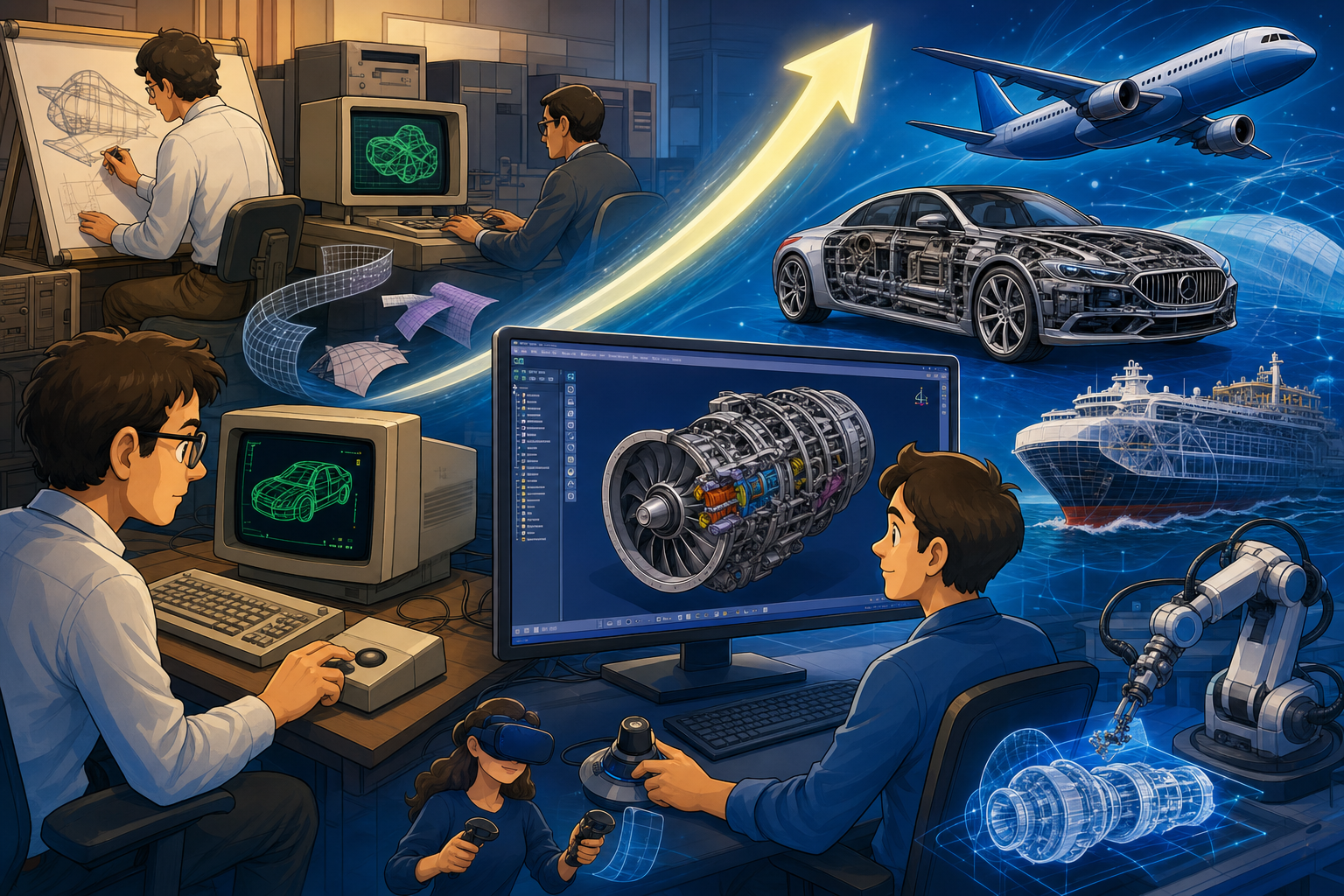


Origins: From Dassault Aviation’s Internal Need to a Commercial CAD Powerhouse
Aircraft design exposed the limits of conventional drafting
CATIA’s history begins inside Dassault Aviation in France during the late 1970s, not as a broad commercial drafting package, but as a response to the severe geometric demands of aircraft development. Aircraft were already among the most complex industrial products ever built, and their design processes depended on far more than orthographic drawings, dimensioned views, and manual lofting tables. Wings, fuselages, engine nacelles, ducts, fairings, control surfaces, and cockpit transparencies required careful handling of curvature, tangency, aerodynamic continuity, and manufacturable surface transitions. In that environment, a small geometric deviation could affect tooling, fit, performance, inspection, or downstream production. Dassault engineers needed software that could help them define sophisticated three-dimensional shapes with enough precision to support both design intent and manufacturing execution. This need produced an earlier internal software effort known as CATI — Conception Assistée Tridimensionnelle Interactive, a name that clearly reflected the ambition: interactive three-dimensional assisted design rather than electronic drawing alone.
CATI became the foundation for a different class of design system
The importance of CATI was not only that it created digital geometry, but that it was born in an industrial setting where digital geometry had to survive contact with aerodynamics, tooling, manufacturing, inspection, and assembly. Many earlier CAD systems in the 1960s and 1970s were remarkable achievements, including Ivan Sutherland’s Sketchpad at MIT, General Motors’ DAC system, Lockheed’s CADAM, and various drafting systems developed for mainframes and minicomputers. Yet much of commercial CAD remained strongly connected to two-dimensional production drafting or relatively limited mechanical geometry. Dassault Aviation’s software effort moved in another direction because the aircraft problem was different. It required the consistent manipulation of curves and surfaces in three dimensions, with practical usefulness for engineers who had to convert aircraft shapes into physical parts. CATI’s internal evolution therefore anticipated what would become one of CATIA’s defining traits: it treated the digital model not merely as a picture or a documentation aid, but as a central technical object that could coordinate design and production.
The IBM relationship gave CATIA international reach
The transition from an internal aircraft-design tool to an international CAD product depended heavily on the relationship between Dassault Aviation and IBM. IBM was already deeply embedded in large technical organizations through mainframes, terminals, engineering computing infrastructure, and enterprise relationships with manufacturers in aerospace, defense, automotive, and heavy industry. By helping commercialize and distribute CATIA internationally, IBM gave the emerging software access to precisely the customers that needed high-end design capability and could afford the computing systems necessary to run it. This mattered because advanced CAD in that period was not a lightweight desktop purchase; it was tied to expensive computing hardware, specialized graphics workstations, data management practices, and organizational commitment. IBM’s sales reach and credibility helped place CATIA in front of companies that were already attacking problems of aircraft structures, automobile body engineering, tooling development, and multi-disciplinary manufacturing coordination. The partnership also helped position CATIA as an industrial-strength system rather than a niche laboratory tool.
- Dassault Aviation supplied the demanding aircraft-design origin and technical credibility.
- IBM supplied global distribution, large-account access, and enterprise computing presence.
- CATI supplied the conceptual and technological foundation for interactive 3D design.
- CATIA emerged as a commercial expression of aerospace-grade geometric modeling.
CATIA entered a market still dominated by drafting-oriented thinking
CATIA’s distinction becomes clearer when placed against the broader CAD landscape of its early commercial period. Many systems were still optimized around drawing productivity: faster linework, cleaner revisions, reusable symbols, electronic storage, and plotter output. Those improvements were important, but they did not fundamentally solve the challenge of defining complex aircraft geometry as a coordinated three-dimensional product. CATIA’s strength lay in its ability to represent difficult surfaces and manage large engineered assemblies with a level of seriousness demanded by aerospace programs. That is why its origin matters so much. It did not begin as a general-purpose office automation tool for designers, nor as a low-cost replacement for the drafting board. It began in one of the world’s most demanding design environments, where geometry had to connect aerodynamic reasoning, structural packaging, tooling surfaces, manufacturing operations, and assembly coordination. In this sense, CATIA’s identity was shaped from the beginning by high consequence rather than convenience.
Why Aerospace Needed CATIA: Surfaces, Assemblies, and Digital Continuity
Aerodynamic form required sophisticated surface control
Aerospace design created software requirements that ordinary mechanical drafting could not satisfy because aircraft geometry is governed by smoothness, continuity, and controlled variation across long spans of form. A wing is not simply an extruded section, and a fuselage is not simply a cylinder; both are carefully managed aerodynamic bodies whose surfaces must transition through changing curvature while respecting structural, manufacturing, and performance constraints. Nacelles, ducts, empennage fairings, wing-body joins, and control-surface gaps introduce additional complexity because they combine exterior aerodynamic requirements with interior packaging needs. These shapes depended historically on lofting, templates, physical models, and expert interpretation by highly skilled specialists. CATIA brought a new level of computational discipline to that tradition by giving engineers tools for defining curves, splines, and surfaces with mathematical precision. As CAD technology matured, spline-based workflows and later NURBS-based surface modeling became central to the representation of the freeform, high-continuity geometry required by modern aircraft design.
Surface quality became a shared language between disciplines
CATIA became known for handling advanced curves and surfaces because it addressed a practical coordination problem: aerodynamicists, industrial designers, structural engineers, tooling specialists, and manufacturing planners all cared about the same shapes for different reasons. An aerodynamic team might evaluate pressure distribution and drag, while a tooling engineer might examine whether a surface could be manufactured within tolerance using available processes. A structural designer might need to align frames, ribs, spars, clips, and access panels to that same outer mold line. Industrial design and human-factors teams might also affect cockpit glazing, cabin interiors, or exterior fairings. CATIA’s value was that it allowed these requirements to be worked through using a common geometric framework. The model could become more than a static record of a design decision; it could become the place where competing technical intentions met. This made advanced surface modeling one of CATIA’s most durable reputational strengths in aerospace and later in automotive body engineering.
Large assemblies made digital coordination essential
Aerospace products contain staggering numbers of parts, and the management of their relationships is often as difficult as the modeling of any one component. A commercial aircraft includes structural frames, skins, spars, ribs, brackets, fasteners, fuel systems, avionics racks, ducting, hydraulic lines, electrical harnesses, insulation, interiors, landing gear mechanisms, and installation hardware. Each part may be designed by a different team, supplier, or discipline, and each may carry dependencies on surrounding geometry. CATIA helped teams coordinate geometry across this complexity long before the phrase digital thread became common in engineering management. The underlying challenge was not simply to create a beautiful 3D model, but to prevent engineering decisions from colliding with one another as a product grew in detail. A duct route could conflict with a structural bracket; a wiring harness could interfere with maintenance access; a tooling split could affect a surface definition. CATIA’s assembly and geometric reference capabilities helped organizations identify and resolve these problems earlier.
- Aircraft geometry required precise mathematical control of curves, surfaces, transitions, and continuity.
- Aircraft assemblies required coordination among structures, systems, interiors, tooling, and suppliers.
- Digital geometry reduced dependence on late physical discovery and manual interpretation.
- CATIA helped make the aircraft model a common reference for multiple engineering disciplines.
The Boeing 777 made digital mockup a historical milestone
One of the most frequently cited moments in CATIA’s history is its extensive use by Boeing on the Boeing 777, a program widely associated with comprehensive digital mockup strategy. Boeing’s use of CATIA, together with process changes and supplier coordination, gave the 777 a special place in the history of computer-aided aircraft development. The significance was not only that the airplane was modeled in three dimensions, but that the digital model became a central coordination environment for design, checking, assembly planning, and communication across a highly distributed engineering organization. This helped demonstrate that CAD could move beyond departmental drafting and become a foundation for product definition at aircraft scale. The 777’s development is often discussed alongside the decline of traditional full-scale physical mockup dependence, because the digital mockup allowed many interferences and installation problems to be addressed before hardware existed. In the same era, Airbus also became closely associated with CATIA-based workflows, reinforcing CATIA’s stature across global aerospace development.
Digital continuity changed what CAD meant
CATIA became important in aerospace not merely because it could model difficult shapes, but because it supported continuity between conceptual geometry, detailed design, tooling, and manufacturing. In earlier drawing-centered workflows, interpretation gaps could appear at many stages. A designer’s section drawing might be interpreted differently by a tooling group; a surface might require manual reconstruction; a supplier might create local geometry that did not fully match the intended assembly environment. CATIA helped reduce those discontinuities by making more of the product definition explicitly digital and reusable. This did not eliminate engineering judgment, nor did it remove the need for validation, testing, and physical manufacturing expertise. However, it did change the nature of coordination. The authoritative representation of the product increasingly shifted from stacks of drawings and physical mockups toward a maintained, interrogable, three-dimensional definition. That transition is central to CATIA’s legacy: it helped make complex products understandable as coherent digital systems rather than as collections of disconnected documents.
From Surface Modeling to Enterprise Design: CATIA’s Expansion Across Industries
Automotive companies recognized CATIA’s surface advantage
As CATIA matured, its appeal naturally extended beyond aerospace into industries that shared similar geometric complexity, especially automotive design and manufacturing. Automobile exterior bodies, interior trim, lamp assemblies, instrument panels, closure panels, and tooling surfaces require a level of surface quality that ordinary mechanical modeling cannot easily provide. Automotive companies care deeply about Class-A surfaces, where reflections, highlights, gaps, flushness, and perceived quality determine whether a vehicle looks refined or crude. CATIA’s ability to handle sophisticated curves and surfaces made it attractive for body engineering, die design, tooling development, and large assembly coordination. The automotive world also resembled aerospace in its dependence on supplier networks, variant management, manufacturing planning, and intensive downstream use of geometry. Companies associated with high-end automotive CAD adoption saw that CATIA could support not only styling geometry but also the production realities that followed it. The system’s aerospace roots therefore became a competitive advantage in automotive because disciplined surface control and assembly coordination translated directly into vehicle development.
Shipbuilding, machinery, and consumer product design found similar value
CATIA’s expansion also reached shipbuilding, industrial machinery, and consumer product design because these fields increasingly confronted their own versions of large-scale geometric and process complexity. Shipbuilding involved hull forms, compartment layouts, pipe routing, structural members, outfitting, and manufacturing sequencing. Industrial machinery required robust mechanisms, castings, frames, sheet metal, electrical integration, and service access. Consumer product design increasingly demanded ergonomic surfaces, molded housings, aesthetic continuity, and coordination between industrial design and tooling. CATIA was not always the lowest-cost or easiest-to-deploy option, but its value was strongest where product definition required advanced geometry and disciplined lifecycle coordination. This also explains why CATIA occupied a different cultural position from systems such as AutoCAD or later midrange parametric modelers. It was identified with organizations that had high consequences for geometric accuracy, assembly fit, supplier collaboration, and production planning. The system’s reputation was built not on casual accessibility, but on solving demanding problems where geometry was inseparable from manufacturing consequences.
Dassault Systèmes turned an aircraft tool into a software company
The founding of Dassault Systèmes in 1981 was a decisive institutional event in CATIA’s evolution. Dassault Aviation had created the technical need and early capability, but Dassault Systèmes became the company responsible for developing, commercializing, and broadening CATIA as a software product. This separation mattered because it allowed the CAD technology to become a business in its own right, serving industries beyond the aircraft programs that originally motivated it. Over time, Dassault Systèmes expanded far beyond CAD into a much larger vision of product development, lifecycle management, manufacturing planning, simulation, and collaboration. Products and platforms such as ENOVIA, DELMIA, and SIMULIA reflected this strategy. ENOVIA addressed product data and lifecycle collaboration; DELMIA focused on manufacturing processes, factory planning, and digital manufacturing; SIMULIA extended the portfolio into simulation and analysis. CATIA remained a central design authoring environment, but it increasingly sat inside a broader architecture for managing the life of complex products.
- CATIA supplied high-end design authoring and advanced geometric modeling.
- ENOVIA supported product lifecycle management, collaboration, and enterprise data control.
- DELMIA extended digital tools into manufacturing planning and production simulation.
- SIMULIA strengthened the connection between design geometry and engineering simulation.
CATIA V4 defined the high-end UNIX and mainframe era
CATIA V4 became one of the dominant high-end CAD systems in aerospace and automotive workflows, especially in the era when UNIX workstations, large graphics systems, and enterprise installations defined serious mechanical design computing. V4 earned its reputation in organizations that needed industrial-strength surface modeling, assembly management, drafting, manufacturing support, and data exchange within complex engineering structures. Its interface and operating assumptions reflected the professional computing environment of its time: powerful, specialized, and oriented toward trained expert users rather than casual adoption. In aerospace and automotive firms, CATIA V4 data often became deeply embedded in product definition practices, supplier requirements, tooling workflows, and long-running programs. That installed base gave CATIA enormous influence, but it also created migration challenges as computing shifted toward Windows, more graphical interaction styles, and broader feature-based parametric modeling expectations. CATIA V4 therefore represents more than a software release; it represents an era in which high-end CAD belonged to specialized infrastructure and tightly governed engineering organizations.
CATIA V5 modernized the user experience and modeling architecture
CATIA V5, launched in the late 1990s, marked a major historical phase because it modernized CATIA for a broader computing environment while expanding parametric, feature-based, and associative modeling capabilities. Its Windows-based interface made CATIA more approachable to many engineers and aligned it with the desktop computing transformation that had already reshaped engineering offices. V5 also competed in a world where parametric solid modeling had become widely influential through systems such as Pro/ENGINEER from PTC and SolidWorks, which Dassault Systèmes acquired in 1997. The challenge for CATIA V5 was unique: it had to preserve CATIA’s high-end traditions in surfaces, assemblies, and complex product development while incorporating more modern interaction, feature history, and integrated workbenches. V5’s significance lies in that blend. It was not simply an interface update; it represented a shift from narrowly specialized high-end CAD toward a broader product development environment capable of serving industrial design, mechanical engineering, manufacturing, analysis preparation, and enterprise collaboration.
Integration became CATIA’s strategic identity
CATIA’s strategic importance increasingly came from integration rather than modeling alone. A high-complexity manufacturer does not merely ask whether a system can create a bracket, a surface, or an assembly; it asks whether the system can support product definition across disciplines, revisions, suppliers, manufacturing plans, simulation contexts, and lifecycle states. CATIA became part of a larger ecosystem for design intent, manufacturing planning, digital validation, and product lifecycle management. This separated it from the historical role of tools that primarily improved drafting productivity. The contrast is useful: AutoCAD, developed by Autodesk, democratized electronic drafting by making CAD accessible on personal computers and widely useful across architecture, engineering, and construction. SolidWorks popularized mainstream Windows-based parametric CAD for mechanical design teams that needed capability without the cost and complexity of traditional high-end systems. CATIA, by contrast, specialized in the high-complexity end of design, where surface quality, enormous assemblies, configuration control, and enterprise process discipline were not optional features but central requirements.
Conclusion: CATIA’s Legacy as the Language of High-Complexity Design
CATIA solved problems simpler CAD systems could not
CATIA became a standard in aerospace and complex surface design because it addressed problems that simpler CAD systems could not realistically solve at the same depth. It supported aerodynamic geometry where curvature, smoothness, and surface continuity carried direct engineering consequences. It helped coordinate large digital assemblies where millions of parts and countless spatial dependencies had to be managed across many disciplines. It connected product definition with tooling, manufacturing planning, lifecycle management, and enterprise-scale collaboration. These strengths explain why CATIA’s history cannot be understood merely as the rise of a successful CAD brand. It was part of a broader transformation in which the digital model became a governing artifact for complex engineering. In aircraft and automotive development especially, the consequences of geometry ripple outward into cost, performance, manufacturability, serviceability, and schedule. CATIA’s value was that it gave organizations a more precise and coordinated way to manage those consequences before they appeared on the factory floor or during final assembly.
Aerospace forced CAD to mature
CATIA’s history shows that demanding industries do not simply adopt software; they shape what software must become. Aerospace did not merely purchase CAD to replace drawing boards. It forced CAD to mature into a discipline of mathematical surface definition, digital assembly coordination, product data control, manufacturing integration, and cross-organizational collaboration. Companies such as Dassault Aviation, Dassault Systèmes, IBM, Boeing, and Airbus helped define the expectations of high-end digital design. Their influence can be seen in the concepts now taken for granted across modern engineering: digital mockup, authoritative 3D product definition, interference checking, model reuse, lifecycle-managed data, manufacturing simulation, and model-based engineering. The historical lesson is clear. CATIA did not emerge because engineers wanted prettier drawings; it emerged because complex products required a more reliable way to think, communicate, and manufacture. The software was shaped by physical reality, but it also changed how that reality could be planned and controlled.
The influence continues in modern design platforms
CATIA’s influence continues in modern design software, even when users are working in environments that look very different from the mainframe and workstation systems of the 1980s and 1990s. Contemporary expectations around digital mockup, high-quality surface modeling, integrated manufacturing, PLM connectivity, simulation-driven design, and model-based systems engineering all owe part of their evolution to CATIA-centered workflows. The idea that a product can be developed as a coordinated digital universe, rather than as a pile of drawings interpreted separately by each department, is now foundational to advanced manufacturing. Cloud platforms, generative design, additive manufacturing preparation, real-time visualization, and systems engineering tools are extending this logic further, but they build on historical foundations established by high-end CAD environments. CATIA’s story is therefore not simply the story of a CAD program becoming successful. It is the story of complex engineering moving from drawings, manual reconciliation, and expensive physical discovery into a more coordinated digital universe where geometry, process, and enterprise knowledge operate together.
Also in Design News