
Your Cart is Empty


Design Software History: CAD APIs and the Rise of Extensible Design Platforms
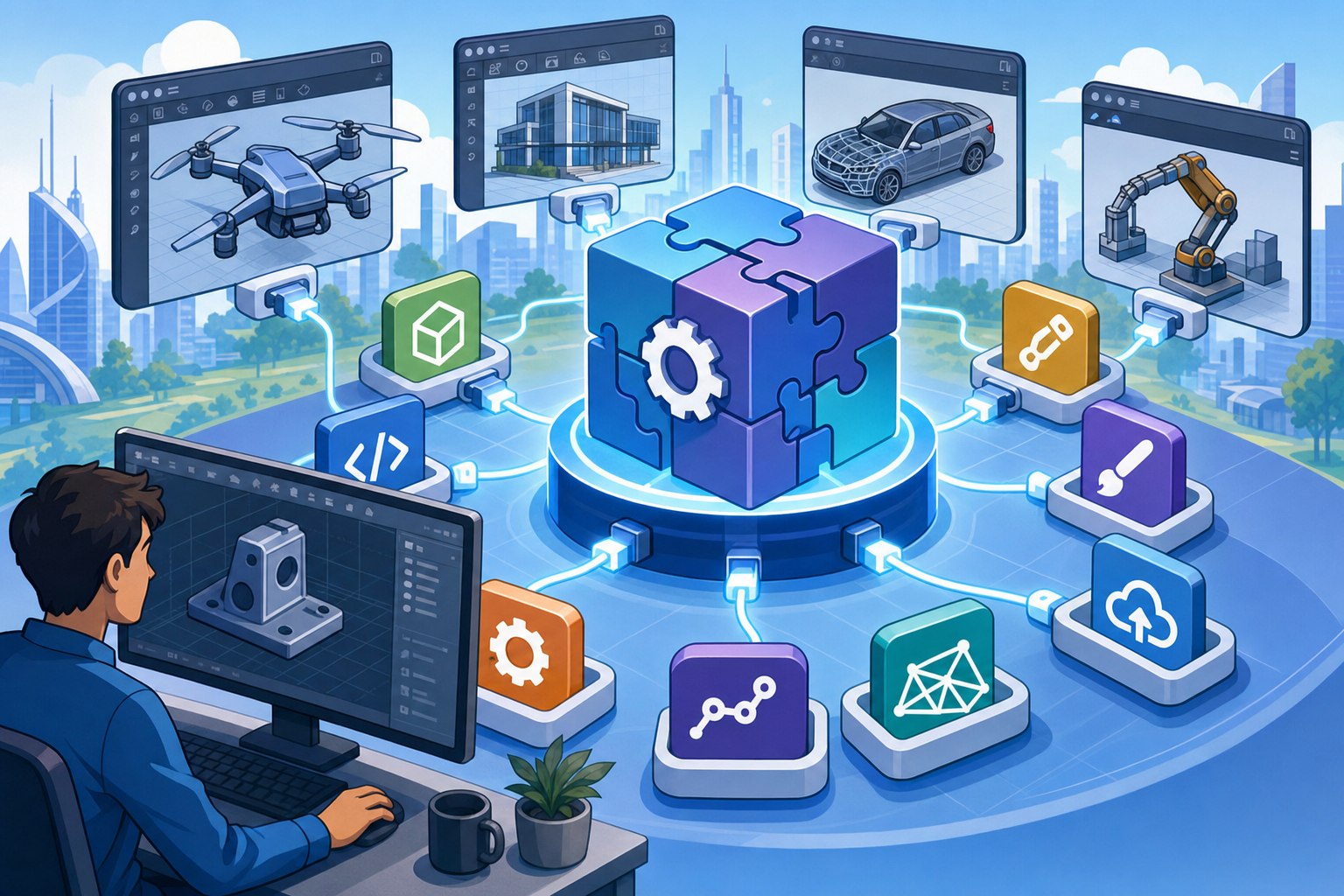


From Closed Engineering Environments to Extensible Design Platforms
The early history of computer-aided design was shaped by systems that were powerful, highly specialized, and almost entirely closed. In the 1960s, 1970s, and into much of the 1980s, CAD software was typically delivered as part of a tightly controlled technical environment that combined proprietary software, proprietary hardware, expensive graphics terminals, and carefully defined engineering workflows. Companies such as Computervision, Applicon, CADAM, Intergraph, and early Dassault Systèmes built solutions that were rarely intended to be altered by end users. In many cases, the software was optimized for a specific category of work such as 2D drafting, aerospace surfacing, or numerically controlled manufacturing preparation, and it ran on minicomputers or workstations from vendors such as Digital Equipment Corporation, IBM, Prime Computer, Apollo Computer, and Sun Microsystems. The business model rewarded stability, service contracts, and controlled implementation rather than user-driven experimentation. In that world, the idea that a design office might routinely write its own code on top of the CAD system was not yet central to the product strategy. The software vendor defined the boundaries of the system, and customers adapted their internal processes to fit those boundaries, even when those processes involved repetitive drafting standards, custom data management rules, or highly specific engineering calculations that were not elegantly supported by the base application.
Why Early CAD Stayed Closed
There were practical reasons for that closed structure. Early interactive graphics systems were technically difficult to build and maintain, and many vendors were still solving fundamental problems in display management, database handling, geometric computation, and input-device interaction. The core technologies behind drafting and modeling were fragile enough that exposing too much internal behavior to customers could threaten reliability. At the same time, software companies were often selling a total package rather than a portable application. A customer buying a high-end CAD installation was often entering a relationship that included hardware procurement, installation, training, data migration, and support engineering. That arrangement naturally favored controlled environments over open ones. Yet as CAD moved from elite installations into broader industrial use, especially with the spread of workstation computing and later personal computers, customers began to demand more than a fixed toolset. Engineering firms wanted to automate title blocks, parts lists, layer management, drawing standards, and repeated geometric operations. Manufacturers wanted connections to bill-of-materials systems, process planning tools, CAM environments, and later PDM and PLM platforms. Architects and industrial designers wanted to tailor the software to their own design languages and documentation conventions. These needs created pressure for a new concept: CAD not merely as a product, but as a programmable environment into which company knowledge could be embedded.
The Turning Point Toward Extensibility
That shift toward extensibility became one of the most important turning points in design software history because it changed both the technical architecture and the economic meaning of CAD. Once vendors saw that customers were not just asking for more commands but for ways to create their own commands, a different strategy emerged. Instead of trying to predict every workflow variation in mechanical design, plant layout, mold design, architecture, electrical schematics, and fabrication documentation, software companies began to expose programmable interfaces. These interfaces took many forms over time, from command scripts and keyboard macros to embedded languages and full software development kits. The result was profound. APIs allowed firms to encode internal methods that reflected decades of accumulated engineering practice. A shipbuilder could automate naming conventions and compartment layouts. An automotive supplier could build parametric routines tied to manufacturing constraints. A machine builder could generate drawings and standard components from configuration data. In every such case, the CAD system became a host for organizational intelligence. The most important historical consequence was that CAD APIs turned design software into a platform, not just a drafting or modeling application.
How APIs Changed the Role of CAD in Industry
Once programmability entered mainstream CAD, the software’s role expanded dramatically across engineering organizations. APIs enabled users to do far more than speed up drafting. They made it possible to create connected workflows in which geometry, metadata, documentation, and downstream processes could move together. The platform idea was powerful because it supported several layers of value at once:
- Macros and scripts reduced repetitive labor and improved consistency.
- Custom commands allowed firms to mirror their own terminology and processes.
- External applications could connect CAD to estimating, analysis, manufacturing planning, and data management.
- Internal standards could be enforced automatically rather than manually audited.
- Third-party developers could build vertical solutions that the original vendor never had the resources to create.
This evolution also changed competition among CAD vendors. A system that lacked a vibrant extension strategy increasingly looked limited, even if its modeling tools were strong. Conversely, a product with a good API could succeed in markets where customization mattered more than default functionality. That historical transformation helps explain why extensibility became one of the defining characteristics of successful CAD platforms from the late 1980s onward.
The Companies, Products, and People That Built CAD API Culture
No company did more to normalize mass-market CAD programmability than Autodesk in the era of AutoCAD. Founded in 1982 by John Walker and a group of co-founders including Dan Drake, Mike Riddle, and David Kaliel, Autodesk entered the market at a moment when CAD was moving from expensive workstations toward personal computers. AutoCAD’s affordability and hardware flexibility already made it disruptive, but its long-term influence came equally from programmability. The introduction of AutoLISP in the mid-1980s gave users a surprisingly powerful embedded language based on the Lisp tradition, allowing routines to manipulate drawings, generate entities, automate drafting standards, and create domain-specific tools. AutoLISP was instrumental because it did not only serve professional software developers; it empowered technically inclined designers, drafters, and CAD managers. An enormous ecosystem of consultants, add-on developers, reseller programmers, and in-house automation specialists grew around AutoCAD. Over time Autodesk expanded this environment with ADS, ObjectARX, VBA support, and later .NET APIs, but AutoLISP remained culturally important because it democratized the idea that users could shape the software themselves. The AutoCAD community, trade publications, reseller channels, and Autodesk University all played a decisive role in cultivating this culture of extensibility, making Autodesk one of the clearest examples of how a CAD vendor evolved into a platform company.
PTC, Parametrics, and Industrial-Scale Extensibility
If Autodesk showed how API culture could spread across a broad installed base, Parametric Technology Corporation, founded by Samuel Geisberg and Mike Payne in 1985, demonstrated how programmability could become central to a more sophisticated model of engineering automation. Pro/ENGINEER, introduced in 1987, transformed mechanical CAD through feature-based, parametric, and associative solid modeling. But that transformation quickly created a second need: companies wanted to programmatically access the feature tree, dimensions, families of parts, drawing associations, and engineering logic that made the product so powerful. PTC responded over time with a series of extensibility mechanisms including Pro/PROGRAM, Pro/Toolkit, J-Link, Web.Link, and later frameworks around Creo. These tools allowed manufacturers to automate configuration, template-driven design, model generation, BOM extraction, and integration with enterprise systems. At PTC, APIs were not simply convenience layers; they were a way to industrialize parametric design. They enabled users to embed business rules directly into the model creation process, which mattered enormously in sectors such as industrial equipment, automotive supply, and discrete manufacturing. PTC’s user communities, implementation partners, and technical specialists helped normalize the expectation that advanced CAD should be programmable deep into the product structure rather than only around the edges of drawing production.
SolidWorks, COM Automation, and the Windows Developer World
SolidWorks brought a different and historically significant flavor to CAD extensibility after its founding in 1993 under Jon Hirschtick, with influential early technical leadership from figures such as John McEleney and a development culture strongly tied to Windows software conventions. When SolidWorks reached market in the mid-1990s, one of its advantages was that it fit naturally into the Microsoft ecosystem. Its API strategy reflected that environment through COM-based automation, VBA scripting, and later .NET support. This mattered because it lowered the barrier between CAD customization and mainstream business software development on Windows. A vast number of engineers, CAD administrators, and solution providers could build automation tools using technologies already familiar in corporate IT departments. Add-ins emerged for custom property handling, drawing generation, PDM integration, design checking, costing, nesting, quotation support, and manufacturing preparation. The SolidWorks API also encouraged a strong third-party market because independent software vendors could build professional add-ins without needing access to obscure workstation platforms or unusually specialized development environments. The annual SolidWorks World event, user groups, reseller technical networks, and online developer communities all reinforced the idea that the application was not just a modeler but an expandable engineering framework. In historical terms, SolidWorks helped make COM-based automation in CAD a mainstream expectation for small and medium-sized manufacturers and not only for large enterprise engineering organizations.
CATIA, Unigraphics, Siemens, and Ecosystem Strategy at the High End
At the high end of industrial design and engineering, Dassault Systèmes and the lineage that became Siemens Digital Industries Software played equally important roles, though often with different strategic emphases. CATIA, shaped by Dassault Systèmes in close historical connection with aerospace needs at companies such as Dassault Aviation and later with major automotive manufacturers, developed extensive customization and integration pathways because large enterprises required platform-level control across design, manufacturing, and lifecycle management. The APIs around CATIA, CAA in particular, reflected a world in which software extensibility was tied to complex product development environments, digital mock-up, knowledgeware, and enterprise-scale process orchestration. Unigraphics, which originated in the McDonnell Douglas environment before passing through SDRC and EDS and eventually into the Siemens portfolio as NX, likewise developed robust programmability through UG/Open and related frameworks. These were not merely developer conveniences but strategic system interfaces for industries managing assemblies of extraordinary complexity. In both CATIA and Unigraphics/NX, the ecosystem model depended on relationships among OEMs, major systems integrators, software partners, and internal engineering software teams. The companies understood that for advanced manufacturing customers, the strength of the platform depended on how well it connected to CAM, CAE, PLM, and highly specific domain applications. Their API strategies helped define what enterprise CAD platform architecture looked like at scale.
Rhino and the Developer-Friendly Culture of Openness
Rhinoceros, developed by Robert McNeel & Associates, occupies a special place in the history of CAD API culture because it showed that developer friendliness could itself be a product identity. Rhino emerged from a geometric tradition centered on NURBS modeling and became widely adopted across industrial design, jewelry, marine design, architecture, digital fabrication, and computational design communities. Unlike some enterprise platforms where APIs were strongly mediated through formal partner structures, Rhino developed a reputation for accessibility, experimentation, and responsiveness to its user-developer base. McNeel encouraged scripting and plugin development through RhinoScript, RhinoCommon, Python support, and later a broad environment around Grasshopper, itself created by David Rutten. This ecosystem attracted not only commercial software developers but also architects, fabrication researchers, university labs, and computational designers who treated the software as a medium for invention. Grasshopper in particular expanded the meaning of API culture because visual programming became a way to expose geometric logic, parametric relationships, and algorithmic thinking to users who were not conventional programmers. That made Rhino central to the modern history of programmable geometry, where scripting, plugin development, and computational design methods merged into a highly creative and unusually open software culture.
Communities, Power Users, and the Social Infrastructure of APIs
The rise of CAD programmability was not created by software vendors alone. It depended on a broad social infrastructure composed of platform architects, consultants, reseller specialists, in-house CAD managers, third-party entrepreneurs, educators, and technically ambitious users. In many organizations, the first API champions were not professional software engineers but engineers who were frustrated by repetitive drafting or modeling work and had enough programming experience to automate it. These people became local innovators, often building tools that later influenced official product directions. Conferences and user gatherings were vital because they created spaces where code, workflows, and practical solutions could be exchanged. Autodesk University, PTC user events, SolidWorks World, Siemens and Dassault partner gatherings, and Rhino community forums all helped transform isolated customization efforts into recognizable ecosystems. Developer programs and partner networks then professionalized these activities by publishing SDKs, sample code, documentation, certification pathways, and technical support channels. The result was a durable cultural shift. CAD users increasingly expected to ask not only whether a system could model a part or generate a drawing, but whether it could be extended, integrated, and embedded within a larger engineering process. API culture became part of CAD buying criteria, and that change remains historically significant.
The Technologies Behind CAD API Evolution
The technical history of CAD APIs is a story of gradual opening, moving from simple command repetition toward deep programmatic access to geometry, features, assemblies, and enterprise data. The earliest forms of automation were often little more than command scripts, keyboard macros, and batch routines. These mechanisms were limited, but they established the crucial idea that user actions could be formalized and replayed. In drafting-centric systems, that alone could save substantial time by standardizing layer creation, title block insertion, plot settings, and repeated annotation patterns. Some products offered menu customization and parameter files that occupied a middle ground between full programming and static configuration. As CAD systems became more interactive and more widely deployed, vendors began embedding languages directly in the product. Lisp, especially through AutoLISP, was especially important because it matched symbolic graphics manipulation well and let users create custom commands without leaving the CAD environment. VBA later became significant in Windows-centric products because it seemed approachable to corporate users and leveraged Microsoft’s automation culture. These steps mattered historically because they expanded the community of people who could extend CAD. A system no longer required a formal software engineering team before customization could begin; a technically skilled user inside the design department could increasingly do meaningful work.
From Embedded Scripting to Professional SDKs
As expectations grew, command automation and embedded scripting proved insufficient for many industrial needs. Firms wanted performance, richer interfaces, stronger control over product data, and access to lower-level parts of the modeling environment. That led to the rise of software development kits based on C and C++, often exposing object models, event systems, geometry functions, feature operations, and user-interface integration points. In products such as Pro/ENGINEER, SolidWorks, CATIA, and Unigraphics/NX, these SDKs supported serious application development rather than simple automation. Developers could create companion applications, custom dialogs, model validators, manufacturing preparation tools, and company-specific engineering assistants. On Windows, COM and later .NET became especially influential because they allowed CAD systems to plug into a broader ecosystem of office automation, database access, PDM interfaces, and custom enterprise applications. This integration layer was historically important because engineering software stopped being isolated. A plugin could now pull data from Excel, write to SQL databases, connect to ERP workflows, trigger document management operations, or feed manufacturing systems. More recently, Python and JavaScript have expanded the field again by lowering barriers for web-connected, data-driven, and computational workflows. In newer platforms, APIs may be local, cloud-based, browser-oriented, or hybrid, reflecting a world in which design software is no longer confined to a single desktop executable.
What CAD APIs Actually Exposed
The power of these technologies depended on what vendors chose to expose through their APIs. At first, access might be limited to commands and user interface automation, but mature ecosystems increasingly opened up the internal structure of design models. This included:
- Geometry creation, such as points, curves, surfaces, solids, and coordinate systems.
- Feature control, including sketches, extrusions, revolves, blends, patterns, holes, fillets, and constraints.
- Drawing automation for views, dimensions, symbol placement, title blocks, and bills of materials.
- Assembly operations involving component insertion, mating, positioning, suppression, and configuration management.
- Metadata and property handling for part numbers, materials, revision data, and custom attributes.
- Data exchange with PDM, PLM, CAM, simulation, and downstream manufacturing software.
This breadth is what made APIs transformative. Once a company could programmatically create or interrogate not only geometry but also design intent and product structure, entirely new classes of automation became possible. Engineers could generate families of parts from rules, synchronize design changes with downstream documentation, or build interfaces where non-CAD users supplied configuration data that drove model creation behind the scenes. APIs were therefore not secondary features; they were mechanisms for translating engineering knowledge into repeatable digital processes.
The Hidden Mathematical and Kernel-Level Challenge
Beneath the visible convenience of CAD APIs lay a difficult technical reality: geometric modeling systems are built on mathematically complex kernels and data structures that are hard to expose safely. Whether a platform used proprietary modeling technology or kernels such as Parasolid from Siemens or ACIS from Spatial, the internal representation of topology, geometry, tolerances, feature history, constraints, and associativity created constant challenges for API design. A command that seems simple to an end user may invoke chains of operations involving boundary representation updates, constraint solves, regeneration logic, reference resolution, and transaction management. Vendors therefore had to decide how much of that machinery developers should see. If the interface was too shallow, meaningful customization was impossible. If it was too deep, external applications could break model integrity, depend on unstable behaviors, or tie themselves to implementation details that would later change. This tension explains why some APIs remained carefully mediated through sanctioned objects and methods while others exposed lower-level capabilities only to selected partners. It also explains why documentation quality varied so much across the industry. A well-documented API required not only technical references but conceptual explanations of geometric behavior, regeneration order, and data persistence, all of which were costly to produce and maintain.
Version Fragility and the Cost of Openness
One of the enduring limitations of CAD APIs has been version fragility. Every time a vendor changes the internal model, the user interface, the file structure, or the object model, existing customizations are put at risk. A macro that relies on exact command names can fail after a menu redesign. An add-in built around undocumented assumptions may crash after a service pack. A feature tree traversal that worked in one release may behave differently when regeneration logic changes in the next. These problems become even more severe when third-party tools interact with PDM, PLM, CAM, or simulation environments, because compatibility must be preserved across multiple software stacks at once. For customers, this creates a historical paradox: the more deeply APIs are used to encode business processes, the more valuable the CAD platform becomes, but also the harder it becomes to change versions or switch vendors. Documentation gaps, unofficial workarounds, and hidden dependencies have always been part of this landscape. Maintaining compatibility over time is costly for the software vendor and equally costly for customers with large automation investments. That is why API stability became a strategic issue, not just a technical one. A strong ecosystem required trust that developers’ work would survive product evolution at least well enough to justify continued investment.
From Desktop Add-Ins to Cloud and Web Interfaces
The newest phase of CAD API history extends these earlier patterns into cloud platforms, browser-based systems, and service-oriented architectures. Modern platforms increasingly expose REST APIs, webhooks, JavaScript environments, Python workflows, and cloud compute services alongside or instead of traditional desktop SDKs. This changes not just implementation details but the conceptual reach of programmability. APIs are no longer limited to commands inside a local modeling session. They may manage documents in the cloud, trigger geometry processing remotely, connect browser-based model views to enterprise dashboards, or allow AI systems to recommend or generate design alternatives. Yet the historical continuity is clear. The same core ambitions remain in place: automate repeated work, connect design to other systems, encode company knowledge, and let third parties expand the platform. What has changed is the scope. The old question was whether a CAD seat could be customized; the new question is whether a design environment can function as part of a digital service network spanning collaboration, manufacturing, simulation, procurement, and intelligent assistance. In that sense, today’s web APIs and cloud extensions are the descendants of yesterday’s macros and scripting languages, but operating at far greater scale.
Why API Ecosystems Redefined CAD Competition and Why That History Still Matters
The long-term consequence of CAD API development is that it changed the competitive meaning of design software itself. In earlier periods, vendors were often judged primarily by graphics performance, drafting functions, surfacing quality, solid modeling capability, or hardware efficiency. Those metrics remained important, but extensibility introduced a new basis for strength. The most durable platforms were increasingly those that allowed customers, partners, and independent developers to build on top of them. A CAD product with excellent native tools but weak programmability could be less valuable in practice than a somewhat less elegant modeler surrounded by a rich ecosystem of automation, integrations, and specialized applications. This was a decisive shift because it changed software from a finished artifact into an expandable infrastructure. Once APIs matured, a platform could be adapted to custom fixture design, piping, plant layout, mold design, sheet metal automation, fabrication nesting, engineering validation, cost estimation, or configuration management without the core vendor having to build every vertical solution internally. That ecosystem logic rewarded openness, developer support, and platform stability in ways that were not central in the earliest generations of CAD.
The Broader Industrial Effects of CAD API Ecosystems
The historical impact of that shift spread far beyond software architecture. It produced major industrial consequences that are still visible today:
- The creation of substantial third-party software markets around major CAD platforms.
- Deeper integration of design with PDM, PLM, CAM, CAE, ERP, and manufacturing execution workflows.
- Greater ability for organizations to encode proprietary methods and preserve them digitally.
- Stronger customer lock-in, because custom automation made migration away from a platform more expensive.
- At the same time, greater innovation, because outside developers could explore needs the core vendor did not prioritize.
This dual effect is important. APIs increased dependence on successful platforms, but they also made those platforms more useful and inventive. A firm that built years of internal engineering logic into AutoCAD, Creo, NX, CATIA, SolidWorks, or Rhino was undoubtedly more tied to that environment. Yet it also gained productivity, consistency, and the ability to operationalize knowledge that might otherwise remain trapped in manuals, spreadsheets, or individual expertise. That tension between dependence and innovation has defined much of the software platform economy in engineering.
Connecting the Historical Arc to the Present
That history now leads directly into the present moment, where cloud-native CAD, browser-based collaboration, additive manufacturing workflows, real-time product visualization, and AI-assisted design are again redefining what an API ecosystem can be. Today the question is not only how to automate commands or build plugins, but how to orchestrate geometry, data, compute services, and intelligent recommendations across distributed systems. Companies developing modern platforms understand, just as Autodesk, PTC, Dassault Systèmes, Siemens, SolidWorks, and McNeel understood in earlier eras, that software becomes strategically stronger when others can extend it. The forms have changed, but the lesson remains constant: in design software history, the most influential systems were rarely those that only delivered tools. They were the ones that enabled communities, developers, and industrial organizations to turn those tools into larger, living systems of work. That is why the history of CAD APIs is not a technical side note. It is one of the central stories in how digital design became programmable, interconnected, and open to continuous reinvention.
Also in Design News


