Your Cart is Empty


Design Software History: Autodesk Inventor and the Rise of Parametric CAD After Pro/ENGINEER
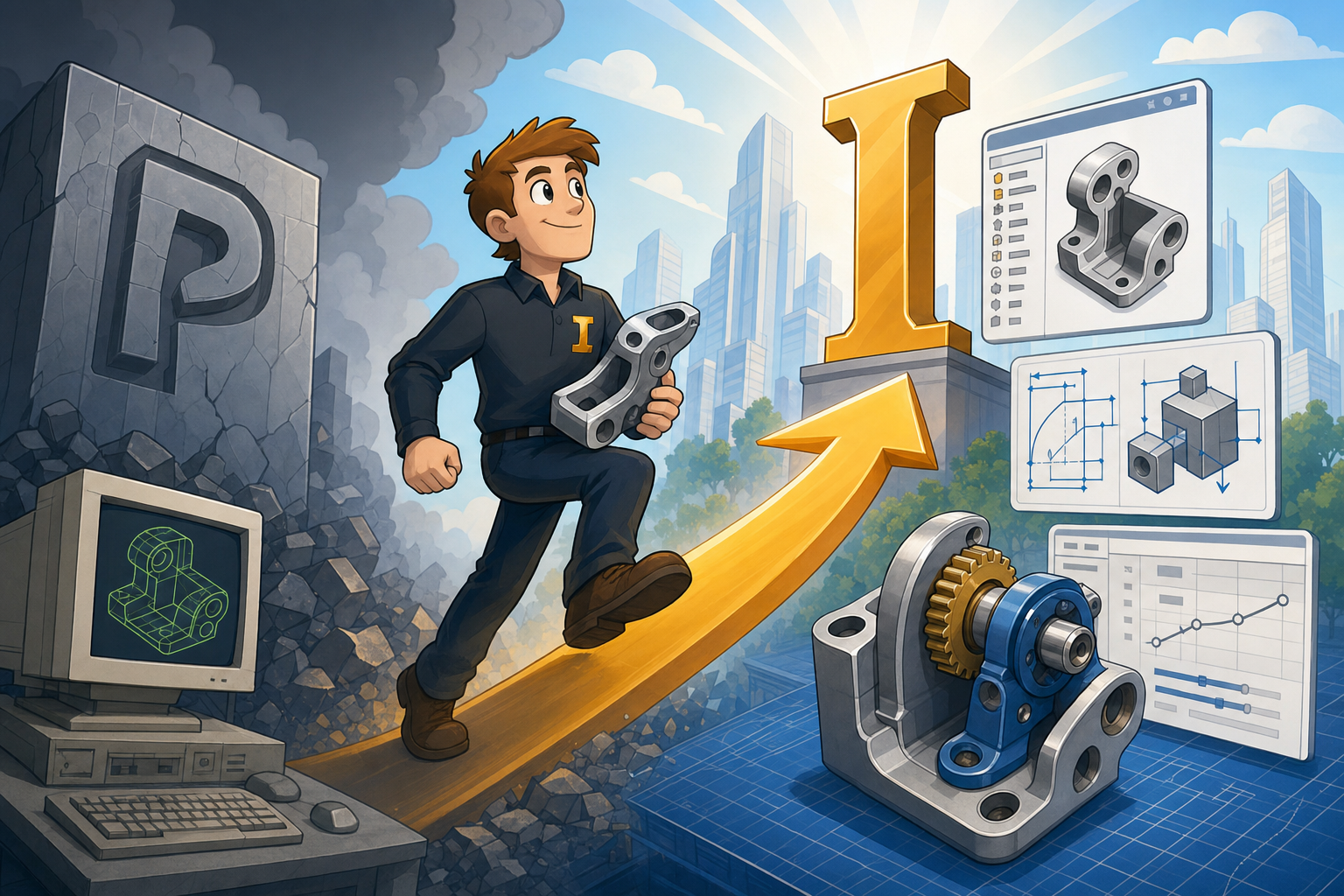


The Market Inventor Entered: Parametric CAD After Pro/ENGINEER
A market already transformed before Autodesk arrived
Autodesk Inventor entered a CAD market that had already been fundamentally reshaped by the parametric revolution. In 1987, Parametric Technology Corporation introduced Pro/ENGINEER, and PTC founder Dr. Samuel Geisberg gave commercial CAD a new center of gravity: history-based, feature-driven, parametric solid modeling. Instead of treating geometry as a collection of isolated lines, arcs, surfaces, or dumb solids, Pro/ENGINEER made the model a controlled system of sketches, dimensions, constraints, parent-child relationships, and ordered features. A hole was not merely a cylindrical subtraction; it was a design intention located from references and controlled by parameters. A boss, rib, protrusion, shell, pattern, or round could become part of an editable recipe. This was not just a technical upgrade. It changed how companies thought about engineering change, because geometry could be regenerated after dimensional edits and design variations could be explored without redrawing the product from scratch.
The high-end systems that defined industrial credibility
By the time Autodesk prepared Inventor, the high end of CAD was already occupied by powerful incumbents with strong industrial loyalties. Dassault Systèmes CATIA, with origins connected to Dassault Aviation and its early 1980s commercialization, had become deeply embedded in aerospace and automotive engineering. Under leaders such as Bernard Charlès, Dassault Systèmes expanded CATIA from a specialist aircraft design system into a broad enterprise platform for product development, manufacturing preparation, surfacing, and lifecycle workflows. Unigraphics also carried enormous credibility, tracing its lineage through United Computing, McDonnell Douglas, EDS, UGS, and eventually Siemens NX. It served demanding manufacturing and engineering organizations that needed advanced modeling, tooling, machining, and assembly capabilities. These systems did not merely sell software licenses; they sold organizational standards. Aerospace companies, automotive suppliers, heavy equipment firms, and precision manufacturers built methods, training programs, libraries, and supplier requirements around them, making displacement extraordinarily difficult.
SolidWorks and the Windows-native disruption
The most direct pressure on Autodesk, however, came from the emerging midrange market, where SolidWorks changed expectations after its 1995 launch. Founded by Jon Hirschtick in 1993 and later acquired by Dassault Systèmes in 1997, SolidWorks showed that serious 3D parametric mechanical CAD could run on Microsoft Windows PCs rather than expensive UNIX workstations. This mattered because it changed the economics and psychology of mechanical design. Engineers who had lived in 2D drafting environments could now imagine 3D modeling at department scale, not only inside elite aerospace or automotive engineering groups. SolidWorks combined parametric modeling with an approachable interface, Windows conventions, lower hardware barriers, and aggressive reseller-driven education. It did not carry the full enterprise weight of CATIA or Unigraphics, but that was precisely its advantage in small and medium-sized manufacturers. It made the transition to 3D feel practical, affordable, and personally empowering for designers who wanted modern solid modeling without the cultural burden of a massive enterprise implementation.
Autodesk’s 2D dominance became a strategic complication
Autodesk had a different problem: it was already enormously successful. AutoCAD, first released in 1982 after the founding of Autodesk by John Walker and colleagues, became the world’s most widely used drafting platform. Its DWG format, customization culture, reseller network, training ecosystem, and broad use across architecture, engineering, manufacturing, and construction made it one of the most influential software products in technical design history. Yet that success created a perception Autodesk struggled to escape. To many mechanical engineers in the 1990s, Autodesk meant 2D drafting, not elite parametric solid modeling. Mechanical Desktop, introduced as an AutoCAD-based mechanical modeling and drafting product, was an important transitional step, but it inherited the gravitational pull of AutoCAD’s drafting architecture. It helped existing users move toward mechanical 3D, yet it could not fully match systems designed from the beginning around parametric features, constraints, assemblies, and model associativity.
- AutoCAD gave Autodesk market reach, file-format power, and user familiarity.
- Mechanical Desktop gave Autodesk a bridge from drafting to 3D mechanical design.
- Inventor represented the decision that a bridge was not enough; Autodesk needed a purpose-built 3D platform.
Inventor was not AutoCAD with depth added
The essential historical point is that Autodesk Inventor was not simply “AutoCAD in 3D.” That phrase misunderstands both the competitive threat and the technical challenge Autodesk faced. If Inventor had been a conventional drafting product with solid tools attached, it would have repeated the limitations Autodesk already saw in Mechanical Desktop. Inventor was instead Autodesk’s attempt to retain its vast installed base while competing with SolidWorks, Pro/ENGINEER, Unigraphics, and CATIA in the language of modern mechanical design. It had to speak to AutoCAD users without being trapped by AutoCAD assumptions. It had to be approachable enough for Windows-based designers, but credible enough to be considered a real parametric modeler. That was a difficult balance, because the people Autodesk wanted to keep were comfortable with drawings, layers, blocks, linework, and DWG-centered workflows, while the market’s future was moving toward sketch constraints, feature trees, assemblies, mass properties, interference checks, and associative manufacturing documentation.
Building Inventor: A New Architecture for a New CAD Era
Why Autodesk needed a fresh technical start
AutoCAD’s architecture was extraordinarily flexible for drafting, but drafting flexibility is not the same as parametric modeling coherence. In traditional CAD drafting, the drawing is often the authority: lines define edges, dimensions annotate intent, and revisions are made by editing geometry and documentation together. In parametric solid modeling, the model becomes the authority: sketches define profiles, features generate topology, dimensions drive geometry, and drawings are derived views of a coherent three-dimensional object. That shift requires a different internal logic. It requires dependency management, regeneration sequencing, persistent topological references, constraint solving, feature editing, assembly relationships, and associativity between parts, assemblies, and drawings. Mechanical Desktop extended AutoCAD into this world, but its dependence on AutoCAD’s structure limited how far it could evolve. Autodesk needed a platform whose foundations assumed that mechanical design would begin with model-centered product definition, not with drawing sheets enhanced by solid geometry.
Inventor’s release and Windows-centered design decision
Introduced in 1999, Autodesk Inventor was designed as a dedicated 3D mechanical design system for the Microsoft Windows era. That decision was historically important. The workstation CAD world of the 1980s and early 1990s had been shaped by specialized hardware, UNIX environments, and enterprise procurement patterns. By the late 1990s, Windows PCs had become powerful enough to handle increasingly serious engineering work, and SolidWorks had already proven the strategic value of being native to that environment. Inventor was Autodesk’s answer to that market reality. It treated Windows not as a compromise but as the mainstream platform for mechanical design expansion. This gave Autodesk access to a broad population of existing PC-based AutoCAD users and engineering departments that were reluctant to buy proprietary workstation infrastructure. The same shift also influenced interface expectations: designers expected familiar menus, dialog boxes, file management behavior, drag-and-drop conventions, and a shorter path from installation to productive modeling.
The modeling concepts built into Inventor
Inventor was built around the core vocabulary of modern parametric CAD: sketches, constraints, features, parts, assemblies, drawings, and libraries. A typical workflow began with a two-dimensional sketch constrained by dimensions and geometric relationships, then converted into a solid feature through operations such as extrusion, revolution, sweep, loft, hole creation, filleting, shelling, or patterning. The order of those operations appeared in a feature history that could be edited and regenerated. Drawings were associative, meaning views and dimensions could reflect model changes rather than existing as disconnected drafting artifacts. Assemblies used constraints to define relationships between components, such as mate, flush, angle, insert, and tangent conditions. This framework reflected the broader industry movement toward geometry that contained intent, not merely shape. Inventor therefore had to teach many Autodesk users a new mental model: design was no longer only the act of producing an accurate drawing, but the act of building a structured, editable digital product representation.
- Sketch-based modeling allowed designers to capture design intent through dimensions and geometric constraints.
- Feature history made parts editable through ordered operations rather than disconnected solid edits.
- Associative drawings reduced the separation between model definition and documentation.
- Assembly constraints supported product-level relationships, motion understanding, and fit validation.
- Sheet metal tools addressed a manufacturing domain where flat patterns, bends, reliefs, and fabrication rules were essential.
- Part libraries and mechanical content helped users reuse standardized components instead of remodeling common hardware.
ACIS, Spatial Technology, and ShapeManager
The geometric modeling kernel story is central to Inventor’s technical history. Early Autodesk Inventor releases used the ACIS geometric modeling kernel from Spatial Technology, a company founded in 1986 that became one of the most important suppliers of commercial solid modeling technology. ACIS provided boundary representation modeling capabilities needed for operations such as Boolean combinations, blends, shelling, and feature-based solid construction. Autodesk had long experience licensing modeling technology, but reliance on an external kernel also exposed a strategic issue: a CAD vendor’s ability to control modeling behavior, performance, robustness, and innovation can be limited when the deepest geometric engine is not fully under its own development direction. Autodesk later developed ShapeManager, derived from ACIS technology under its licensing rights, and integrated it into its mechanical CAD products. This move gave Autodesk greater control over the kernel layer and allowed Inventor to evolve with a modeling engine more closely aligned to Autodesk’s product roadmap.
Parametrics, usability, and migration had to coexist
Inventor’s technical agenda was unusually demanding because it needed to compete on multiple dimensions at once. Pro/ENGINEER’s strength was rigorous parametric control, and its users respected the discipline of strong parent-child relationships, regeneration logic, and design intent management. SolidWorks’ strength was accessibility: it translated many of the same parametric concepts into a Windows-native interface that felt less intimidating to mainstream mechanical designers. Inventor had to respond to both. If it was too loose, it would be dismissed by engineers who valued parametric discipline; if it was too severe, it would alienate AutoCAD users trying to move into 3D. Autodesk therefore positioned Inventor as a new mechanical design environment rather than as a simple replacement for every AutoCAD workflow. Its challenge was to create a migration path where users could retain drawing knowledge, manufacturing documentation habits, and Autodesk trust while learning assemblies, model constraints, part features, and associativity.
The Competitive Battle: Autodesk, SolidWorks, PTC, and the Midrange CAD Market
The midrange market became the decisive battleground
By the late 1990s and early 2000s, the most intense CAD competition was not restricted to the aerospace enterprise level. A rapidly expanding market of small and medium-sized manufacturers was moving from 2D drafting to 3D design, and these companies were not always committed to the heavyweight processes of CATIA, Unigraphics, or enterprise PDM deployments. They built machinery, fixtures, tools, consumer products, metal fabrications, industrial equipment, packaging machines, medical devices, and countless engineered components. For them, the promise of 3D CAD was practical: fewer ambiguous drawings, faster design revisions, better visualization, cleaner interference detection, easier customer communication, and more direct preparation for simulation and manufacturing. This was the arena where SolidWorks, Autodesk Inventor, Solid Edge, and other Windows-oriented systems fought for everyday loyalty. The midrange CAD conflict mattered because it determined what normal mechanical design would look like for a generation of engineers outside the largest corporations.
Autodesk’s installed base was both an asset and a burden
Autodesk entered this battle with strategic advantages that no competitor could ignore. Its installed base of AutoCAD users was massive, and DWG had become a de facto language of technical communication. Drafters, mechanical designers, educators, resellers, trainers, and IT departments already knew Autodesk as a software supplier. The company’s channel network was extensive, and its presence in engineering offices and educational institutions created familiarity that lowered adoption anxiety. Under the leadership era of Carol Bartz, who served as Autodesk’s chief executive from 1992 to 2006, the company strengthened its position as a broad design software vendor while navigating the challenge of moving beyond its 2D identity. Yet the same installed base also created inertia. A company famous for AutoCAD had to persuade users that it could build a first-class parametric mechanical modeler. Autodesk could not simply rely on brand recognition; in 3D mechanical CAD, users wanted proof of modeling robustness, assembly performance, and design workflow maturity.
- Autodesk had broad recognition among engineers and drafters who already trusted its software licensing, support, and reseller ecosystem.
- AutoCAD familiarity helped Autodesk reach organizations that were cautious about abandoning established drafting practice.
- The DWG ecosystem gave Autodesk a documentation advantage, especially where legacy drawings remained central to manufacturing communication.
- Educational penetration meant many new designers encountered Autodesk tools before entering industry.
SolidWorks had captured the emotional center of Windows CAD
SolidWorks posed Autodesk’s most direct midrange threat because it had already become the emotional favorite of many Windows-based mechanical designers. Its story was easy to understand: a modern parametric modeler made for ordinary PCs, designed around approachability, and backed by energetic resellers and a passionate user community. Jon Hirschtick and the SolidWorks organization understood that usability was not a superficial concern; it was a market weapon. If engineers could learn 3D modeling quickly, see immediate productivity, and feel that the software respected Windows conventions, adoption accelerated. Dassault Systèmes’ acquisition of SolidWorks strengthened the company’s resources while letting the product maintain a distinct midrange identity separate from CATIA. Autodesk therefore faced a competitor that was not merely technically capable but culturally well-positioned. SolidWorks users often described their preference in personal terms: the software felt direct, modern, and built for the mechanical designer rather than inherited from an older drafting or enterprise CAD tradition.
PTC retained the authority of the parametric pioneer
PTC remained important because it possessed the credibility of invention. Pro/ENGINEER had established the commercial model for parametric solid modeling, and that historical authority mattered to engineering managers who associated Pro/ENGINEER with design rigor. PTC’s technology encouraged disciplined intent capture, although some users also found its early interface demanding compared with later Windows-native systems. Still, PTC’s presence reminded the market that parametric CAD was not just about convenience; it was about controlling product variation, design families, and engineering change with mathematical and procedural precision. Autodesk Inventor needed to demonstrate that it was not only easier for AutoCAD-oriented users but also serious enough to support real mechanical engineering. This involved robustness in regeneration, useful constraints, dependable drawings, large assembly handling, and credible integration with adjacent workflows. Competing with PTC meant competing with the origin story of modern parametric CAD itself, not only with a product feature list.
Digital prototyping became Autodesk’s positioning language
Autodesk increasingly marketed Inventor through the language of “digital prototyping,” a phrase that helped reposition the product beyond simple part modeling. The term suggested a broader workflow in which designers could build, inspect, validate, present, document, and prepare products digitally before physical prototypes consumed time and budget. This was a strategic message because it moved the conversation away from whether Inventor was merely catching up to SolidWorks or Pro/ENGINEER and toward what Autodesk could offer as a connected product development environment. Digital prototyping also spoke to Autodesk’s larger portfolio ambitions: visualization, documentation, simulation, data management, manufacturing preparation, and collaboration could be framed as parts of a continuous process. The phrase was not unique in spirit; the whole industry was moving from drawings to digital product definitions. But Autodesk used it effectively to explain why Inventor mattered to companies that had historically depended on 2D documentation.
- Simulation supported early evaluation of stress, motion, and functional behavior before fabrication.
- Visualization helped teams, clients, suppliers, and managers understand products without interpreting orthographic drawings.
- Assembly validation allowed designers to check fit, clearance, interference, and component relationships.
- Documentation remained essential, but drawings became outputs from the model rather than isolated originals.
- Manufacturing preparation connected model geometry to tooling, sheet metal flat patterns, bills of materials, and downstream processes.
The competitive field included kernels, channels, and habits
The battle was never only a side-by-side comparison of features. Spatial Technology and ACIS were part of the story because geometric kernels affected what modelers could reliably calculate. Dassault Systèmes mattered both through CATIA at the high end and through SolidWorks in the midrange. PTC mattered as the parametric pioneer. Siemens NX and Solid Edge represented another branch of serious manufacturing-oriented CAD, with Solid Edge emerging from Intergraph technology before becoming part of the UGS and later Siemens portfolio. Autodesk’s differentiator was not simply that Inventor could extrude, revolve, constrain, and generate drawings. Its differentiator was the combination of a new 3D mechanical platform with a vast AutoCAD-centered market presence. That combination made Inventor historically significant even when it was not first. CAD markets are shaped by developer architecture, but they are also shaped by reseller incentives, classroom habits, legacy data, user confidence, file exchange demands, hardware trends, and the emotional comfort of familiar software ecosystems.
Inventor’s Historical Significance in the CAD Transition
A serious commitment to native 3D mechanical design
Autodesk Inventor mattered because it marked Autodesk’s serious commitment to native 3D parametric mechanical design. It was a response to a market Autodesk could not afford to ignore. AutoCAD’s dominance had made Autodesk one of the most important companies in design software history, but dominance in drafting did not guarantee leadership in solid modeling. The industry had changed under Autodesk’s feet: Pro/ENGINEER had proven the power of parameterized feature history, CATIA and Unigraphics had anchored enterprise mechanical and aerospace design, and SolidWorks had made Windows-native 3D CAD feel inevitable for ordinary engineering departments. Inventor represented technical rebuilding under competitive pressure. Autodesk had to accept that the future of mechanical CAD required a new architecture, a new user experience, and a new story about design intent. The result was not an invention of parametric CAD, but a major act of normalization for users already living inside the Autodesk universe.
The difficult transition from drawings to models
The larger historical meaning of Inventor is that it reveals how difficult the transition from 2D CAD dominance to 3D parametric modeling really was. In retrospective summaries, this shift can look obvious: drawings gave way to models, and the industry naturally advanced. In practice, the transition was organizationally complex. Drawings were not just old technology; they were contractual artifacts, manufacturing instructions, inspection references, training materials, archives, and communication tools. A 2D drafting culture contained decades of accumulated habits. Moving to 3D required more than teaching extrude and fillet commands. It required engineers to understand constraint strategy, model stability, assembly structure, feature order, design intent, drawing associativity, revision control, and downstream consequences. Autodesk Inventor’s historical role was partly educational. It helped a large Autodesk-oriented population cross from drawing-centered documentation into model-centered product development, even when those organizations still needed drawings as official deliverables.
Market leadership depends on ecosystems, not only algorithms
Inventor also demonstrates that CAD history is shaped not only by algorithms and kernels, but also by installed user bases, interface expectations, training ecosystems, and migration strategy. A geometric modeling kernel can define the mathematical possibilities of a CAD system, but commercial success depends on whether users can adopt those possibilities within real offices and factories. Autodesk understood distribution, training, resellers, and upgrade pathways exceptionally well. The company knew that many organizations would not abandon existing data, familiar vendors, or established support networks lightly. At the same time, Autodesk could not assume loyalty would last if competitors offered a better future. Inventor therefore stands as a defensive and offensive move at once: defensive because it protected Autodesk’s mechanical customer base from SolidWorks and PTC, offensive because it gave Autodesk a credible platform for digital prototyping, simulation, visualization, and manufacturing-oriented workflows. That strategic duality is central to understanding why Inventor deserves attention in design software history.
The final interpretation
Autodesk Inventor did not invent parametric CAD, and its importance should not be exaggerated by pretending that it arrived before Pro/ENGINEER, CATIA, Unigraphics, or SolidWorks established their claims. Its importance lies elsewhere. Inventor helped make parametric mechanical modeling normal for a huge population of engineers, designers, drafters, educators, and manufacturers who already associated Autodesk with everyday technical work. It showed that a company rooted in 2D drafting could rebuild around a native 3D architecture, even if doing so required a difficult break from legacy assumptions. Its story is one of defensive strategy, technical reconstruction, kernel evolution, Windows-era competition, and market migration. Above all, Inventor belongs to the broader industry shift from drawing-centered documentation to model-centered product development. That shift was not a single invention or a single product launch; it was a long competitive struggle among companies, technologies, and user communities deciding what the digital definition of a product should become.
Also in Design News