Your Cart is Empty


Design Software History: Additive Manufacturing and the Evolution of CAD Geometry Models
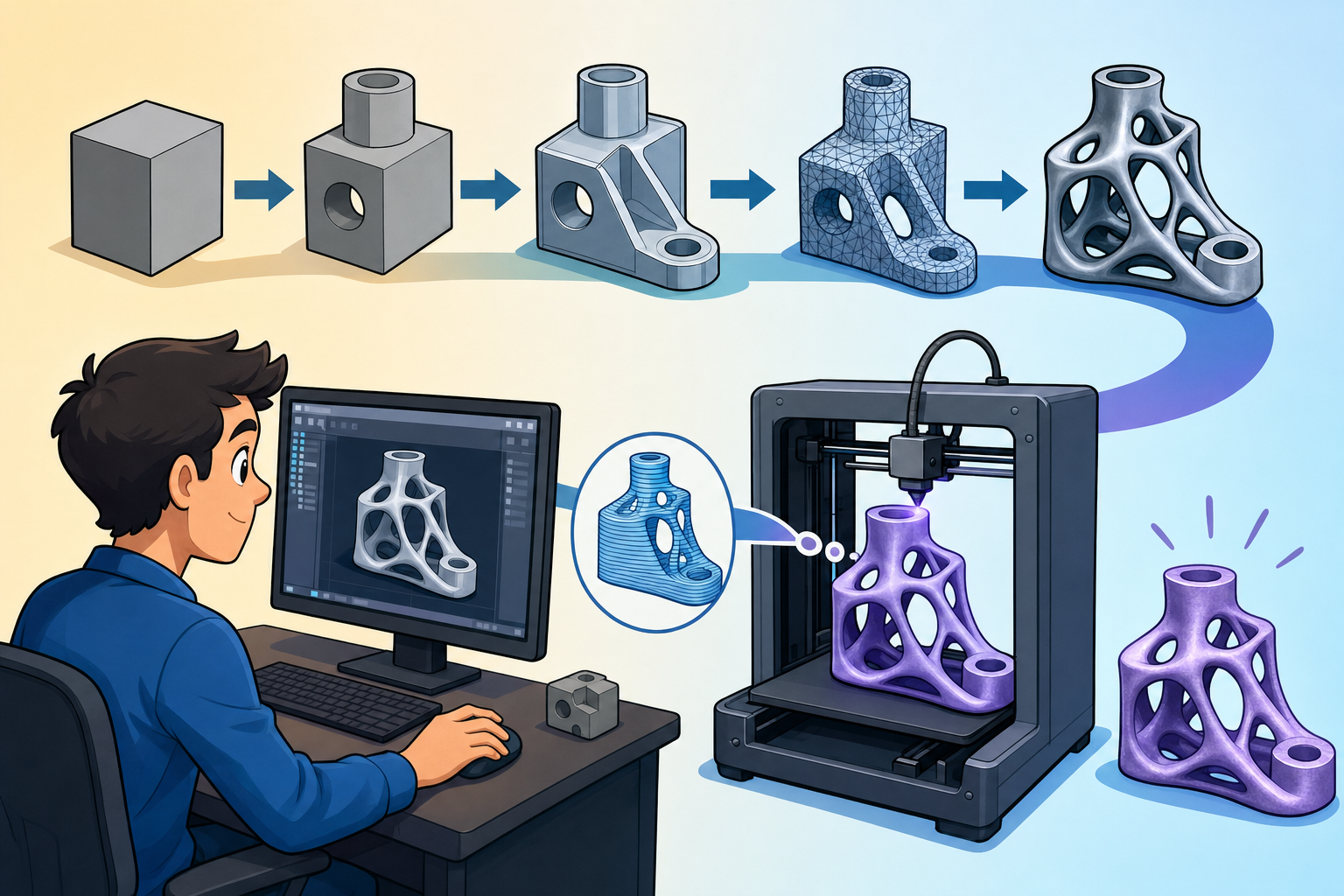


For most of the history of digital design, CAD systems were not built with additive manufacturing in mind. They were built to describe parts that would be cut, bent, cast, stamped, milled, drilled, forged, and assembled using industrial methods that assumed tool access, draft, fixture strategy, and manufacturing simplification. That original orientation shaped not only the user interfaces of major systems, but also the mathematical foundations underneath them, the data structures used to define parts, and the assumptions engineers made about what a “good” model should look like. When additive manufacturing moved from prototyping into production, it did not simply create demand for a new export format. It exposed a deep historical tension between software designed for traditional production logic and a fabrication process that could make geometry previously dismissed as impractical, unnecessary, or impossible.
Before Additive Manufacturing, CAD Was Built for Traditional Production
Manufacturing Logic Was Embedded in CAD Architecture
Mainstream CAD systems emerged in an era when the dominant manufacturing constraints came from subtractive and formative processes, so their logic naturally mirrored the needs of machining, casting, molding, and sheet metal fabrication. A designer using early and later mainstream systems was usually expected to produce a model that could be interpreted as a part for milling, turning, injection molding, die casting, or brake-forming. That meant the software rewarded geometry that was regular, measurable, and compatible with conventional process planning. In practical terms, features such as holes, bosses, fillets, pockets, shells, ribs, drafts, bends, and patterns made sense because they were directly legible to engineers who knew how the part would be made. CAD did not evolve in an abstract vacuum. It grew alongside manufacturing engineering, and software vendors succeeded by encoding the assumptions of the factory floor into the modeling environment itself. The result was a world in which feature histories, dimensional constraints, and exact surfaces were not merely convenient techniques. They were expressions of an industrial worldview centered on tool-driven production, process predictability, and geometric discipline.
Boundary Representation Reflected Traditional Production Assumptions
The dominance of boundary representation, parametric feature trees, and idealized watertight solids reflected this same orientation. A B-rep model defines geometry through mathematically exact faces, edges, and vertices, usually based on analytic surfaces and NURBS patches stitched into a topologically coherent shell. That is an elegant and powerful way to describe engineered parts, especially when dimensions, tolerances, and downstream manufacturing operations must remain controlled. Parametric feature trees added another layer of logic by letting designers construct geometry through ordered operations that resembled manufacturing intent: extrude, cut, fillet, shell, draft, mirror, pattern. The model became a history of rational engineering decisions, and this history was extremely valuable for redesign and product family variation. Yet this framework also carried assumptions. It favored exactness over approximation, smooth topological consistency over messy local complexity, and manufacturability according to traditional methods over free formal exploration. A perfect watertight solid was central because traditional CAD expected the part to represent an unambiguous volume suitable for mass, interference, sectioning, drafting output, and manufacturing documentation. Long before additive manufacturing arrived, the software ecosystem had already committed itself to a definition of geometry rooted in conventional production needs.
Major Vendors and Kernels Reinforced This Paradigm
The influence of major vendors and geometric kernel developers made these assumptions durable across the industry. PTC, through Pro/ENGINEER under the leadership of Samuel Geisberg and the company founded by Geisberg and Mike Payne, transformed parametric feature-based modeling into one of the defining paradigms of modern mechanical CAD. Pro/ENGINEER taught a generation of engineers to think in terms of parent-child relations, design intent, and feature order, all deeply compatible with conventional engineering workflows. Dassault Systèmes, initially through CATIA and later through SOLIDWORKS, expanded the reach of precise surface and solid modeling from aerospace and automotive into mainstream mechanical design, reinforcing the value of exact geometry connected to enterprise manufacturing processes. Siemens, through Unigraphics and later NX, and through stewardship of the Parasolid kernel originally shaped at ShapeData by figures including Ian Braid, helped standardize robust solid modeling infrastructure across many applications. Spatial and its ACIS kernel, associated with pioneers such as Alan Grayer and further commercialized under the influence of Mike Payne, also provided fundamental modeling technology used by many CAD developers. These vendors and kernels did not intentionally exclude additive manufacturing. Rather, they matured in a context where geometric rigor meant compatibility with machining centers, molds, and metrology, not with laser scan paths, voxel fields, or lattice-filled build volumes.
Printable Reality Did Not Match Engineering Ideals
Once additive manufacturing began to matter beyond rapid prototyping, the mismatch between these engineering ideals and printable reality became increasingly obvious. Traditional CAD tended to treat extremely thin walls as risky or undesirable because conventional manufacturing often struggles with them, whether due to tooling, warping, breakage, or mold filling limitations. Internal cavities were often awkward because they offered little value in subtractive workflows where inaccessible voids could not be machined without assembly or sacrificial tooling. Undercuts mattered greatly in molding and casting because they complicated part release, tooling cost, and process feasibility. Organic complexity was often tolerated only where high-end surfacing justified it, especially in automotive and aerospace exterior forms, but not as an everyday strategy for internal functional complexity. Additive manufacturing reversed many of those priorities. Thin walls became practical within process limits. Internal channels could be designed for cooling, fluid flow, lightweighting, or biomedical functionality. Undercuts ceased to dominate manufacturability logic in the same way. Highly complex organic forms, once a burden, became a key advantage. The core issue was historical: CAD had evolved to describe parts the machine shop and mold shop could understand, while additive invited designers to create geometries that made sense only when built layer by layer, often with material and thermal behavior integrated into the form itself.
3D Printing Exposed the Gaps in Traditional Geometry Workflows
STL Became the Bridge Because CAD Had No Native Additive Language
The emergence of STL as the practical bridge between CAD and early additive manufacturing revealed both the ingenuity and the inadequacy of the existing software stack. Developed in the orbit of 3D Systems during the stereolithography era associated with Charles Hull, STL was not a rich manufacturing model. It was a stripped-down triangulated approximation of a surface, typically with no units, no features, no topology semantics beyond triangle adjacency, and no representation of design intent, material behavior, or process strategy. Yet it became the de facto language because exact CAD solids could not be consumed directly by the early generation of printers and preprocessing systems. Printers needed faceted geometry that could be sliced, and STL was simple enough to produce and simple enough to parse. Its success was therefore historical rather than theoretical. It flourished because it solved a narrow interoperability problem at the moment additive needed one solved urgently. But its limitations were severe. Tessellation quality could distort design fidelity. Curved surfaces became faceted approximations. Small details could vanish or produce oversized files. The model ceased to be a fully expressive engineering object and became a polygon shell fragile enough that downstream preparation often turned into damage control.
Mesh Processing Became a Critical but Uncomfortable Discipline
As additive workflows matured, mesh processing, tessellation control, and repair tools became central to production practice, even though they sat uncomfortably beside traditional CAD. Engineers trained in exact solids often found themselves wrestling with polygonal approximations that behaved differently from the mathematically defined surfaces they had created. The quality of tessellation became an engineering issue because too coarse a mesh could flatten curvature, corrupt fit, and misrepresent fine geometry, while too dense a mesh could create bloated files and unstable processing downstream. Repair tools became essential because the exported mesh was often no longer a faithful, clean expression of the original solid. Instead, it was a triangulated artifact vulnerable to cracks, self-intersections, duplicate facets, degenerate triangles, and malformed edge relationships. Software companies that specialized in repairing and preparing geometry for additive effectively built a missing middle layer between CAD and manufacturing. This was historically important because it shifted attention away from the idea that geometry creation alone was enough. Printability depended on translation quality, mesh integrity, orientation, support logic, and machine-specific preparation. In other words, additive manufacturing turned geometric approximation from a side concern into a critical production variable, exposing a weakness in workflows that had long assumed exact CAD was the authoritative endpoint.
Additive Forced the Industry to Confront Geometry Pathologies
The technical problems additive manufacturing forced software to confront were not new in a mathematical sense, but they became newly unavoidable in practice. Non-manifold geometry was especially troublesome because many printable models violated assumptions about how edges and faces should define a coherent volume. Holes in meshes, flipped normals, inverted triangles, intersecting shells, and disconnected components all created ambiguity about what material should actually exist after slicing. Tolerance mismatches between exact CAD and polygon meshes added another layer of complexity. CAD kernels worked with robust but finite numerical tolerances, while STL exported approximations that could introduce tiny gaps or overlaps large enough to break slicing while remaining nearly invisible to the user. Conversion errors from solids to triangulated surfaces were often dismissed early on as inconvenient technicalities, but in additive they could determine whether a build failed, deformed, or misrepresented internal features. This was a major software history moment because it showed that the old hierarchy of exact model first, rough export later was no longer adequate. The exported form was not secondary. It was the form the machine actually built, and therefore every defect introduced at triangulation became materially real in a way that drafting and CNC documentation workflows had often insulated engineers from.
A New Ecosystem Defined the Additive Toolchain
Service bureaus, printer manufacturers, and specialized software firms played a decisive role in defining the new toolchain because the mainstream CAD environment alone was not sufficient. 3D Systems and Stratasys, as foundational companies in stereolithography and fused deposition modeling respectively, helped establish the practical realities of file preparation, slicing, support generation, and machine communication. Materialise, founded by Fried Vancraen, became one of the most influential software and service organizations in additive by building powerful preparation and repair workflows, especially through Magics, and by connecting geometry handling to medical, industrial, and manufacturing applications. Autodesk increasingly entered the space through mesh-aware tools, digital fabrication ambitions, and later generative and additive-oriented workflows that acknowledged the inadequacy of pure solid modeling alone. nTopology, founded by Bradley Rothenberg, represented a later but highly significant phase, in which additive-specific demands drove software toward field-driven and implicit approaches rather than legacy feature trees. The roles of these companies mattered because they redistributed authority within the design pipeline. No longer was the CAD model exclusively governed by the logic of mechanical design departments. Print bureaus, application engineers, machine vendors, and preprocessing specialists all shaped what a successful part definition looked like.
Additive Shifted Attention to Preparation and Validation
Perhaps the most consequential change was that additive manufacturing shifted software attention from pure shape definition to print preparation and manufacturability validation. In traditional CAD culture, a well-constructed model often implied readiness for downstream engineering. In additive, a beautiful shape could still be unprintable, unstable, poorly supported, thermally distorted, improperly oriented, or economically irrational. This changed what “done” meant in digital design. The workflow expanded to include build orientation, support structures, nesting, compensation, slicing parameters, machine envelopes, powder removal pathways, trapped volumes, recoater interactions, and process simulation. Geometry was still central, but it was now inseparable from process context. That was a software-historical turning point because it blurred old boundaries between design definition and manufacturing planning. Additive software pipelines increasingly required:
- mesh repair and manifold validation
- orientation analysis for quality, speed, and support minimization
- lattice fill and lightweighting strategies
- machine-specific slicing and parameter tuning
- checks for thermal distortion, trapped powder, and support accessibility
Additive Manufacturing Changed What Designers Wanted CAD to Do
Design for Additive Became Its Own Discipline
As additive manufacturing matured, it became clear that it was not merely another output device attached to an unchanged CAD process. It gave rise to design for additive manufacturing as a distinct discipline with its own principles, constraints, and opportunities. Engineers no longer saw 3D printing simply as a way to prototype parts originally designed for machining or molding. Instead, they began designing parts specifically to exploit layer-by-layer fabrication, material distribution freedom, and the ability to integrate complexity without proportional tooling cost. This represented a conceptual departure from traditional mechanical CAD. In a conventional workflow, manufacturability usually meant simplification, accessible tooling, manageable setups, and geometry rationalized for repeatable production. In additive, manufacturability often meant balancing complexity with process realities rather than removing complexity altogether. Internal channels could improve thermal or fluid performance. Lightweight lattice regions could reduce mass while preserving stiffness. Customized geometry could be generated for individual users, patients, or applications. This was not just a new feature request for CAD vendors. It was a demand for software that could reason about geometry as a performance outcome rather than only as an engineered artifact defined by dimensions and manually ordered features.
New Modeling Demands Stretched Parametric CAD
The new demands stretched conventional parametric CAD beyond the conditions for which it had been historically optimized. Lattice structures, topology-optimized parts, generative design outputs, conformal internal channels, and mass customization all challenged the classic feature-tree paradigm. Parametric systems excelled when a part could be described as a manageable sequence of intentional operations with dimensions, relations, and edits flowing through a logical history. But lattices could involve millions of repeating or graded elements. Topology optimization produced forms that emerged from simulation constraints rather than from feature-by-feature construction. Generative design systems could yield multiple irregular geometries shaped by objectives, loads, materials, and manufacturing rules. Conformal internal channels often had to follow thermal or fluid paths not easily represented as standard internal features. Mass customization required models to adapt algorithmically across many individualized variants. These were not impossible within legacy systems, but they often felt unnatural, brittle, or computationally inefficient. Designers increasingly needed workflows that could handle:
- very high geometric complexity without fragile history trees
- performance-driven geometry derived from simulation results
- localized variation in cell size, density, and internal architecture
- rapid generation of families of unique parts
- geometry that mixed exact engineering interfaces with complex freeform interiors
Hybrid Modeling Became the New Reality
In response, design software began moving toward hybrid workflows that combined exact solids, meshes, implicit representations, and simulation-driven form generation. This transition is one of the most important software developments associated with additive manufacturing. Exact solids remained essential for interfaces, toleranced regions, mating features, and many engineering definitions. Meshes remained unavoidable because scan data, printable intermediates, and complex triangulated outputs remained part of the workflow. But additive also encouraged the growth of implicit modeling, in which geometry is defined through fields, equations, or volumetric functions rather than explicitly stitched boundary faces. This approach is especially powerful for lattices, graded structures, smooth Boolean combinations, and high-complexity internal architectures because it avoids many of the topological fragilities of face-edge-vertex systems. Simulation-driven form generation added yet another layer, allowing forces, heat, flow, frequency, or optimization criteria to influence shape directly. Historically, this marked a profound broadening of what CAD could be. The software no longer served only as a vessel for geometry manually composed by the designer. It increasingly became a computational environment in which geometry could emerge from rules, fields, optimization, and manufacturing-aware constraints while still interfacing with traditional solids where precision mattered most.
Vendors and New Entrants Redefined the Design Stack
Important companies and figures played visible roles in this transition. Autodesk pushed aggressively into generative design, mesh-aware workflows, and cloud-assisted computational design in products and research initiatives that reflected the company’s long-standing interest in broadening CAD beyond classical mechanical modeling. Figures such as Carl Bass publicly advocated for additive manufacturing and computational design as strategic directions, helping legitimize the shift within mainstream design software. Dassault Systèmes developed increasingly integrated simulation-to-manufacture environments, linking design, engineering analysis, lifecycle management, and additive production logic within the 3DEXPERIENCE vision, thereby reinforcing the idea that additive parts could not be designed in isolation from their performance and production context. nTopology became especially influential by centering its platform on field-driven and implicit modeling, offering a practical answer to the inadequacy of legacy history trees for lattices, graded structures, and process-aware complex geometry. Materialise continued to occupy a strategically important position by connecting print preparation, medical segmentation, manufacturing workflows, and industrial additive execution. These companies mattered not simply because they introduced new tools, but because they each redefined what counted as a design model in an additive era: not only exact shape, but computationally generated, machine-aware, and materially informed geometry.
Additive Blurred the Boundaries Between CAD, CAE, CAM, and Build Preparation
One reason additive manufacturing has had such a powerful effect on software history is that it blurred the boundaries between disciplines previously treated as distinct. In conventional workflows, CAD created geometry, CAE analyzed it, CAM planned toolpaths, and manufacturing engineering handled process execution. Those domains interacted, but they often remained organizationally and technically separated. Additive collapsed many of those distinctions. The geometry of a part might originate in optimization results, be modified to meet support or thermal constraints, incorporate machine-specific allowances, and then be validated through build simulation before final slicing. In this environment, the line between design and preparation became porous. A support strategy could alter surface quality and therefore influence design choices. Build orientation could affect strength, deformation, and post-processing cost. Lattice density could serve both structural optimization and process management. The additive workflow increasingly required software capable of connecting:
- geometry creation and structural simulation
- material distribution and process parameter logic
- build preparation and mechanical performance
- customization algorithms and production planning
- machine behavior and part qualification
Conclusion
Additive Challenged the Core Assumptions of Design Software
Additive manufacturing did not merely add a new fabrication endpoint to existing CAD workflows. It challenged the core assumptions on which much of design software had been built. For decades, geometric exactness, orderly feature histories, and boundary-defined solids were the unquestioned foundation of digital engineering because they aligned with the needs of traditional production. Additive exposed the fact that those assumptions were historically contingent rather than universal. A model suitable for machining or molding was not automatically suitable for printing. A mathematically elegant solid was not sufficient if triangulation corrupted it, if internal complexity could not be represented efficiently, or if process-aware preparation became the true determinant of manufacturability. The deeper shift was from designing fixed manufacturable parts toward designing highly complex, performance-driven geometries whose value emerged from material distribution, internal architecture, and machine-enabled complexity. At the same time, software attention moved from exact geometry alone toward geometry plus process, material, and machine behavior. This matters in software history because additive accelerated mesh and implicit modeling adoption, elevated simulation and optimization inside everyday design workflows, and exposed the limits of legacy CAD architectures developed in an earlier industrial context. In the additive era, CAD has been forced to think less like drafting for machines and more like computational design for materialized complexity, a transition that may prove as historically significant as the original rise of solid modeling itself.
Also in Design News