Your Cart is Empty


Cloud Licensing as Design Operations Infrastructure
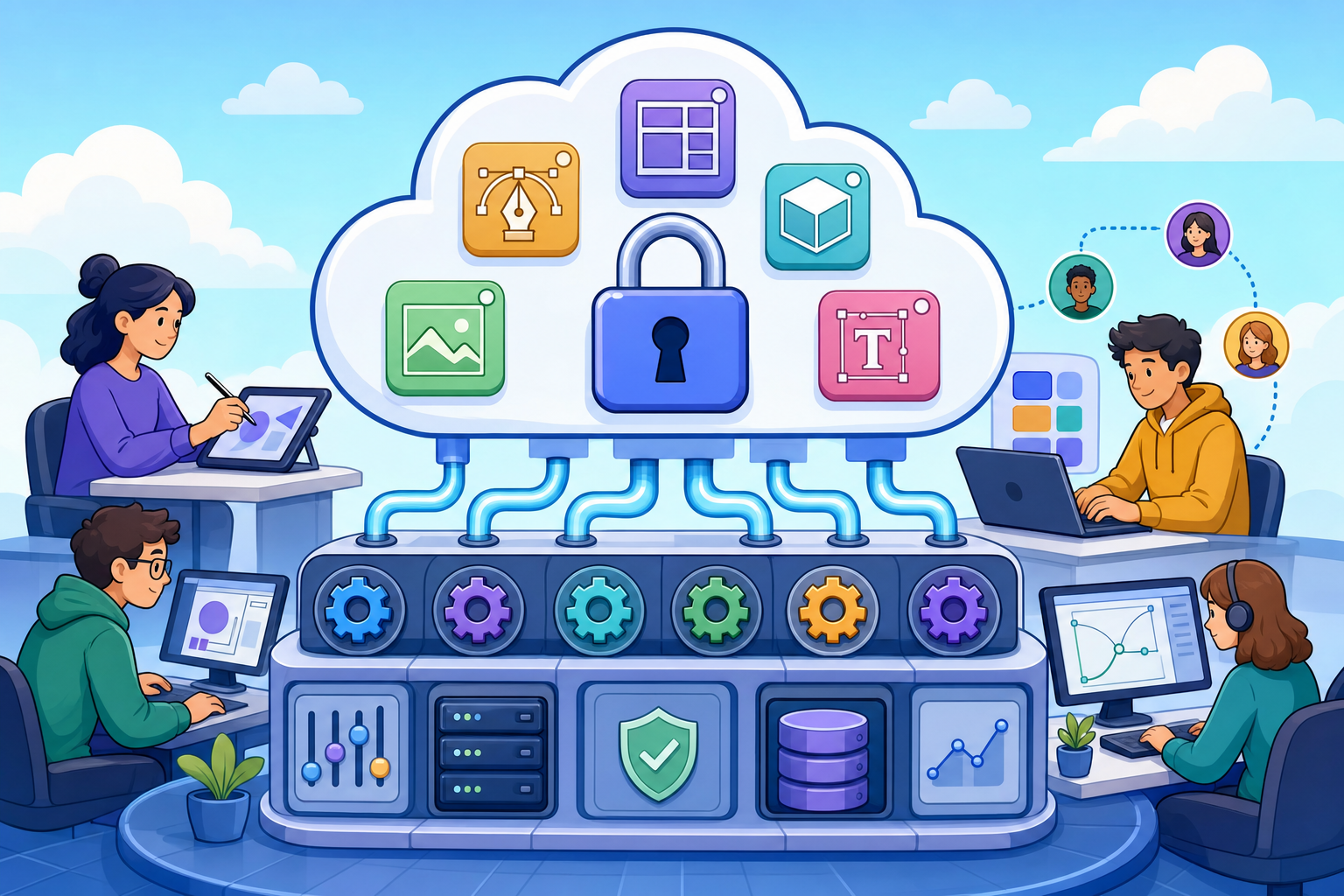


Cloud Licensing Has Become a Design Operations Question
From Procurement Detail to Workflow Infrastructure
Cloud licensing has moved far beyond the purchasing department and now sits directly inside the daily mechanics of design work. For engineering, product development, architecture, visualization, simulation, and manufacturing teams, software access determines who can open a model, run an analysis, publish a rendering, collaborate with a supplier, or prepare a toolpath at a critical project moment. Traditional software licensing was often treated as a fixed asset decision: buy seats, pay maintenance, install locally, and manage renewals. That model gave organizations a sense of predictable ownership, but it also created operational drag through underused seats, rigid deployments, expensive maintenance contracts, and slow response when project staffing changed. By contrast, cloud licensing turns software access into an active operational variable. Access can expand or contract with project demand, but it also requires closer governance, sharper cost forecasting, and better alignment between design leadership, IT, finance, and security teams.
Why Access Timing Matters
The operational importance of licensing becomes obvious when a project team needs capability at the exact moment work accelerates. A concept designer may need subdivision modeling for two weeks, a simulation engineer may need burst access to nonlinear analysis for a design review, and a visualization team may require cloud rendering capacity overnight before a client presentation. In a perpetual-license environment, companies often solved this by overbuying software “just in case,” which tied capital to tools that might sit idle for months. Cloud models offer a different logic: access becomes more fluid, but the company must understand actual usage patterns. The key shift is that licensing is no longer only about controlling software cost; it is about controlling design throughput, collaboration speed, and computational availability. When licensing becomes misaligned, teams do not simply overspend—they lose time, duplicate workflows, postpone decisions, or push advanced analysis until too late in the process.
The Limits of Traditional Perpetual Licensing
Predictability with Hidden Inefficiency
Perpetual licensing gave design organizations long-term predictability because software seats were treated as owned assets. This was reassuring for companies with stable teams, fixed office locations, and well-defined toolchains. A mechanical design department could budget for a defined number of CAD seats, an architecture studio could maintain a known mix of BIM licenses, and manufacturing engineers could keep CAM tools available on specific workstations. However, the model often hid significant inefficiency. Seats were frequently assigned to users whose workload changed, installed on machines that were rarely used, or reserved for departments that needed peak capacity only occasionally. Maintenance contracts added another layer of recurring cost, even when the organization did not fully use the software. In distributed companies, deployment could be slow because installation, license servers, upgrades, and office-specific configurations required coordination across multiple technical teams.
Why Static Ownership Conflicts with Modern Project Work
Modern design workflows are rarely static. A product team may move from industrial design to detailed engineering, simulation, tooling, visualization, and additive manufacturing preparation within a compressed timeline. Architectural teams may scale rapidly during competition phases and then shift resources to documentation or coordination. Contractors, suppliers, freelancers, and regional offices may join for short intervals, requiring secure but immediate access. Traditional licensing often struggles with this kind of elasticity because software availability is tied to purchased capacity, local installation, and administrative lead time. When software entitlement cannot follow project rhythm, teams create workarounds: sharing files through less capable tools, delaying advanced computation, assigning tasks only to licensed specialists, or duplicating data between applications. These workarounds reduce the value of the design software ecosystem. The inefficiency is not only financial; it becomes a constraint on experimentation, iteration frequency, and cross-disciplinary participation.
- Perpetual licensing can create underused seats when staff roles or project demand changes.
- Maintenance contracts may preserve access but do not guarantee better utilization.
- Distributed teams often face slower deployment and version alignment challenges.
- Temporary contributors are difficult to support without overbuying licenses.
Named-User Subscriptions and Role-Based Control
Where Named Access Works Well
Named-user subscriptions are one of the most common cloud licensing structures, assigning software access to specific individuals rather than to machines or anonymous pools. This model works well for stable design teams with clearly defined responsibilities. A senior mechanical engineer who uses CAD daily, a BIM coordinator managing linked models continuously, or a visualization specialist producing regular renders will usually justify dedicated access. Named-user licensing also supports stronger security and compliance because each entitlement is tied to an identity. Administrators can remove access when someone leaves, apply region-specific policies, connect usage to single sign-on, and maintain clearer audit trails. For regulated industries or firms handling confidential intellectual property, this identity-based control is valuable. It allows design software access to be governed like other enterprise systems, with permissions aligned to employee status, project role, and approved application scope.
The Cost Problem of Occasional Use
The weakness of named-user licensing appears when users need only intermittent access. A project manager may open CAD files once a week for review, a manufacturing engineer may need design software only during tooling updates, or a supplier quality specialist may access a model during a narrow inspection window. If each occasional user receives a full subscription, the organization can quickly accumulate expensive low-utilization accounts. This matters because design software portfolios often include multiple applications: core CAD, advanced simulation, rendering, data management, CAM, additive preparation, and collaboration platforms. A named-user approach can become costly when every participant is licensed for every possible need rather than for actual frequency and depth of use. Design operations teams should therefore define user personas, such as daily creators, occasional reviewers, computational specialists, and external collaborators. The goal is not simply to reduce licenses, but to match entitlement intensity to work intensity.
- Best fit: daily users with predictable responsibilities and frequent application use.
- Strong benefit: identity-based access control, compliance tracking, and audit clarity.
- Main risk: expensive subscriptions assigned to users with limited or occasional need.
- Practical action: classify users by role, usage frequency, and required feature depth.
Concurrent and Floating Licenses for Distributed Teams
Utilization Across Time Zones
Concurrent or floating licenses remain highly relevant in cloud licensing strategies because they allow a defined number of users to draw from a shared pool rather than requiring every user to hold a dedicated entitlement. This model is especially effective for global organizations working across time zones. A design office in Europe may use a license pool during its business day, while a team in North America or Asia uses the same pool later. When configured well, floating access improves utilization and reduces the need to buy capacity for every potential user. It is also helpful in multi-department environments where different groups need the same advanced tool at different project phases. For example, industrial designers may need rendering tools early, simulation teams may need compute-connected analysis tools later, and manufacturing engineers may need CAM functions during production preparation. A shared pool can serve these shifting needs more efficiently than permanently assigned access.
Avoiding License Bottlenecks
The operational risk of floating licensing is access contention. If too many users request the same tool at once, critical work may stop until a license becomes available. This is particularly damaging near design gates, manufacturing deadlines, bid submissions, or coordination milestones. A blocked license is not just an inconvenience; it can delay model changes, simulation validation, drawing release, or client deliverables. To prevent bottlenecks, organizations need usage analytics that show peak demand, denial events, time-of-day patterns, and department-level consumption. License pools should not be managed purely by average usage because average utilization can hide spikes. A pool that appears efficient over a month may still fail during the final week of a project. Design operations leaders should establish priority rules for mission-critical workflows, maintain reserve capacity for deadline periods, and review whether high-frequency users should move from floating to named access.
- Floating access works well when usage is distributed across regions, departments, or project phases.
- Peak-demand monitoring is more important than simple average utilization.
- License denial events should be treated as workflow incidents, not minor administrative details.
- Critical users may require dedicated access even when general users share a pool.
Token-Based and Consumption-Based Licensing
Paying for Advanced Capability When Needed
Token-based and consumption-based licensing is reshaping access to advanced design computation. Instead of paying for a permanent entitlement to every high-end capability, teams consume tokens, credits, or metered units when they run specific operations. This is particularly relevant for simulation, generative design, cloud rendering, optimization, computational fluid dynamics, structural analysis, and additive manufacturing preparation. These workflows often require intense capability in bursts rather than continuous daily use by every designer. A product team may run dozens of topology optimization studies during concept exploration, then use very little compute for several weeks. An architecture team may produce heavy visualization output before a presentation, then return to documentation work. A manufacturing team may simulate print distortion or machining strategies during process planning, not throughout the entire project lifecycle. Consumption-based access can therefore unlock advanced tools without forcing companies to license them permanently for broad populations.
Budgeting for Variable Demand
The challenge is that consumption models can make costs less predictable. Designers may launch larger simulation batches than expected, rendering teams may increase image resolution or animation length, and generative design workflows may multiply quickly as engineers explore alternatives. This is not necessarily wasteful; in many situations, more computation produces better decisions. The risk is that finance teams see cloud spending rise without understanding the design value behind it. To manage this, organizations need cost governance that is technically informed rather than purely restrictive. Dashboards should show consumption by project, department, workflow type, and user group. Budgets should include thresholds, alerts, approval rules for unusually expensive jobs, and post-project reviews that compare compute cost to design outcomes. The best approach is not to discourage experimentation, but to make computational exploration intentional, visible, and aligned with project priorities.
- Excellent fit for burst-heavy workflows such as rendering, simulation, and generative design.
- Can reduce fixed cost by avoiding permanent entitlements for occasional advanced use.
- Requires clear tracking of credits, tokens, compute hours, or job-based charges.
- Budget governance should focus on visibility and purpose, not only spending limits.
Feature-Tiered Subscriptions and Workflow Fragmentation
Separating Core Tools from Premium Capabilities
Feature-tiered subscriptions divide software access into levels, often separating core design functionality from advanced modules such as CAM, CAE, PLM integration, visualization, scripting, data management, or manufacturing extensions. This structure gives companies more control over who receives premium tools. A large organization may want every engineer to access basic model review and light CAD editing, while only a smaller group receives advanced surfacing, simulation, or manufacturing functions. In principle, this is financially sensible because not every designer needs every capability. It allows software portfolios to align more closely with actual roles and can prevent expensive tools from being assigned too broadly. Feature tiers also support clearer capability planning. Design leaders can define what constitutes a baseline design seat, an advanced engineering seat, a manufacturing engineering seat, or a visualization specialist seat, then map software access accordingly.
The Risk of Artificial Workflow Barriers
The danger is that feature tiers can fragment workflows when critical capabilities are locked behind higher subscription levels. A designer may be able to create geometry but not evaluate manufacturability. An engineer may view simulation results but not modify the setup. A manufacturing specialist may need to request model adjustments from someone with a different entitlement. These divisions can slow iteration and discourage integrated decision-making. In modern design practice, value often comes from connecting disciplines earlier: designers consider manufacturing constraints, engineers test performance while geometry is still flexible, and visualization teams provide feedback on material or form before release. If licensing tiers enforce outdated role boundaries, the organization may save subscription cost while losing process efficiency. The best strategy is to identify workflow-critical features and ensure they are available at the point of decision, not only within specialized departments.
- Feature tiers help control premium access to advanced modules and specialized functions.
- They are effective when roles are clearly defined and workflows are well understood.
- They can damage productivity if essential capabilities are isolated from daily decision-makers.
- Tier planning should be based on workflow maps, not only software price comparisons.
Operational Flexibility and Faster Design Mobilization
Scaling Teams Around Project Demand
One of the strongest benefits of cloud licensing is the ability to scale access as projects change. Design organizations often experience uneven demand: a new product launch expands the engineering team, a major architectural proposal requires temporary visualization resources, or an additive manufacturing program needs specialized preparation tools for a limited period. Cloud licensing enables faster mobilization because access can be provisioned through administrative portals rather than lengthy purchasing and installation cycles. Contractors, suppliers, and remote collaborators can be onboarded more quickly, especially when entitlement is connected to secure identity management. This agility matters because design schedules are increasingly compressed. Teams cannot afford to wait days or weeks for tool availability when project value depends on rapid iteration. Flexible licensing supports flexible design execution, allowing organizations to match capability to project tempo more accurately than fixed ownership models allow.
Activating Distributed Offices and Temporary Groups
Cloud licensing also helps organizations activate new offices, project groups, or remote teams without building large local license infrastructure. A new design cell can receive access to shared applications, templates, cloud storage, and collaboration tools through centralized administration. This is especially useful for companies coordinating across regions or creating temporary innovation groups. However, flexibility should not be confused with absence of structure. Fast onboarding must still include security review, role assignment, data access rules, training, and withdrawal procedures when the engagement ends. Without these controls, organizations may leave unused subscriptions active, expose sensitive project information, or create inconsistent workflows between groups. The operational ideal is a repeatable onboarding pattern: define the contributor type, assign the correct application bundle, connect access to project duration, monitor usage, and remove entitlement automatically when the need expires.
- Cloud licensing improves responsiveness when teams scale up or down quickly.
- Remote users and contractors can be added without local license server complexity.
- Temporary access should include expiration dates, role limits, and security controls.
- Fast provisioning is most valuable when paired with standardized onboarding workflows.
Cost Visibility and Hidden Complexity
What Dashboards Reveal
Cloud licensing platforms often provide dashboards that show assigned seats, user activity, consumption levels, renewal dates, and sometimes application-specific usage. This creates a major opportunity for design operations teams because software spending can be connected to actual behavior. Instead of relying on rough estimates or departmental claims, leaders can review who is using which tools, how often applications are launched, whether advanced features are being consumed, and where subscriptions remain idle. This visibility supports smarter reallocation. A dormant named-user subscription can be reassigned, a heavily used floating pool can be expanded, and a low-use premium tier can be downgraded. In theory, this makes design software cost management more precise than it was under many perpetual-license environments. It also encourages productive conversations between finance and technical leaders because spending can be explained in relation to project activity and workflow demand.
Where Cloud Costs Still Escape Control
Despite better dashboards, cloud licensing can introduce hidden complexity. Costs may rise through unused subscriptions that automatically renew, duplicate licenses purchased by separate departments, premium add-ons activated without portfolio review, and cloud credits consumed faster than expected. In large organizations, different teams may buy overlapping tools to solve similar problems, especially when procurement is decentralized. Consumption-based charges can also accumulate quietly if teams run large simulations, high-resolution renders, or automated design studies without budget alerts. The solution is not a simple mandate to cut licenses. Over-optimization can harm productivity if users lose access to tools they genuinely need. Instead, companies should develop a software utilization rhythm: monthly reviews of assigned and active users, quarterly portfolio rationalization, project-level compute reporting, and renewal planning based on evidence. Cost visibility only becomes cost control when someone acts on the data.
- Useful metrics include active users, peak concurrency, idle subscriptions, and credit consumption.
- Hidden costs often come from renewals, add-ons, duplicated purchases, and unmanaged compute bursts.
- License optimization should protect productivity while reducing waste.
- Portfolio reviews should involve design leaders, IT, procurement, finance, and security stakeholders.
Governance, Compliance, and Entitlement Accuracy
Centralized Control as a Strategic Advantage
Cloud licensing can improve governance by centralizing entitlement management. IT and operations teams can assign access based on roles, projects, regions, departments, or security classifications. Integration with single sign-on and identity providers makes it easier to remove access when employees leave, adjust permissions when roles change, and enforce policies across distributed offices. For companies working with sensitive designs, regulated products, defense-related data, medical devices, or proprietary manufacturing methods, this level of control is essential. Audit readiness improves when the organization can show who had access to which applications and when. Centralized administration also reduces the risk of informal sharing, outdated local installations, or untracked software deployments. In this sense, licensing governance becomes part of broader digital engineering governance, sitting alongside data management, cybersecurity, model release procedures, and supplier collaboration rules.
Why Governance Fails Without Maintenance
The weakness is that centralized systems are only as reliable as the data maintained inside them. If users change projects but retain old entitlements, if contractors remain active after engagements end, or if administrators assign broad access to avoid support requests, the governance value declines. Audit readiness requires active entitlement hygiene. Design organizations should establish ownership for license management rather than assuming IT alone understands workflow needs. Technical leads know which tools are necessary, project managers know staffing changes, procurement understands contracts, and security teams understand access risk. These perspectives need to converge. A practical governance model includes periodic access reviews, automated deprovisioning where possible, documented approval paths for premium tools, and clear rules for external collaborators. License compliance is not a once-a-year audit activity; it is an ongoing operational discipline that protects cost, security, and design continuity.
- Access can be tied to identity, role, project, region, and security policy.
- Audit readiness depends on accurate entitlement records and documented approval processes.
- Contractor access should include start dates, end dates, and limited project scope.
- Governance requires collaboration between IT, design operations, procurement, and security teams.
Operational Risk in a Cloud-Licensed Environment
Internet Dependency and Account Infrastructure
Cloud licensing introduces operational risks that design leaders must take seriously. Internet dependency can affect access in secure facilities, remote construction sites, manufacturing plants, ships, field offices, and regions with unstable connectivity. Even when applications run locally, licensing checks, account authentication, or cloud entitlement validation may depend on network availability. If access fails during a production deadline or design review, the licensing model becomes a business continuity issue. Vendor account systems also become critical infrastructure. Authentication outages, account lockouts, regional service interruptions, or identity synchronization errors can prevent users from reaching tools they legally own or subscribe to. Organizations should therefore understand offline access rules, grace periods, admin recovery procedures, and support escalation paths. Cloud licensing can be efficient, but it should be designed with resilience in mind, particularly for teams working in controlled, isolated, or mission-critical environments.
Commercial Risk and Vendor Packaging Changes
Another operational risk is commercial dependency on vendor pricing, packaging, and licensing terms. Cloud models can change more frequently than traditional perpetual-license contracts. A vendor may repackage features into higher tiers, retire a licensing model, change token consumption rates, modify storage entitlements, or increase subscription prices. These changes can disrupt long-term planning, especially when workflows are deeply integrated into a specific software ecosystem. Design leaders should evaluate licensing terms with the same seriousness they apply to file formats, data portability, and platform architecture. Renewal negotiations should include usage data, growth forecasts, required capabilities, and contingency plans. Organizations should also avoid building workflows that depend invisibly on premium features without recognizing the financial exposure. The aim is not to resist cloud licensing, but to negotiate and architect it intelligently. Software access continuity is now part of design infrastructure resilience.
- Review offline access, authentication behavior, and license grace periods before deployment.
- Treat vendor identity systems as critical dependencies in operational planning.
- Track packaging changes that may move key functions into higher-cost tiers.
- Use renewal periods to align contracts with actual usage and strategic workflow needs.
Evaluating Licensing as Part of the Design Software Ecosystem
Connecting Licensing to How Work Actually Happens
Cloud licensing should be evaluated as part of the broader design software ecosystem, not as a simple annual cost line. The best strategy depends on how the organization designs, collaborates, simulates, visualizes, documents, manufactures, and manages data. A company emphasizing rapid product iteration may require broad access to CAD, simulation, and cloud compute. An architecture practice may need flexible BIM collaboration, visualization bursts, and external consultant access. A manufacturer using additive processes may need specialized build preparation, lattice generation, inspection tools, and simulation only during certain phases. Licensing decisions should follow workflow analysis. Leaders should map when users need access, how long they need it, what features are essential, and which outputs depend on premium capabilities. This produces a more accurate entitlement model than simply counting employees or copying last year’s subscription list.
Questions Design Leaders Should Ask Regularly
Because cloud licensing is dynamic, it should be reviewed regularly rather than only at renewal. Design leaders need to understand actual utilization, project-based demand, contractor and supplier access patterns, cloud compute consumption, compliance requirements, and emerging capability needs. These reviews should connect data with judgment. Low utilization may indicate waste, but it may also indicate a specialized tool held for critical moments. High consumption may suggest poor control, but it may also reflect valuable exploration that improves design quality. The point is to interpret licensing behavior in context. Organizations should ask whether users have the right tools at the right moment, whether cost is aligned with output, whether access supports collaboration, and whether licensing rules create friction in the design process. A mature approach treats licensing as a living system that evolves with technology, team structure, and project ambition.
- Review actual license utilization rather than relying only on assigned-seat counts.
- Compare software demand across project phases, disciplines, and regions.
- Track contractor, supplier, and temporary collaborator access separately.
- Monitor cloud compute consumption for simulation, rendering, and generative workflows.
- Align access rules with security, compliance, and intellectual property requirements.
Licensing as Adaptive Design Infrastructure
From Cost Control to Capability Orchestration
The most successful organizations will treat licensing as an adaptive operating model rather than a static contract. This means software access is orchestrated around capability demand, project priority, collaboration structure, and computational intensity. Named-user subscriptions provide stable access for core contributors, floating licenses improve utilization across groups, token models unlock advanced computation on demand, and feature tiers help control premium capabilities. No single model is universally best. The strongest licensing strategies combine models deliberately, using data to decide where dedicated access is justified, where shared pools are efficient, where consumption is appropriate, and where premium features must be democratized to avoid workflow fragmentation. In this environment, licensing becomes a design infrastructure decision similar to selecting a PLM backbone, cloud storage architecture, simulation platform, or visualization pipeline. It shapes what teams can do and how quickly they can do it.
The Strategic End State
Cloud licensing will continue to evolve as design software becomes more connected, computational, collaborative, and service-based. Generative systems, AI-assisted modeling, real-time rendering, cloud-native simulation, digital twins, and additive manufacturing workflows will likely deepen the relationship between software access and cloud consumption. As this happens, organizations that manage licensing passively will face rising cost, fragmented workflows, and avoidable risk. Organizations that manage it strategically will gain flexibility, stronger governance, better utilization, and faster access to advanced tools. The objective is not simply to spend less; it is to spend intelligently while enabling better design decisions. Licensing should help teams experiment earlier, validate more rigorously, collaborate more securely, and manufacture with greater confidence. In practical terms, the right licensing model gives designers, engineers, architects, and manufacturing specialists the right capability at the right moment, without forcing the organization into unnecessary waste or operational fragility.
Also in Design News