Your Cart is Empty


Cloud Computation as the Analytical Backbone of Architectural Design
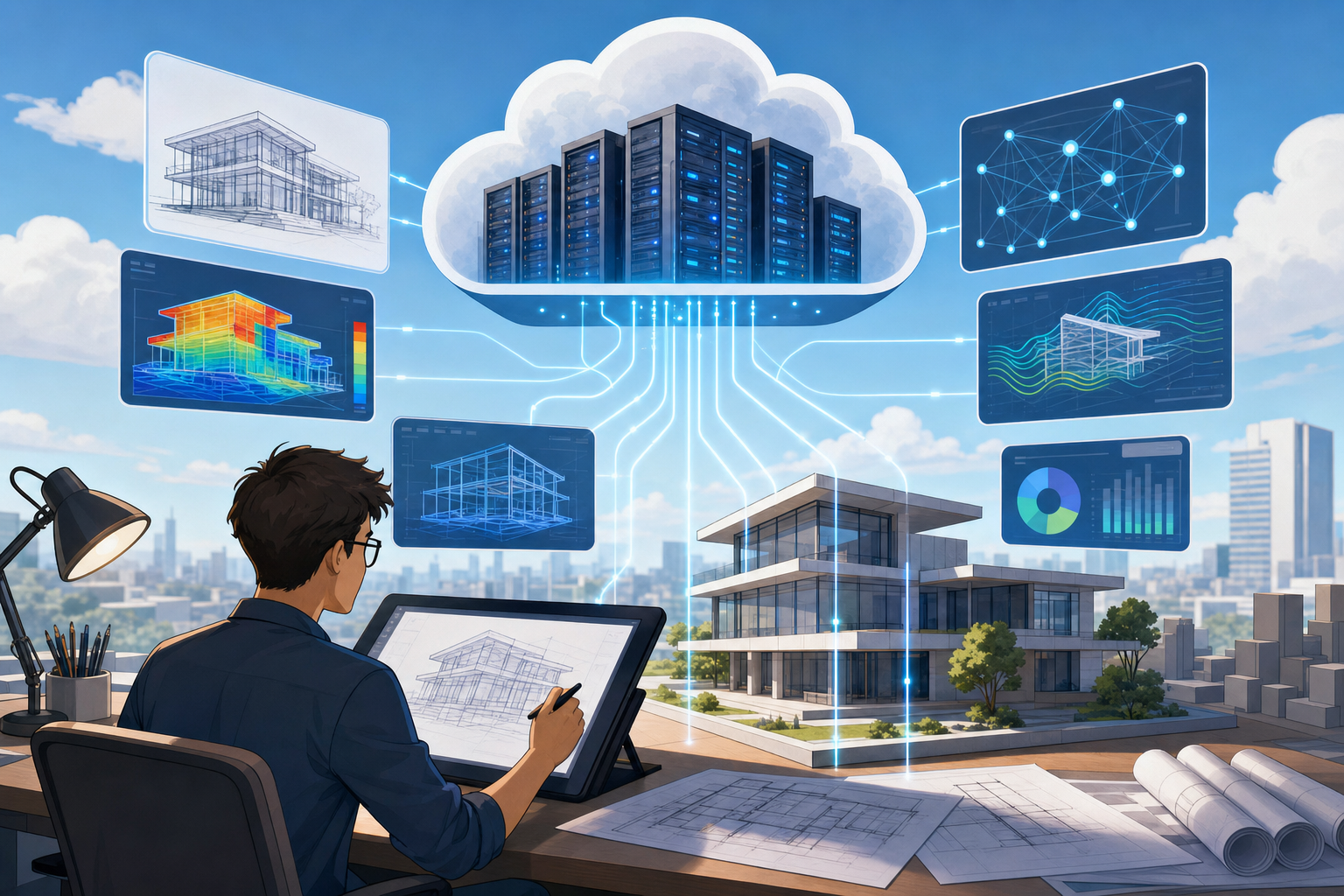


Cloud Computation as the New Analytical Backbone
Beyond the Workstation Boundary
Architecture and structural analysis have historically been constrained by the computing resources available on local workstations. Even powerful desktop machines impose limits on model size, mesh resolution, simulation frequency, and the number of alternatives that can be evaluated within a practical project schedule. As buildings become more geometrically ambitious, materially hybrid, environmentally responsive, and data-rich, those limits become more than technical inconveniences; they shape the design decisions teams are able to consider. Cloud computation changes this condition by moving the analytical workload from a single machine to distributed infrastructure that can scale according to demand. Instead of asking whether a designer’s laptop can process a detailed daylight study, a nonlinear structural simulation, or thousands of parametric façade variations, the more relevant question becomes how to structure the computation so that it produces meaningful design intelligence. This transition is redefining computation from a background technical resource into an analytical backbone that supports continuous inquiry throughout architectural and engineering workflows.
Analysis Moves Earlier in the Process
The most important change is not simply that cloud platforms can run simulations faster. The deeper transformation is that analysis can happen earlier, more often, and across a broader set of design alternatives. In a workstation-centered workflow, simulation is often delayed until geometry is stable enough to justify the time and technical setup required for evaluation. This tends to push analysis toward late-stage validation, where it confirms or rejects decisions already embedded in the design. In a cloud-centered workflow, teams can begin evaluating performance during massing, orientation, structural grid exploration, façade articulation, and early material strategy. Early-stage exploration becomes computationally informed rather than purely intuitive. Designers can compare many spatial and structural propositions without treating each simulation as a major interruption. Engineers can test assumptions before the architectural concept becomes rigid. This changes the role of simulation from a checkpoint to a design medium, allowing performance evidence to influence decisions while those decisions are still fluid and negotiable.
- Late-stage compliance reviews can become early-stage performance conversations.
- Single-model analysis can expand into comparative option evaluation.
- Engineering feedback can occur before geometry reaches documentation maturity.
- Architectural intuition can be tested against measurable environmental and structural behavior.
Analytical Models at Building Scale
Cloud infrastructure is especially valuable when analytical models exceed the practical limits of local computation. Large-scale finite element analysis, for example, can require dense meshes, multiple load combinations, nonlinear material behavior, staged construction logic, and complex boundary conditions. Running such simulations locally may force teams to simplify the model beyond usefulness or wait for long processing cycles that discourage repeated testing. In the cloud, computation can be distributed across multiple processors or instances, allowing structural teams to investigate more variants and more load cases within the same design period. A high-rise tower with transfer structures, long-span floors, irregular cores, and responsive façade systems can be evaluated with higher resolution and greater frequency. The same principle applies to wind studies, thermal comfort simulations, daylight autonomy analysis, and energy modeling. Rather than isolating each domain within its own specialist timeline, cloud platforms enable multiple analytical streams to operate in parallel, creating a richer understanding of how architectural geometry behaves under real performance constraints.
From Individual Simulations to Comparative Studies
One of the clearest advantages of cloud computation is the ability to move from isolated analysis to broad comparative studies. A single simulation can answer whether one design option meets a target, but it rarely explains where the strongest opportunities for improvement are located. Comparative computation allows the team to test families of alternatives: different structural bay sizes, core locations, façade depths, shading geometries, floor-to-floor heights, material substitutions, or envelope performance assumptions. When these alternatives are simulated in parallel, the design team receives a performance landscape rather than a yes-or-no answer. This is essential for generative design and AI-assisted optimization, where algorithms may generate hundreds or thousands of options according to defined constraints. AI-assisted optimization becomes practical only when computational capacity can support repeated evaluation at scale. The cloud provides that capacity, but the value depends on how carefully objectives are defined. A well-structured comparative study can reveal options that are structurally efficient, spatially coherent, environmentally responsible, and economically plausible.
- Finite element models can be evaluated across multiple structural grids.
- Energy simulations can compare envelope specifications and orientation strategies.
- Wind simulations can test tower massing alternatives and podium configurations.
- Daylight studies can assess façade geometry, glazing ratio, and shading depth.
- Optimization routines can balance cost, carbon, comfort, and structural efficiency.
Visualization as Analytical Interpretation
Cloud computation also expands the role of visualization. High-resolution analytical results are difficult to interpret if they remain trapped in specialist software interfaces or static reports. Cloud platforms increasingly allow design teams to visualize stress distributions, solar exposure, glare probability, thermal gradients, wind pressure, embodied carbon intensity, and energy demand directly in shared model environments. This creates a bridge between quantitative analysis and spatial reasoning. A structural engineer may understand a stress contour plot in detail, but an architect can make better design decisions when those contours are connected to geometry, material systems, and experiential consequences. High-resolution performance visualization transforms abstract data into spatial evidence. However, visualization must remain disciplined. Beautiful graphics can conceal uncertainty, incomplete assumptions, or inappropriate resolution. The best analytical visualizations show not only results but also context: what was tested, which assumptions were applied, what level of accuracy is reasonable, and where design judgment must still interpret the outcome.
From Static Models to Continuous Performance Feedback
Design Models Become Live Analytical Environments
The traditional digital model is often treated as a representation of design intent: a container of geometry, annotation, quantities, and documentation. Cloud-based analysis encourages a different interpretation. The model becomes a live analytical environment, continuously connected to performance feedback as geometry, metadata, and design assumptions evolve. This is a major shift for architectural software because it changes the status of the model from static output to active computational instrument. When a designer adjusts building depth, façade orientation, floor plate proportions, or structural spacing, the model can trigger new calculations or update previously processed results. The feedback may not always be fully real time, especially for complex simulations, but it can become near-real-time enough to influence design behavior. Continuous performance feedback creates a loop in which designers act, computation evaluates, and teams respond. The value is not only faster answers; it is the formation of a design culture in which performance considerations are embedded in everyday modeling rather than reserved for formal review milestones.
Structural Feasibility as an Early Design Constraint
Structural feasibility is one of the first areas transformed by this feedback loop. In conventional workflows, architects may develop massing and spatial ideas before engineers have enough information to provide detailed feedback. By the time structural concerns are fully evaluated, significant architectural intent may already be attached to inefficient spans, irregular load paths, or difficult transfer conditions. Cloud-connected analysis allows early structural signals to appear while the design is still flexible. Approximate but informative models can test span ranges, column layouts, lateral system behavior, foundation implications, and load distribution. These early evaluations do not replace engineering expertise or detailed finite element analysis, but they help identify structural risk before it becomes expensive to correct. For example, a parametric model can generate alternative grids and automatically send simplified frame models to a cloud solver. The returned results can indicate relative steel tonnage, deflection behavior, or lateral stiffness. Structural feasibility then becomes a design parameter that architects and engineers can discuss through evidence rather than assumption.
- Long-span zones can be flagged before floor plans become fixed.
- Transfer structures can be evaluated against spatial and cost consequences.
- Lateral systems can be compared during massing development.
- Early deflection estimates can guide structural depth and ceiling coordination.
Energy, Carbon, and Massing Decisions
Energy and carbon analysis also gain influence when feedback occurs during concept design. At early stages, the most significant environmental decisions are often related to massing, orientation, compactness, glazing ratio, structural system, and material strategy. If environmental analysis is postponed until compliance documentation, the design may already be locked into patterns that require technical compensation rather than fundamental improvement. Cloud-based tools can evaluate energy demand, solar exposure, daylight availability, operational carbon, and embodied carbon across massing alternatives while changes remain relatively inexpensive. For instance, a design team can compare a deep compact floor plate with a shallower daylight-optimized alternative, then examine how each affects façade load, mechanical demand, structural material quantity, and rentable area. Carbon-aware design depends on this type of integrated analysis because carbon performance is distributed across many decisions. A lower-energy envelope may increase embodied carbon if it requires material-intensive systems, while a structurally efficient frame may perform poorly if it compromises daylight or thermal comfort. The cloud makes these trade-offs more visible.
Environmental Analysis Leaves the Compliance Corner
Environmental simulation has often been associated with regulatory submission, certification documentation, or specialist reports produced after major decisions are complete. Cloud computation brings environmental analysis into concept design by reducing the friction required to ask environmental questions. Designers can test whether a courtyard traps heat or improves daylight, whether a tower orientation increases wind discomfort, whether a shading system reduces glare without over-darkening interior zones, or whether a façade geometry supports seasonal solar control. The significance is procedural as much as technical. When environmental feedback is available during sketching, massing, and parametric exploration, sustainability becomes part of form-making rather than an external audit. This shifts the responsibility for environmental quality across the whole team. Engineers and sustainability consultants still provide expertise, but the architectural model itself begins to carry environmental consequences. Environmental performance becomes visible to designers who are shaping space, proportion, envelope, and orientation. This creates stronger alignment between design authorship and building performance.
- Daylight autonomy can be tested during floor plate development.
- Thermal comfort can inform atrium design and façade strategies.
- Wind pressure and pedestrian comfort can influence tower placement.
- Solar radiation can guide shading depth and glazing distribution.
Integrated Data Ecosystems
The most advanced platforms are beginning to combine BIM models, parametric geometry, simulation engines, material databases, cost information, and embodied carbon data into unified computational ecosystems. This integration is powerful because performance rarely belongs to one category. A façade decision may affect daylight, glare, cooling load, structural support, maintenance access, construction cost, and carbon intensity. A structural material decision may influence spans, fire protection, construction sequencing, embodied carbon, and architectural expression. Integrated cloud platforms allow these consequences to be evaluated together rather than sequentially. The challenge is data consistency. BIM elements must contain reliable properties, parametric models must expose meaningful variables, simulation engines must receive valid inputs, and outputs must return in formats designers can interpret. When this ecosystem works, it supports a more computationally aware design practice. Form, performance, and constructability can be evaluated as interdependent conditions. The designer is no longer merely shaping geometry; the designer is managing relationships among geometry, physics, material behavior, cost, carbon, and experience.
Collaboration, Scalability, and the Risks of Abstraction
Cloud Computation as a Collaboration Structure
Cloud computation is often discussed in terms of processing power, but its collaborative impact may be equally important. Distributed design teams can access shared models, simulation outputs, dashboards, and design alternatives from different locations without depending on a single office server or specialized local workstation. This supports architectural practice as it actually operates: across time zones, disciplines, consultants, contractors, clients, and regulatory contexts. A structural engineer can review an updated model, submit an analysis, and share results with façade consultants and architects in a common environment. A sustainability consultant can compare energy outcomes against massing options generated by the design team. A project leader can review cost, carbon, and performance trends without opening multiple specialist applications. Shared analytical environments reduce the distance between designers and technical evidence. They also preserve decision history, allowing teams to understand why one option was selected over another. This is especially valuable when complex projects involve many stakeholders and long design timelines.
- Large analytical datasets can be shared without manual file transfer.
- Remote specialists can contribute without duplicating software infrastructure.
- Simulation results can be linked to specific design versions.
- Discipline-specific insights can be reviewed in a common visual environment.
Scalability and Elastic Resource Use
The cloud introduces a new model of computational scalability. Instead of purchasing local machines sized for occasional peak demand, firms can access computational resources elastically. During heavy design exploration, a team may run multiple wind simulations, structural optimization routines, or daylight evaluations in parallel. During quieter periods, resource use can decrease. This elasticity is valuable because architectural computation is rarely constant. Project needs fluctuate according to design deadlines, competition phases, engineering coordination milestones, and client review cycles. Scalable computing power enables teams to match computational intensity to design need. It also democratizes advanced analysis to some degree, because smaller firms can access high-performance resources without maintaining expensive hardware infrastructure. However, scalability should not be confused with unlimited freedom. Each cloud process has cost, data management implications, and setup requirements. The most effective teams develop computational strategies: deciding which questions require high-resolution analysis, which can be answered with simplified models, and which should be deferred until assumptions are more mature.
The False Precision Problem
One of the most serious risks of cloud-based simulation is abstraction. As analytical tools become easier to run, designers may become more willing to trust results without understanding how they were produced. A dashboard might report annual energy use, structural utilization, daylight compliance, or embodied carbon totals with apparent precision, but early design inputs are often uncertain. Material specifications may not be selected, occupancy assumptions may be provisional, mechanical systems may be generalized, and structural connections may be unresolved. If teams treat early outputs as exact predictions, simulation can create a false sense of certainty. False precision is especially dangerous because numerical results appear objective even when they depend on incomplete assumptions. A thermal model may compare two massing options reliably in relative terms but not predict final energy consumption accurately. A structural estimate may identify inefficient spans but not reflect final connection complexity. Good practice requires teams to distinguish between directional intelligence, comparative ranking, and validated prediction. Cloud platforms must communicate uncertainty clearly.
- Early simulations should be labeled according to confidence level.
- Assumptions should be visible alongside results.
- Comparative findings should not be mistaken for final compliance values.
- Specialists should review critical inputs before decisions become fixed.
Cost, Governance, and Computational Discipline
Cloud computation can also introduce cost volatility. When simulations are easy to launch, teams may run more studies than they can interpret or justify. A generative design exploration with thousands of options, high-resolution energy simulations, or computational fluid dynamics studies can become expensive if not carefully managed. Cost is not only financial; it includes time spent cleaning data, reviewing outputs, documenting assumptions, and communicating results. Computational discipline becomes essential. Teams should decide which design questions are worth cloud-scale analysis and establish thresholds for model resolution, number of alternatives, and acceptable runtime. They should also create governance rules for who can launch large computations, how results are stored, and how expired model versions are archived. Cloud cost management is therefore part of design management. The most sophisticated teams do not simply run more simulations because they can. They structure analytical campaigns around clear hypotheses: Which variable is being tested? What decision will the output inform? What level of accuracy is necessary?
Security, Intellectual Property, and Vendor Dependence
Moving design computation into the cloud also changes the risk profile of architectural data. BIM models, structural systems, façade concepts, cost information, material specifications, and project metadata can represent significant intellectual property. When these assets are uploaded to cloud platforms, teams must consider data security, access permissions, contractual obligations, regional data storage requirements, and ownership of derived analytical outputs. Data security and intellectual property protection become central concerns rather than administrative details. Proprietary platforms can create additional complexity. If analytical workflows, model histories, scripts, and optimization routines depend heavily on one vendor ecosystem, firms may face vendor lock-in. This can limit flexibility, increase long-term costs, and make it difficult to migrate project intelligence to other tools. Open standards, exportable data formats, transparent APIs, and clear contractual controls are increasingly important. Cloud computation should make collaboration more fluid, not trap design knowledge inside closed systems. Teams need both technical capability and governance policies to protect their computational independence.
Transparency as a Design Requirement
The challenge is to make cloud computation transparent enough that teams can question, verify, and interpret its results. Transparency does not mean every architect must become a simulation specialist, but it does mean that the workflow should expose assumptions, inputs, solver settings, data sources, and confidence levels. A useful analytical platform should answer several questions clearly: What geometry was analyzed? Which version of the model was used? What simplifications were applied? What material properties were assumed? Which environmental data file was selected? How sensitive are results to input changes? Without this transparency, cloud computation becomes a black box that may influence major design decisions without adequate scrutiny. Interpretability is therefore a core software requirement. In advanced practices, simulation literacy becomes part of design literacy. Architects, engineers, consultants, and project leaders do not need identical expertise, but they must share enough understanding to challenge results constructively and avoid mistaking automated output for architectural truth.
Conclusion: Toward a More Computational Design Practice
A Sequential Process Becomes Continuous
The expanding role of cloud computation is reshaping architecture and structural analysis from a sequential process into a continuous, collaborative one. Instead of moving from design concept to engineering validation to environmental review to cost evaluation in separate stages, teams can connect these forms of intelligence throughout the development of the project. The value of this shift is not merely speed, although speed is important. The greater value is the ability to explore more alternatives, compare competing objectives, and connect design intuition with evidence-based performance data. Cloud-based analysis makes it possible to ask better questions earlier: How does this massing affect structure and carbon? How does this façade improve daylight but increase cooling load? Which structural bay provides the best balance between flexibility, material use, and cost? These questions become part of design thinking rather than external technical checks. The result is a practice model where architecture is shaped through ongoing conversation between spatial ambition, analytical evidence, and professional judgment.
The Future Platform Stack
The future of architectural software will likely depend on how well platforms combine parametric modeling, structural simulation, environmental analysis, cost intelligence, carbon accounting, and collaborative review workflows. No single feature will define the next generation of design tools. The breakthrough will come from integration: the ability to move from a parametric geometry change to a structural implication, from a material substitution to an embodied carbon impact, from a façade adjustment to a daylight and thermal comfort response, and from those findings to a shared decision environment. Integrated computational design platforms will need to support both creative exploration and technical accountability. They must remain flexible enough for concept design while rigorous enough to support engineering coordination. They must allow automation without eliminating interpretation. They must handle large datasets while making results understandable to human teams. The strongest platforms will not simply compute more; they will help designers understand what computation means in relation to architectural intent, constructability, cost, and environmental responsibility.
- Parametric modeling will define adaptable design variables.
- Structural simulation will test feasibility, stability, and efficiency.
- Environmental analysis will evaluate comfort, energy, daylight, and climate response.
- Cost and carbon intelligence will connect design choices to measurable consequences.
- Collaborative review workflows will make analytical decisions visible and traceable.
Critical Use Over Blind Automation
The most successful design teams will not be those that automate every decision. They will be those that know how to use cloud computation critically. Automation is powerful when it expands the field of possible solutions, reveals hidden patterns, or accelerates repetitive evaluation. It becomes dangerous when it narrows design thinking to whatever the software can easily measure. Architecture includes technical performance, but it also includes cultural meaning, urban contribution, spatial quality, material expression, human experience, and long-term adaptability. These values cannot be fully reduced to optimization metrics. Critical computational practice means using simulation to inform judgment, not replace it. It means understanding when a model is detailed enough, when results are directional, when a specialist must intervene, and when a design decision should resist pure numerical optimization. Cloud computation is a design partner: powerful, scalable, and informative, but still dependent on human judgment, engineering expertise, and architectural intent. Its highest value emerges when computation supports better choices rather than pretending to make choices on behalf of the design team.
Also in Design News