
Your Cart is Empty


Get a Personalized Quote×
Overview
|
sphereneNXT is an engineering platform for designing the inside of 3D-printed parts. It enables engineers to transform conventional solid CAD designs into lightweight, high-performance structures by intelligently engineering their internal architecture. Built around Spherene’s patented Adaptive Density Minimal Surfaces (ADMS) technology, sphereneNXT allows users to create complex, continuously connected internal structures with controllable density and geometry in minutes — without having to manually design traditional lattice or infill patterns.
The platform connects CAD geometry, internal architecture design and additive manufacturing in one workflow. Engineers can import their existing CAD part, define the desired internal structure and performance requirements, and export a manufacturing-ready design.
|
Key Benefits
- Lightweighting: Reduce material and weight while maintaining structural performance.
- Performance optimization: Engineer internal geometry for specific mechanical and functional requirements.
- Thermal management: Create complex internal structures for heat transfer and cooling.
- Energy absorption: Design controlled internal architectures for impact and crash applications.
- Manufacturing freedom: Leverage the geometric capabilities of additive manufacturing.
- Scalable design: Apply variable density and complex internal structures without manually modeling them.
Features
|
Integrated Import-to-Production Workflow
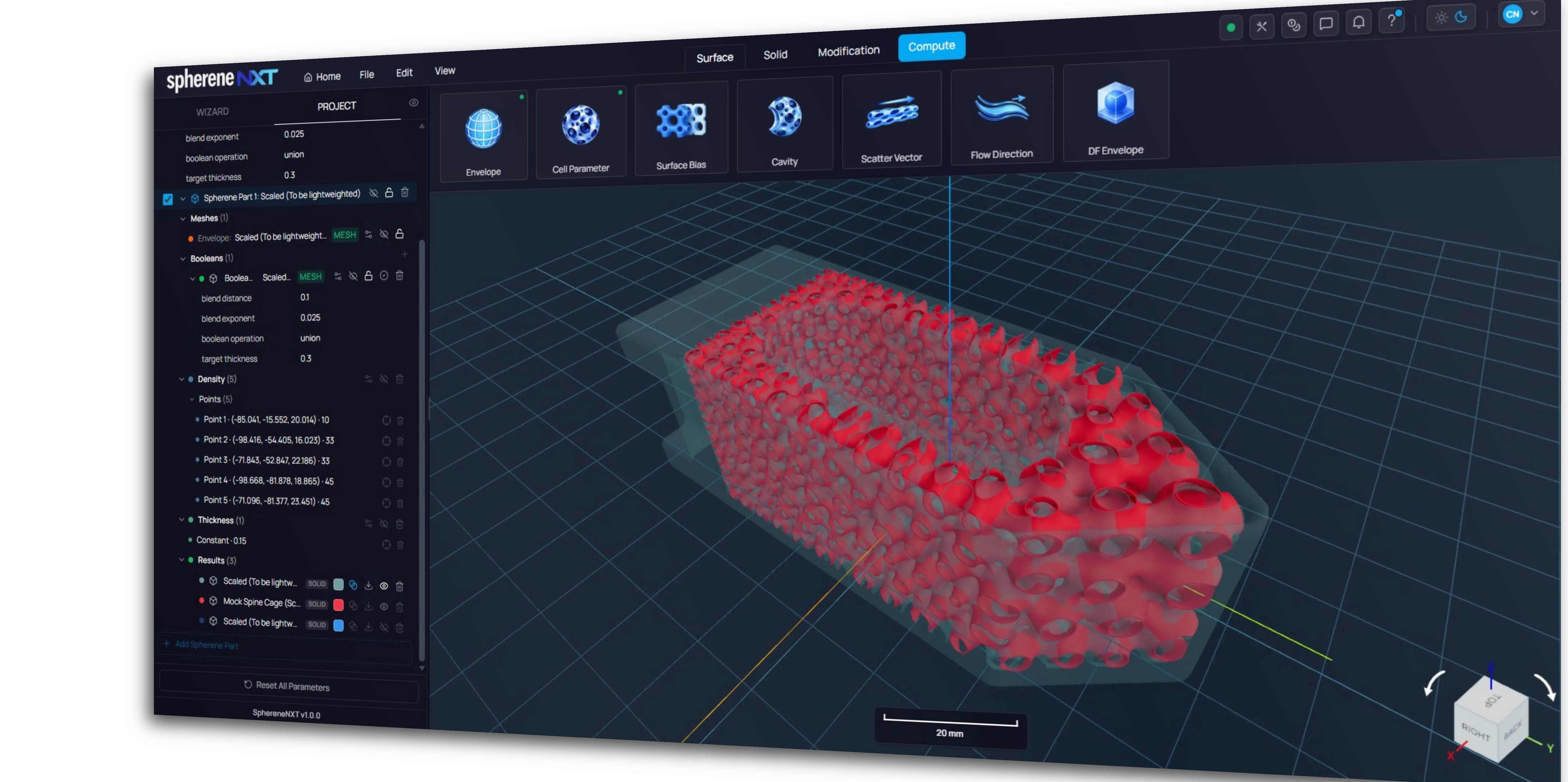
sphereneNXT organizes internal-architecture development into a streamlined Import, Design, Optimize, and Print workflow. The import stage lets engineers begin with geometry created in their established CAD solution, reducing the need to rebuild models or commit to a single design ecosystem. After importing the component, users can define the outcomes that matter for the application, including target weight, structural stiffness, thermal behavior, energy absorption, and manufacturing constraints. sphereneNXT then generates an internal structure intended to deliver those requirements while fitting the available design volume. Optimization helps distribute material where it creates functional value instead of filling the part with an unnecessarily uniform pattern. The platform also considers printability so that sophisticated geometry remains connected to practical production objectives. At the output stage, users can prepare print-ready files for additive-manufacturing workflows across different printers and materials. This connected process reduces handoffs between disconnected tools, supports faster iteration, and helps teams move from an engineering concept to a manufacturable component without losing design intent. By keeping core activities in one accessible environment, sphereneNXT also supports distributed teams that need to review, refine, and advance internal structures from different locations. |
 |
|
ADMS, TPMS, and Adaptive Metamaterial Architectures
Different engineering objectives require different internal geometries, and sphereneNXT provides access to a broad spectrum of metamaterial architectures. Its proprietary ADMS approach advances beyond static, repeating lattices by adapting density, topology, wall characteristics, and cell distribution in response to local functional requirements. Material can therefore be concentrated in areas influenced by stress, heat flow, or other performance demands and reduced where it contributes less value. The resulting architecture is designed to provide adaptive and substantially isotropic behavior while conforming to complex boundaries. SphereneNXT also supports established TPMS architectures, which use continuous periodic surfaces to deliver useful mechanical and thermal characteristics with smooth, lightweight cellular geometry. TPMS structures remain well suited to applications that benefit from uniform properties, continuous surfaces, fluid interaction, or efficient heat transfer. By offering ADMS, TPMS, and other infill strategies within the same engineering environment, the platform helps users select the architecture that best matches the problem. Applications can include adaptive load paths, uniform stiffness, lightweighting, impact management, heat exchange, and controlled energy absorption. This flexible architecture strategy helps reduce unnecessary material consumption while supporting stronger, lighter, and more efficient components. |
|
|
Flexible Browser Platform and CAD Integrations
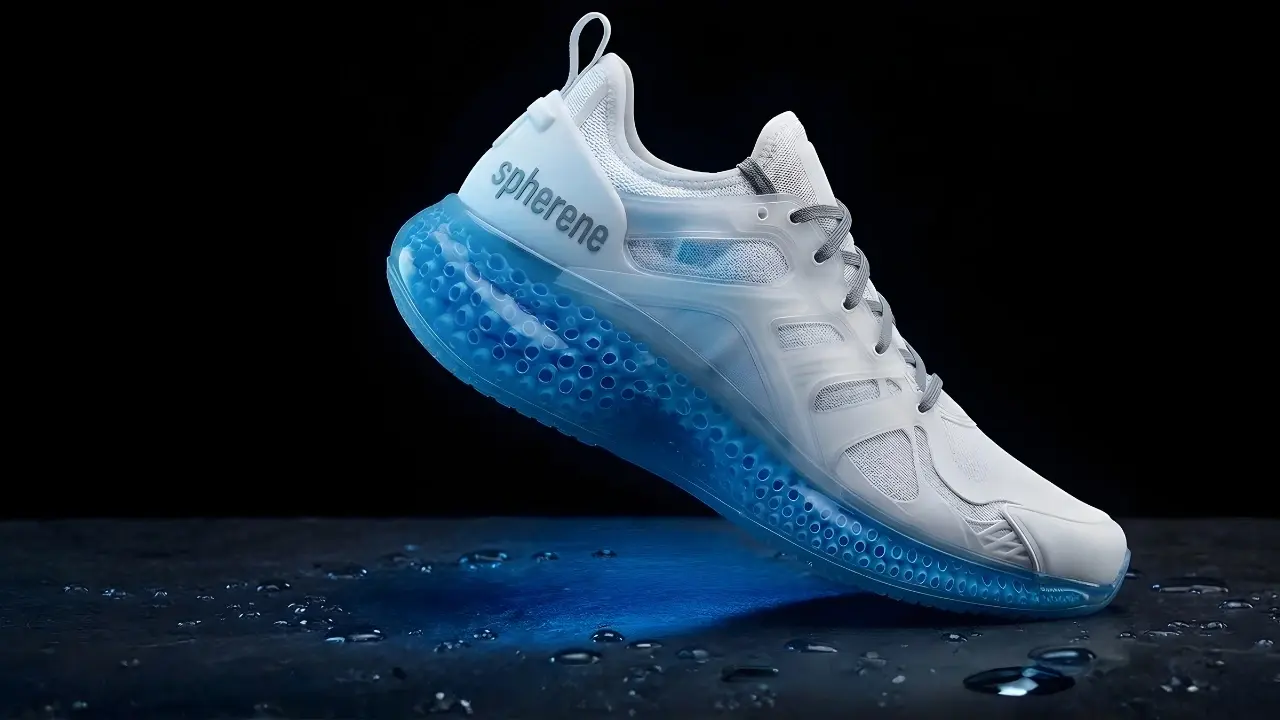
sphereneNXT can be used through its full-featured web-based platform, providing engineers with flexible access to internal-architecture tools without restricting work to a particular desktop workstation. This approach is particularly useful for organizations that value remote access, centralized workflows, and easier collaboration among design, simulation, and manufacturing specialists. For teams that prefer to remain inside existing design environments, sphereneNXT capabilities are also available through dedicated integrations for nTop, Autodesk Fusion, Rhino, and Grasshopper. These options allow businesses to choose a working method that fits established processes rather than replacing every part of their current software stack. The platform’s capabilities are applicable to a wide range of performance-driven products: aerospace and defense teams can pursue minimal weight with high structural efficiency; automotive engineers can address energy absorption, heat dissipation, and mass reduction; medical designers can develop complex implant structures; and energy specialists can create efficient heat-transfer geometry. Construction and architecture projects can use internal structures to improve material efficiency and durability, while consumer-product and footwear developers can combine lightweight construction with tuned functionality. Across these fields, sphereneNXT connects generative geometry, manufacturability, and additive production in a practical engineering workflow. |
 |
