Your Cart is Empty


Unified Concept-to-Release Design Software for Connected Product Development
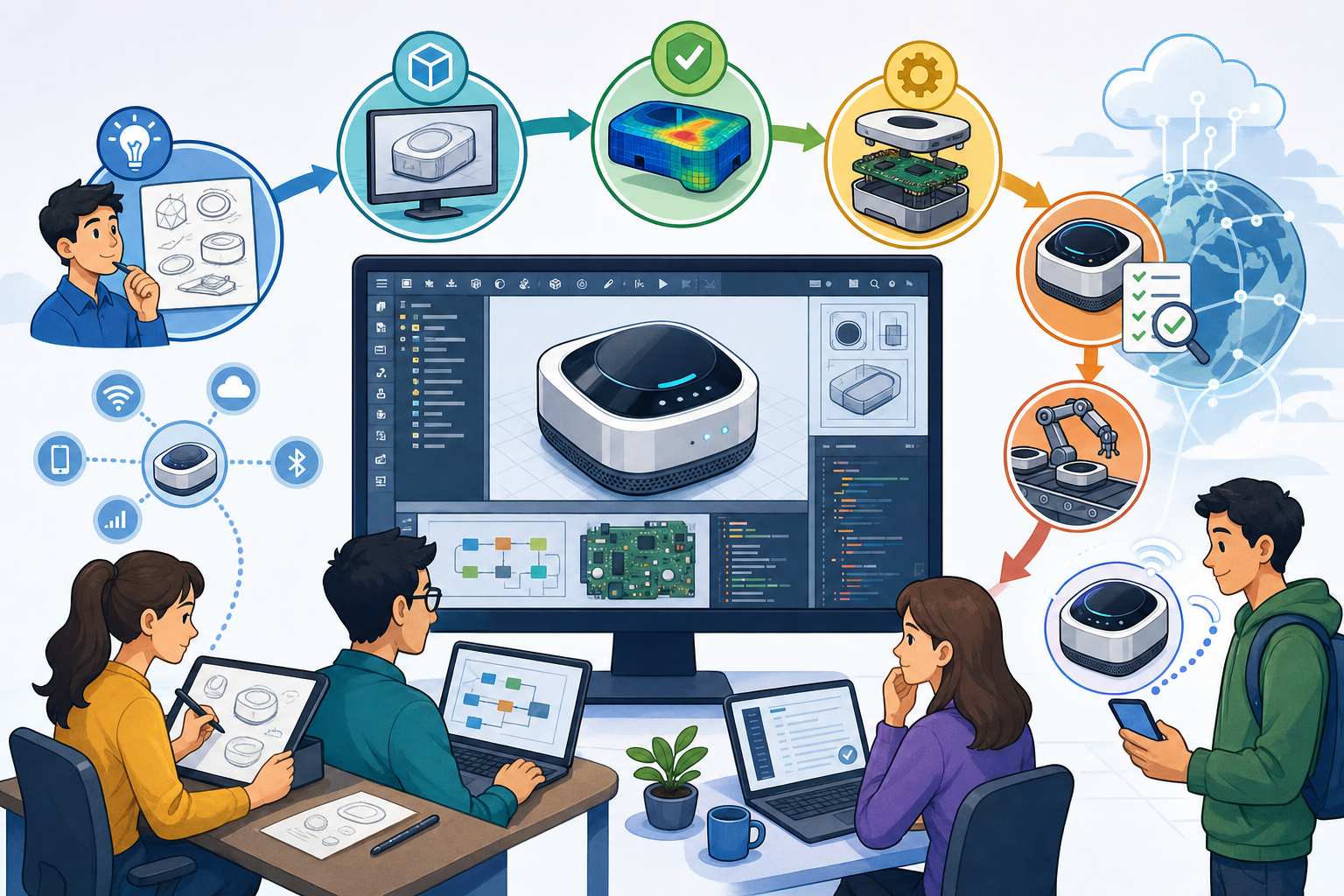


Design software is entering a decisive transition: from collections of specialized applications toward connected environments where ideas, geometry, validation, documentation, and release data remain attached from the first sketch to the approved product definition.
Why Isolated Design Tools Are Reaching Their Practical Limit
Fragmentation as a Historical Compromise
For decades, design organizations accepted fragmented software workflows because each phase of development demanded deep specialization. Industrial designers used sketching, subdivision, surface modeling, or visualization tools to explore form quickly. Mechanical engineers rebuilt or refined those ideas in parametric CAD systems, where dimensions, constraints, assemblies, and manufacturable structure became more explicit. Analysts then transferred geometry into CAE platforms for structural, thermal, fluid, or motion studies. Drafting teams generated production drawings in documentation environments, while release managers controlled approvals through PDM or PLM systems. This separation was logical when computing power, file formats, and departmental responsibilities were more rigid. However, the cost of this separation has become increasingly visible as products grow more complex, schedules compress, and design teams become distributed across disciplines, suppliers, and geographies. The old software stack can still produce excellent work, but it often depends on manual translation, duplicated effort, and informal knowledge transfer. In modern product development, that is no longer a minor inconvenience; it is a structural bottleneck that weakens decision quality and slows progress.
Where Design Intent Gets Lost
The most serious problem with isolated tools is not simply that files must move from one system to another. The deeper issue is that design intent often fails to travel with the geometry. A concept model may contain subtle decisions about proportion, ergonomics, visual balance, airflow direction, assembly access, or brand identity, yet those decisions may be represented only as surfaces, meshes, screenshots, or verbal notes. When the engineering team receives the model, it may need to rebuild features parametrically, approximate organic surfaces, simplify forms for tooling, or reinterpret why certain proportions matter. Every reconstruction step introduces the possibility of distortion. A fillet may become easier to manufacture but lose the intended tactile character. A housing may meet packaging requirements but compromise service access. A bracket may pass simulation but ignore the original weight target. In an isolated workflow, the final product definition can become an accumulation of translations rather than a continuous development of the original idea. The result is frequent rework, late negotiation, and avoidable tension between creative, engineering, and manufacturing priorities.
- Concept geometry may arrive without editable parametric relationships.
- Simulation models may omit styling or assembly assumptions that influenced the original design.
- Manufacturing feedback may appear after the team has already invested heavily in a flawed direction.
- Approval comments may live in email threads instead of remaining attached to the model.
The Hidden Cost of File Translation and Manual Reconstruction
Conversion Is Not Neutral
File conversion is often treated as an administrative detail, but in design software it is a technical and organizational risk. Moving data between disconnected systems usually means exporting STEP, IGES, STL, OBJ, DXF, DWG, JT, Parasolid, or proprietary formats, each of which preserves different types of information. A neutral geometry file may transfer surfaces but discard feature history. A mesh may retain visual form but lose analytic precision. A drawing export may preserve annotations but detach them from live model behavior. A simulation package may idealize geometry, remove small features, or create a separate analysis-specific model that no longer updates automatically with product changes. These conversions may appear manageable in small projects, but they become fragile when assemblies include hundreds or thousands of parts, each with relationships, configurations, tolerances, material assignments, supplier data, and manufacturing constraints. The organization then spends valuable engineering time verifying whether imported geometry is accurate, repairing broken surfaces, remapping materials, recreating mates, and confirming that a downstream file still reflects the current design. This is not value-added design work; it is operational friction created by disconnected software architecture.
Duplicate Modeling as a Process Tax
Duplicate modeling is another persistent cost of fragmented environments. A designer may produce a visually persuasive concept model that cannot be used directly for engineering. An engineer then creates a clean parametric version. A simulation analyst may defeature that model into a separate analysis representation. A manufacturing engineer may simplify it again for toolpath generation, sheet metal unfolding, additive build preparation, or fixture design. A technical publications team may create lightweight illustrations for manuals, while marketing may generate separate visualization assets for launch material. Each downstream model serves a valid purpose, yet each one can drift away from the evolving product definition. When a design change occurs, all representations must be found, updated, checked, and approved. If one version is missed, the organization risks producing the wrong drawing, quoting the wrong component, printing an obsolete prototype, or validating an outdated geometry. The cost of fragmentation is cumulative: every duplicate model increases the coordination burden and weakens confidence in which version represents the truth.
- Engineering teams spend time rebuilding instead of refining.
- Analysts may simulate geometry that is no longer current.
- Manufacturing teams may prepare processes from outdated exports.
- Stakeholders may review renderings that no longer match the approved configuration.
What a Unified Concept-to-Release Environment Actually Means
More Than CAD with Storage
A unified concept-to-release environment is frequently misunderstood as a CAD system with built-in file storage. That definition is far too narrow. The most capable platforms combine concept exploration, detailed modeling, validation, visualization, documentation, and governance into a connected product development environment. At the concept stage, teams need tools for freeform shape creation, layout studies, sketch-driven exploration, generative alternatives, subdivision surfaces, and rapid iteration without excessive feature-tree overhead. As the design matures, the same environment must support parametric relationships, direct editing, configurations, assembly constraints, tolerance-aware modeling, standard components, and manufacturing-specific feature logic. Embedded simulation then allows early checks of stiffness, thermal behavior, motion envelopes, pressure drop, vibration risk, or packaging conflicts before the design becomes expensive to change. Visualization tools help communicate geometry, materials, lighting, scale, ergonomics, and product narratives to non-technical stakeholders without exporting to a separate rendering pipeline. Documentation functions generate drawings, model-based definition, PMI, inspection dimensions, and release packages from the same source model. The defining principle is not feature quantity; it is the preservation of connected design information across the complete lifecycle.
The Layers of Unification
True unification requires multiple data layers working together. Geometry is the most obvious layer, but it is only one part of the digital product definition. A mature platform also connects materials, requirements, simulation assumptions, design rationale, assembly structures, manufacturing methods, cost targets, supplier notes, change requests, comments, approvals, and release states. This creates a continuous digital thread, where the team can trace why a design decision was made, which requirement it satisfies, which analysis supports it, who reviewed it, and which manufacturing process constrains it. In practical terms, this means an engineer can modify a housing wall thickness and immediately understand the downstream effect on mass, stiffness, injection molding rules, additive build orientation, drawing dimensions, bill of materials, and release status. The platform does not eliminate judgment; instead, it organizes the information needed to make judgment faster, more transparent, and more defensible. The shift is from storing files to managing evolving product intelligence.
- Concept tools support early exploration without breaking later engineering continuity.
- Parametric and direct modeling tools allow both disciplined control and flexible change.
- Embedded simulation helps evaluate feasibility before formal validation.
- Visualization and documentation remain linked to live product geometry.
- Revision control and approval workflows define who can change, release, or consume data.
How Connected Data Changes Early Design Decisions
Earlier Feasibility Without Killing Exploration
One of the strongest advantages of unified platforms is the ability to evaluate feasibility earlier without forcing premature engineering closure. In traditional workflows, concept design often remains separated from technical validation because early forms are incomplete, non-parametric, or disconnected from simulation and manufacturing tools. Designers may avoid feasibility checks because exporting, cleaning, and rebuilding geometry interrupts creative flow. In a unified environment, lightweight simulation, packaging analysis, interference detection, weight estimation, and manufacturability feedback can be applied to early models while they are still fluid. For example, a product designer exploring a handheld device enclosure can examine internal component clearance, wall thickness tendencies, snap-fit access, estimated part mass, center of gravity, and thermal venting implications before the design is formally handed to mechanical engineering. This does not mean every concept becomes over-engineered from the start. Rather, the platform gives the team rapid feedback on whether a direction is promising, risky, or fundamentally incompatible with known constraints. Earlier evaluation improves creative freedom because weak directions can be abandoned before they consume detailed engineering effort.
Preserving Intent Through Engineering Refinement
When engineers work from connected concept data, they do not need to infer every decision from static exports. They can see reference sketches, comments, spatial constraints, material targets, and prior review decisions alongside the evolving model. This is especially valuable for products where form, performance, and assembly are tightly coupled, such as consumer electronics, medical devices, transportation interiors, industrial equipment, and additive manufactured components. A surface transition may exist because it directs liquid away from a seam. A rib pattern may communicate visual rhythm while also improving stiffness. A curvature may create clearance for a user’s hand, a robot gripper, or a maintenance tool. In a disconnected process, those intentions can be lost when the model is rebuilt as clean engineering geometry. In a unified process, the refinement can preserve intent while adding manufacturable detail, tolerances, fasteners, draft, sealing features, datum schemes, and inspection requirements. The result is not a conflict between creativity and engineering discipline, but a shared environment where creative intent becomes one of the inputs to technical resolution.
- Designers can test whether early concepts violate fundamental packaging or production constraints.
- Engineers can identify which visual or ergonomic decisions must be preserved during refinement.
- Analysts can run preliminary checks before formal simulation models are created.
- Manufacturing specialists can flag tooling, additive orientation, machining, or sheet metal concerns sooner.
Collaboration Becomes a Continuous Model-Centered Activity
From File Exchange to Shared Context
Traditional design reviews often revolve around file exchange: someone exports a model, compresses an assembly, sends a drawing, posts a rendering, or uploads a package to a shared drive. Reviewers then respond through email, screenshots, meeting notes, markup PDFs, spreadsheets, or separate issue-tracking systems. This creates a split between the product definition and the conversation about the product definition. Unified platforms change that dynamic by allowing comments, annotations, markups, tasks, approvals, and objections to remain attached to the model or specific geometry. A manufacturing engineer can comment directly on a flange that lacks tool access. A simulation analyst can flag a stress concentration on a rib intersection. A project manager can link a decision to a milestone requirement. An industrial designer can explain why a curvature should not be flattened during cost reduction. This shared context makes collaboration more precise because everyone is referring to the same evolving object rather than arguing from disconnected files. Model-centered collaboration reduces ambiguity, especially when teams are remote, cross-functional, or working across time zones.
Role-Based Participation Without Data Chaos
A unified environment does not mean every participant edits every part of the model. In fact, advanced platforms depend on role-based permissions, controlled workspaces, branch-and-merge strategies, lifecycle states, and review gates to prevent chaos. Industrial designers may own early form studies, while mechanical engineers own production features and assemblies. Analysts may generate derived simulation representations, while manufacturing engineers contribute process constraints. Procurement may view BOM structures and supplier references without changing geometry. Executives or clients may review visualization states and approve direction without accessing editable CAD data. The value lies in structured participation: each discipline can work from the same source of truth while interacting with the level of detail appropriate to its responsibility. This is particularly important for complex assemblies where uncontrolled modification would be dangerous. Unified platforms must therefore balance openness with governance. They succeed not by removing process control, but by embedding process control into the same environment where design decisions occur.
- Comments stay connected to geometry rather than scattered across email chains.
- Review decisions can be traced to specific model states and revisions.
- Permissions define who can view, edit, approve, release, or archive data.
- Cross-functional teams can participate without producing uncontrolled duplicate files.
Simulation and Manufacturability Move Upstream
Embedded Validation as Design Guidance
In older workflows, simulation often appeared after detailed CAD work had already been completed. This made analysis powerful but sometimes reactive. If a design failed a structural or thermal check late in development, the team had to redesign features, update drawings, revise BOMs, renegotiate deadlines, and possibly restart manufacturing preparation. Unified platforms make it easier to use simulation earlier as a guide rather than only as a gate. A designer or engineer can run simplified structural checks on a bracket, compare thermal paths in an electronics enclosure, estimate deflection in a snap feature, or evaluate motion interference in an assembly before formal validation begins. These early simulations are not a replacement for high-fidelity CAE, certification testing, or specialist analysis. Their value is directional intelligence. They help teams understand trends: which ribs matter, which thickness changes are meaningful, which load paths are inefficient, or which clearances are too fragile. By keeping analysis connected to live geometry, teams can iterate faster and carry knowledge forward instead of treating each simulation as a disconnected event.
Manufacturing Rules as Active Constraints
Manufacturability checks are equally important. A unified platform can embed rules for additive manufacturing, machining, sheet metal, casting, injection molding, composite layup, or fabrication workflows. For additive manufacturing, the system may evaluate wall thickness, unsupported overhangs, build orientation, trapped powder, lattice density, minimum feature size, and support removal access. For machining, it may flag deep pockets, inaccessible corners, unfavorable tool length-to-diameter ratios, or features requiring excessive setups. For sheet metal, it may check bend radii, relief geometry, flange collisions, flat pattern validity, and grain direction. When these constraints appear only after design release, they become expensive disruptions. When they appear during concept and refinement, they become part of the design conversation. Manufacturability is no longer a downstream correction; it becomes an active design parameter. The practical benefit is not merely fewer errors, but better trade-offs between form, strength, cost, production speed, sustainability, and assembly efficiency.
- Additive manufacturing checks can guide lattice design, supports, orientation, and post-processing access.
- Machining checks can reveal tool access issues before part geometry becomes fixed.
- Sheet metal checks can prevent invalid flat patterns and bend conflicts.
- Early simulation can identify performance trends before formal verification begins.
Release Workflows Become More Traceable and Defensible
Connecting Changes to Decisions
Release management is where the benefits of unification become highly visible. In fragmented environments, a change may begin as a meeting comment, move into an email request, appear later as a CAD modification, require a drawing update, trigger a BOM change, and eventually become a released revision. If the organization lacks strong traceability, it may be difficult to prove why the change was made, who approved it, which requirement it satisfied, which simulations were updated, and whether manufacturing data remained synchronized. Unified environments can link change requests, model revisions, drawing updates, BOM structures, requirements, comments, simulation results, and approvals within one controlled workflow. This matters for all engineering organizations, but it is especially important in regulated industries where auditability, accountability, and configuration control are mandatory. A design team should be able to demonstrate not only that a component changed, but also the reason for the change and the evidence behind the decision. Traceable release workflows transform product data from a collection of deliverables into a defensible record of engineering intent.
BOMs, Drawings, and Model-Based Definition
Unified platforms also reduce inconsistency between source models and downstream deliverables. Bills of materials, drawings, manufacturing annotations, inspection requirements, exploded views, and model-based definition can update from the same authoritative product structure. This does not remove the need for checking; automation without review can create its own risks. However, it reduces the number of manual synchronization points where errors typically occur. If a fastener changes length, a material changes grade, or a casting becomes a machined component, the connected environment can propagate that information to relevant deliverables and workflow participants. This is particularly valuable when organizations move toward model-based definition, where the 3D model carries tolerances, datums, surface finish requirements, notes, and inspection information. In such workflows, the model is no longer merely a source for drawings; it becomes the primary manufacturing and quality reference. The release process must therefore manage geometry, annotations, metadata, and approvals as one coherent product definition rather than as separate documents that happen to describe the same object.
- Change requests can be linked to model versions, comments, and requirements.
- Approval decisions can remain attached to the released product definition.
- BOM updates can follow controlled changes in assembly structure.
- Model-based definition can reduce ambiguity when properly governed.
AI, Automation, and Design Reuse in Unified Platforms
Search Becomes Contextual
One of the most promising developments in unified environments is the ability to apply AI-assisted search and classification to connected design data. In a fragmented workflow, finding reusable designs often depends on file names, folder structures, part numbers, or tribal memory. Engineers may unknowingly redesign brackets, housings, fixtures, connectors, or mechanisms that already exist elsewhere in the organization. A unified platform can search across geometry, metadata, requirements, materials, manufacturing processes, prior simulations, project tags, and release histories. AI-assisted tools can identify visually similar parts, suggest reusable components, classify features, recommend standard fasteners, detect duplicate functions, or surface previous design decisions. This does not mean the platform designs autonomously; rather, it helps teams recognize organizational knowledge that would otherwise remain hidden. Design reuse becomes more intelligent when the system understands not only what a part is called, but how it looks, what it does, how it was made, and where it has been approved before.
Automation Beyond Repetitive CAD Tasks
API-driven automation is another major layer of advanced unified platforms. Traditional CAD automation often focused on generating geometry from parameters, creating drawing views, or batch-processing files. In unified environments, automation can reach across requirements, modeling, simulation, documentation, workflow routing, supplier packaging, and reporting. A company might automate the creation of configurable product variants, generate preliminary drawings from approved templates, run standard simulation checks after certain geometry changes, validate naming conventions, populate BOM metadata, route release packages to discipline-specific approvers, or generate manufacturing preparation data for additive builds. The value of API-driven automation increases when the platform holds connected data rather than isolated files. A script or enterprise integration can act on the product definition as a system, not merely on individual documents. The most sophisticated organizations will treat unified design platforms as programmable infrastructure, connecting them to ERP, MES, quality systems, cost estimation tools, requirements databases, and customer configuration portals.
- AI-assisted search can reveal reusable geometry and approved design patterns.
- Automated tagging can improve classification and retrieval of product data.
- APIs can connect design workflows to enterprise systems and custom approval logic.
- Automation can enforce standards without relying entirely on manual checking.
The Organizational Challenges Behind Unified Software
Processes Must Change Alongside Tools
Adopting a unified concept-to-release environment is not merely a software installation. It requires a redesign of working habits, departmental boundaries, governance models, and data responsibilities. Teams that have long operated in sequential handoffs may need to learn concurrent collaboration. Designers may need to expose incomplete concepts earlier. Engineers may need to engage before all requirements are frozen. Manufacturing teams may need to participate during ideation rather than after release. Managers may need to rethink approval gates so they support continuous visibility without slowing iteration. These changes can be uncomfortable because fragmented workflows often reinforce organizational identity: the design department owns form, engineering owns function, manufacturing owns production, and document control owns release. Unified environments blur those boundaries by making information visible sooner and by attaching decisions to shared models. The cultural challenge is to maintain clear accountability while allowing earlier, richer participation. Without process redesign, organizations may simply reproduce old handoff behavior inside a newer platform and miss the real benefits.
Governance, Security, and Lock-In
Unified platforms also increase the importance of data governance. When a single environment holds geometry, requirements, comments, approvals, manufacturing constraints, supplier information, and release records, the organization must define ownership, permission models, retention policies, naming standards, classification rules, and integration strategies carefully. Security becomes a central concern, particularly when external suppliers, contractors, or clients participate in the same environment. Platform lock-in is another serious strategic issue. The more workflows, automations, metadata structures, and release histories become embedded in one system, the harder it may be to migrate later. Organizations should evaluate openness, export quality, API maturity, interoperability with legacy tools, and long-term vendor strategy before committing critical product data to a unified platform. Unification creates power, but also dependency. The best implementation strategies acknowledge that reality and establish governance frameworks that protect design continuity without surrendering future flexibility.
- Departments must shift from sequential handoffs to coordinated development.
- Data ownership and permission structures must be explicitly defined.
- Legacy tools, suppliers, and archived projects may require integration planning.
- Platform lock-in should be evaluated as a long-term business risk, not just an IT concern.
From Software Stack to Design Operating System
Continuity as the Strategic Value
The movement toward unified design environments signals a broader transformation in how organizations understand design software. The goal is no longer simply to assemble the best sketching tool, the best CAD tool, the best simulation package, the best rendering system, and the best release database into a workable stack. The emerging goal is to create something closer to a design operating system: a connected environment where geometry, intent, validation, collaboration, documentation, and governance function as parts of one evolving product definition. The largest value is not just speed, although speed matters. It is continuity. Continuity of geometry means teams spend less time rebuilding and repairing. Continuity of intent means original decisions remain visible during engineering refinement. Continuity of decisions means comments, approvals, and trade-offs stay attached to the model. Continuity of accountability means release records can show not only what changed, but why, when, and under whose authority. This continuity allows teams to make better decisions earlier and defend those decisions later.
The Practical Question for Design Organizations
For design and engineering organizations, the question is no longer whether unified environments will matter. They already matter because product complexity, distributed collaboration, shorter development cycles, additive manufacturing, model-based definition, and regulated traceability all reward connected data. The practical question is how quickly an organization can adapt its processes, teams, and data strategies to benefit from them. Some teams will begin by connecting CAD and PDM more tightly. Others will introduce embedded simulation, model-based definition, collaborative review, automated release routing, or AI-assisted reuse. The most advanced organizations will gradually treat the platform as a programmable digital backbone that extends from concept exploration to manufacturing readiness and approved release. Success will depend less on buying every available module and more on designing a coherent operating model for product data. The future of design software is not a single button that converts ideas into finished products. It is a disciplined, connected environment where ideas can mature without losing their geometry, context, evidence, or accountability along the way.
Also in Design News