Your Cart is Empty


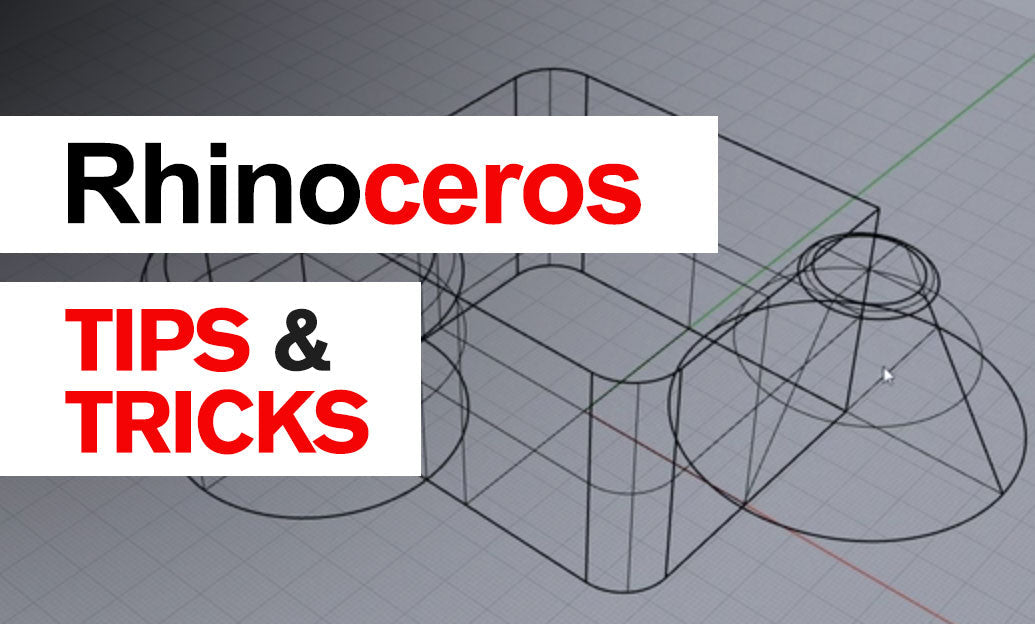

Use Scale1D and Scale2D to reshape parts precisely along one or two axes without disturbing the third. Perfect for fine-tuning fit, compensating for manufacturing allowances, or matching reference dimensions—fast, controlled, and predictable.
When to use:
- Scale1D: Change length in a single direction (e.g., stretch a slot or extend a handle) while keeping the other two directions unchanged.
- Scale2D: Resize within a plane (e.g., adjust width and depth together) while preserving height.
Key principles for reliable results:
-
Pick the right origin:
- For symmetric changes, set the origin at a midpoint (use OSnap: Mid).
- To grow from a fixed reference edge, set the origin on that edge.
-
Lock direction:
- Use Ortho or SmartTrack to keep the scaling axis aligned with your CPlane.
- Reorient the CPlane to a face or edge first if the desired axis isn’t world-aligned.
-
Be numeric:
- Type exact scale factors (e.g., 1.125) or target distances.
- Enter math directly (e.g., 150/120) to avoid calculator context switches.
Practical workflows:
-
Match a specific length with Scale1D
- Measure current length (Distance) between two controlling points.
- Run
Scale1D, choose a stable origin (often the midpoint), define axis with a reference pick, then type the new length or factor. - Result: precise stretch along one axis with all other dimensions untouched.
-
Adjust footprint without changing height with Scale2D
- Set CPlane to Top (or your working orientation).
- Run
Scale2D, pick a logical origin (center for uniform expansion), define planar reference, then enter your factor (e.g., 0.95 to shrink).
-
Thickness tweaks along a face normal
- Set CPlane to the target face (CPlane > Object).
- Use
Scale1Dwith Ortho to scale along the face normal (CPlane Z) for controlled thickness changes.
Quality and geometry integrity:
- Expect feature distortion when scaling non-uniformly: circles become ellipses. Protect critical features (e.g., bores) by isolating them and scaling only unaffected regions, or keep uniform scale for those parts.
- For assemblies, scale sub-components individually to preserve mating conditions. If using Blocks, consider editing the definition or inserting a scaled instance.
- Use analysis tools (BoundingBox, Dimensions) to verify results. If tolerances are tight, confirm your absolute tolerance and unit settings before and after scaling.
Time-savers:
- Create aliases:
s1=_Scale1D,s2=_Scale2D. - Prefer commands over Gumball for exact numbers; use Gumball when visually iterating, then finalize with numeric input.
- Combine with Named Views and CPlanes to repeat directional edits consistently across a model.
Looking to refine your Rhino toolset or licenses? Explore solutions and expert advice from NOVEDGE. For teams standardizing workflows, consult NOVEDGE on best practices, training options, and complementary plugins.