
Your Cart is Empty


Integrating CAD and CAM: Overcoming Technical Challenges for Streamlined Manufacturing
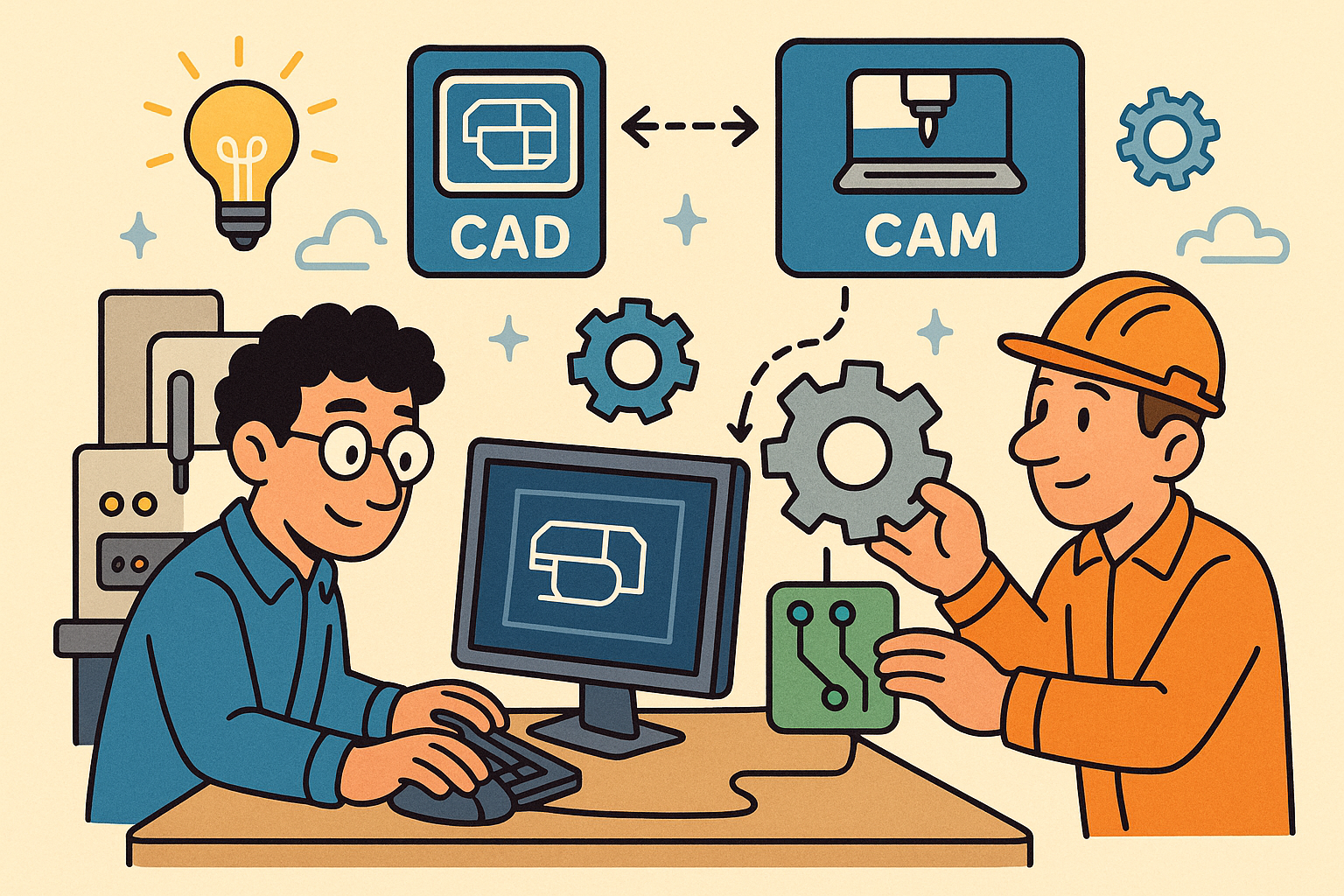


Setting the Stage
Defining CAD and CAM in Traditional Environments
In today’s rapidly evolving engineering landscape, it is essential to begin by laying the groundwork for understanding the fundamental definitions of CAD (Computer-Aided Design) and CAM (Computer-Aided Manufacturing). Traditionally, these systems operated as separate entities, each with distinct functionalities and workflows. CAD focused on the creation of detailed digital models and designs—with highly specialized software that allowed engineers, architects, and designers to manipulate shapes, dimensions, and materials—while CAM was dedicated to the practical realization of these digital designs through automated manufacturing processes. Historically, this segmentation meant that design professionals and manufacturing teams relied on different software platforms and data formats, sometimes leading to significant misalignments once the design was translated into production. This separation inevitably led to challenges, including compatibility issues and inefficiencies when transferring data between systems. The traditional approach often involved isolated teams working in silos with proprietary file formats that could not be easily understood by other systems, resulting in a laborious manual conversion process. Key challenges were not only technological but procedural, as bridging the gap required efforts that were both time-consuming and error-prone. Engineers often resorted to repetitious manual checks, and quality control became complicated when verifying that design specifications had been faithfully translated to manufacturing instructions. This disjointed approach fostered a fragmented workflow that hindered the speed of the design-to-manufacturing process, emphasizing the urgent need for integrative solutions.
The Imperative for Integrated Workflows and Their Challenges
As global competition has intensified and product development cycles have shrunk, the imperative for integrated workflows between CAD and CAM systems has become undeniable. Modern manufacturing environments now face increasing pressure to streamline operations, reduce errors, and accelerate the transition from design to production. An integrated workflow helps in bridging the gap that traditionally existed between digital design and physical manufacturing, addressing numerous challenges that arise from differing data formats, misaligned functionalities, and complex operational protocols. In today’s market, the demand for rapid prototyping and on-time delivery has raised expectations for faster iterations and more cohesive communication between design and manufacturing teams. Some of the pressing challenges include the need to maintain data integrity during transfers, ensuring that intricate design details are not lost or misinterpreted during the conversion process, and adapting legacy systems to contemporary standards. The issues are compounded by variations in software architectures, where some systems excel at visualization and design while others are finely tuned for the rigors of machining and production. Moreover, industry experts have identified that addressing such challenges requires comprehensive process re-engineering. To succinctly outline these hurdles, one can consider:
- Incompatibility among proprietary file formats
- Synchronization discrepancies between design iterations and manufacturing setups
- High potential for human error during manual data translation
Technical Challenges and Integration Strategies
Understanding Technical Hurdles in Integration
The path toward successful integration between CAD and CAM systems is riddled with technical hurdles that require careful analysis. One major challenge is data translation, where diverse file formats not only introduce compatibility issues but also risk the loss of critical design information during conversion. This issue is compounded by interoperability limitations, given that each system is often developed with a unique set of protocols and data structures in mind. Additionally, synchronization discrepancies arise when real-time updates made in one environment fail to propagate accurately to the corresponding environment, leading to miscommunication between design specifications and production capabilities. The technical complexities in this realm include the need to manage and reconcile disparate data sets, ensuring that each element from detailed geometric constructions to material properties are correctly aligned with manufacturing instructions. To delve deeper into the problem, consider the following technical challenges:
- Data translation issues that cause loss or distortion of design details
- Interoperability limitations due to proprietary technologies and varying data structures
- Synchronization discrepancies leading to conflicting or outdated production parameters
Modern Integration Techniques and Their Advantages
In parallel with recognizing the challenges in cross-platform integration, modern techniques have emerged that pave the way for smoother transitions between CAD and CAM systems. One of the most significant developments is the use of standardized file formats such as STEP and IGES, which serve as neutral, widely accepted data exchange standards. These formats foster consistency and reliability, enabling data to travel between different systems with much lower risk of corruption. In addition, API-based solutions have revolutionized the integration space, allowing developers to build custom plugins and middleware connectors that facilitate real-time communication between disparate platforms. Through these application programming interfaces, developers can not only translate data but also enforce synchronization protocols that ensure both design and manufacturing teams operate with the most current information. Benefits of these modern integration techniques include improved consistency in data transfer, a reduction in manual intervention, and the flexibility to rapidly incorporate new functionalities as market demands change. A few salient advantages are:
- Enhanced interoperability through standardized file formats
- Seamless, real-time data exchange enabled by robust APIs
- Reduced human error and accelerated workflow processes through middleware solutions
The Role of Open Standards and Cloud-Based Platforms
With the realization that closed ecosystems limit the potential for seamless integration, the role of open standards in conjunction with cloud-based platforms has garnered significant attention. Open standards act as the universal language for CAD and CAM systems, enabling different technologies to communicate without the hindrance of proprietary restrictions. These standards ensure that information is preserved in its entirety as it passes between design and manufacturing tools. Cloud-based platforms take this a step further by centralizing data, ensuring that updates and modifications are shared in real time across all integrated systems. This dual approach of utilizing both open standards and cloud infrastructures addresses several inherent issues in legacy systems. For instance, standardized communication protocols can solve persistent data translation challenges and provide an environment that is more resilient to updates and scalability concerns. Key elements of this transformative approach include:
- Adoption of open standards to facilitate a universal data exchange framework
- Utilization of cloud-based solutions to centralize and secure data
- Real-time synchronization and enhanced collaboration among cross-functional teams
Industry Impact and Benefits
Streamlined Workflows and Enhanced Collaboration
The cross-platform compatibility between traditionally siloed CAD and CAM environments has far-reaching impacts across the industrial landscape. A major benefit of achieving integration is the substantial streamlining of workflows, where design iterations and manufacturing preparations occur in a synchronized manner, minimizing delays and redundancies. In an integrated system, design modifications instantly trigger corresponding updates in manufacturing instructions, ensuring that every team member operates from an accurate and current information base. This integration minimizes miscommunications and significantly reduces the risk of discrepancies that can arise when adjustments in one area are not properly reflected in another. The resulting efficiency leads to more dynamic and collaborative project management, where the boundaries between design and production become increasingly blurred. To further elucidate these points:
- Enhanced collaboration between multidisciplinary teams ensures that all stakeholders contribute effectively to the design-to-manufacturing cycle.
- Streamlined workflows reduce the need for repetitive manual data entry, thereby minimizing errors.
- Real-time synchronization lowers downtime and makes rapid prototyping more viable.
Improved Accuracy, Accelerated Time-to-Market, and Resource Optimization
As organizations strive to compete in a marketplace where speed and accuracy are paramount, the integrated capabilities of modern CAD and CAM systems offer profound advantages. One of the critical outcomes of a seamlessly integrated approach is the enhancement of overall accuracy in both design and production. When data discrepancies are minimized through automated synchronization and standardized communication protocols, the fidelity of design outputs is significantly improved, reducing the likelihood of costly rework or manufacturing errors. This fundamental shift towards greater accuracy naturally accelerates the time-to-market by expediting the transition from conceptualization to final production. Furthermore, resource optimization is realized through the elimination of redundant workflows and more precise allocation of labor and materials. A few of the essential impacts include:
- Enhanced precision in design details, leading to better quality products.
- Faster iteration cycles by reducing the lag between design changes and manufacturing updates.
- Reduced waste of both time and materials due to fewer errors and reworks.
Resource Optimization and Production Cycle Benefits
Beyond the immediately apparent improvements in workflow and accuracy, the holistic integration of CAD and CAM systems fosters profound benefits in terms of overall resource optimization and production cycle management. This integration enables companies to better allocate human, material, and financial capital, ensuring that every stage of the design-to-manufacture process contributes constructively to the final product. When information is consistently synchronized across platforms, not only does the entire process become more predictable, but it also paves the way for intelligent decision-making, where predictive analytics and real-time data insights drive operational improvements. For instance, departments can meet to precisely calibrate machine settings based on the most recent design changes, monitor production in real time for quality assurance, and schedule maintenance activities more strategically to avoid downtime. This level of coordination is particularly beneficial in environments where production cycles are short and the cost of errors is high. In practice, these benefits often manifest as:
- Reduced idle time for production machinery through improved scheduling and resource allocation.
- Enhanced financial performance by lowering operational costs and minimizing material waste.
- Improved scalability, as efficient workflows allow rapid ramp-up in production volumes without sacrificing quality.
Conclusion
Summarizing the Evolution of Design-to-Manufacturing Integration
In summary, the journey from isolated CAD and CAM platforms to a fully integrated design-to-manufacturing pipeline represents a significant leap forward in industrial innovation. Historically, the separation between design and production systems created inefficiencies, data discrepancies, and workflow silos that impeded progress in many technical fields. The evolution of integration has been driven by the urgent need to bridge these gaps through the adoption of standardized protocols, API-based integration, and cloud-based data mediators. These advancements not only address longstanding technical hitches such as data translation issues and interoperability limitations but also significantly enhance overall operational efficiency. As highlighted throughout this discussion, the benefits—ranging from improved accuracy and optimized resource allocation to accelerated product development cycles—collectively provide a compelling case for embracing integrated solutions. The transformation is substantial enough to redefine how organizations approach product innovation, ensuring that both design and manufacturing are seen as interdependent disciplines rather than isolated stages in the value chain. This step change towards unified workflows ultimately leads to more robust, resilient, and agile production environments capable of meeting the challenges of an increasingly competitive market.
Future Trends and the Evolving Role of Integrated Solutions
Looking ahead, the role of integrated CAD and CAM systems is set to expand even further as emerging technologies continue to influence the dynamics of product development and manufacturing. Future trends point towards even greater integration, driven by advancements in artificial intelligence, machine learning, and the Internet of Things (IoT), all of which promise to add layers of predictive analytics, automation, and real-time responsiveness to the design-to-manufacturing continuum. As these technologies mature, we are likely to see integrated platforms that not only facilitate the seamless exchange of information but also proactively analyze and optimize workflows, ensuring that every phase from conceptual design to physical production is continually refined. This evolution heralds a future where design innovation is not stifled by data silos or manual translation bottlenecks but is instead propelled forward by intelligent, self-correcting, and highly adaptive systems. Additionally, the integration of augmented reality and virtual reality into the workflow could offer immersive visualization techniques that further empower designers and engineers to prototype and test ideas before committing them to production. These advancements are expected to drive the next wave of industrial transformation, fostering an environment where collaboration becomes more intuitive and product cycles are drastically shortened. In essence, the future of manufacturing lies in this seamless connection of design and production—a convergence that not only enhances operational efficiency but also fuels creativity and innovation. As integrated solutions continue to evolve, they will remain at the forefront of technological progress, ensuring that industries remain competitive, resilient, and ready to meet the challenges of tomorrow.
Also in Design News


