Your Cart is Empty


Integrated CAD and Simulation for Operational Digital Twins
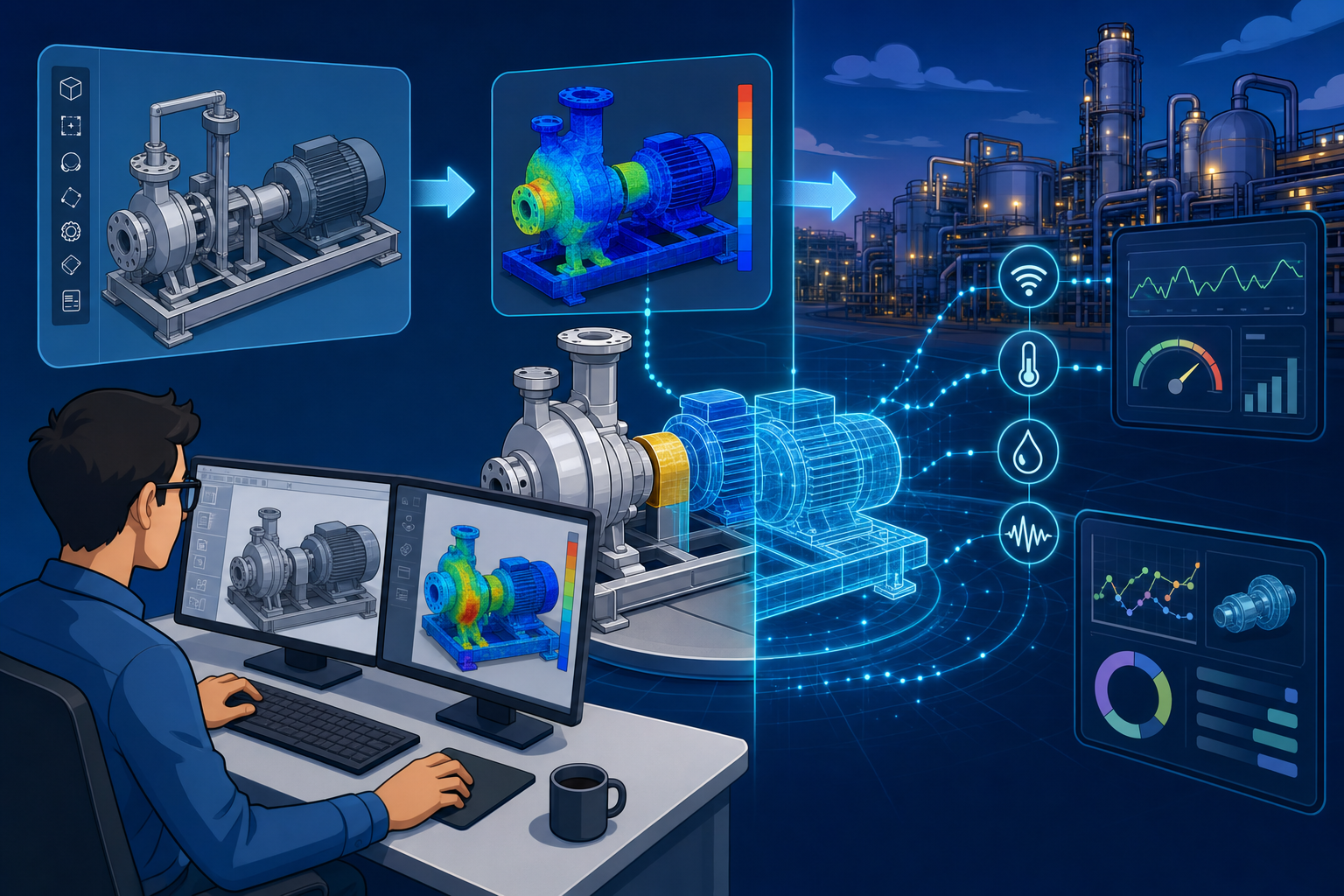


Digital twins have matured into one of the most important concepts in contemporary engineering because they promise something that design teams have wanted for decades: a living technical representation of a product that remains valuable after the initial release. For years, many organizations treated a digital model as a design artifact that helped create drawings, renderings, and manufacturing inputs. That approach still matters, but it now captures only a fraction of what high-performing engineering teams require. In connected products, advanced equipment, and increasingly automated buildings and infrastructure, the digital model must continue to evolve alongside the physical asset. It must absorb performance data, reflect engineering assumptions, support analysis, and provide a basis for prediction rather than merely description.
This shift matters now because development cycles are tighter, field conditions are more variable, and the expectation of continuous optimization has become normal across manufacturing, product development, and architecture. What used to be sufficient as a static 3D representation is now inadequate when teams must forecast failure, improve service intervals, reduce energy consumption, or validate design changes against operating behavior. The emerging value of the digital twin lies not in producing a nicer model, but in linking geometry, physics, and live data into a coordinated decision environment.
Beyond Static Geometry: What a Modern Digital Twin Actually Contains
A modern digital twin is not simply a detailed CAD assembly placed inside a dashboard. It is a structured engineering system that combines several layers of information into a model that can describe, evaluate, and increasingly anticipate the condition of a physical asset. At the base level, the twin usually begins with CAD geometry, because geometry defines massing, interfaces, tolerances, flow paths, material assignments, and component relationships. Yet geometry alone cannot explain how the asset behaves under stress, heat, pressure, vibration, or usage cycles. That is why an effective twin also incorporates simulation models that represent structural response, thermal performance, fluid behavior, controls logic, and motion. These simulation assets are what allow the twin to move from shape to behavior, and from behavior to prediction.
Operational Context Makes the Model Useful
The next layer is sensor and operational context, which is what distinguishes a truly field-relevant twin from a design-stage engineering model. Sensor feeds may include temperature histories, pressure changes, motor currents, positional readings, strain data, humidity conditions, occupancy patterns, or maintenance events. Operational context expands that picture by adding duty cycles, environmental exposure, operator behavior, mission profiles, maintenance records, and load variations. Without this context, a simulation might be technically correct in isolation but disconnected from how the product actually performs. A pump designed for one flow envelope may experience a completely different set of transients in service. A façade model might meet thermal assumptions on paper while underperforming due to installation deviations, occupancy changes, or local climate extremes. The twin becomes powerful when it reflects these realities as an evolving engineering construct rather than a frozen release package.
Visualization, Simulation, and Twin Are Not the Same Thing
One reason digital twin discussions often become muddled is that several different model types are casually grouped together under the same label. A visualization model is intended primarily for communication. It may be highly polished, lightweight, and useful for configuration reviews, marketing content, customer approvals, or spatial coordination. It can show what a product or building looks like with impressive clarity, but it does not necessarily encode physics, behavior, or operational history. A simulation model goes much further by representing performance through equations, assumptions, and boundary conditions. It allows teams to ask what happens if a bracket sees a concentrated load, if a battery enclosure overheats, or if airflow distribution changes under a revised duct network. But even a simulation model is not automatically a digital twin if it remains detached from the actual operating asset.
The Difference That Defines a Real Twin
A true operational digital twin closes the loop between engineering intent and physical reality. It links the designed system to in-service data, compares measured behavior with expected behavior, and creates a framework for updating predictions or adjusting engineering decisions. That distinction is crucial because many organizations invest in attractive 3D environments and call them twins when they are better described as digital replicas or monitoring interfaces. The twin earns its name when it becomes a persistent, updateable reference for condition assessment, performance forecasting, and lifecycle decisions. Integrated CAD and simulation platforms form the foundation of this capability because they preserve the logic connecting geometry, materials, meshing strategies, loads, and parameters. When the design changes, the simulation context can change with it. That continuity is what makes the model useful after design release, especially when products become more connected and predictive engineering becomes a baseline expectation instead of a specialized research activity.
Why Integrated CAD and Simulation Platforms Have Become the Core of Twin Development
The workflow required to build and maintain a meaningful digital twin is too demanding to rely on disconnected tools and manual reconstruction at every stage. Historically, many engineering teams created geometry in one environment, simplified it for another, exported it for analysis, rebuilt assumptions for a specialist tool, and then archived results in reports that were only loosely tied back to the original design data. That approach was tolerable when simulation was occasional and products changed less frequently. It becomes a major liability when teams need to update models quickly, compare design variants, feed operating data back into engineering, and maintain alignment across product revisions. Integrated CAD and simulation platforms change the twin-building workflow by minimizing the fractures between design creation and engineering validation.
Data Continuity Across Physical Domains
In a modern integrated environment, teams can move from geometry creation into structural, thermal, fluid, and motion analysis without repeatedly breaking the data chain. A housing created in CAD can retain material definitions, assembled relationships, wall thicknesses, and named features as it enters stress analysis. The same underlying geometry can support thermal studies that examine heat concentration at electronics interfaces, CFD investigations that evaluate cooling paths, and motion studies that assess kinematic limits or dynamic loads. This continuity matters because digital twins depend on preserving the association between physical design decisions and simulated behavior. If every analysis model is a detached copy, it becomes extremely difficult to determine whether operational discrepancies are caused by the current product revision, outdated assumptions, or analysis artifacts introduced during translation.
Associativity and Parameters Keep the Twin Alive
Associative modeling is one of the least glamorous but most important enablers of practical digital twins. When thickness, material grade, opening dimensions, fastener spacing, control parameters, or thermal interface properties are linked across CAD and simulation, the twin can evolve with the product. A revised rib pattern can automatically influence stiffness studies. A battery pack spacing update can propagate into thermal and airflow evaluations. A change in hinge geometry can trigger motion and stress validation without requiring analysts to manually rebuild the model from scratch. This parameter linking is valuable not just for speed but for trust. Engineering teams need confidence that the twin reflects the latest intent and that revisions are synchronized instead of drifting into parallel, contradictory realities.
Revision Synchronization Supports Predictive Engineering
Revision synchronization becomes even more critical after release, when design updates, manufacturing deviations, and service observations begin to accumulate. A digital twin intended to support predictive maintenance or lifecycle optimization cannot remain static while the physical fleet evolves. Integrated platforms help maintain traceability between original design assumptions and subsequent modifications, making it easier to evaluate whether a field issue stems from a design revision, supplier variation, installation difference, or altered operating profile. This is where cloud computing and real-time data pipelines increasingly shape the workflow. Cloud infrastructure allows teams to scale simulation tasks, centralize model access, and support geographically distributed collaboration, while data pipelines connect the engineering model to streaming or periodic operational inputs. The twin stays current not because engineers continuously rebuild it by hand, but because the platform architecture supports ongoing synchronization between design state, simulation state, and observed performance.
Workflow Gains That Make Integrated Twin Strategies Practical
The appeal of integrated twin development is not theoretical. It creates tangible workflow improvements that directly affect engineering productivity, validation quality, and decision speed. One of the most immediate gains is the reduction of translation errors. Every time geometry is exported between tools, teams risk losing feature definitions, corrupting surfaces, misassigning materials, or introducing topology issues that compromise the analysis setup. These problems may appear minor, but in practice they consume large amounts of expert time and can undermine confidence in results. An integrated platform reduces these breakdowns by preserving model intelligence through the workflow, allowing engineers to spend less effort repairing data and more effort interpreting performance. This becomes especially valuable for products that require repeated design-validation loops under compressed schedules.
Faster Iteration Between Design and Validation
Another major advantage is faster iteration. In a disconnected workflow, a design update often means the analysis team must reimport geometry, rebuild contacts, remesh, and manually compare assumptions against previous runs. In an associative environment, much of that overhead is reduced. Engineers can evaluate multiple design variants more quickly, and design teams can receive feedback before decisions become expensive to reverse. This supports a more agile form of engineering where validation is not a late-stage checkpoint but a continuous participant in development. Digital twins benefit directly from this rhythm because the same mechanisms that accelerate pre-release analysis also make it easier to update the twin once operational data begins revealing where assumptions were optimistic, conservative, or incomplete.
Cross-Disciplinary Collaboration Improves Decision Quality
Integrated platforms also improve collaboration across disciplines that traditionally work in separate toolchains and timelines. Mechanical engineers, thermal analysts, controls specialists, manufacturing engineers, and service teams often interpret the same product through different technical lenses. A twin strategy built on integrated data models makes it easier for these groups to align around a common reference instead of exchanging disconnected files and reports. The benefit is not only communication efficiency but better engineering judgment. A design change intended to solve a structural issue may create an airflow problem. A thermal fix may alter manufacturability. A maintenance access improvement may affect stiffness or sealing performance. When the digital environment supports shared visibility and synchronized revisions, teams can resolve these interactions earlier and with less ambiguity.
Traceability Across the Full Lifecycle
Perhaps the most strategic gain is stronger traceability from concept through in-service performance. This traceability is the backbone of a useful digital twin because it creates a record of why decisions were made, which assumptions informed the design, what analyses supported release, and how the asset actually behaves in operation. That continuity supports several practical outcomes:
- Reduced rework because teams can connect failures or anomalies to specific design assumptions or revisions.
- Better maintenance planning because service data can be interpreted against simulated load paths, degradation patterns, and duty cycles.
- More credible product updates because design improvements can be justified using both engineering models and operational evidence.
- Improved regulatory and quality documentation because design history and performance history remain linked.
- Higher confidence in predictive models because the twin is grounded in both validated simulation and real operating data.
When organizations talk about digital transformation in engineering, these are the kinds of workflow gains that make the idea economically credible. The digital twin becomes less of a futuristic concept and more of a disciplined extension of integrated design, analysis, and operations.
Technical Barriers That Still Limit Digital Twin Effectiveness
Despite major advances in software platforms and computing infrastructure, designing an effective digital twin remains technically challenging. One persistent barrier is interoperability. Even in organizations that adopt integrated environments, important data often still resides in separate systems for PLM, MES, SCADA, BIM coordination, IoT platforms, service logs, controls software, and manufacturing quality records. A digital twin that cannot reliably connect to these sources risks becoming partial or stale. Interoperability issues are rarely just about opening a file format. They involve semantic consistency, unit discipline, metadata structure, naming standards, and timing. A sensor channel identified one way in operations may not map cleanly to the component naming logic used in engineering. A maintenance event may describe symptoms in language that does not align with simulation assumptions. Without governance around these mappings, the twin cannot serve as a dependable decision tool.
Model Fidelity Is a Strategic Decision, Not a Purely Technical One
Model fidelity presents another major challenge. A twin must be detailed enough to capture the physical behavior that matters, but not so complex that it becomes impossible to update, compute, or interpret. High-fidelity simulation can deliver exceptional insight, yet it also demands more setup time, more computational resources, more specialized expertise, and more disciplined data inputs. Everyday engineering teams often need models that are fast enough for comparison and responsive enough for operational use. This creates a tension between computational accuracy and practical usability. A highly resolved CFD model of cooling behavior might be ideal for deep design investigation, but too slow for routine monitoring or rapid scenario testing. A reduced-order model may be easier to operationalize, but only if it preserves the right physical sensitivities. Choosing where fidelity belongs is therefore a design decision in itself, one that must reflect the twin’s purpose rather than an abstract pursuit of maximum detail.
Sensor Integration Is Harder Than It Appears
Sensor integration also introduces more complexity than many early digital twin programs anticipate. Raw sensor streams are not inherently meaningful. They must be filtered, validated, contextualized, timestamped, and aligned with engineering states. Sensors fail, drift, saturate, and behave unpredictably under real field conditions. Data rates vary, communication can be intermittent, and installation locations may not correspond neatly to the variables engineers wish they could measure. In many products and facilities, the most important behaviors are inferred rather than directly observed. Teams may have temperature readings at enclosure surfaces but not at the precise internal hotspot modeled during design. They may know total energy consumption without having a direct measurement for a localized loss mechanism. Building a reliable twin therefore involves estimation strategies, calibration methods, uncertainty handling, and sometimes surrogate modeling to bridge the gap between available signals and desired engineering insight.
Scaling Simulation to Real-World Conditions Remains Difficult
Scaling simulation to represent real-world operating diversity is equally demanding. Products and buildings rarely operate under a single steady-state condition. They experience variable loads, environmental shifts, user interventions, maintenance inconsistencies, and degradation over time. A digital twin that was validated against nominal conditions may perform poorly when exposed to seasonal variation, edge-case behavior, supply chain substitutions, or unexpected duty cycles. To remain effective, the twin must accommodate a broader operational envelope, which often means combining physics-based models with data-driven methods, scenario libraries, and probabilistic approaches. That combination is promising, but it requires mature engineering judgment. Without it, organizations can end up with twins that are technically sophisticated yet brittle, accurate in narrow circumstances but weak when confronted with the complexity of actual service life.
Organizational Discipline Determines Whether a Twin Survives Beyond the Pilot Stage
Many digital twin initiatives struggle not because the software is inadequate, but because the organization has not defined the workflows and responsibilities needed to maintain a living engineering asset. Ownership of model updates is one of the first points of failure. If nobody clearly owns the transition from released design to operational twin maintenance, the model quickly becomes outdated. Should design engineering be responsible for ongoing updates, or should a reliability team take over? Who approves changes when field observations contradict simulation assumptions? Who decides whether a discrepancy indicates a design issue, a manufacturing deviation, or a sensing problem? These questions cannot be left implicit. A digital twin is not self-sustaining just because a platform has connectivity features.
Data Quality and Version Control Need Formal Governance
Data quality and version control create another set of governance demands. An organization may have an excellent CAD backbone and strong simulation capability, but still struggle if revision states are not synchronized across departments. Manufacturing may implement approved substitutions. Service teams may record repairs without structured component attribution. Controls teams may update firmware behavior that alters the operating envelope. If these changes do not feed back into the twin framework, predictive outputs become suspect. Effective governance needs clear rules for data validation, update frequency, naming conventions, and approval workflows. It also requires visibility into lineage: which model revision, which parameter set, which solver assumptions, and which operational dataset contributed to a given recommendation or prediction. Without that lineage, trust erodes rapidly, especially when teams are expected to make maintenance, warranty, or redesign decisions based on the twin.
Cybersecurity and Access Control Are Engineering Issues
Cybersecurity is often treated as an IT concern, but for connected engineering environments it is also a modeling and process concern. A digital twin that connects design data, simulation logic, operational telemetry, and sometimes service or manufacturing systems creates a valuable but sensitive information nexus. Unauthorized access could expose intellectual property, reveal vulnerabilities in product behavior, or compromise operational decision-making. Strong access control, segmented architectures, secure data pipelines, and auditability are therefore fundamental parts of twin design. Teams also need to decide what level of fidelity and technical detail should be accessible to which users. Service personnel may need actionable outputs without exposure to proprietary simulation methods. Suppliers may need bounded access to subsystem data without full visibility into the total asset model. These are engineering governance decisions as much as security ones because they influence how the twin is structured and how collaboration occurs.
Process Transformation Matters More Than Software Procurement
Alignment between design, manufacturing, and service teams is the final organizational hurdle that often determines success or failure. Many companies approach digital twins as a software purchase, expecting the platform to generate transformation automatically. In reality, the twin only becomes valuable when the organization changes how information moves across the lifecycle. Design intent must be captured in ways that downstream teams can use. Manufacturing deviations and quality observations must flow back into engineering. Service insights must be structured and comparable, not buried in unstandardized notes. Operational priorities must inform which simulations are maintained and which parameters are monitored. When companies fail to make these process changes, the result is usually a sophisticated demonstration environment with limited operational relevance. The lesson is simple but important: a digital twin initiative is fundamentally a workflow transformation supported by software, not the other way around.
The Next Stage of Digital Twins Will Be More Autonomous but More Demanding
The real value of a digital twin lies in its ability to connect design intent with operational reality. That connection is what turns engineering data into lifecycle intelligence. A model that captures geometry but ignores service conditions cannot explain why a product underperforms. A monitoring dashboard that shows live sensor values but lacks physics and design context cannot reliably predict what happens next. The digital twin matters because it joins these worlds into a shared reference for decision-making, allowing teams to compare what was expected, what is happening, and what is likely to happen under future conditions. Integrated CAD and simulation platforms are making this much more practical by preserving continuity from concept modeling to validation to operational interpretation. They reduce friction, improve revision alignment, and create the structural backbone required for meaningful predictive engineering.
Practical Progress Depends on Discipline
Still, software integration alone does not guarantee success. Effective twins depend on disciplined workflows, well-chosen model fidelity, reliable data pipelines, and cross-functional coordination that survives beyond initial enthusiasm. Engineering teams must decide what the twin is for, which questions it is expected to answer, how often it should be updated, and who is accountable for its accuracy. They must also commit to the less visible work of data quality management, governance, cybersecurity, and lifecycle traceability. These demands are substantial, but they are increasingly justified by the complexity of modern products, buildings, and infrastructure, where performance can no longer be separated from connectivity, software behavior, and changing usage patterns.
A More Continuous Engineering Future
Looking ahead, the next generation of digital twins will likely become more autonomous, more continuously updated, and more central to engineering decisions across the full product lifecycle. They will make greater use of automated calibration, reduced-order models, cloud-scale computation, and hybrid methods that combine physics with machine learning. They will support not only diagnosis and prediction, but recommendation and adaptive optimization. As this happens, the digital twin will stop being viewed as an advanced add-on and will instead become a core operational layer of engineering practice. The organizations that benefit most will not simply be those with the most software, but those that build the strongest connection between design, analysis, manufacturing, and service. In that environment, the twin becomes far more than a digital reflection. It becomes an active participant in how products are understood, maintained, improved, and ultimately reinvented.
Also in Design News