Your Cart is Empty


From Raw Scans to Manufacture-Ready Geometry: Pipeline, Algorithms, and Quality Gates
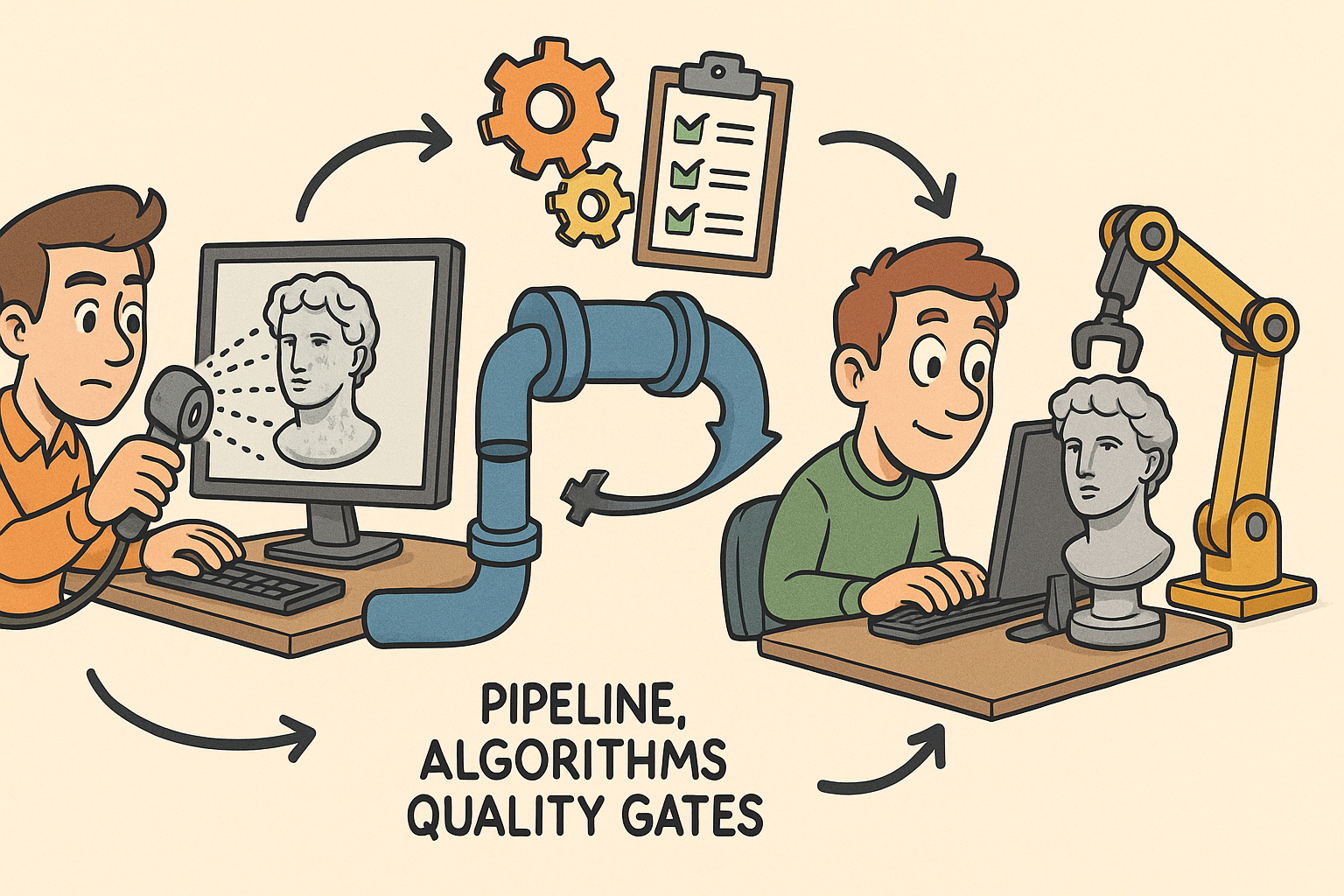


From Raw Scans to a Target: Defining “Manufacture-Ready” and the End-to-End Pipeline
Inputs and their pathologies
The road from a raw point cloud to something that can be manufactured begins by accepting that scans are not ground truth; they are sensor-biased approximations riddled with quirks that shape every downstream decision. Structured light rigs can deliver dense coverage with strong local accuracy yet struggle with deep cavities and specular finishes; LiDAR excels at scale but introduces range-dependent noise and angular bias; photogrammetry is flexible and affordable, but is prone to drift, scale ambiguity, and texture-driven non-uniform sampling. These differences materialize as noise, outliers, anisotropic density, and pose drift, all of which conspire to confuse both registration and reconstruction if addressed late. Even the best capture pipeline runs into partial coverage on occluded undersides, while transparent or highly reflective surfaces yield point deserts or phantom geometry. Mixed assemblies bring their own hazards when unintended fixtures, targets, or background clutter leak into the capture, fusing with the object and setting traps for later topology operations. Extracting a stable unit system sounds mundane, yet mismatched scale (millimeters vs inches) and untagged coordinate frames routinely derail manufacturability checks. A defensible pipeline treats these pathologies not as afterthoughts but as first-class citizens: measure noise statistics early, preserve per-point confidence for later weighting, and isolate foreground from background before pursuing any surface inference. When inputs are curated with these realities in mind, the rest of the process stops firefighting and starts engineering.
- Expect non-stationary noise: vary filters across distance and incidence angle.
- Plan for incomplete data: codify acceptable hole classes versus must-fill regions.
- Sandbox fixtures: tag, separate, and version trash geometry for reproducibility.
- Carry units and frame provenance through all steps; never trust defaults.
What “manufacture-ready” means by process
“Manufacture-ready” is not a single checkbox; it is a policy envelope driven by the downstream process. For additive manufacturing, the target is a watertight manifold mesh with no self-intersections, consistent orientation, and thickness and overhang profiles compatible with the print technology. Powder-bed fusion demands trapped powder escape paths, minimum hole diameters, and thermally aware support strategies; SLA asks for resin drains and anti-cupping details; MJF tolerates different overhang angles than FDM. For subtractive processes, the emphasis shifts from watertightness to recoverable features: visibility of fillets and undercuts, explicit datum strategy, tolerance-bearing surfaces isolated for toolpath precision, and corner radii that match available tools. Metrology asks for something else entirely: bounded deviation to a reference via Hausdorff or L2 metrics, surfaces that can host GD&T semantics, and explicit mapping between scanned and nominal features for conformance reporting. These are not academic differences; they change what repairs are acceptable. Closing a hole might be mandatory for AM but unacceptable for metrology if it conceals a dimensional truth. The practical discipline is to formalize rules per process, encode them as quality gates, and let those gates backpropagate constraints to reconstruction and repair: do we sharpen this edge for CNC datum clarity, or smooth it for AM stress mitigation? The answer should be automated by intent, not improvised after the fact.
- Additive readiness: watertight manifold, overhang budget, escape paths, minimum feature sizes.
- Subtractive readiness: tool-aware radii, access direction sets, datum hierarchy, chordal deviation limits.
- Metrology readiness: stable correspondences, deviation envelopes, feature semantics for GD&T.
Canonical pipeline (and where automation decisions live)
A resilient pipeline is canonical not because it is rigid, but because its decisions are legible and measurable. Start with preprocessing: denoise using robust statistics (radius or conditional outlier removal), suppress outliers, infer and lock units, and normalize coordinates for numerical stability. Move to registration: coarse global alignment via descriptors and RANSAC, followed by local refinement (trimmed ICP), with loop-closure-fed pose graph optimization to arrest drift. Then reconstruction: choose an implicit or explicit surface method that matches data density and sharp-feature requirements, carrying confidence weights from the capture. Enter repair: rationalize topology, remove self-intersections with exact predicates, orient, fill holes in a curvature-aware way, and condition the mesh with feature-preserving smoothing. Proceed to validation: run DFM rules, compute deviation maps, and quantify uncertainty. Finish with outputs: generate a mesh for AM, or a surface/parametric model for CAD and metrology, pairing the geometry with provenance and metrics. Automation belongs at every transition: during preprocessing to tune radii from density histograms, during registration to adapt trim ratios to outlier rates, during reconstruction to pick depth parameters from sampling frequency, and during repair to switch hole strategies based on curvature and boundary confidence. When each step records decisions with inputs and metrics, the pipeline becomes auditable, reproducible, and improvable rather than opaque.
- Preprocessing: denoise, outlier removal, unit/frame inference.
- Registration: global descriptor alignment → local trimmed ICP → pose graph.
- Reconstruction: Poisson/TSDF/BPA with confidence weighting.
- Repair: self-intersection removal, hole filling, remeshing, smoothing.
- Validation: DFM checks, deviation and uncertainty reporting.
- Output: AM mesh, CAD/NURBS, and provenance with metrics.
Algorithmic Building Blocks: Robust, Topology-Safe, and Feature-Preserving
Preprocessing and registration
Robustness is earned early. A simple pass of radius outlier removal can collapse in regions where sampling density varies by an order of magnitude, so adapt the radius from local k-nearest neighbor statistics and apply trimmed estimators to prevent outliers from biasing means. For global alignment, pair scale-invariant keypoints (ISS or SIFT-3D) with descriptors like FPFH or SHOT, and vet correspondences via RANSAC or its graph-theoretic relatives. When outlier rates spike, TEASER++ provides certifiable robustness, delivering a global pose hypothesis that resists extreme contamination before refining with trimmed ICP. Multi-acquisition assemblies demand drift control: build a pose graph where nodes are scan poses and edges are relative transformations, then optimize with robust kernels and introduce loop closures from repeated geometry or targets. This prevents local ICP from ratcheting tiny biases into large global warp. Keep normals dynamic: for photogrammetry, propagate camera geometry to seed normal orientation; for LiDAR, use incidence to stabilize weighting. The registration stage is also where you establish uncertainty: quantify residuals per edge, track inliers, and store covariances so later reconstruction and repair can weight decisions. Well-registered, uncertainty-aware points behave like a network of votes; poorly registered points shout over each other and force heavy-handed smoothing downstream, erasing the very features manufacturing cares about.
- Use ISS/SIFT-3D for keypoints, FPFH/SHOT for descriptors; prune with geometric consistency.
- TEASER++ for outlier-heavy matching; trimmed ICP for refinement.
- Pose graph with loop closures to eliminate cumulative drift.
- Propagate normals and confidence for reconstruction weighting.
Surface reconstruction choices
Surface inference is where you cash the checks written by preprocessing and registration. Poisson and screened Poisson methods excel at generating watertight, smooth manifolds from oriented points, making them a natural fit for AM targets that require closed geometry. Depth, interpolation weight, and confidence parameters are not cosmetic; tune them from point spacing histograms and per-point confidence to balance detail retention with smoothness. When sharp edges matter, Ball-Pivoting (BPA) or alpha shapes can outperform on adequately sampled regions, as they adhere better to discontinuities—yet they are less forgiving with noise and gaps. TSDF and MLS-based implicit fusion shine for multi-view streams, absorbing noise by averaging signed distances in a voxel grid and offering a topology-safe substrate for later operations. Hybrid strategies often win: segment candidate sharp features first, constrain screened Poisson with those edges, or reconstruct with TSDF then refine with feature-aware meshing. The decisive factor is intent: for metrology, avoid over-smoothing that biases dimensional checks; for CNC surfaces, prioritize G1/G2 continuity in subsequent surfacing; for AM, prefer watertightness and even triangle quality. Whatever the choice, encode the selection logic with measurable signals: sampling density, curvature variance, and residuals from registration should gate whether to run BPA in a region or fall back to Poisson with feature constraints.
- Poisson: stable, watertight; tune depth from sampling histograms.
- BPA/alpha: sharper edges, needs dense uniform sampling.
- TSDF/MLS: noise-robust, great for multi-scan fusion.
- Hybrid: feature-first segmentation plus constrained Poisson.
Topology repair and conditioning
Topology errors sabotage manufacturability and simulation fidelity; fix them with exactness, not hope. Self-intersections should be detected with exact predicates (e.g., CGAL kernels) and resolved via continuous collision checks, avoiding the whack-a-mole of purely local flips. Orientation and inside/outside classification benefit from generalized winding numbers, which remain stable on open or noisy surfaces and provide a robust foundation for remeshing and Boolean operations. Holes are not equal: curvature-aware strategies produce patches aligned with local principal directions, while SDF graph-cut methods can carve plausible closures in low-confidence regions; advancing-front with feature anchoring preserves sharp boundaries where they exist. Mesh conditioning then balances fidelity and quality: use isotropic or adaptive decimation guided by QEM with edge length and angle controls; refine in high-curvature zones; and smooth with bilateral or Taubin filtering under feature tags to avoid blunting. For AM, run thickness analysis through medial-axis approximations or voxelized distance transforms to detect knife-edges and thin walls; for CNC, flat skinny triangles that hide scallops must be avoided by enforcing triangle aspect ratios and chordal deviation limits. The end goal is a surface that is topologically sane, geometrically well-conditioned, and faithful to the scan within a stated deviation—achieved with algorithms that respect the brittleness of thin, sharp, and near-parallel features.
- Self-intersection removal with exact kernels; continuous collision checks.
- Orientation via generalized winding numbers for stable inside/outside.
- Hole filling: curvature-aware patches, SDF graph-cuts, advancing-front.
- Remeshing with curvature-aware refinement; bilateral/Taubin with feature tags.
- Thickness via medial-axis or voxel distance fields with corrective offsets.
Feature recovery for downstream CAD
Manufacturing systems thrive on semantics. After the mesh is clean, extract features that reintroduce design intent. Start with primitive fitting using RANSAC to detect planes, cylinders, cones, and spheres, then merge consensus sets to avoid over-segmentation. Run region-growing on normals and curvature to generate coherent patches, with MRF or graph-cut models smoothing label noise while honoring sharp boundaries. For freeform areas, fit NURBS with constrained least squares, enforcing G0/G1/G2 continuity across patch borders where the surface demands smoothness and respecting creases where the part signals manufacturing breaks. The bridge between mesh and CAD is not merely cosmetic: recover datums for CNC setups, hole axes for drilling cycles, and bosses/pockets for tool selection. Tie feature recovery to uncertainty maps; a cylinder fit with high residual variance should downgrade its semantic confidence, preventing dogmatic CAD exports. When the final deliverable is a STEP file with precise surfaces, ensure chordal deviation between the mesh and the surfacing stays within tolerance budgets, and record the mapping so later deviation analysis can be run equivalently on mesh or CAD. By the end, you want a geometry stack that lets AM receive a watertight mesh, CNC receive surfaced features with tool-aware radii, and QA receive semantic anchors for GD&T—all consistent with the same measured reality.
- RANSAC for primitives; consensus merging to avoid tiny fragments.
- Patch segmentation with normal/curvature region growing and MRF smoothing.
- NURBS fitting with continuity constraints and crease preservation.
- Export STEP with tessellation and PMI hooks for PLM pipelines.
Automation Patterns: Parameter Tuning, Quality Gates, and Manufacturing-Aware Policies
Adaptive parameterization
Static parameters fail in the real world. Adaptive strategies begin by quantifying local sampling: build histograms of k-nearest neighbor distances to set radius filters, Poisson depth, and BPA pivot sizes so that neighborhoods match local density rather than a global guess. Fuse confidence from per-point normals, albedo, and incidence; encourage reconstruction methods to trust points that emerged from strong photometric or geometric evidence. For photogrammetry, harvest camera geometry priors: baseline distribution predicts where parallax is strong (trust) versus weak (skeptical), while grazing angles warn of inflated noise. Layer in ML meta-controllers that don’t replace geometry, but predict parameter sets from quick proxies: point count, bounding box size, density skewness, and descriptor inlier ratios. Such controllers can choose between TSDF and Poisson, set screened weights, or flip between hole strategies based on boundary curvature and confidence. Crucially, adaptivity must remain auditable: record why depth was set to 10 instead of 8, which histogram percentile drove the radius, and how much uncertainty influenced weighting. That way, when a print fails or a CNC toolpath chatters, you can replay decisions, adjust policy, and train the controller with ground truth from outcomes, turning the pipeline into a living system that gets sharper with each job rather than a frozen cookbook.
- Density-aware neighborhoods from kNN statistics.
- Confidence-weighted fusion using normals/albedo/incidence.
- Camera priors: baseline distributions and grazing-angle filters.
- Meta-controllers predict reconstruction/repair settings from proxies.
Quality gates and metrics
Automation without gates is just faster guessing. Define a hierarchy of topology, geometry, and manufacturability gates with quantitative thresholds. Topology checks cover watertightness, manifoldness, genus stability across remeshing, and self-intersection counts. Geometry gates enforce triangle quality (minimum angle, aspect ratio), curvature distributions that don’t show spurious oscillations, and deviation to points measured via RMS and Hausdorff distances. Manufacturability gates translate process physics into numbers: minimum thickness histograms, overhang angle distributions, hole diameters compared to printer/tool capabilities, and trapped-volume detection for powder or resin. Every gate produces not only a pass/fail but a report: surface uncertainty maps, DFM violations with locations and magnitudes, and a change log that explains how repairs altered the model. Calibrate thresholds per process: PBF tolerates steep overhangs differently than SLA; CNC chordal deviation budgets depend on finishing passes. These gates should be cheap enough to run frequently and strict enough to prevent unstable geometries from slipping into scheduling. Over time, they become a shared language between automation and experts: when a gate fails, both the machine and the human know exactly why, where, and by how much, shortening the path to a robust fix instead of a vague redesign.
- Topology: watertight, manifold, stable genus, zero self-intersections.
- Geometry: minimum triangle angle, aspect ratio, curvature sanity, RMS/Hausdorff deviation.
- Manufacturability: thickness/overhang histograms, hole sizes, trapped volumes.
- Reporting: uncertainty maps, change logs, process-specific thresholds.
Human-in-the-loop escalation
No matter how tuned the pipeline, ambiguity persists: should that near-sharp ridge be sharpened for datum clarity or smoothed to reflect worn reality? Encode a policy: if all gates pass with margin, auto-approve; if deviation or DFM failures exceed bounded tolerances, escalate to an expert with focused suggestions generated from the metrics. Assisted edits can propose hole caps with implied curvature, re-sharpen edges with constrained ARAP/Laplacian solves, and offer candidate build orientations with print-time and support estimates. Present the operator with three or four high-value alternatives rather than a blank canvas. Importantly, keep humans from doing low-level surgery the machine can do deterministically; reserve their judgment for intent decisions: accept a slight thickening to meet AM rules, or preserve the measured thinness for metrology. Close the loop by capturing outcomes—what was chosen, why, and what the subsequent build or inspection revealed—so the meta-controller learns and thresholds tighten. Over time, the escalation rate should drop, the suggestions should converge to good defaults, and expert time shifts from rescue to oversight. The human remains essential not as a patch for weak automation, but as the arbiter of conflicting goals where only domain context can break the tie.
- Auto-approve when all gates pass; escalate when deviations exceed bounds.
- Suggest targeted edits: caps, re-sharpening, orientations with estimates.
- Limit manual edits to intent, not mechanics; record decisions and outcomes.
Infrastructure for scale and reproducibility
Scaling geometry pipelines requires infrastructure choices as deliberate as algorithmic ones. An SDF-first volumetric core improves topology safety and unlocks GPU acceleration for voxel operations like TSDF fusion, morphological thickness evaluation, and generalized winding computations. Streaming, out-of-core meshing and remeshing allow terascale scans to be processed on commodity hardware by tiling volumes and stitching with overlap-aware constraints. Treat geometry like code: establish CI for shapes with golden datasets, regression tests on metrics (e.g., Hausdorff to reference, triangle quality distributions), deterministic seeds, and exact arithmetic kernels to avoid flakiness. Provenance is non-negotiable: snapshot parameters, capture environment hashes (library versions, kernel precision modes), and store deviation PDFs alongside the model. These practices turn a single hero workstation into a fleet of deterministic workers and make “works on my machine” an exception rather than a norm. When something regresses—an unexpected genus change, a spike in self-intersections—the CI gate fails early, not after a wasted build. And when the customer asks why a hole grew by 0.2 mm, you have a chain of evidence from raw scans to the final export that explains precisely which decision and parameter produced that outcome.
- Volumetric/SDF core with GPU-accelerated voxel ops.
- Out-of-core streaming for massive scans with overlap stitching.
- Geometry CI: golden sets, metric regression, deterministic kernels.
- Provenance: parameter snapshots, environment hashes, deviation PDFs.
Process-specific finalization
Finishing turns a good model into a production-ready asset. For AM, integrate lattice infill where appropriate to reduce mass while maintaining stiffness, and design escape strategies that guarantee powder or resin removal without compromising structural intent. Auto-orient parts to balance overhang, support volume, and surface finish trade-offs, and apply support-lite geometry optimization, thickening fragile features minimally to meet printer constraints. For CNC, verify surface continuity to avoid tool dwell marks, enforce chordal deviation constraints aligned with finishing stepovers, and detect fillets and corner radii to drive tool selection and multi-axis strategy. Export pathways should be neutral and richly annotated: 3MF for AM with materials and slicing hints; STEP with tessellation and PMI hooks for CAD/PLM; glTF or USD for lightweight review and AR validation. Where metrology follows manufacturing, include alignment frames and datum features as named entities so CMM and scan-to-CAD workflows consume the same semantics. Finally, embed a compact report that travels with the asset: DFM pass/fail summaries, expected deviations, uncertainty hotspots, and a minimal provenance digest. The last mile is part of the pipeline, not a folder of ad hoc scripts; treat it with the same rigor you applied to reconstruction and repair, and the handoff to machines and people becomes smooth, explainable, and repeatable.
- AM: lattice infill, escape paths, auto-orientation, support-lite thickening.
- CNC: continuity checks, chordal deviation budgets, fillet detection for tools.
- Neutral outputs: 3MF, STEP + PMI, glTF for review; carry metrics and provenance.
Conclusion
Key takeaways
Robust mesh repair automation is not one trick; it is a stack where each layer protects the next. Representations that are topology-safe—SDFs and generalized winding numbers—supply certainty about inside/outside and intersections, enabling trustworthy repairs and Boolean operations. Reconstruction must be feature-aware, whether through hybrid Poisson constrained by segmented edges or TSDF fusion that respects confidence and incidence. Everything adapts to data via density-aware neighborhoods, screened weights, and meta-controllers that pick parameters from measurable proxies rather than intuition. “Manufacture-ready” is context, not dogma: define it per process—AM, CNC, metrology—and enforce it with gates that quantify watertightness, triangle quality, thickness, overhangs, chordal deviation, and deviation to points, paired with uncertainty maps and change logs. Automation should be bold yet humble, escalating ambiguous decisions to experts with targeted suggestions and crisp telemetry. Above all, log everything: parameters, seeds, versions, and metrics that tell you what changed, by how much, and why. This blend of safe representations, feature-preserving algorithms, adaptive control, measurable gates, and traceability turns scanning from an art that occasionally works into an engineering discipline that scales.
A baseline stack to start and how to iterate
If you need a defensible starting point that delivers value quickly, assemble a baseline composed of screened Poisson reconstruction, generalized winding orientation, adaptive remeshing with curvature-aware refinement, and a compact suite of DFM checks tuned to your dominant process. Precede it with TEASER++ plus trimmed ICP and pose graphs for registration, and follow it with primitive fitting and NURBS surfacing where CNC or metrology require semantics. Wrap the whole flow in a provenance shell and geometry CI so changes are testable. From there, iterate with ML-driven parameter selection using fast proxies, graft in TSDF for multi-view heavy jobs, expand hole strategies to include SDF graph-cuts, and harden exact arithmetic kernels where numerical drift appears. Enrich outputs with PMI, escape paths, and orientation advisories, and keep feeding outcomes—print success, toolpath stability, inspection deltas—back into the meta-controller and gate thresholds. The arc you are aiming for is reliability at scale: jobs pass with fewer escalations, deviations tighten, turnaround shrinks, and experts spend time on edge cases that truly need intent. When the baseline consistently produces watertight manifold meshes, preserves sharpness where it matters, and flags risks before they become failures, you will know the system has crossed from helpful to dependable—ready to turn raw scans into production with confidence.
Also in Design News