Your Cart is Empty


Edge AI for CAM Machines: Deterministic Closed-Loop Control, On-Device Optimization and Secure MLOps


Why Edge AI for CAM Machines Now?
Motivation
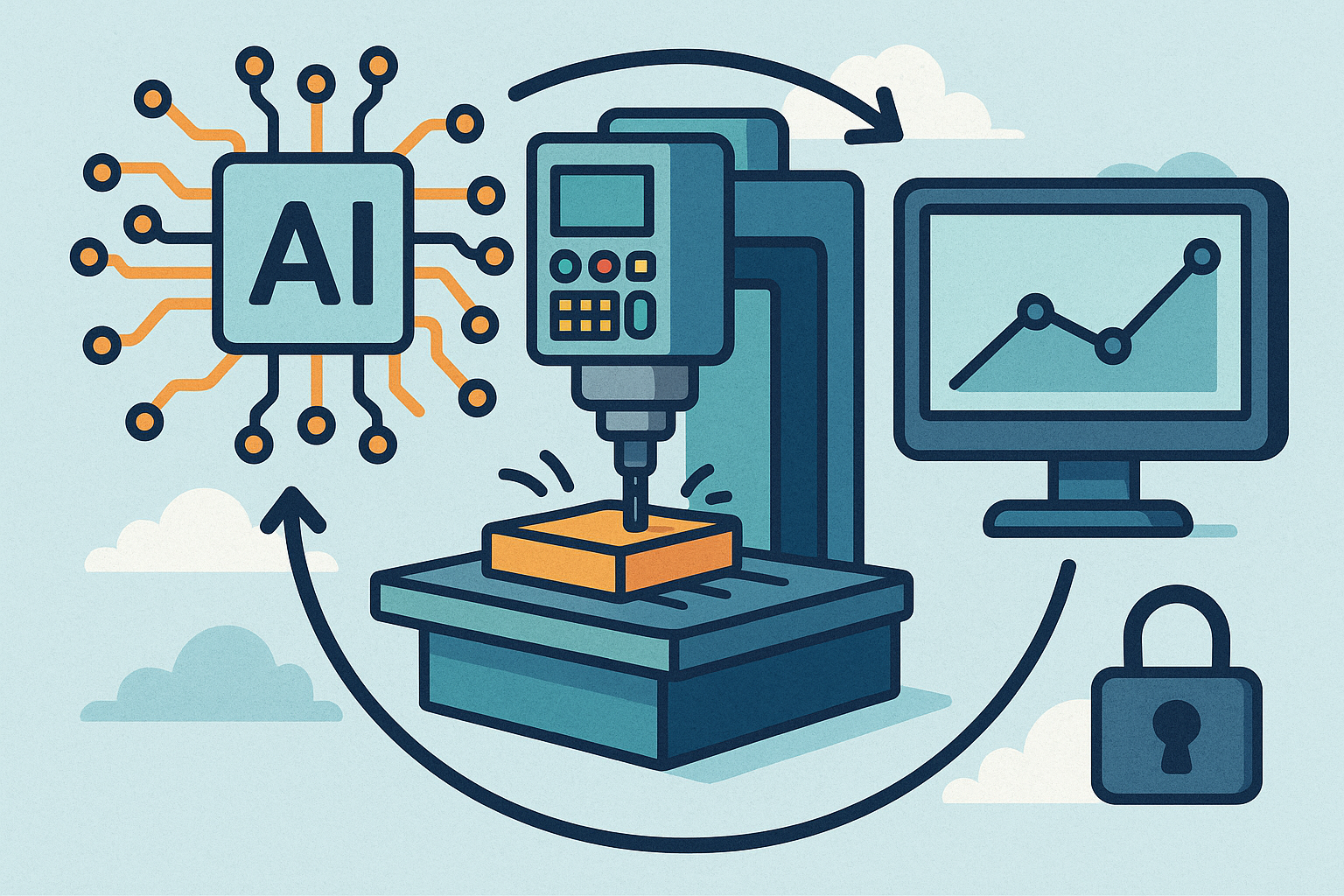
Computer-aided manufacturing is crossing a threshold where static toolpaths and fixed override heuristics can no longer keep up with material variability, complex kinematics, and aggressive delivery expectations. **Edge AI** meets this moment by driving the decision-making intelligence as close as possible to the spindle, closing the loop in milliseconds rather than seconds or minutes. First, reducing latency and network dependency transforms familiar controls—feed and spindle overrides, chatter suppression, and axis coordination—into **real-time control loops** that continuously track force envelopes and chip load targets. Instead of hoping that conservative parameters cover worst-case scenarios, the machine responds dynamically to the actual cut. Second, keeping models and telemetry on-prem safeguards trade secrets and sensitive production data. Proprietary tool libraries, material coefficients, and process fingerprints stay behind the firewall, where IP leakage risk is minimized and model governance is easier to enforce.
Third, **adaptive optimization** improves overall equipment effectiveness. Shorter cycle times come from opportunistically raising feed where stability margin allows, while longer tool life follows from maintaining chip thickness and temperature within safe bands. Fewer scrap events result when the system detects unstable modes early and executes safe evasive actions. Finally, resilience matters: shops should keep running even when disconnected from the cloud or MES. Edge-resident models and local buffers allow machines to **continue operating offline**, synchronizing insights later when connectivity returns. The result is not just faster machining; it is a safer, smarter cell that defends margins by making the best possible decision in the small slice of time available between encoder ticks.
Typical on-device use cases
Practical edge intelligence concentrates on what must happen inside tight, deterministic windows. One recurring application is online optimization of feeds, speeds, and step-over derived from high-rate signals: spindle power, triaxial vibration, force proxies, thermocouple temperature, and acoustic emission. With appropriately constrained action spaces and guardrails, the machine raises or lowers overrides without pausing the cut. Another is sub-10 ms **chatter and collision avoidance**. Chatter onset can be recognized from harmonic growth or energy bursts in specific bands, followed by safe responses—slight spindle retuning, feed reduction, or controlled retracts—to avoid tool, spindle, or part damage. Tool wear and state estimation support predictive changes and adaptive re-pathing; instead of a timed change, decisions reflect actual edge condition, measured indirectly via spectral and power signatures.
Surface finish prediction closes the loop for aesthetics and tolerance. Lightweight surrogates estimate roughness and scallop and then apply in-process correction: contour smoothing, micro-dwells, or scallop-thickness control that prevents the need for extra passes. Lastly, the drive toward sustainability puts **energy-per-part minimization** in scope. Models select parameter combinations and axis trajectories that trim idle and transient losses while respecting geometric and thermal constraints. Engineers can extend these functions to multi-axis strategies, where jerk-aware motion profiles and axis synchronization unlock additional energy savings without sacrificing quality. A common thread across all use cases is embedding fast, compact models beside the controller and limiting cloud reliance to non-real-time analytics and global learning.
Edge vs cloud tradeoffs
When safety and determinism are on the line, the edge wins. Closed-loop optimization, chatter detection, and evasive maneuvers require **low jitter and bounded execution**; cloud roundtrips and variable networks are incompatible with these guarantees. Conversely, large-scale training, cross-fleet benchmarking, and advanced experiment management benefit from cloud elasticity. The right architecture bifurcates responsibilities: inference, control, and hard safety checks stay at the edge; heavy training, toolpath library mining, and shop-wide analytics move to the cloud. Data minimization further strengthens the design. Instead of streaming raw, high-rate telemetry, the edge emits compact features, events, or anonymized summaries.
For global learning without raw data exfiltration, **federated learning** pushes updates from central orchestration while models train locally on each machine’s data. Periodic model aggregation then reflects insights from diverse machines, materials, and geometries without violating IP boundaries. The practical question isn’t “edge or cloud” but “what belongs where for safety, determinism, and privacy?” Anchoring that answer in latency budgets, safety integrity levels, and the economics of bandwidth ensures the stack delivers both responsive control and cumulative learning.
On-Device Optimization and Monitoring Techniques
Real-time optimization loops
At the heart of edge-enabled CAM is the ability to pick new parameters fast, safely, and with uncertainty in mind. **Safe bandit** and Bayesian optimization strategies explore the neighborhood of current feeds and speeds while honoring process constraints: force limits, temperature envelopes, spindle current thresholds, and machine geometry. These strategies favor improvement only within a certified “safe set,” shrinking the risk of sudden instability. They can be scheduled to probe gently between cutter exits, retracts, or low-engagement segments, blending learning with machining cadence. **Model Predictive Control (MPC)** offers another path, maintaining target chip load and stable cutting forces under dynamic disturbances—material heterogeneity, tool runout, or thermal drift. MPC leverages a compact process model that can predict how an incremental override will affect force and roughness a few control horizons ahead.
When physics-based models are incomplete, **surrogate models**—Gaussian processes or lightweight neural networks—approximate the mapping from parameters and features to forces, roughness, or energy. Importantly, these surrogates quantify uncertainty, letting the controller back off when predictions lose confidence. Runtimes must be deterministic: successful loops pre-allocate memory, pin CPU cores, and cap computation to microseconds-to-milliseconds budgets. Optimization variants that precompute safe action lattices or use fixed-time solvers help meet strict deadlines. Together, constrained exploration, short-horizon prediction, and uncertainty-aware surrogates make optimization practical in the narrow windows available between trajectory planner updates.
Sensing and inference
Edge AI hinges on measurement quality and signal processing discipline. High-rate DSP on accelerometers, acoustic emission sensors, and spindle current enables **streaming FFT/CWT feature** extraction at kilohertz rates. Windowing, spectral whitening, cross-channel coherence, and envelope detection produce compact, informative vectors that capture stability transitions before the human eye or a coarse SCADA trend could. On ultra-tight budgets, TinyML classifiers deployed on MCUs handle first-tier chatter onset detection or anomaly flags near the sensors, while edge GPUs or VPUs perform **multimodal fusion**—combining vibration, current, temperature, and kinematics—to refine diagnosis and avoid false positives.
Machine-to-machine variability and new materials complicate supervised labeling. Here, **self-supervised anomaly detection** excels. Autoencoders or predictive coding models learn the joint distribution of “normal” cutting from unlabeled runs, flagging departures that likely reflect wear, instability, or collisions. To boost robustness, the pipeline should include online normalization, sensor health checks, and on-the-fly recalibration routines that adapt to mounting changes or thermal shifts. Synchronized sampling, preferably using PTP (Precision Time Protocol), aligns sensor frames with controller timestamps, making inference explainable and replayable. All of this must execute inside defined real-time lanes, with bounded pre- and post-processing so that inference never starves motion control.
Reliability, safety, and explainability
Adding intelligence must never erode safety. Systems need **hard bounds**, certified fallbacks, and fail-safe states maintained under a clear SIL/PL separation and the black-channel principle. The AI’s suggested override is checked against independent safety logic; if limits are exceeded or the model reports low confidence, the controller reverts to conservative baselines or triggers a controlled retract. Deterministic execution budgets—e.g., end-to-end inference and decision in under 5 ms—are enforced via priority scheduling (SCHED_FIFO) and watchdogs that tear down late computations. Memory is locked, real-time threads are pinned, and telemetry buffers are bounded to avoid surprise latencies.
Operator trust grows when the system communicates in meaningful, compact terms. Lightweight interpretability can provide **confidence intervals**, trend arrows, and reason codes such as “force envelope breach risk” or “harmonic 1.8× spindle frequency growth” rather than raw SHAP values or opaque vectors. The HMI should present both machine and model status, including override activity frequency, remaining tool life estimates, and current stability margin. Recorded snapshots around interventions make audits straightforward. If the health monitor sees flapping behavior or repeated near-limit excursions, it throttles autonomy and asks for operator input. The goal is not to replace seasoned machinists but to augment them with consistent, high-speed attention and defensible, reversible automations.
Model engineering for the edge
Edge constraints reward disciplined **model engineering**. Quantization and pruning shrink neural nets without sacrificing accuracy in the bands that matter; calibration-aware quantization techniques maintain confidence scores that align with floating-point baselines. Inference accelerators such as TensorRT or OpenVINO lower latency, while fixed-point kernels or even FPGA blocks handle hot paths like spectral transforms. Concept drift is inevitable—new batches, fresh inserts, different coolants—so drift detectors using PSI or KS tests watch feature distributions and trigger on-device calibration updates between jobs. These updates can be as light as re-centering norms or as heavy as a short fine-tune under frozen early layers.
Rollouts must be staged to protect throughput. Start in shadow mode, where models observe and propose overrides but never actuate. Compare proposals against actual outcomes, collect false positives/negatives, and refine thresholds. Next, move to **canary** deployments: enable constrained overrides on low-risk ops or materials, with automated rollback triggers tied to quality or stability metrics. Only after statistically significant wins should full control be granted. That process, combined with rigorous signed artifacts and versioned configuration, produces a living system that improves without endangering the shop’s schedule.
Reference Architecture and Workflow Integration
Hardware and control stack
The practical stack begins with a rugged **industrial PC** or Jetson-class module co-located with the machine, equipped with a modest GPU/TPU where multimodal inference warrants it. Integration with the PLC/CNC controller occurs over OPC UA or MTConnect, with deterministic channels for status and setpoints and read-only mirrors for richer telemetry. Sensor front-ends cover acoustic emission, triaxial vibration, thermocouples, and spindle power/current; they are time-aligned using PTP to guarantee coherent cross-sensor features. For high-speed samples, dedicated DAQ modules stream into ring buffers shared with the inference process. Network cards should support hardware timestamping to keep synchronization tight under load.
On the compute side, a real-time OS or Linux **PREEMPT_RT** kernel provides the scheduling foundations. Inference and control threads run as SCHED_FIFO with priority higher than non-critical services; I/O completion paths are profiled to remove sporadic spikes. Safety PLCs—and any emergency stop logic—remain electrically and functionally isolated, preserving a clean safety case where the AI is advisory or bounded by certified supervisors. Thermal design, dust-proofing, and vibration isolation of the compute module are not afterthoughts; an over-heated edge box that throttles mid-shift introduces the very jitter we are trying to eliminate. The physical footprint includes accessible service points for swapping sensors and managing secure boot hardware modules without interrupting production.
Software and data flow
The software path starts with a **G-code interception layer** that respects ISO 6983 conventions while enabling adaptive moves. Standard FRO/SO overrides remain the first-line actuators; beyond them, controlled dwell or micro lead-in/lead-out adjustments can stabilize entry/exit conditions without rewriting programs. Where possible, STEP-NC augments semantics—features, strategies, tolerances—so the edge logic understands intent and can reason about allowable changes. The inference service exposes a low-latency API backed by a ring-buffer telemetry store and an append-only event journal that makes every decision reproducible. A compact feature store persists calculated descriptors (spectral peaks, coherence, envelope stats) with versioned preprocessing so models can be replayed exactly.
Closed-loop integration continues upstream. Interfaces to CAM/MES/PLM push back optimal parameters, stability maps, and annotated tool libraries. Post-processors can embed **transparent recommendations** directly into program headers or tool notes, so programmers see what the machine learned and can codify improvements in templates. When roughing a family of parts, the system might propose a narrower step-over and slightly higher spindle speed to stay in a stable lobe, annotating the evidence. The MES tracks experiments and approvals, while the PLM preserves artifact lineage and ensures that regulated shops maintain traceability from model and sensor versions to final part records. Every byte moves with provenance and time, turning the edge from a black box into a traceable, explainable participant in the workflow.
Deployment and MLOps at the edge
Operationalizing edge AI mirrors cloud MLOps with stricter controls. Applications run in containers with signed images and **secure boot**, and secrets are anchored in TPM-backed keys. Updates arrive over-the-air in blue/green deployments that allow a quick fall back to the last-known-good image; a health monitor halts promotion if latency rises, override frequency spikes, or safety events tick upward. Fleet orchestration supports staged rollouts by cell, shift, or part family, making risk visible and manageable. Telemetry pipelines track real-time budgets, queue depths, inference latency distributions, and watchdog rescues; all alerts route to both IT and operations channels to avoid blind spots.
Learning continues without exporting raw sensor firehoses. **Federated learning** coordinates on-device training with periodic global aggregation, allowing distinct machines to contribute to shared models while enforcing IP boundaries. When bandwidth allows, curated feature slices and anonymized events supplement the global picture. A/B tests compare model variants per operation, captured in the MES alongside quality and throughput metrics. Data retention policies balance reproducibility and storage cost: retain high-rate windows around interventions and anomalies; summarize the rest. The result is a maintainable, observable edge service that evolves as the shop’s mix of tools, materials, and fixtures changes.
Compliance and security
Manufacturing networks demand a defense-in-depth approach aligned to **IEC 62443** zones and conduits. The edge node sits in a strictly controlled zone with least-privilege access to the controller and sensors, and only a narrow, audited path to upstream services. Model artifacts and telemetry-at-rest are encrypted, and signing policies ensure that nothing unverified runs near the controller. Software bills of materials (SBOMs) cover plugins, drivers, and DSP libraries, giving security and quality teams a complete inventory for vulnerability management. For regulated industries, append-only **audit trails** map model and configuration versions to specific parts, inspections, and outcomes, supporting robust compliance narratives without offloading raw data to third parties.
Human-machine interfaces adhere to ISA-101 principles so operators see a clear, consistent status: current overrides, remaining tool life, quality and stability indicators, and the autonomy level in force. Authentication and authorization separate roles—operator, programmer, maintenance, data scientist—with minimal overlap. When an anomaly or drift trigger fires, the system explains both the reason and the action taken, then logs operator acknowledgments where policy requires them. Security and compliance cannot be bolted on after the fact; they shape dataflows, UI affordances, and even algorithm choices from day one.
UX and change management
Edge AI succeeds when operators and programmers feel that it amplifies their judgment rather than second-guesses them. A thoughtful UX supports **operator-in-the-loop** control with adjustable autonomy levels: recommend-only, constrained override, and full adaptive control. Lockouts and per-operation caps prevent surprises on delicate features or tight-tolerance finishing passes. The HMI surfaces recommended changes with short rationales (“predicted force spike in pocket corner; reduce feed 8% for 0.6 s”) and easily reversible actions. For programmers, post-processor integrations attach machine-learned stability maps and parameter updates right where decisions happen—in the CAM environment—closing the loop without extra steps.
Change management pairs these affordances with training and SOP updates. Quick reference guides explain what signals the system watches, how confidence is expressed, and what triggers a rollback. Maintenance teams learn to interpret sensor health indicators and recalibration prompts. Program review boards adopt a cadence for approving template changes sourced from the edge. To keep trust high, success metrics and error budgets are shared openly: how often the system intervened, how much time it saved, and when it stood down. The cultural goal is a collaborative rhythm where humans set goals and constraints while the **deterministic execution** layer takes on the micro-adjustments that humans cannot reliably perform at millisecond scales.
Conclusion
Key takeaways
Bringing intelligence to the spindle transforms CAM from static programming into **adaptive, closed-loop manufacturing** that does not rely on cloud roundtrips. The edge is where determinism lives: force envelopes, chatter suppression, and energy-aware motion all demand microsecond-to-millisecond guarantees. The cloud complements with global model training, fleet analytics, and experiment orchestration but never decides time-critical moves. Success depends on engineering discipline—hard bounds and certified fallbacks, watchdogs and priority scheduling, and interpretable outputs that earn operator trust. Integration must be seamless: G-code interception for ISO 6983, richer semantics from STEP-NC where available, and clean handshakes with MES and PLM so improvements propagate to templates and tool libraries.
Approached this way, Edge AI **increases OEE**, prolongs tool life, and reduces scrap without creating a black box. It preserves IP by keeping raw telemetry and models at the source, enabling federated or periodic aggregation for cross-shop learning. The path from concept to sustained value is pragmatic: start safely in shadow mode, quantify gains with A/B tests, and widen autonomy as confidence grows. What emerges is not just faster machining but a more robust and resilient process that can weather network hiccups, material variability, and schedule pressure.
Measurable outcomes to target
Clear targets ground the program in results and help prioritize where to deploy first. While every shop and material mix differs, teams commonly set goals in several domains: time, quality, reliability, and sustainability. Cycle time reductions come from higher in-cut feeds, fewer air moves, and less conservative dwell. Tool life improves when chip load and temperature stay within safe envelopes and when chatter is recognized early and suppressed. Reliability shows up as fewer unplanned stops and smoother shifts, while sustainability benefits from reduced **energy per part** and stable surface roughness distributions that avoid rework. To make these goals actionable, attach them to specific operations and part families and monitor continuously.
- Cycle time reduction: 5–15% across target operations, with part-family rollups.
- Tool life improvement: 20–40% via better stability and temperature management.
- Chatter events avoided: >30%, verified by spectral markers and operator logs.
- Surface roughness variance: measurable decrease with target Ra/Rz bands met.
- Energy per part: downward trend after optimizer activation, normalized by material removal rate.
- Unplanned stops: reduction trending alongside anomaly detection and safe retractions.
- First-pass yield: upward movement as adaptive corrections remove rework causes.
Suggested rollout roadmap
Disciplined rollouts protect production while proving value quickly. In the first 0–30 days, instrument one machine and a small set of representative operations. Establish baseline telemetry—forces, spectra, spindle current—and correlate with downtime and quality outcomes. Deploy the inference stack in shadow mode, capturing proposed overrides and comparing them with actual results. Validate latency budgets and determinism under normal and peak conditions. Between 30–60 days, enable **constrained overrides** for the most stable operations and materials. Run A/B tests where identical parts alternate between baseline and adaptive settings, and review intervening logic weekly with operators and programmers. Tie rollback triggers to simple, auditable thresholds: rising false-positive rates, surface finish deviations, or near-limit force excursions.
From 60–120 days, scale cautiously to a cell. Extend integrations to CAM so learned parameters feed back into templates and annotated tool libraries. Begin **federated updates** if multiple machines share the same process families, and elevate autonomy where data demonstrates consistent gains. Formalize SOPs for sensor checks, drift monitoring, and model promotions, and align HMI conventions across machines to reduce cognitive load. By the end of this phase, the program should have defensible, repeatable wins and a runway for expanding across the shop with predictable effort and risk.
Future directions
Several frontiers promise further gains. Wider **STEP-NC** adoption will deliver the semantics needed for richer edge reasoning: explicit features, tolerances, and strategies that tell the controller not only what to cut but why. **Physics-informed surrogates** can fuse mechanistic stability maps with data-driven learning to improve sample efficiency and extrapolation, while multi-axis optimizers that consider jerk and acceleration constraints will squeeze more performance from modern kinematics without degrading surface finish. Standardization across vendors—interfaces, timing models, feature schemas—will make adaptive machining a first-class capability across diverse controllers and sensors.
On the hardware plane, expect more specialized accelerators tuned for spectral and time-series workloads and closer coupling between actuator drives and inference hardware. In software, toolchain maturity—quantization-aware training that preserves uncertainty calibration, robust TinyML pipelines for first-tier classifiers, and built-in **deterministic execution** constructs—will lower barriers. The direction is clear: as edge intelligence becomes native to CAM, the spindle stops being the end of a static post-process and becomes an active participant in an ever-learning, closed-loop manufacturing system that thrives on variability instead of fearing it.
Also in Design News