Your Cart is Empty


Deterministic, Event-Sourced Architecture for Real-Time Collaborative CAD


Introduction
Why this problem matters now
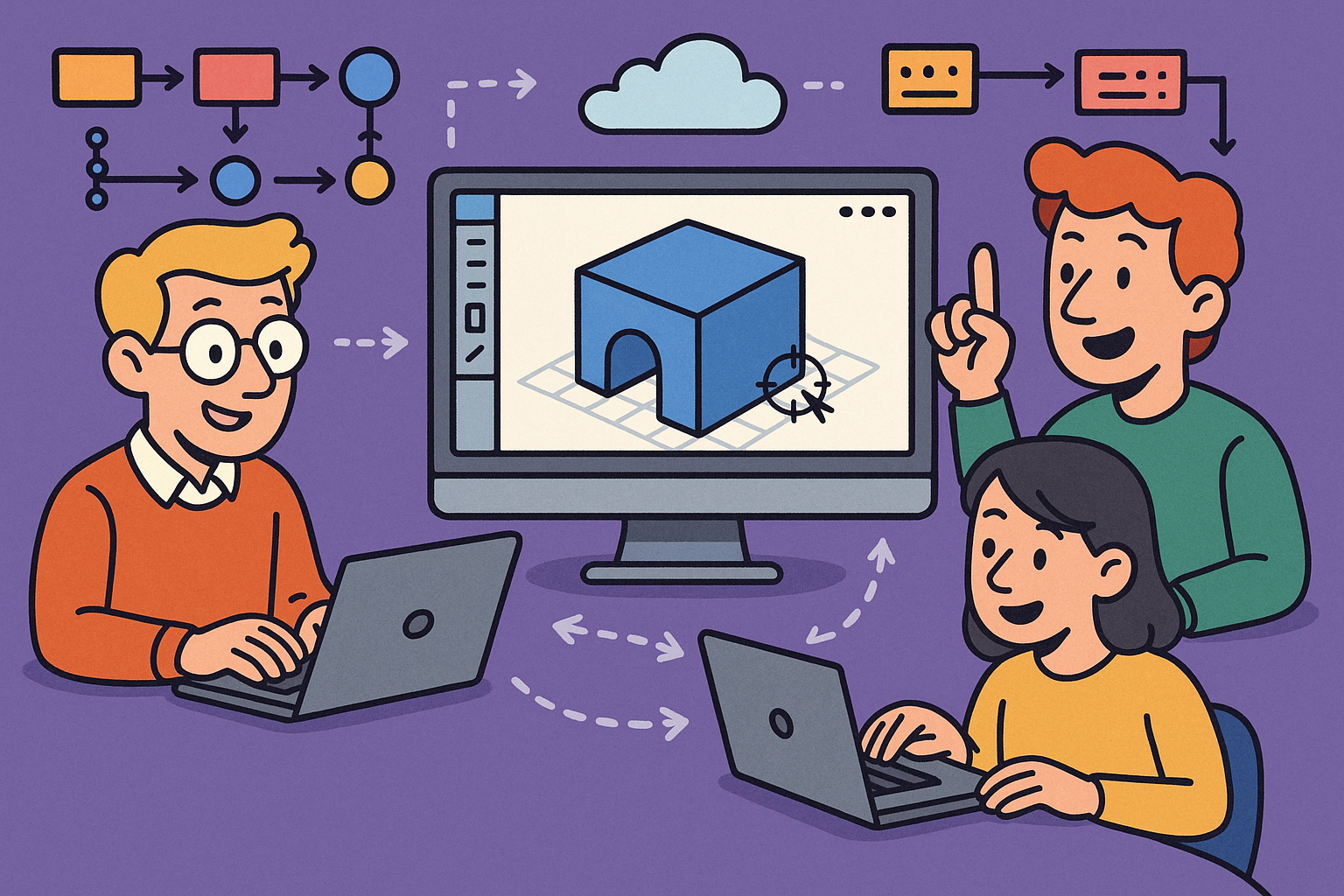
Design teams expect the same frictionless co-editing they enjoy in documents and code editors, yet applying that expectation to geometry is uniquely challenging. Real-time collaborative CAD sits at the intersection of compute-heavy kernels, intent-rich modeling decisions, and human coordination under tight latency budgets. The opportunity is enormous—shorter iteration loops, shared context, and lower transfer costs between disciplines—but only if the experience is stable and predictable. Delivering that requires more than pushing bits faster; it demands a deep rethinking of how models are represented, synchronized, and recomputed. In practice, success hinges on aligning three pillars: an event-sourced, intent-aware model, a deterministic compute pipeline that can be sliced and replayed, and UX patterns that help people collaborate gracefully despite hidden complexity.
A pragmatic promise
This article distills advanced architectural patterns and hands-on UX guidance for building cloud-native, multiuser CAD that actually works at scale. We will examine why “real-time” is harder in geometry than in text, outline proven sync strategies and kernel guardrails, and close with concrete workflows that reduce friction in day-to-day design. Along the way, we emphasize a simple principle: treat the model as a durable ledger of intent, not just a snapshot of surfaces. If every client can confidently replay the same events into the same kernel with the same rules, then reliable collaboration becomes a matter of ordering, slicing, and surfacing conflicts rather than wrestling with ghosts in the topology.
Why “Real-Time” Is Harder in CAD Than in Docs or Code
Parametric graphs propagate change non-locally
Parametric CAD models are directed acyclic graphs (DAGs) where features, sketches, constraints, and assemblies interdepend. Changing a sketch dimension can invalidate downstream operations—fillets, shell, patterns—several steps away from the edit. This means a single operation can trigger a cascade of computations and topology rewrites. The feedback loop has variable latency: sometimes it resolves in tens of milliseconds, other times a constraint solver or Boolean consumes seconds. For collaboration, this variability complicates “live” presence; two users might see different partial states while the graph resolves. Practical consequences include:
- Edits ripple unpredictably; a “simple” tweak can change the feasibility of distant features.
- Partial recompute must be correct-by-construction, or previews become misleading.
- Background solves require cancellation and resumption when newer edits arrive.
Topological naming is fragile under concurrency
CAD kernels typically index faces and edges by position in a B-rep. Upstream changes alter the makeup of topology, causing indices to shift or entities to split/merge. When users edit concurrently, the frequency of these reidentification events increases, raising the likelihood of dangling references. A chamfer that targeted “Face 17” can silently bind to the wrong face after an earlier extrusion changes. In multiuser settings, two “valid” local previews can diverge once the server-authoritative order lands. To sustain collaboration, references must attach to stable anchors, and systems need robust reattachment strategies that preserve intent rather than naïvely track IDs.
Edits encode intent, not raw states
Text editors synchronize characters and lines; code tools coordinate tokens and AST nodes. CAD must synchronize operations that inherently carry semantics: “make tangent,” “pattern across this datum,” “offset this face preserving draft.” These are not byte-level mutations; they are intent-bearing constraints with solver-visible meaning. Concurrency must therefore reason at feature, parameter, and entity scope, not pixels. Practical implications include:
- Operational transforms for text don’t map cleanly; CAD needs domain-specific merges.
- “Last write wins” can break models if it discards constraints that make geometry solvable.
- Conflict UI must express intent collisions, not just numeric diffs.
Determinism is a hard requirement
A collaborative model must produce the same geometry everywhere from the same event log. Floating-point kernels, tolerance stacks, and heuristic solvers invite divergence across CPU architectures, locales, and compiler flags. A single epsilon discrepancy can flip a Boolean outcome or constraint branch, forking the model silently. Multiuser systems require deterministic recompute gates: fixed tolerances, seeded randomness, locale-invariant numerics, and canonical ordering of otherwise ambiguous decisions. Without these guarantees, optimistic concurrency becomes a lottery—clients converge on different shapes while believing they are in sync.
Latency budgets sculpt the experience
Human perception sets hard constraints. Presence and selection cues must land within ~100 ms to feel real-time. Parameter updates can tolerate 200–500 ms if accompanied by predictive previews. Deep rebuilds can take seconds, but only if the interface streams progressive results and confidence indicators. Real-time CAD therefore orchestrates a pipeline where lightweight, speculative views keep users in flow while definitive solves catch up. This demands clear staging between “tentative” and “committed” states, cancellation on new input, and careful bandwidth use so that the viewport remains responsive even when the kernel is busy.
Proven Architecture and Sync Patterns for Cloud-Native Multiuser CAD
Event-sourced model and identity
Represent the design as an immutable operation log with materialized snapshots for fast joins. Each operation captures user intent (e.g., “Extrude Sketch A by D, symmetric, up to Face X”) rather than only geometric deltas. Selections use stable anchors such as feature IDs, construction frames, and constraint references, not ephemeral face indices. Benefits include:
- Deterministic replay across clients and regions.
- Cheap branching via log forks; easy auditing and time travel.
- Robust identity for selections that survives topological churn.
Synchronization with server-authoritative structure
Partition operations into structure-changing edits (feature graph mutations) and non-structural layers (comments, camera, markups). For structure, use a server-authoritative timeline with optimistic local apply and speculative recompute on the client. For non-structural layers, use CRDTs or OT to allow fully peer-mergeable edits. Causality matters: maintain per-feature op streams and require clients to rebase local edits on confirmed server commits. This hybrid yields stability for the graph while keeping collaboration fluid for ancillary data.
Concurrency control at human granularity
Heavy locks kill collaboration; free-for-all breaks models. Soft micro-locks provide a middle ground: temporarily “claim” a feature, parameter, or sketch region with auto-expiry and preemptive handoff. Conflict rules should be deterministic and predictable:
- Numeric parameters: last-writer-wins with timestamp ties resolved by client IDs.
- Constraints: merge-by-intent; preserve solvability over recency.
- Topology-altering collisions: require explicit human review before commit.
Deterministic recompute and partial rebuild
Determinism starts in the kernel. Fix tolerances system-wide, use seeded decision points, standardize math modes, and canonicalize entity ordering. On the performance side, employ dependency slicing so only affected subgraphs recompute. Queue rebuilds as cancelable background tasks so a new input interrupts work-in-progress. A robust engine distinguishes fast incremental solves (dimensions, constraint weights) from full topological rebuilds, streaming partial results with clear “preview versus final” markings.
Stabilizing topological naming
Attach downstream references to procedures and intent, not only indices. Useful anchors include sketch regions, construction geometry, persistent query expressions (“largest planar face on datum A”), and feature-local coordinate frames. When upstream changes occur, a reattachment pipeline tries in priority order:
- Intent queries over attributes and relations.
- Geometry hashing keyed by curvature/radius/area.
- Proximity and incidence heuristics under tolerance gates.
If ambiguity remains, surface a clear choice set to the user with ranked candidates and rationale.
Streamed representations and decoupled view state
Separate the authoritative B-rep from viewport payloads. Stream mesh/B-rep deltas optimized for rendering while the model state evolves independently. Use progressive LOD and predictive caching for likely-edit regions—near the last selection, sketch planes, or areas with active micro-locks. Decouple camera, clipping, and annotation layers so that visual collaboration remains fluid even when model commits are pending. This preserves interactivity on constrained networks and isolates rendering hiccups from solver cadence.
Branching and merging with semantic diffs
Maintain a Git-like DAG of design branches, but diff at the level of feature graph changes, constraint sets, and parameter deltas. A three-way geometric merge proceeds in phases: reconcile parameters and constraints first, attempt topological reconciliation second, and finally mark unresolved scopes as tasks with targeted previews. Semantic diffs enable meaningful reviews: “Pattern changed from 4 to 6 instances” is far more actionable than “faces reindexed.”
Offline and recovery by design
Clients hold local snapshots plus an op journal. On reconnect, use resumable uploads and deterministic replay; if divergence occurs, visualize it as a branch-and-merge, not an opaque error. The server periodically materializes snapshots for fast joins, and sessions create checkpoints for quick rollbacks. This makes collaboration resilient to flaky networks and provides a safety net for exploratory edits that need to be backed out cleanly.
UX Patterns That Make Multiuser CAD Work in Practice
Presence and soft territories
Realtime presence anchors trust. Show live cursors, selections, and “edit halos” around claimed features to signal intent without blocking others. Avoid hard locks; instead, apply gentle nudges: suggest handoff when someone approaches a claimed area, highlight overlapping scopes, and offer a one-click baton pass. Idle decay frees claims automatically to minimize friction. These subtle cues allow designers to coordinate attention and reduce accidental conflicts without heavy process.
Real-time review and guided navigation
Design reviews flourish with “follow mode,” where viewers shadow a lead designer’s camera and feature timeline. Provide staging for live demos: authors can stage changes, preview them in a shared sandbox, and unstage or commit with a single action. “Time travel” should expose per-checkpoint diffs plus recompute previews, so stakeholders understand not only what changed but why solving behavior shifted. This aligns expectations and keeps reviews grounded in intent, not just visuals.
Comments and tasks anchored to intent
Discussion should attach to features, constraints, or query-driven selections, not raw faces. When topology shifts, annotations reattach via the same reidentification pipeline that stabilizes modeling references. System-generated tasks can arise from solver failures (“overconstrained sketch”), violated design rules (“minimum wall thickness”), or tolerance risk. A good task card includes:
- Intent anchor (feature/constraint/query) and context thumbnails.
- “Why chain” from the solver and affected downstream features.
- Suggested fixes or alternative constraints when available.
Surfacing conflicts and educating through explanations
When collisions occur, show human-readable change cards: before/after values, touched constraints, and projected fallout. Pair these with explorable diagnostics—graph slices, constraint redundancy heatmaps, and step-by-step solver traces. The goal is to teach, not punish; equip collaborators to converge by seeing the model as the kernel does. Over time, this reduces repeated mistakes and fosters a shared vocabulary for intent-based modeling.
Performance-aware interactions
Latency is inevitable; how you handle it defines the experience. Provide immediate predictive previews for parameter tweaks, rendered with confidence indicators (e.g., “speculative” tint). Kick off the definitive solve asynchronously and upgrade the view when it lands. Degrade gracefully on poor networks: batch inputs during drags, snapshot locally, and reconcile later. Users should feel continuity—never blocked—while still trusting that the final geometry is authoritative and deterministic.
Permissions and workflow that fit teams
Map roles to real work: viewer, commenter, editor, maintainer. Protect release branches; funnel edits through proposals with checklist-driven reviews (manufacturability, standards, materials). Private working copies let individuals explore without disturbing shared branches, while shareable proposals invite targeted feedback. The result is a steady rhythm where experimentation and control coexist, with gated merges ensuring that production models remain clean and traceable.
Security and privacy inside the canvas
Not every participant should see every secret. Offer fine-grained access to subassemblies, redaction modes that mask sensitive IP, and session-level restrictions for external collaborators. Visual placeholders maintain context without leaking details. Combined with audit trails tied to the event log, this makes in-canvas collaboration viable for organizations with strict confidentiality requirements.
Conclusion
Architecture, determinism, and UX must co-evolve
Real-time collaborative CAD works when the system treats geometry as a durable ledger of intent and recomputes it deterministically, while the interface helps people coordinate around that ledger. The model’s event log, the kernel’s numerical rigor, and the client’s interaction design are inseparable. When they align, teams experience fluid co-editing that respects both physics and people—fast previews, reliable outcomes, and clear pathways through conflict. When they don’t, the system oscillates between brittle and blocked, and trust evaporates. The path forward is to encode intent deeply, synchronize conservatively where structure is at stake, and empower users with previews, explanations, and respectful guardrails.
Key lessons to internalize
- Treat the design as an event-sourced, intent-rich graph, with server-authoritative commits for structural changes.
- Apply CRDT/OT selectively to non-structural layers; use optimistic local apply with deterministic replay for the core model.
- Stabilize references via intent-based identifiers and strong reattachment strategies; never lean solely on face/edge indices.
- Implement partial rebuilds and dependency slicing to maintain tight feedback loops without sacrificing correctness.
- Design humane collaboration: soft territories, survivable annotations, guided conflict resolution, and role-based workflows.
Practical checklist for shipping
- Kernel gates: fixed tolerances, seeded decisions, locale-invariant numerics, and canonical entity ordering.
- Recompute: dependency slicing, background queues, cancellation on new input, and progressive previews with confidence states.
- Identity: stable IDs, procedural queries, geometry hashing, and proximity heuristics validated with fuzz tests.
- Collaboration: semantic diffs, branch/merge UX, protected release flows, and micro-locks with clear handoff.
- Pipeline: streamed mesh/B-rep deltas, predictive caching, decoupled view state, and offline-safe journaling.
What’s next
Frontiers are opening quickly. WebAssembly kernels and edge co-processing will shrink tail latencies by moving compute closer to collaborators while preserving determinism. AI-assisted merges and constraint suggestions can accelerate resolution—so long as their rationales are inspectable and respect the solver’s rules. Expect progress toward shared standards for semantic CAD diffs and interoperable collaborative sessions, enabling cross-platform co-editing without throwing intent away. The long-term direction is clear: richer intent in the model, more predictable numerics in the engine, and kinder collaboration patterns in the UI. With these in place, “real-time CAD” graduates from demo to dependable daily practice.
Also in Design News