Your Cart is Empty


Design Software History: The Evolution of CAD Licensing: From Perpetual Models to Flexible Frameworks in Design Software History


Introduction and Context
Computer-Aided Design (CAD) software has evolved into one of the most transformative technologies in the fields of design, engineering, and architecture. In its earliest incarnations, CAD software provided designers and engineers with a digital medium that not only increased the accuracy of their drawings and models but also fundamentally changed the way projects were planned and executed. CAD software enabled the rapid visualization of ideas, improving the efficiency of drafting complex blueprints and facilitating scenarios that were once the exclusive realm of manual drafting. Beyond just facilitating design, CAD tools integrated sophisticated mathematical models and computational techniques that allowed users to simulate real-world physics and stress analyses, ultimately enhancing the precision in product prototyping and architectural planning.
Early Licensing Models and Fundamental Licensing Concepts
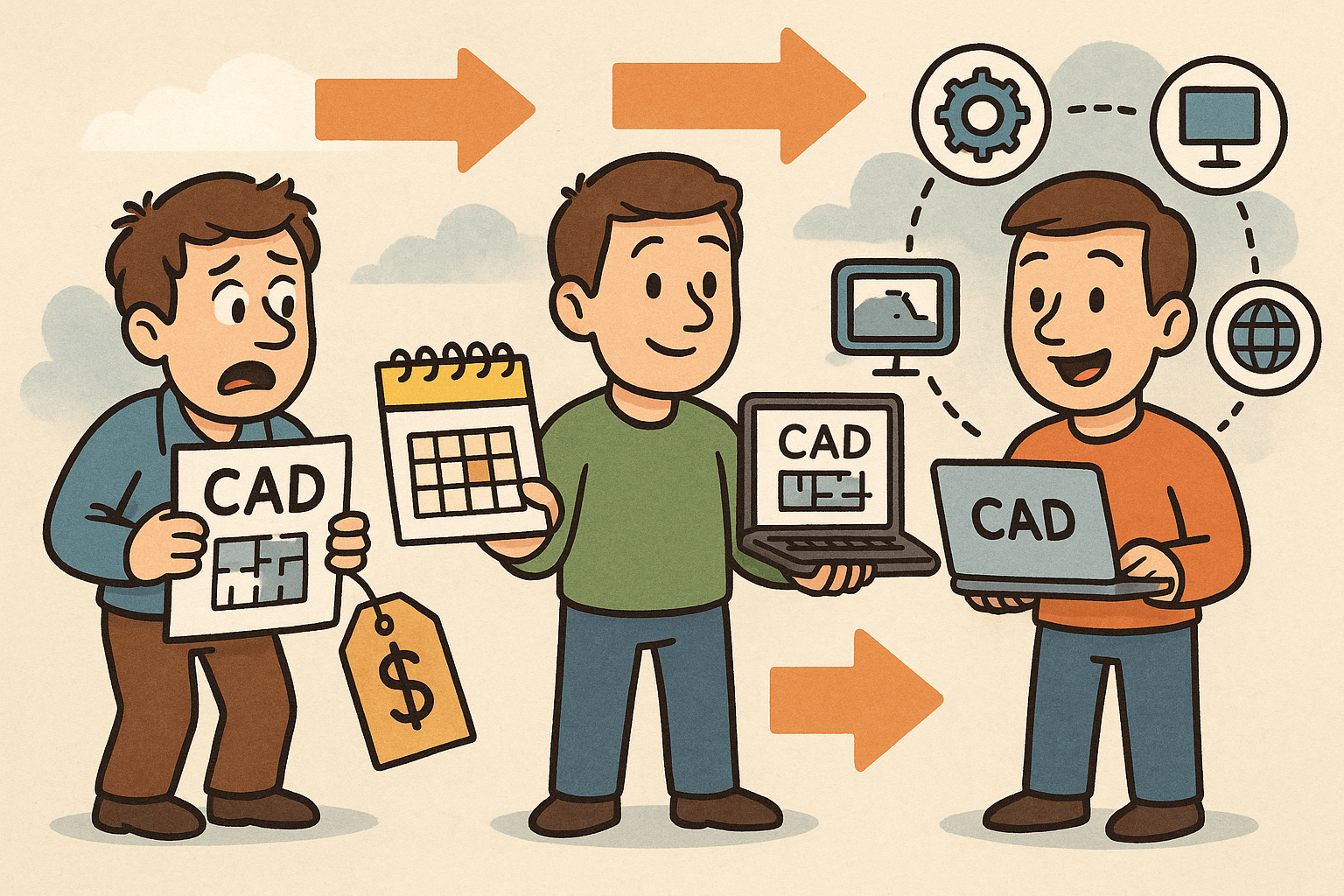
From a commercial perspective, the early phases of CAD software development were inextricably linked with the concept of software licensing. Licensing, at its core, refers to the legal framework that defines how a software product is used, distributed, and maintained. In the nascent stage, licensing models were notably simple and transparent, typically manifesting as perpetual licenses or fixed pricing schemes. In a perpetual licensing scenario, customers could make a one-time purchase that granted them indefinite use of the software. This approach played a critical role in establishing trust between vendors and users by ensuring that once the significant investment was made, the software could be used consistently without recurring fees. Fixed pricing similarly provided a steady cost structure, which was essential during a time when market fluctuations and evolving hardware requirements called for predictable budgeting.
The importance of grasping these early licensing challenges cannot be overstated because they set the precedent for how digital intellectual property would be managed for decades. Innovators in the field had to balance the need to recoup research and development expenses with the potential barriers these costs could create for potential users. In this context, designers, engineers, and architects were quick to adopt these digital tools because the clarity of licensing terms—whether through a one-off fee or clearly defined pricing—ensured that long-term usage and maintenance were predictable. Some of the very early factors that enhanced adoption included:
- Perpetual License: A one-time purchase that provided endless usage without recurring fees.
- Fixed Pricing: A known, predetermined cost that simplified budgeting for design firms and engineering departments.
Early Licensing Models and Their Impacts
In the formative years of CAD software, the industry predominantly relied on a set of straightforward licensing paradigms aimed at establishing a stable market foothold. Traditional models such as perpetual licenses and fixed-pricing structures played an instrumental role in catalyzing user adoption and expanding CAD’s market reach. With perpetual licenses, users were afforded the opportunity to purchase the software once and utilize it indefinitely, an approach that eliminated the recurring financial burden that subscription models might impose. Fixed pricing, on the other hand, ensured that the cost was both transparent and stable, allowing companies to plan their capital expenditures without the uncertainty of fluctuating fees. These models were instrumental for early players such as AutoDesk, PTC, and other pioneering entities which recognized that clear, understandable pricing could pave the way for broader market penetration.
Pioneering Approaches in Early Licensing
These early licensing figures were not merely business decisions but strategic maneuvers designed to overcome the technological constraints of the era. There were several factors at play:
- Simplicity in Pricing: With the hardware and software operating environments still evolving, it was essential to have licensing terms that were simple and easy to comprehend.
- Cost Recovery: Companies leveraged perpetual licenses and fixed pricing as methods for recovering considerable investments made in research and development while ensuring that the software remained accessible to a broad audience.
- Trust and Stability: Consistent and known pricing provided reassurance to early adopters who were transitioning from traditional drafting methods to expensive computer-driven design tools.
Notably, this initial phase of CAD licensing was marked by an emphasis on balance. Software developers recognized early on that the relationship between pricing, access, and the evolution of design tools was delicate. On the one hand, a straightforward, one-time purchase model fostered trust and long-term commitment; on the other, it also limited the ability of vendors to periodically upgrade revenue streams in response to continuous improvements and market demands. This tension was an early indicator of the intricate licensing challenges that would follow in later years. Overall, the early licensing approaches not only shaped user behavior and market growth but also laid a firm foundation for the more diverse and flexible licensing frameworks that characterize the modern CAD industry.
The Evolution and Complexity of Licensing Challenges
As the CAD industry matured and digital infrastructure became more complex, the licensing models that once operated under static, simple frameworks began to evolve in response to dynamic market and technological conditions. The once straight-forward perpetual license or fixed pricing models gave way to innovative schemes such as subscription-based licensing and network licensing models. Subscription-based licensing shifted the paradigm by introducing recurring fee structures that allowed users to access the latest software versions, support, and upgrades on a continuous basis. Similarly, network licensing, which enabled multiple users within an organization to share a single license pool over a network, provided organizations with the flexibility to manage access in an environment that demanded greater scalability and collaboration. This evolution was not merely an administrative overhaul; it encapsulated a broader shift in how software developers and end-users perceived value and ownership within the realm of digital design tools.
Key Challenges and Industry Reactions
With the introduction of these modern licensing models came a series of challenges that would eventually redefine the industry’s approach to intellectual property management. Among the most prominent issues were legal battles and disputes over intellectual property rights, which became increasingly visible as software companies vied to protect their innovations. The move away from static pricing created an environment where users frequently demanded more flexibility and access to the latest features without incurring tremendous costs. This tension was particularly evident in situations where restrictive licensing terms were perceived to limit creativity and workplace productivity. Furthermore, the balancing act between maintaining proprietary interests and adapting to market demands for open, user-friendly licensing frameworks led to several high-profile disputes. The transformation also demanded that vendors continuously adapt their revenue models to align with the rapid pace of technological progress and evolving user requirements.
Industry leaders had to contend with several dynamic factors during this period:
- Legal and Intellectual Challenges: As vendors attempted to protect their innovative solutions, legal challenges became more frequent, which often resulted in prolonged disputes.
- Adaptation to Market Needs: Users expected more agile and scalable licensing structures that aligned with the fast evolution of technology and collaborative design environments.
- Sustainability of Revenue Models: The traditional perpetual license was increasingly seen as inadequate in the face of rapid software development cycles that demanded regular updates and maintenance.
The incremental shifts in licensing models over the decades have not only fostered greater innovation in software development practices but have also necessitated a rethinking of how value is communicated to customers. Today’s licensing arrangements, populated by subscription and network-based models, are a testament to the growing need for flexibility and ongoing support in a digital era that values constant evolution and immediate access to cutting-edge technology. The journey from simple, perpetual licenses to these sophisticated frameworks provides invaluable insights into the intricate challenges and opportunities that have shaped the CAD industry.
Conclusion
The historical progression of licensing models in the CAD industry encapsulates a broader narrative of rapidly evolving technology interwoven with the complexities of legal and economic paradigms. Early CAD licensing was marked by straightforward and transparent models such as perpetual licenses and fixed pricing, which enabled early adopters to transition from manual drafting to digital design with confidence. Over time, however, the demands of an increasingly competitive market, paired with rapid technological advances, urged vendors to explore more adaptable pricing strategies that could support continuous improvement and collaborative work environments. Subscription-based, network, and cloud-driven licensing models have since emerged, each bringing along unique challenges ranging from intellectual property disputes to shifts in revenue generation and user empowerment.
Reflecting on the Implications for the Future
As we reflect on this evolution, it becomes clear that licensing within the CAD industry has never been a static concept but rather a dynamic element that responds to the interplay between innovation and market needs. Key takeaways from this historical evolution include:
- Evolution of Flexibility: Modern licensing models demand a degree of flexibility that accommodates frequent updates, scalability, and the collaborative needs of modern design environments.
- Impact on User Engagement: The shift from perpetual licenses to subscription-based structures has redefined the relationship between vendors and end-users, emphasizing ongoing service, support, and sustained innovation.
- Balance of Interests: The need to protect proprietary technology while ensuring that users have seamless access to emerging features remains a core challenge, fueling continuous debates and legal considerations.
In summary, the evolution from simple, straightforward perpetual licenses to today’s complex and adaptive frameworks is not simply a reflection of changes in technology but a cogent narrative of the growing sophistication in the way we value creative and engineering work. The interplay between economic models and licensing strategies has driven major innovations within the CAD industry, resulting in software tools that are more user-centric, responsive, and innovative. For design professionals, engineers, and architects, understanding this evolution is critical not only for appreciating the historical context but also for anticipating future trends that will undoubtedly continue to shape how creativity and technology intersect in our digital future.
Also in Design News