Your Cart is Empty


Design Software History: Pro/ENGINEER to Creo: PTC’s Parametric CAD Revolution and the Rise of Hybrid Modeling
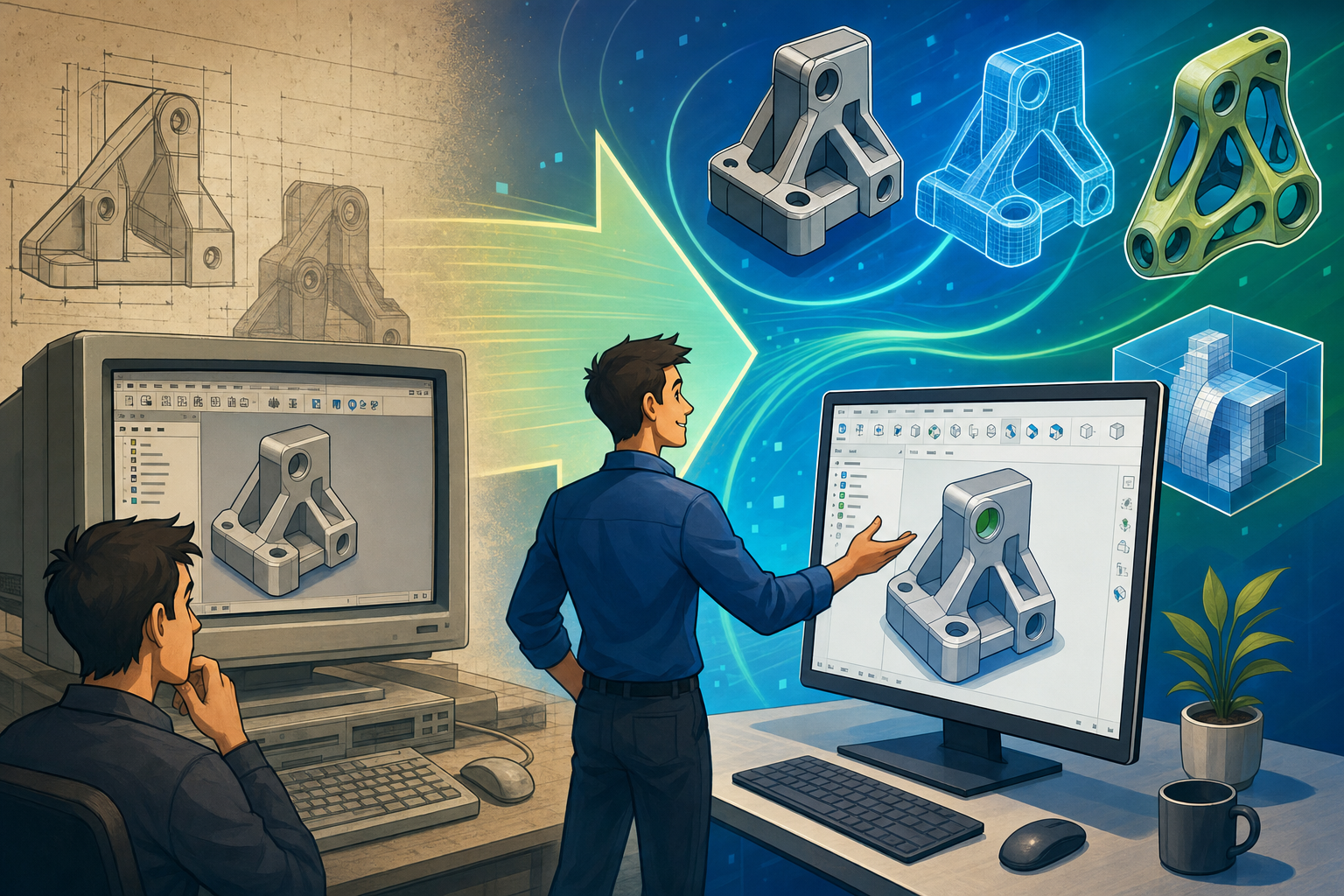


PTC’s Pro/ENGINEER did not merely improve mechanical CAD; it changed the assumptions behind it. Launched in the late 1980s by Parametric Technology Corporation, the system made parametric, feature-based 3D modeling a practical commercial force and ultimately reshaped expectations for how engineers should define, revise, document, and manufacture products.
Pro/ENGINEER Before Creo: The System That Changed Mechanical CAD
The Late-1980s Break With Drafting-Centered CAD
When Parametric Technology Corporation introduced Pro/ENGINEER in 1987, the mechanical CAD world was still heavily influenced by drafting automation, wireframe construction, surface modeling, and geometry-editing techniques that often treated the digital model as a more sophisticated drawing board. PTC, founded in 1985 by Samuel P. Geisberg along with figures including Steven Walske and other early executives and engineers, entered a market where major systems such as CADAM, Computervision, Intergraph, McDonnell Douglas Unigraphics, and later high-end CATIA installations had already established strong positions in manufacturing and engineering organizations. Yet much of that world still required users to think in terms of geometry creation and manipulation rather than structured product definition. Pro/ENGINEER’s central proposition was radically different: a mechanical part should not be only a collection of lines, surfaces, and trimmed volumes, but a structured sequence of intelligent features, dimensions, constraints, and relationships that could be regenerated when design requirements changed.
Design Intent as a Modeling Discipline
The importance of that shift is difficult to overstate because Pro/ENGINEER transformed CAD from a digital representation tool into a design reasoning environment. The model was no longer simply an artifact at the end of the engineering process; it became a container for decisions about function, manufacturing order, dimensional dependency, mating conditions, and future modification. The phrase design intent became inseparable from Pro/ENGINEER because the system pushed users to encode the logic of a product into the model itself. If a hole pattern had to remain centered on a mounting face, if a rib thickness had to follow a wall thickness, if a bracket’s flange needed to adjust when the main body changed, those relationships could be built directly into the part. For mechanical engineers accustomed to redrawing views or manually repairing geometry after each revision, this was not an incremental improvement. It was a new model of engineering memory, one where the CAD database remembered why geometry existed, not merely where it had been placed.
The Technical Ideas That Made Pro/ENGINEER Influential
Feature History, Dimensions, and Regeneration
Pro/ENGINEER’s most visible technical innovation was the history-based feature tree, a sequential record of modeling operations such as protrusions, cuts, rounds, chamfers, shells, patterns, drafts, and datum references. This history was not merely an undo list; it was the structure through which the model regenerated. A user could modify an early dimension, and every dependent feature would attempt to rebuild according to the logic defined downstream. In practical terms, this meant that geometry became procedural. A boss was not just a cylindrical solid; it was a feature created from a sketched profile, extruded to a depth, located relative to datums or edges, and possibly connected to other features through dimensions or constraints. This framework made design variations far more efficient when the model had been planned carefully. It also gave organizations a way to standardize engineering practices, because models could carry repeatable logic across product families, tooling variations, and configuration-driven designs.
Associativity Across Parts, Assemblies, and Drawings
The power of Pro/ENGINEER extended beyond individual parts because it connected models, assemblies, and drawings through associative relationships. A change in a part could update an assembly; a change in a model dimension could propagate to drawings; a drawing view could represent the 3D model rather than exist as a separate manually maintained document. This associativity addressed one of the chronic problems of older CAD workflows: the divergence between the model, the assembly definition, the manufacturing drawing, and the real design decision. In Pro/ENGINEER, the 3D model increasingly became the master definition, while drawings became downstream documentation rather than independent sources of truth. This approach was especially powerful for mechanical product development, where late changes to components, tooling constraints, hole locations, clearance envelopes, and assembly interfaces could otherwise generate a cascade of manual drafting errors. The same principle eventually became central to broader product lifecycle management thinking, but Pro/ENGINEER helped make it concrete for mechanical engineering teams before such terminology became commonplace.
- History-based feature trees created a structured sequence of modeling operations.
- Parametric dimensions allowed geometry to update when engineering values changed.
- Parent-child relationships carried dependencies between sketches, datums, features, and assemblies.
- Associative drawings reduced the separation between 3D models and production documentation.
- Design intent turned CAD modeling into a disciplined act of engineering logic.
Why Mechanical Engineering Adopted Pro/ENGINEER So Intensely
From Geometry Editing to Product Definition
Pro/ENGINEER became particularly important in mechanical engineering because mechanical products are full of recurring relationships, dimensional dependencies, manufacturing constraints, and assembly interfaces. A plastic enclosure must maintain wall thickness, draft angles, ribs, bosses, snap fits, and clearance zones; a machined component must respect hole patterns, datum schemes, tolerances, tool access, and mating surfaces; an electromechanical assembly must coordinate sheet metal, castings, fasteners, connectors, and service envelopes. These are not random geometric problems. They are structured engineering problems, and Pro/ENGINEER’s modeling philosophy fit them well. The system encouraged users to construct parts around datums, references, sketches, and parameters so that product updates could be made with some expectation of controlled regeneration. In organizations producing complex mechanical goods, this was an economic advantage. The cost of change is one of the central facts of engineering, and Pro/ENGINEER promised that if change was foreseeable, it could be built into the model before the change arrived.
The Culture of Respect and Fear
At the same time, Pro/ENGINEER acquired a cultural reputation as a system that was powerful, rigorous, and often unforgiving. Users respected it because it could capture deep engineering logic and manage sophisticated assemblies, but many also feared it because a poorly considered parent-child dependency could cause regeneration failures that were hard to diagnose. The command structure, workflows, and modeling assumptions were often described as demanding, especially when compared with later Windows-native CAD systems that placed greater emphasis on discoverability and interactive ease. In many engineering departments, proficiency in Pro/ENGINEER became a badge of technical seriousness. It was not considered a casual tool. It rewarded planning, discipline, and a strong grasp of feature order, references, and design hierarchy. That seriousness helped it win credibility in manufacturing organizations, but it also planted the seeds of future frustration. The very qualities that made Pro/ENGINEER a benchmark for engineering rigor also made it vulnerable when the market began rewarding speed, flexibility, and a more tolerant user experience.
Why Reinvention Became Necessary
The Competitive Pressure of Easier 3D CAD
By the late 1990s and 2000s, the CAD market had changed dramatically. SolidWorks, founded in 1993 by Jon Hirschtick and acquired by Dassault Systèmes in 1997, helped redefine expectations for midrange mechanical CAD by emphasizing Windows-native usability, accessible 3D modeling, and a lower barrier to entry. Autodesk Inventor, introduced in 1999, brought Autodesk’s enormous installed base and desktop software culture into the parametric mechanical CAD market. Siemens software, through the histories of Unigraphics, NX, and Solid Edge, offered both high-end integrated engineering depth and the developing appeal of synchronous and direct editing techniques. CATIA, particularly under Dassault Systèmes, remained a dominant force in aerospace and automotive engineering, where complex surfaces, large assemblies, and enterprise integration mattered enormously. Against these competitors, Pro/ENGINEER could no longer rely only on its pioneering status. The market had absorbed parametric modeling as a norm, and once a breakthrough becomes expected, the competition shifts to usability, interoperability, workflow breadth, and the ability to handle imperfect real-world data.
Changing Expectations in the 2000s
The arrival of more approachable desktop CAD systems changed user demands in several ways. Engineers and designers increasingly expected interfaces that behaved like modern Windows applications, with graphical interaction, contextual menus, drag handles, easier sketching, and less dependence on deeply nested command sequences. They also expected to work with imported geometry from suppliers, customers, and legacy systems without rebuilding every feature history from scratch. This was crucial because globalized product development made clean, native, fully parametric models less common than CAD theory implied. A supplier might send a STEP file without features; a contract manufacturer might return a modified model; an acquired product line might contain geometry from a different system; an engineer might need to move a boss, resize a pocket, or remove a fillet with no access to the original modeling intent. In this environment, purely history-driven modeling could feel less like a source of intelligence and more like a dependency trap when the model’s history was absent, fragile, or irrelevant to the required edit.
- Usability became a competitive weapon, not a secondary convenience.
- Windows-native interaction reshaped expectations for menus, dialogs, selection, and visual feedback.
- Imported geometry editing became essential as supply chains exchanged neutral CAD data.
- Simulation and visualization became expected parts of product development, not optional afterthoughts.
- PLM integration became more important as engineering data moved across large organizations.
The Strategic Importance of CoCreate and Direct Modeling
Direct Modeling as a Different Engineering Philosophy
PTC’s acquisition of CoCreate in 2007 was one of the clearest signs that the company understood the limits of relying exclusively on the Pro/ENGINEER paradigm. CoCreate had roots in Hewlett-Packard’s mechanical design software lineage and was known for approaches that emphasized direct modeling, where users could modify geometry by pushing, pulling, moving, deleting, and resizing faces without depending on a feature-history tree. This was not simply an interface preference; it represented a different theory of CAD. In a direct modeling environment, the system cared less about the chronological origin of a feature and more about the current shape and the user’s immediate engineering objective. If a designer needed to move a hole six millimeters, extend a rib, delete a boss, or reshape an imported casting, the operation did not necessarily require understanding how the original model had been built. For late-stage engineering changes, supplier data repair, conceptual rearrangement, and manufacturing-driven modifications, this was highly attractive.
The Central Problem PTC Had to Solve
The challenge for PTC was that Pro/ENGINEER’s historical identity was inseparable from parametric discipline. It had trained generations of engineers to think in terms of structured intent, parent-child dependency, and model regeneration, but the market increasingly demanded a system that could also deal with incomplete, messy, externally created, or rapidly changing geometry. The company could not simply abandon Pro/ENGINEER’s strengths, because many customers depended on them for high-value mechanical work. Nor could it continue presenting a rigid, monolithic CAD identity while competitors promoted more flexible workflows and smoother user experiences. PTC therefore faced a strategic contradiction: the system that had made the company famous had become both an asset and a burden. Its architecture, reputation, and user experience carried the weight of decades of innovation, but also decades of accumulated expectations and frustrations. A major rebranding alone would not be enough. What was needed was a broader technical and philosophical rethinking of how PTC’s design software should be organized.
The Birth of Creo: Rebranding, Modularization, and Direct Modeling
From Pro/ENGINEER to Creo Parametric
In 2010, PTC announced Creo as an attempt to modernize and unify its CAD portfolio. The transition from “Pro/ENGINEER” to “Creo Parametric” was symbolically important because it acknowledged the historic product while placing it inside a broader family. Pro/ENGINEER did not vanish as a technical lineage; rather, its core parametric capabilities became Creo Parametric. This naming mattered because it moved the software away from the identity of a single dominant application and toward a platform concept. The word “Creo” suggested creation, but the strategy behind it was more specific: different users in product development needed different tools, and CAD software had to support more than classic feature creation. Mechanical engineers, industrial designers, analysts, technical illustrators, manufacturing planners, managers, and supply chain collaborators did not all need the same interface or the same modeling depth. PTC’s answer was to present Creo as a suite of applications connected by shared data and workflow intent rather than as one monolithic CAD environment.
The Broader Creo Family
The Creo family concept included Creo Parametric for traditional parametric modeling, Creo Direct for direct geometry manipulation, Creo Simulate for engineering analysis, Creo View for visualization and lightweight collaboration, and additional specialized products such as Creo Layout, Creo Schematics, Creo Illustrate, and manufacturing-oriented capabilities. This structure reflected a broader industry movement: CAD was no longer only about creating precise geometry. It was becoming part of a larger product development environment that included analysis, documentation, visualization, digital mockup, collaboration, and lifecycle data management. PTC’s long involvement with Windchill, its PLM platform, reinforced this direction because companies increasingly needed controlled data, revision management, configuration management, and engineering release processes tied to geometry. Creo’s modular approach allowed PTC to address different roles without forcing every user into the same heavy authoring environment. It also gave the company a way to absorb direct modeling and visualization technology into a coherent brand while preserving the engineering credibility associated with Pro/ENGINEER.
- Creo Parametric carried forward the Pro/ENGINEER tradition of history-based, feature-driven modeling.
- Creo Direct supported face-level geometry edits without requiring original feature history.
- Creo Simulate connected design geometry with structural and engineering analysis workflows.
- Creo View allowed broader product teams to inspect and communicate design data without full CAD authoring.
- Creo Illustrate, Layout, and Schematics addressed specialized communication, conceptual, and systems-design needs.
The Philosophical Shift Behind Creo
From Monolithic CAD to Role-Based Tools
The deepest significance of Creo was not the name change but the change in architectural and workflow philosophy. Pro/ENGINEER had represented a world in which the parametric modeler was the central object and the expert CAD user was the primary operator. Creo represented a world in which product data moved through different roles, levels of fidelity, and stages of maturity. A concept designer might need layout tools and flexible geometry exploration; a mechanical engineer might refine the design using rigorous parametric features; an analyst might evaluate structural behavior; a documentation specialist might create service illustrations; a manager or supplier might need lightweight visualization rather than authoring control. This was a more realistic description of modern product development. It also reflected the fact that CAD systems had become embedded in enterprise processes rather than isolated engineering workstations. By presenting CAD as a family of connected applications, PTC was acknowledging that product definition is distributed across people, disciplines, and decisions.
Hybrid Modeling as a Practical Necessity
The shift from purely history-driven modeling toward hybrid workflows was equally important. History-based parametrics remains extremely powerful when a model is built with foresight and when future change follows anticipated patterns. Direct modeling becomes powerful when the edit is local, urgent, imported, or unrelated to the original structure of the model. In real engineering offices, both conditions occur constantly. An engineer may carefully define a family of cast housings using parameters and relations, then receive an imported supplier model that must be modified immediately to clear a fastener. A designer may preserve structured assembly constraints while making direct edits to faces during a packaging review. A manufacturing engineer may remove features, adjust drafts, or simplify geometry for tooling without wanting to disturb the design model’s original logic. Creo’s hybrid direction recognized that design intent is valuable, but not every change arrives with clean intent attached. This was a practical confession about the real world of product data.
Why Direct Modeling Mattered So Much
Editing Without Reconstructing History
Direct modeling mattered because it solved one of the most persistent frustrations of parametric CAD: the difficulty of editing geometry when the feature history is missing, broken, overly complex, or irrelevant. Imported models from STEP, IGES, Parasolid, ACIS, or other exchange formats often arrive as boundary representation geometry without the feature tree that created them. A traditional parametric system may recognize faces and edges, but it does not automatically know that a group of cylindrical faces represents a patterned hole feature, or that a collection of planar faces forms a pocket intended to maintain a tooling clearance. Direct modeling tools allow users to operate on the geometry as it exists. They can select faces, move them, offset them, delete them, or modify them while the system attempts to maintain adjacent topology and geometric validity. This capability is especially important in supplier collaboration, engineering change orders, reverse engineering, and legacy data migration, where rebuilding an entire parametric structure would be wasteful or impossible.
Making CAD Tolerant of Real Workflows
The deeper value of direct modeling is that it makes CAD more tolerant. Traditional Pro/ENGINEER rewarded careful modeling discipline, but real product development often includes rushed revisions, incomplete information, inherited data, late manufacturing feedback, and cross-system collaboration. A tool that requires perfect feature logic for every meaningful change can become a bottleneck when the engineering task is simply to make a controlled geometric edit and move forward. Direct modeling reduces dependence on the original author’s decisions. It allows a later user to modify a model even if the original design intent is unknown or poorly expressed. This does not eliminate the need for parametrics; instead, it broadens the range of solvable problems. The most mature CAD environments recognize that engineering history and engineering reality are not always aligned. Creo’s direct modeling capability was therefore not a decorative addition. It was an answer to a market that had learned to value flexibility, interoperability, and late-stage editability alongside disciplined model construction.
- Direct modeling helps users edit supplier or customer geometry without native features.
- It supports late-stage changes when rebuilding design intent would be too slow.
- It enables manufacturing-driven modifications such as draft, clearance, and simplification edits.
- It reduces dependency on the original model creator’s feature strategy.
- It complements parametric modeling rather than replacing it in disciplined engineering workflows.
Preserving Pro/ENGINEER’s Strengths While Addressing Its Weaknesses
The Value PTC Could Not Abandon
PTC could not reinvent its CAD portfolio by simply repudiating Pro/ENGINEER, because Pro/ENGINEER’s strengths remained valuable. Parametric, feature-based modeling is still one of the most effective ways to define mechanical products that require repeatable variation, controlled families of parts, configurable assemblies, and consistent manufacturing logic. The ability to embed relations, dimensions, datum structures, assembly constraints, and associative drawings remains essential in many engineering contexts. Pro/ENGINEER had earned its place not because it was fashionable, but because it solved hard problems in mechanical design. Creo Parametric preserved that inheritance while presenting it in a broader environment. The goal was to retain the robustness, engineering depth, and design-intent discipline associated with Pro/ENGINEER while reducing the sense that users had to obey one workflow for every problem. In historical terms, Creo was an effort to protect the intellectual achievement of Pro/ENGINEER from being trapped inside the user experience and architectural assumptions of its original era.
Addressing Rigidity and Complexity
The frustration PTC needed to address was equally real. Many experienced users knew the pain of failed regenerations, brittle references, overcomplicated feature histories, and models that appeared intelligent until a change exposed their hidden fragility. These problems were not unique to Pro/ENGINEER; they are inherent risks in history-based CAD. But Pro/ENGINEER’s reputation for rigor made them especially visible. Creo’s role-based and hybrid approach offered a way to reduce that friction. Instead of insisting that every edit must pass through the original feature sequence, users could apply more direct methods where appropriate. Instead of treating visualization, simulation, layouts, and technical communication as external afterthoughts, Creo organized them as related activities within the product development ecosystem. The result was not a rejection of parametrics but a recalibration. PTC was effectively saying that disciplined design intent remains essential, but software must also accommodate the imperfect, collaborative, and deadline-driven conditions under which engineering actually happens.
Creo as Both Continuity and Confession
More Than a Name Change
Creo was not simply a name change from Pro/ENGINEER. It was a strategic admission that the original Pro/ENGINEER paradigm, however revolutionary, was no longer sufficient on its own. In the late 1980s and early 1990s, history-based parametrics gave PTC a powerful identity and forced the market to respond. By the 2000s, however, the central question had changed. The issue was no longer whether parametric 3D modeling mattered; the industry had accepted that it did. The issue was whether a CAD system could combine parametric rigor with easier interaction, direct editing, visualization, analysis, collaboration, and lifecycle integration. Creo emerged as PTC’s answer to that question. It carried forward Pro/ENGINEER’s modeling engine heritage and engineering seriousness, but it also acknowledged that product development had become too distributed and too fluid for one strict modeling doctrine to dominate every workflow.
The Historical Arc From Revolution to Adaptation
The historical arc is clear. Pro/ENGINEER made parametric CAD mainstream by showing that 3D models could carry dimensions, dependencies, features, and intent rather than merely represent finished shapes. Competitors learned from that breakthrough, users internalized it, and the market eventually demanded more. SolidWorks contributed to expectations for accessible desktop modeling; Autodesk Inventor expanded mainstream mechanical CAD competition; Siemens NX and Solid Edge advanced integrated and flexible modeling approaches; CATIA continued to dominate demanding high-end sectors; and direct modeling technologies challenged the assumption that history was always the best path to change. Creo was PTC’s bridge between the disciplined model and the fluid model, between the carefully planned product architecture and the imported body that must be edited before a design review. Its birth showed that CAD history is not a sequence of replacements but a layering of methods, where old breakthroughs remain useful while new pressures force them into broader systems.
The Broader Lesson in Design Software History
Every Breakthrough Eventually Becomes a Constraint
The story of Pro/ENGINEER and Creo illustrates one of the most important patterns in design software history: every breakthrough eventually becomes a constraint. A new modeling paradigm succeeds because it imposes a productive structure on chaos. Parametric feature modeling succeeded because it gave engineers a way to manage change, capture logic, and connect documentation to geometry. But the same structure can later restrict action when the environment changes. Once engineering organizations started exchanging more imported data, demanding faster edits, involving more non-authoring stakeholders, and expecting simulation and visualization to be tightly connected, a purely parametric identity became too narrow. This pattern appears repeatedly in software history. The tools that define a generation teach users new habits, and those habits eventually create expectations the original tools were not designed to satisfy. Pro/ENGINEER taught the industry to value intelligent models; Creo arose when intelligent models also had to become adaptable models.
The Reinvention of a Strict Parametric Pioneer
Creo’s birth remains one of CAD history’s most revealing reinventions because it transformed the image of PTC’s flagship technology from a strict parametric pioneer into a more hybrid, modular, and workflow-aware design platform. It did not erase Pro/ENGINEER’s legacy, nor could it. Samuel Geisberg’s vision of parametric, feature-based modeling remains one of the foundational ideas in mechanical CAD, and PTC’s early execution of that vision changed the competitive direction of the entire industry. But Creo showed that even the most influential design systems must adapt to the practices they helped create. Pro/ENGINEER made engineers believe that models should be intelligent; Creo recognized that intelligence must be usable across roles, incomplete histories, imported data, changing assemblies, simulation loops, visualization needs, and enterprise processes. That is why Creo should be understood not as a cosmetic rebranding, but as a historically significant response to the limits of a revolution that had succeeded too well.
Also in Design News