Your Cart is Empty


Design Software History: Geometry Healing in CAD: The Hidden History of Interoperability and Robustness
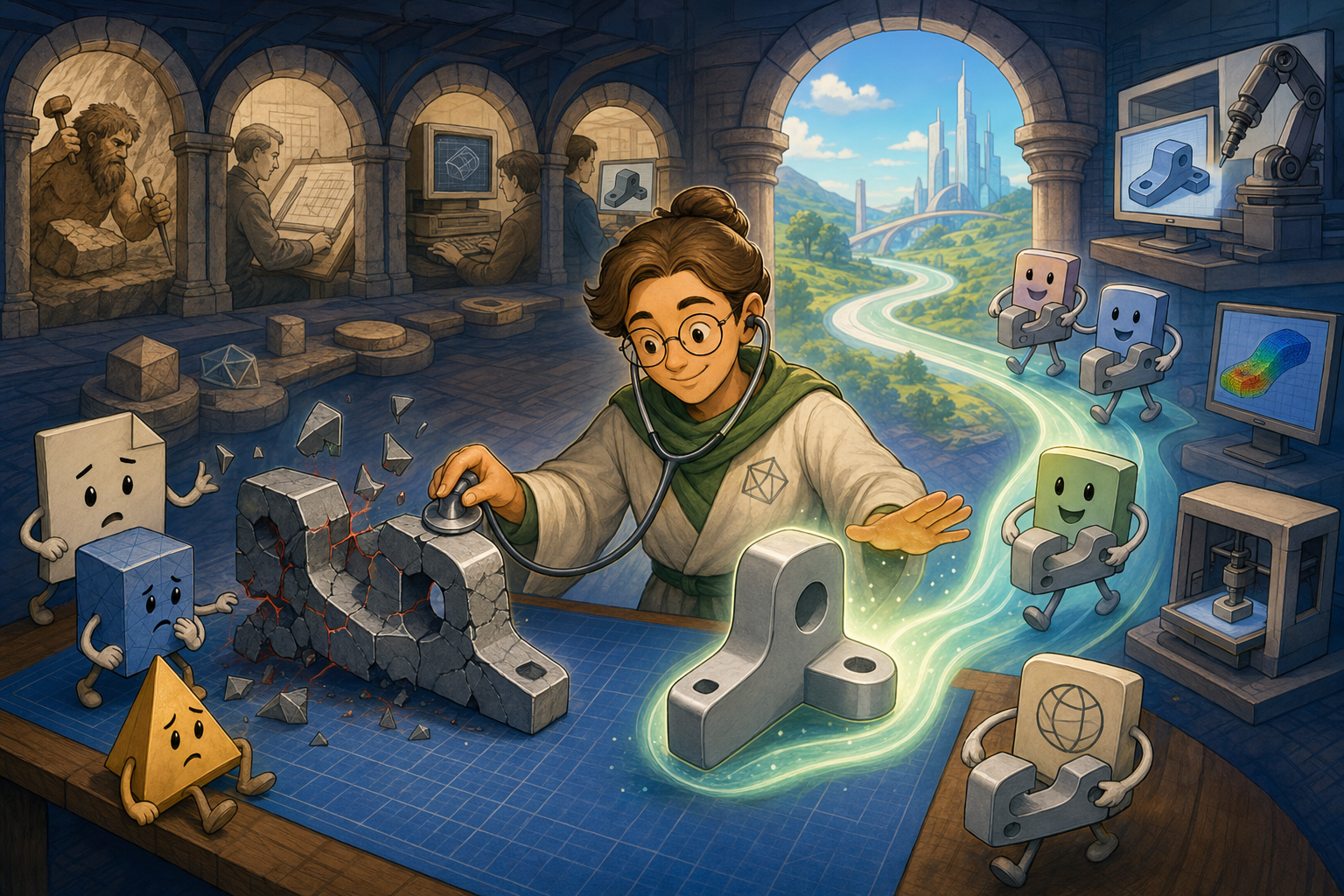


Geometry healing became a permanent problem in CAD not because engineers forgot how to model correctly, but because digital geometry began to travel. The moment companies started moving product data between dissimilar systems, kernels, departments, suppliers, and downstream applications, the apparent certainty of a mathematically defined model gave way to a harsher reality: geometry that looked fine on one workstation could fail catastrophically somewhere else. In practical engineering terms, geometry healing means repairing the defects that prevent a 3D model from behaving as a reliable digital object. These defects include small gaps between adjacent faces, overlapping surfaces, sliver faces too thin for robust downstream operations, bad trims on analytical or freeform surfaces, inconsistent topological definitions, and tolerance mismatches that cause edges and vertices to disagree about where the shape actually ends. A part can appear visually correct and still be computationally broken. That distinction is one of the most consequential in the history of design software, because modern product development depends less on whether a model can be displayed than on whether it can survive translation, meshing, simulation, manufacturing, and revision without losing integrity.
Why geometry healing became a permanent CAD problem
Practical meaning inside engineering workflows
In day-to-day industrial practice, geometry healing is the discipline of restoring imported or damaged models to a state where they can be trusted by software that performs exacting operations. Engineers often encounter the issue when opening supplier geometry, legacy archives, scanned reconstructions, or translated files from neutral and proprietary formats. The software must determine whether adjoining faces really meet, whether edge loops close, whether trim curves remain on their supporting surfaces, and whether the topological graph of the model still corresponds to the embedded geometry. When it does not, the consequences are immediate. A Boolean may fail, a fillet may collapse, a shell operation may generate self-intersections, a finite element mesh may leak through unintended openings, or a CAM toolpath generator may refuse to classify closed regions. Geometry healing therefore emerged as a form of computational maintenance for the entire digital engineering chain, not merely as a convenience feature for CAD specialists. It became the hidden labor required to keep design files operational after they crossed organizational or software boundaries.
Data exchange made fragility visible
The spread of CAD data exchange made these weaknesses impossible to ignore. During the 1980s and 1990s, formats such as IGES and later STEP promised interoperability across systems that had been built on very different internal assumptions. That promise was necessary because aerospace, automotive, industrial equipment, and consumer product development increasingly involved suppliers and partners using different software stacks. Yet neutral transfer did not eliminate the differences between systems. One CAD platform might represent a face boundary with one trimming convention, another with a subtly different interpretation of parametric orientation, periodic surfaces, model tolerances, edge segmentation, or vertex merging rules. Cross-kernel translation made the problem even worse. A model created in one boundary representation environment might satisfy the validity rules of its native kernel while violating the robustness expectations of another. As a result, data exchange exposed a central weakness of digital geometry: models were not universally exact objects, but conditional constructions dependent on the numerical and topological habits of the system that created them.
Historical shift from precision to interoperability
Historically, this was a deeply ironic development. Early solid modeling systems were marketed as instruments of rigor and precision. Companies such as Computervision, SDRC, ShapeData, and later Parametric Technology Corporation presented computer-based geometry as superior to drawings precisely because it could encode an object with logical consistency and repeatable dimensions. Research pioneers including Ian Braid, Charles Lang, Aristides Requicha, Hugues Hoppe in adjacent geometry processing contexts, and many others helped establish the formal language of boundary representation, constructive solid geometry, and geometric validity. But as soon as engineering workflows became multi-system rather than self-contained, the ideal of exact digital form collided with integration reality. A model was no longer judged only by whether it could be constructed, but by whether it could move. The rise of supplier collaboration, digital mock-up, CAE preprocessing, CNC programming, and later additive manufacturing made interoperability the dominant requirement. Geometry healing became unavoidable because no industrial sector standardized on one kernel, one file format, one tolerance policy, or one modeling culture.
The technical roots of broken geometry
Intersection mathematics and trim instability
The technical roots of broken geometry lie in the uneasy marriage between elegant mathematics and finite computation. One major source of failure is the way CAD systems compute intersections between surfaces. In theory, advanced geometry can be described with exact analytical entities or smooth freeform definitions such as NURBS. In practice, the intersection of two surfaces is rarely represented in a clean symbolic form. It must be approximated numerically, sampled, fitted, reparameterized, and then embedded into the topological framework of the model. This process is inherently delicate. When two surfaces meet, the resulting edge must agree simultaneously in model space and in the parameter spaces of both surfaces. If those representations differ even slightly, the trim may drift, a gap may appear, or a self-overlap may emerge. This is especially troublesome in trimmed NURBS models, where the visible face is not the whole parametric surface but a subset defined by trimming loops. If those loops are inconsistent with the underlying surface or with neighboring faces, the model may look closed while remaining mathematically incoherent.
Topology and geometry do not always agree
Another persistent cause of errors comes from the distinction between geometry and topology in boundary representation, or B-rep, models. Geometry defines locations and shapes: points, curves, and surfaces. Topology defines adjacency and connectivity: which edges belong to which faces, which vertices terminate which edges, and how those entities assemble into shells and solids. In a robust model, topology and geometry reinforce one another. In a broken model, they can diverge. A topological edge may claim to connect two faces even though the underlying surfaces do not precisely meet. A vertex may nominally close a loop while occupying a slightly different position than the edge endpoints it is meant to bind. A shell may be marked as closed despite microscopic openings. These mismatches are not merely bookkeeping problems. They strike at the computational foundation of exact modeling, because downstream operations rely on the assumption that the model’s topological declarations match the geometric reality. When they do not, software must either guess, reject the model, or apply healing logic that reconstructs consistency from imperfect evidence.
Floating-point limits and tolerance stacking
Even when modelers aspire to precision, computation introduces unavoidable numerical limits. CAD systems generally operate using floating-point arithmetic, which is practical and fast but not symbolically exact. Every calculation of an intersection, projection, offset, or trim introduces tiny numerical deviations. Those deviations are often harmless inside a single operation, but they accumulate over long modeling histories and become especially hazardous when translated between systems with different absolute or relative tolerance schemes. This phenomenon, often called tolerance stacking, is one reason imported geometry can fail unexpectedly. A kernel that regards two endpoints as coincident within one tolerance band may export them into an environment with stricter standards, where the same endpoints are now considered separated. Conversely, a kernel with looser tolerance assumptions may merge entities that another system would preserve distinctly. These differences can destabilize operations that depend on clean topology, including:
- Booleans that require watertight classification of inside and outside regions
- Fillet and blend generation that relies on stable edge continuity
- Meshing algorithms that expect closed domains without leaks or overlaps
- CAM path planning that depends on unambiguous boundary loops
- Shelling and offsetting operations that magnify tiny defects into major failures
Why exact models still fail across kernels
The phrase “exact model” has always needed qualification. A model may be exact with respect to the rules of one kernel and still unstable in another. This became especially evident as kernel developers such as Spatial Corp., with ACIS, and Siemens PLM, through the Parasolid technology developed out of the Unigraphics lineage and work associated with figures such as Ian Braid, became infrastructural forces across the CAD industry. Their kernels powered not just flagship systems but entire ecosystems of downstream and embedded applications. Yet kernel architecture embodies choices about tolerances, edge-face consistency, sewing behavior, Boolean robustness, persistent naming strategies, and healing heuristics. When geometry crossed from one kernel family to another, even neutral standards could not erase those implementation-level assumptions. Broader research in computational geometry and solid modeling robustness shaped these tools, but industry discovered that mathematically sound definitions were not enough. Robustness was an engineering discipline of its own, involving defensive algorithms, validity checks, fallback routines, and the practical acceptance that geometric truth had to be negotiated numerically.
How software companies built healing into CAD workflows
From manual repair to automatic diagnosis
The earliest response to broken geometry was often painfully manual. Users inspected imported wireframes, patched surfaces one by one, rebuilt suspect faces, resewed boundaries, and recreated solids from partially reliable shells. This was slow, specialized work requiring an intuitive understanding of how each CAD system tolerated imperfection. Over time, however, software vendors recognized that repair could not remain an expert-only craft. As global manufacturing intensified and supplier networks expanded, imported data became too common and too business-critical to treat as an exception. CAD companies therefore began building automated healing tools directly into translation and modeling workflows. These tools could detect open edges, sew adjacent faces within selected tolerance thresholds, merge redundant vertices, remove sliver faces, reorient inconsistent normals, and reconstruct damaged topology from geometric proximity. The industry moved from a paradigm of model rejection toward one of model rehabilitation. This was a significant historical shift because it acknowledged that imperfect data was not an anomaly but the normal condition of multi-system engineering. Healing became embedded in import wizards, validation reports, defeaturing environments, and model preparation utilities because users needed geometry that was not merely readable, but actionable.
Major vendor responses across the CAD market
Major software vendors approached the issue in ways shaped by their own product philosophies and customer bases. Dassault Systèmes, especially through CATIA and later its broader PLM environment, had to support highly demanding aerospace and automotive workflows where exchanged geometry needed to feed digital mock-up, assembly integration, composites, surfacing, and manufacturing preparation. In those contexts, healing was tied closely to quality assurance and enterprise data continuity. PTC, first in Pro/ENGINEER and later in Creo, faced the challenge from a parametric, feature-driven perspective: imported geometry had to coexist with model regeneration logic and support modification, analysis, and production use. PTC therefore invested heavily in import diagnostics, geometry checks, and tools that could convert dumb solids into references suitable for downstream design work. Siemens NX and the wider world of Parasolid-based environments addressed healing as part of robust modeling infrastructure, especially in contexts where exact solids had to survive repeated handoffs between design, CAE, and CAM. Autodesk, serving broad manufacturing and design audiences through multiple products, also developed translation and cleanup capabilities that reflected the practical need to ingest geometry from many sources and make it usable for fabrication, visualization, and documentation.
Healing as infrastructure rather than feature
What is striking historically is that healing migrated from a visible toolset into a largely invisible layer of software infrastructure. Importing a model in a modern CAD or PLM environment often triggers a cascade of checks before the user even begins editing. The system may compare edge tolerances, attempt sewing, classify nonmanifold conditions, detect nearly coincident faces, and produce a summary of residual defects. Specialized translation software and model-checking utilities emerged to support this pipeline, sometimes from dedicated interoperability vendors and sometimes from internal divisions within larger CAD firms. Validation became as important as conversion. Engineers and managers needed assurance not only that a file opened, but that it preserved design intent closely enough for simulation, tooling, procurement, or certification. This broader toolchain often included:
- Neutral and direct translators for proprietary and standards-based exchange
- Model quality analyzers that report gaps, overlaps, and nonmanifold conditions
- Healing engines that sew, merge, trim, extend, and simplify surfaces
- Feature recognition and defeaturing tools for simulation and manufacturing preparation
- Comparison utilities that verify whether translated geometry deviates from source data
Workflow impact in simulation, CAM, and additive manufacturing
The practical impact of geometry healing expanded dramatically as CAD models became upstream inputs to more and more computational processes. In simulation, analysts needed water-tight boundaries and simplified, consistent topology before generating finite element or CFD meshes. In CAM, machinists and process planners depended on stable surfaces and reliable edge definitions to generate toolpaths, detect gouging risks, and classify machining regions. In additive manufacturing, especially as lattice structures, topology optimization outputs, and hybrid mesh-solid workflows became more common, geometry often arrived with mixed representations and defects unsuited to slicing or build preparation. Geometry healing therefore became a bridge not only between CAD systems, but between modeling paradigms. A translated B-rep might need simplification before simulation. A sculpted product surface might require retrimming before mold design. A mesh generated from scanning or generative design might need conversion or repair before integration with conventional CAD. The software industry responded by making healing central to digital continuity. What had once been an annoyance during import became a prerequisite for the entire product lifecycle, from supplier exchange to validation, manufacturing, and long-term archiving.
Conclusion
A central historical theme, not a side issue
Geometry healing should be understood not as a peripheral maintenance function, but as one of the central historical themes in design software. The dominant public narrative of CAD has often emphasized breakthroughs in solid modeling, parametric constraints, surfacing, rendering, PLM integration, and cloud collaboration. Yet underneath those milestones lies a quieter history of repair: the effort required to keep digital shape coherent when it is approximated, exchanged, reinterpreted, and reused under different computational assumptions. That history reveals something important about the evolution of engineering software. Progress did not come simply from inventing more powerful ways to create geometry. It also depended on building systems capable of recognizing when geometry had become fragile and of restoring enough consistency for work to proceed. The lasting lesson is that CAD progress has always depended on making geometry survivable across systems. Survivability, not just expressiveness, turned geometric modeling into industrial infrastructure. The companies that succeeded in practice were often those that invested heavily in robustness, validation, and repair, even when those capabilities were less glamorous than visible modeling innovations.
Why the challenge persists in contemporary design software
The challenge persists today because new workflows continue to generate new categories of imperfect data. Cloud collaboration environments promise easier access and broader participation, but they also multiply translation paths, service layers, and lightweight representations. Mesh-to-CAD pipelines built from scanning, reverse engineering, and reality capture routinely begin with noisy, incomplete, or over-tessellated geometry that does not naturally fit classical B-rep expectations. Generative design and optimization systems can produce forms that are mathematically valid in one representation yet difficult to thicken, trim, machine, or certify downstream. AI-generated geometry introduces another layer of uncertainty, because plausibility in a visual or statistical sense does not guarantee topological or manufacturing robustness. In this context, geometry healing remains indispensable, though its targets are evolving from classic IGES cracks and STEP tolerance mismatches to hybrid solids, polygonal artifacts, inferred surfaces, and algorithmically synthesized forms. The history of CAD is therefore also the history of repairing the gap between mathematical elegance and engineering reality. That gap has never disappeared. It has only changed shape as design software has expanded into new media, new workflows, and new promises of interoperability.
Also in Design News