
Your Cart is Empty


Design Software History: From VRML to WebGL: The History of 3D on the Web
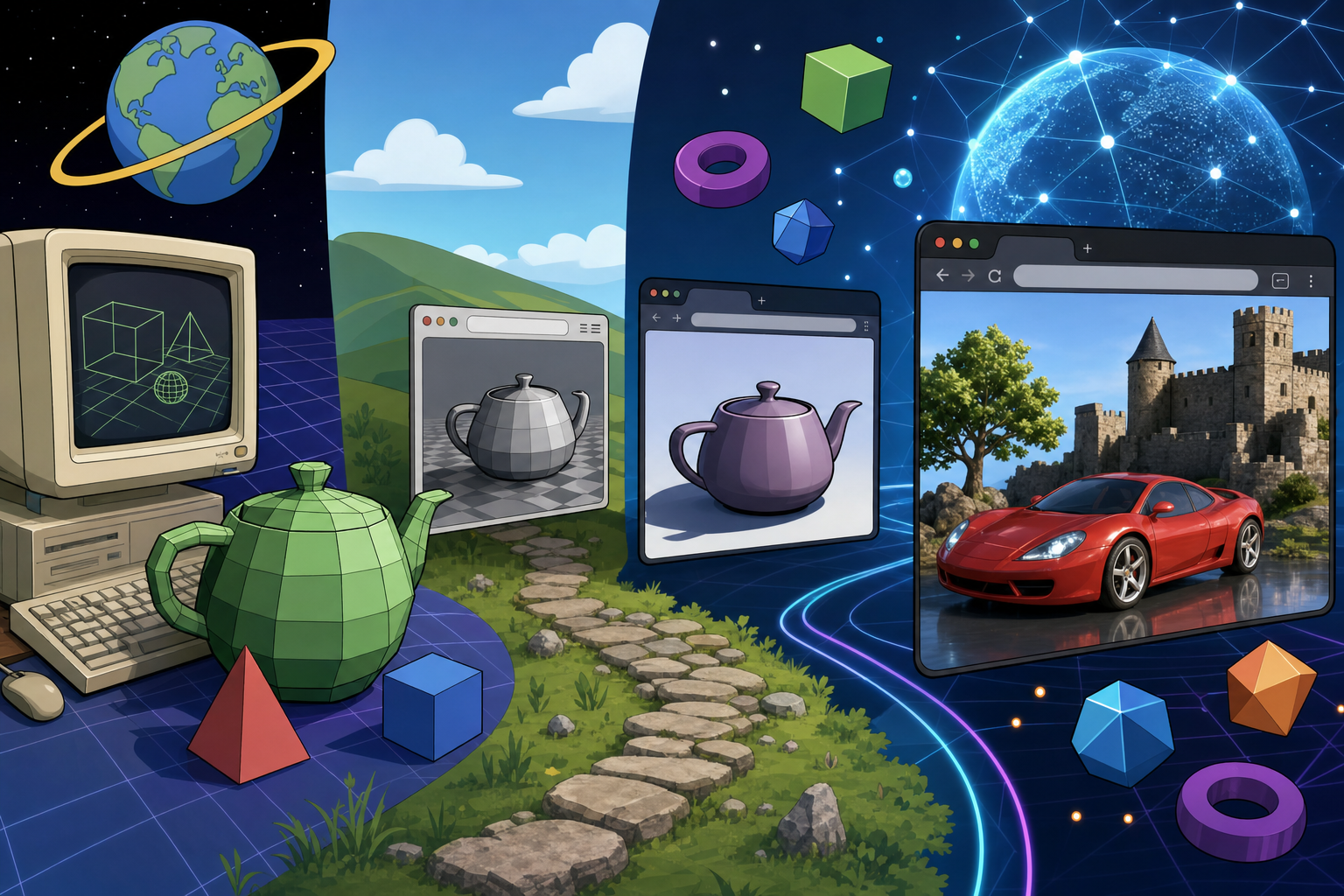


Early Ambitions for 3D on the Web
The Original Appeal of Networked Three-Dimensional Experience
The idea of putting 3D on the web was compelling almost as soon as the web itself became a mass medium, and the reason was never difficult to understand. Design and engineering organizations had long struggled with a structural problem: the most meaningful product information lived inside expensive desktop systems, on powerful workstations, in proprietary file formats, and in workflows that were difficult to share outside a tightly controlled group of specialists. A browser-based 3D environment promised something radically different. It suggested that manufacturers, architects, industrial designers, suppliers, and customers might all inspect the same digital object without installing a full CAD system from Parametric Technology Corporation, Dassault Systèmes, Autodesk, or SDRC. From the beginning, this prospect carried strategic weight because remote collaboration was not merely a convenience. It affected product development speed, supplier alignment, service documentation, and executive decision-making across distributed organizations.
Why Designers and Engineers Wanted Browser Access
The attraction also came from the possibility of lightweight design review. In most companies, only a fraction of employees had access to professional authoring tools such as CATIA, Pro/ENGINEER, Unigraphics, or Alias. Yet many more people needed to examine geometry, understand spatial relationships, and comment on product form. A browser offered the dream of universal participation. Marketing teams could use interactive product visualization without local CAD installs. Sales teams could present configurable products over a network. Service organizations could inspect assemblies interactively. Architects could imagine client-facing walkthroughs that did not require high-end graphics workstations from Silicon Graphics. These ambitions were serious, and they appeared long before the hardware and software ecosystem was ready. The historical misconception is that early web 3D failed because the idea was weak; the opposite is true. The idea was strong enough that many different communities kept returning to it for decades.
The Technical Limits That Framed the First Generation
What held those ambitions back was not imagination but infrastructure. In the 1990s and early 2000s, the average network connection was narrow, unstable, and expensive relative to the size of useful 3D assets. CAD-derived models were far too heavy for typical web delivery, and even simplified polygonal scenes could take frustratingly long to load. Consumer graphics hardware was also weak. While Silicon Graphics had demonstrated what advanced real-time graphics could look like on specialized machines, ordinary personal computers lacked that level of performance, and their GPUs were primitive by later standards. Browsers themselves were immature execution environments, built mainly for text, images, forms, and simple scripts rather than serious interactive graphics. On top of that, there was no stable, universally accepted browser-integrated graphics API with the reach and reliability needed by software companies serving large enterprise audiences.
Standards Before the Platform Was Ready
This environment gave rise to a series of formative technologies and standards efforts. The most famous early initiative was VRML, the Virtual Reality Modeling Language, promoted in the mid-1990s as a universal format for three-dimensional scenes on the web. VRML mattered historically because it captured a genuine aspiration: a common descriptive language for navigable 3D worlds, shared across operating systems and browsers. The aspiration itself was deeply aligned with the spirit of the early web. At the same time, the broader influence of Silicon Graphics was impossible to miss. SGI did not create the web, but it shaped graphics culture through OpenGL, high-end visualization systems, and a generation of engineers and standards advocates who believed interoperable graphics platforms could transform computing. Early browser-era experiments by Netscape and Microsoft showed that both major web platform players understood that richer media would matter, yet their approaches were unstable, strategic, and often entangled with proprietary extensions. The central historical thesis is therefore clear: web 3D was not delayed by lack of vision. It was delayed because hardware, standards, file formats, browsers, and business models aligned only very slowly.
The Long Era of Partial Solutions and False Starts
Why Early Web 3D Remained a Niche Capability
For a long period, web 3D existed in an awkward middle state. It was visible enough to inspire enthusiasm, but unreliable enough to remain niche. Engineers and software vendors could demonstrate rotating models, virtual spaces, basic product viewers, and browser-hosted presentations, yet these demonstrations rarely translated into broad, frictionless adoption. One reason was that many early systems solved only the easiest part of the problem: displaying a simplified scene. They did not solve the harder issues of maintaining semantic links to engineering data, preserving assembly structure, enabling robust measurement and markup, or supporting the practical expectations of design teams accustomed to feature trees, metadata, revisions, and controlled access. A browser demo might impress an executive, but it often did not fit the daily realities of manufacturing, architecture, or industrial design organizations.
The Friction of Delivery and Compatibility
The delivery model was a major source of this friction. Early web 3D often depended on plug-ins, browser extensions, helper applications, Java applets, or ActiveX controls. Each of these carried technical and political problems. Plug-ins required installation, updates, compatibility management, and user trust. Java applets promised portability but often suffered from startup delays, user hesitation, and inconsistent runtime behavior. ActiveX tied experiences closely to Microsoft’s ecosystem and raised significant security and maintainability concerns. Cross-browser consistency remained poor, especially as Netscape and Microsoft competed aggressively for platform control. A web experience that worked in one environment might fail entirely in another. This mattered enormously in enterprise deployment, where IT departments demanded predictable support matrices and long-lived infrastructure. The notion of a universal browser-based 3D layer kept colliding with the fragmented reality of the browser market.
Performance, Data Weight, and Engineering Complexity
Performance formed the second great barrier. Even when users could open a 3D scene, interaction was often slow, visually sparse, or unstable under real product complexity. CAD and DCC pipelines generated data that was too large and too specialized for early web channels. Engineering models contained exact surfaces, assembly logic, tolerances, product manufacturing information, and part relationships that did not map cleanly into lightweight interactive formats. Visualization teams could tessellate or decimate geometry, but this introduced another layer of translation and often stripped away the information engineers cared about most. The gap between engineering and visualization stacks remained severe. A model prepared in CATIA, Pro/ENGINEER, NX, SolidWorks, or I-DEAS did not naturally become a smooth browser experience. Instead, it moved through conversion chains, simplification tools, proprietary viewers, and custom integrations. This difference between viewing 3D on the web and robustly interacting with complex design data is one of the most important distinctions in the history of design software.
VRML, X3D, and the Difficulty of Sustaining Momentum
VRML deserves respect because it articulated a broad vision at a formative moment, but its limitations were substantial. Its world description paradigm was ahead of widespread platform readiness, and the content ecosystem around it never became strong enough to normalize authoring, deployment, and enterprise trust. It was appealing in concept as a universal web 3D language, yet too much of the surrounding stack remained fragile. X3D later emerged as an important successor through the work of the Web3D Consortium, offering cleaner architecture, XML integration, and a more systematic evolution path. Historically, X3D represented continuity of vision rather than collapse. Still, it remained limited in market reach because standardization alone could not overcome the broader ecosystem constraints. Without fast native browser execution, dependable graphics access, mature content pipelines, and compelling mainstream deployment economics, even a sound specification struggled to redefine practice.
Proprietary Viewers and Enterprise Workarounds
As open and semi-open standards strained to scale, proprietary viewers filled the gap. Many software vendors built specialized delivery systems to let enterprises inspect product geometry over intranets, extranets, and controlled portals. Adobe became influential through 3D PDF workflows, especially after the company acquired technology associated with U3D and later integrated richer 3D capabilities into Acrobat and PDF-based review processes. This approach mattered because PDF was already a trusted document container in engineering and manufacturing. Autodesk and Dassault Systèmes each explored browser-based review and collaboration in different periods, motivated by the recognition that not every stakeholder needed a full modeling seat. PTC and Siemens likewise developed engineering visualization pipelines aimed at downstream consumption, markup, and digital mockup activity. These systems often succeeded as practical workarounds, but their success also highlighted the limits of the broader platform. They worked by controlling the stack, narrowing the use case, or translating data into managed representations rather than by making the web itself an inherently capable 3D engineering environment.
Why the Market Kept Stalling
The market repeatedly stalled because too many preconditions were missing at once. The obstacles can be summarized clearly:
- Plug-in dependence created deployment friction and security concerns.
- Inconsistent browser support undermined confidence in universal access.
- Performance bottlenecks made interaction unreliable on ordinary machines.
- Large model sizes from CAD and DCC systems exceeded practical delivery budgets.
- Weak interoperability forced costly translation chains between engineering and visualization tools.
- Limited semantic fidelity reduced the usefulness of the experience for real design review.
These were not isolated inconveniences. They reinforced one another. A heavy model demanded more preprocessing, which increased dependence on specialized pipelines, which in turn reduced interoperability, which made browser support less predictable, which made enterprises fall back to desktop-controlled tools. This is why the history of web 3D is full of false starts that were not foolish at all. They were credible attempts to solve a problem whose surrounding infrastructure had not yet matured.
The Turning Point: Standards, GPUs, and Modern Web Platforms
The Convergence That Finally Changed the Trajectory
The eventual turning point did not come from a single invention. It emerged from the convergence of several technological histories that had matured separately. By the late 2000s and early 2010s, web development had been transformed by Ajax-era thinking, which recast the browser as an application runtime rather than a document viewer. Developers began to expect asynchronous updates, richer client-side logic, and interfaces that behaved more like software than pages. At the same time, JavaScript engines improved dramatically through work such as Google’s V8, Mozilla’s SpiderMonkey advances, and broader competitive pressure among browser vendors. The HTML5 era expanded what the browser could do natively, reducing dependence on external plug-ins for media and interaction. Meanwhile consumer GPUs became vastly more capable, benefiting from the economics of gaming, mobile devices, and graphics-intensive software. What earlier generations had imagined in principle could now begin to exist as a practical, deployable platform.
Why WebGL Mattered Historically
Within that convergence, WebGL was historically decisive. Standardized through the Khronos Group, with crucial participation from browser vendors and graphics companies, WebGL brought GPU-accelerated graphics into the browser in a broadly accessible way rooted in OpenGL ES concepts. Its significance was larger than the API surface itself. WebGL reduced dependence on plug-ins, created a common graphics foundation inside the browser, and gave software companies a target that could support serious interactive visualization at scale. This did not instantly solve every problem in design software, but it changed the baseline assumptions. Developers no longer had to persuade enterprise users to install a special runtime merely to see interactive 3D. They could build browser-native experiences that were portable across major platforms with a much cleaner deployment story. In historical terms, WebGL turned web 3D from a recurring aspiration into a viable software category.
The Browser Vendors and the Politics of Platform Maturity
The role of browser vendors deserves close attention because modern web 3D required stewardship at the platform level. Google pushed aggressively on browser performance and application thinking through Chrome and its V8 engine. Mozilla championed open web capabilities and played an important role in advancing browser graphics and standards-oriented experimentation. Apple’s Safari and WebKit work mattered because a platform is not mature unless major vendors carry it into mainstream consumer and professional environments. Microsoft, even after the era of browser fragmentation had done much damage, remained important as browser support shaped enterprise confidence. The Khronos Group provided a crucial coordination mechanism by offering an industry forum where hardware vendors, browser makers, and software stakeholders could align around graphics standards. This institutional history is central. Web 3D did not win merely because graphics got faster. It won because governance, implementation, and distribution became sufficiently coordinated to support stable software businesses.
What Modern Web 3D Enabled for Design Software
Once those pieces converged, design software vendors and adjacent visualization companies could address more meaningful workflows. Browser-based viewers became capable of smooth exploded views, interactive configuration tools, digital mockups, and distributed design review. These are not trivial features. An exploded view requires careful assembly understanding and performant scene management. A configuration tool demands dynamic geometry or prepared variants linked to product logic. A digital mockup needs scale, part hierarchy, sectioning, visibility control, and often metadata overlays. Distributed team review adds comments, permissions, revision awareness, and durable references to the same visual object. With faster JavaScript, browser storage improvements, and GPU acceleration through WebGL, these experiences became much more practical. The result was not merely prettier product marketing. It was a real expansion of what could be done in a browser for engineering communication, sales support, manufacturing planning, and stakeholder alignment.
Onshape and the Browser-Native CAD Ambition
One of the clearest historical landmarks in this period was Onshape, founded by Jon Hirschtick, John McEleney, Dave Corcoran, and other veterans strongly associated with the history of SolidWorks. Onshape mattered because it did not treat the browser simply as a lightweight viewer. It treated the browser as the primary environment for CAD interaction, backed by cloud-native data management and server-side architecture. That was a profound shift in ambition. Earlier systems often used the web to distribute derived representations of geometry created elsewhere. Onshape attempted to make the browser itself the front end of a serious design system. This distinction is essential. It signaled that the industry had moved beyond asking whether users could inspect 3D online and toward asking whether the web could host parts of the actual design process. Even so, the historical lesson remains nuanced: geometry translation, data security, and feature-level editing fidelity still lagged behind visualization gains in many contexts, especially where legacy CAD ecosystems and exact modeling semantics remained deeply entrenched.
What Still Lagged Behind Visualization
Despite the progress, browser-era visualization matured faster than browser-era engineering authoring. Translation remained difficult because CAD kernels, boundary representation schemes, tessellation strategies, and metadata conventions differed across vendors such as Dassault Systèmes, Siemens, PTC, Autodesk, and others. Security also remained a serious concern. Enterprises were willing to expose lightweight visual derivatives more readily than they were willing to expose authoritative engineering models and process logic in the cloud. Feature-level editing posed another challenge because the browser could display tessellated geometry far more easily than it could reproduce the deep parametric and topological behavior expected of desktop systems built over decades. The result was an uneven but historically important landscape:
- Visualization advanced first because it tolerated derived, simplified, and task-specific representations.
- Engineering-grade editing advanced more slowly because it required exact geometry, persistent model semantics, and robust data governance.
- Collaboration features spread rapidly because they benefited from web-native identity, sharing, and cloud storage models.
- Interoperability remained stubborn because browser capability could not by itself erase decades of CAD fragmentation.
This asymmetry explains why modern web 3D feels simultaneously mature and unfinished. It solved many of the long-standing presentation problems before it solved all of the authoring and interoperability problems.
Conclusion
The Histories That Had to Converge
The maturation of 3D on the web took so long because it required several different histories to converge at once, and each moved at its own pace. Computer graphics had to advance from workstation-era specialty systems to mass-market GPUs powerful enough for fluid real-time rendering. Browser engineering had to evolve from document display to application runtime, with substantial gains in JavaScript execution, security models, and graphics APIs. Network infrastructure had to become fast and stable enough to support large media assets and collaborative cloud workflows. CAD interoperability had to improve enough that design data could be translated, compressed, streamed, and visualized outside the original authoring system. Cloud software economics also had to mature so that vendors could justify subscription models, hosted computation, browser-first distribution, and continuous deployment. Seen in this light, web 3D was never a simple feature waiting to be turned on. It was the meeting point of multiple industrial transitions.
Visual Media Versus Engineering-Grade Environment
That is why it remains essential to distinguish between web 3D as visual media and web 3D as an engineering-grade design environment. The first became practical once browsers could render scenes reliably, handle interaction smoothly, and load optimized assets through modern delivery pipelines. The second demanded much more. It required exact modeling behavior, revision-safe collaboration, access control, rich metadata, resilient translation, and software architecture capable of supporting professional design intent rather than merely showing geometry. Many historical misunderstandings come from collapsing these categories together. A browser product configurator, a digital mockup review session, and a full parametric design system may all involve 3D in a browser, but they are not the same achievement. They sit at different points on the spectrum between visualization and engineering computation.
The Larger Historical Lesson
The larger historical lesson is therefore not that the web simply caught up with desktop design software. That phrasing is too linear and too shallow. The web became viable for serious 3D only when standards, GPUs, compression methods, and software architecture evolved together. In some areas, the browser did not imitate the desktop so much as reorganize the assumptions of software delivery, collaboration, and data access. It enabled persistent cloud-hosted workspaces, live sharing, centralized version control, and easier cross-device access in ways that traditional desktop distribution had never handled elegantly. At the same time, the desktop retained advantages in deeply specialized authoring, local performance control, and decades of accumulated kernel and workflow sophistication. The real history is not a story of replacement but of reconfiguration. Browser platforms opened new forms of design participation while challenging long-standing boundaries between viewer, editor, collaborator, and customer-facing experience.
The Next Chapter in Browser-Based Design Tools
Looking forward, the next chapter is being shaped by technologies that continue the long convergence rather than ending it. WebGL established a durable graphics foundation, but newer layers around it matter too. glTF has become increasingly important as a practical transmission format for efficient 3D assets, often called the “JPEG of 3D” because of its portability and delivery efficiency, though that analogy should not hide its sophistication. WebAssembly opens paths for bringing more demanding computational logic into web contexts, including geometry processing and performance-sensitive components that once seemed impossible in a browser. Cloud-native platforms continue to refine how data, permissions, collaboration, and compute are organized around design workflows. Together, WebGL, glTF, WebAssembly, and cloud-native architecture suggest that the browser will play a larger role not only in visualization but also in simulation access, geometry services, digital thread integration, and distributed engineering processes. The crucial point is that this future rests on a long and difficult history. Web 3D did not arrive late because no one believed in it. It arrived when the platform, the economics, the hardware, and the data ecosystem finally became able to support what earlier generations had already imagined.
Also in Design News


