Your Cart is Empty


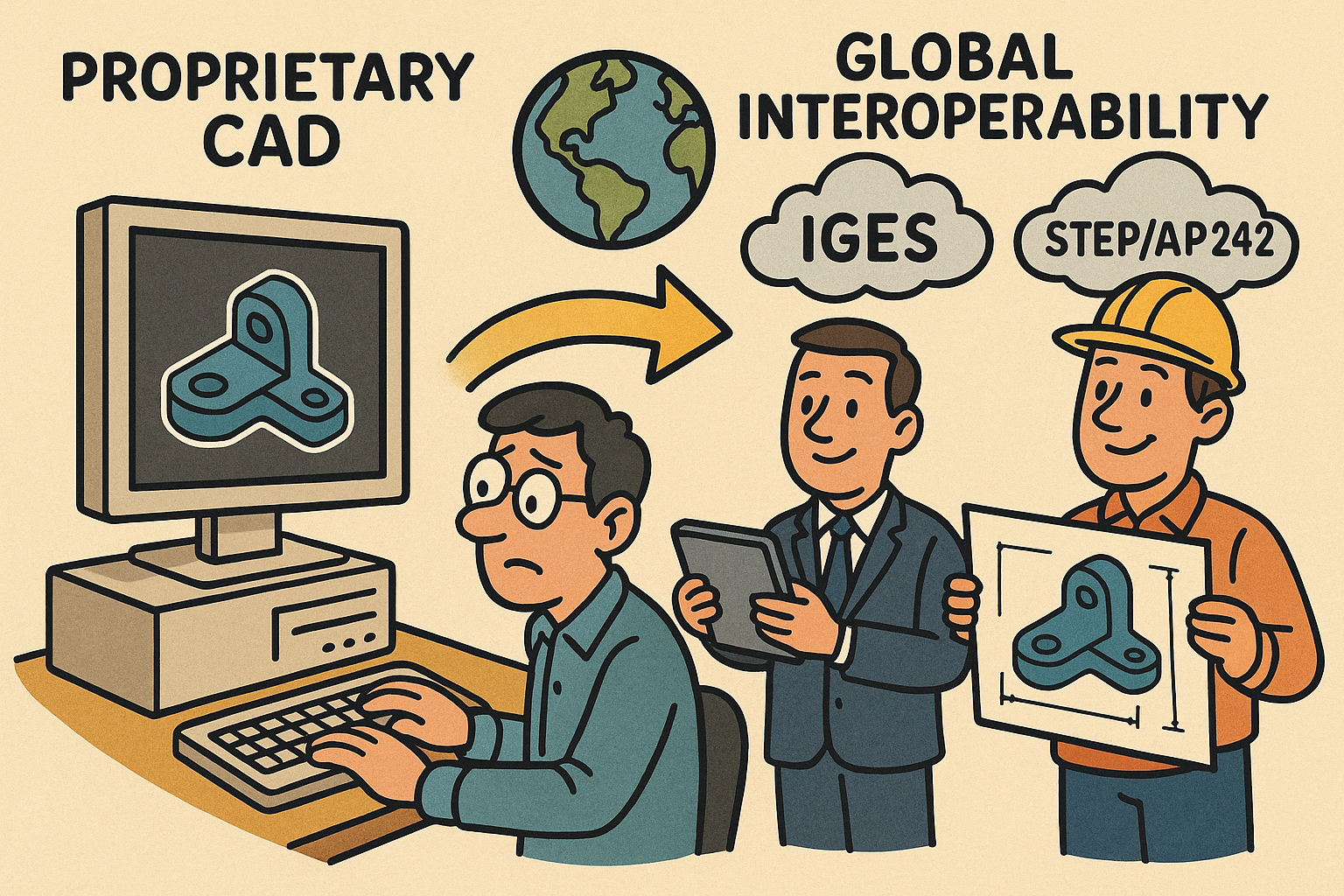
Design Software History: From Proprietary CAD to Global Interoperability: IGES, STEP/AP242 and the Rise of Model-Based Definition


Why Interoperability Needed a Standard: The Pre-IGES Era (1960s–early 1980s)
Proprietary islands in early CAD and the hidden cost of closed files
The modern narrative of neutral CAD exchange begins long before file standards, in an era when design systems were crafted as vertically integrated islands. On IBM 370 mainframes and DEC VAX minicomputers, programs such as CADAM (born at Lockheed and commercialized with IBM), CATIA’s V4 predecessors at Avions Marcel Dassault, McDonnell Douglas’s Unigraphics (later EDS/Siemens), Computervision’s CADDS, and Intergraph’s IDS/IGDS were engineered as complete toolchains with proprietary storage. Each vendor optimized for local performance and scarce memory, not for a world where data would circulate broadly. File formats were undocumented or accessible only through licensing, and modelers diverged in fundamentals—entities for wireframe, spline definitions, and surface constructs—so even when documentation existed, the semantics did not line up cleanly. A drawing could be plotted; a solid model could not simply be “understood” by a rival kernel. In this climate, interoperability was not an afterthought; it was structurally impossible. As projects grew from 2D drafting to 3D surfaces, the cost of re-entering geometry, validating dimensions, and reconciling different mathematical conventions began to dominate schedules. The web did not exist; networks were expensive; tapes and cartridges traveled in courier pouches. The lack of a common language for geometry compounded every logistical constraint, and the bill landed in engineering change orders, rework, and quality escapes that were difficult to trace and harder to justify.
Aerospace and automotive supply chains feel the strain
By the late 1970s, the most compelling demand signal came from large, multi-tier supply chains. Boeing, McDonnell Douglas, Airbus, General Motors, and Ford were orchestrating programs that depended on hundreds of suppliers, each with its own CAD stack and its own modeling conventions. The consequences were predictable: airframe panels did not align, wiring harness lengths drifted, and tool paths diverged from designed intent. For a fuselage or a body-in-white, millimeter deviations at interfaces could spawn weeks of triage. OEMs discovered a sobering truth—without a shared representation of surfaces, curves, and tolerances, coordination degraded into opinion.
- Data re-entry: suppliers recreated geometry from blueprints, losing associativity and design intent.
- Tolerance stack-up: inconsistent spline and surface interpretations produced subtle geometric drift.
- Schedule risk: change propagation across heterogeneous systems took weeks, not hours.
- Liability ambiguity: when models disagreed, responsibility was difficult to assign.
Within the U.S. government, the USAF’s Integrated Computer-Aided Manufacturing (ICAM) program recognized that digital manufacturing would stall without exchangeable, machine-readable geometry. ICAM’s work, coupled with the National Bureau of Standards (NBS, later NIST), reframed interoperability as a strategic capability rather than a vendor nicety. In parallel, graphics-focused precedents such as the Computer Graphics Metafile (CGM) exposed the limits of purely visual, view-centric exchange: CGM could draw a line, but it could not encode a boundary-represented face with topology and tolerances that manufacturing could trust.
National initiatives and early domain standards set the stage
In Europe, sector-specific initiatives emerged to tame local priorities. Germany’s Verband der Automobilindustrie codified VDA-FS, a surface exchange interface tailored to the Class-A surfacing essential for exterior styling. VDA-FS captured the practical methods that German OEMs and suppliers used to collaborate on complex car bodies where curvature continuity (G2/G3) mattered as much as absolute dimension. In France, AFNOR backed SET (Standard d’Echange et de Transfert), another surface- and curve-centric schema adopted by companies like Renault and support vendors that understood CATIA V3/V4-era workflows. These efforts were vital because they proved three ideas: standards can encode high-level surfacing semantics; neutral exchange can shorten supplier ramp-up; and vendor-aligned communities can converge on workable subsets even if they are not globally universal. Underneath, the math was advancing: Bézier curves (Pierre Bézier at Renault), de Casteljau’s algorithm (Paul de Casteljau at Citroën), and later NURBS formalizations (documented extensively by Les Piegl and Wayne Tiller) gave CAD systems shared language for free-form geometry, while boundary representation (B-rep) and Euler operators provided rigorous topological foundations. Yet without cross-vendor agreements on tolerance, orientation, trimming, and parameterization, the same NURBS surface could represent subtly different shapes in different kernels. The pre-IGES era thus closed with a clear diagnosis: a standard must combine common mathematical entities with implementation guidance and community governance to be more than a paper promise.
From IGES to STEP: Building a Global Language for CAD Data (1980s–2000s)
IGES emerges: community momentum and pragmatic scope
In 1980, the Initial Graphics Exchange Specification—IGES—arrived as a pragmatic accord forged by the USAF ICAM program and NBS, with engineering and vendor contributions from Boeing, General Electric, McDonnell Douglas, Applicon, Computervision, and the CADAM team. The genius of IGES was not theoretical purity but coalition building: it targeted what the industry could agree on—wireframe entities, drafting annotations, and a broad swath of analytic and spline surfaces—then codified them in a text file structure that could be parsed on mainframes, minicomputers, and emerging workstations. Standardization through ANSI (Y14.26M lineage) conferred institutional weight. Translator vendors and in-house teams quickly implemented support; service bureaus proliferated to convert between CATIA V4, Unigraphics, CADAM, and Computervision datasets. For many programs, IGES cut weeks from supplier onboarding by letting geometry move without revealing proprietary kernel internals. It also preserved investment: as vendors iterated kernels, companies could still exchange using a stable, vendor-neutral artifact. The rapid uptake validated the core thesis: if neutral exchange aligns with OEM mandates and vendor incentives, adoption can outpace the usual standards inertia.
Where IGES fell short and how the community reacted
IGES’s strengths defined its limits. Because it prioritized graphical and surface coverage, its treatment of topology and solid modeling arrived late and inconsistent just as B-rep solids became mainstream in the 1990s. The standard allowed flexibility that implementors interpreted differently, spawning dialects. Profiles—formal and informal—emerged as companies negotiated exactly which entity types and options they would use. The IGES Implementors Forums attempted to harmonize practice, publishing usage recommendations and test sets, but the proliferation of “IGES flavors” persisted. Regional standards like VDA-FS and SET retained footholds where surface perfection trumped solid history, making multi-standard workflows the norm rather than the exception. The practical outcomes included:
- Ambiguous semantics: identical geometry represented with different trimming conventions or tolerance schemes.
- Round-tripping loss: recurring reparameterization caused face-surface drift and orphaned edges.
- Feature blindness: design intent, constraints, and history remained locked inside native systems.
By the mid-1980s, consensus formed that a next-generation standard must be semantically richer, modular, and verifiable. That vision became STEP.
STEP architecture: EXPRESSing semantics for industry domains
STEP (ISO 10303) grew from the U.S. Product Data Exchange using STEP (PDES) initiative and the international work of ISO TC184/SC4. Unlike IGES, STEP was conceived as an information modeling ecosystem, not just a file format. Its architectural pillars included the EXPRESS language for data modeling; Part 21, a human-readable file syntax; and Part 42 defining a rigorous geometry and topology schema aligned with B-rep and NURBS. Above these technical foundations, STEP introduced Application Protocols (APs) that scoped content by business need—from configuration-managed 3D design to composite materials and manufacturing processes. This layering allowed implementors to target specific, testable slices while reusing the core geometry. PDES and SC4 working groups, alongside national bodies and industrial consortia, iterated reference models, test suites, and recommended practices that explicitly tied schema constructs to real enterprise workflows. By separating the neutral model from how vendors stored data internally, STEP preserved competition among kernels while making semantic exchange possible for assemblies, attributes, and lifecycle metadata that 2D-centric standards could never encode.
Milestone APs, industrial pull, and conformance culture
STEP’s credibility crystallized around several Application Protocols that solved urgent problems and won OEM mandates:
- AP203 (Configuration-controlled 3D design): Adopted widely by PTC Pro/ENGINEER, CATIA, and Unigraphics/NX, AP203 became aerospace’s backbone for exchanging assemblies under revision control, attributes, and exact geometry that survived beyond drawings.
- AP214 (Automotive design): Extended into color, classification, and broader assembly semantics, reflecting automotive’s need to partition and manage massive structures; convergence pressures with AP203 later set the stage for harmonization.
- AP209 (Design with FEA): Linked product definition with finite element analysis, enabling transfer of meshes, loads, and boundary conditions to reduce manual rework between CAD and CAE.
- AP238 STEP-NC: Described CNC manufacturing feature/process data, moving beyond G-code’s machine-centric instructions toward model-driven machining.
- AP242 (Managed model-based 3D engineering): Unified AP203 and AP214 and delivered semantic PMI—machine-interpretable dimensions and tolerances—foundational for Model-Based Definition.
Conformance culture matured alongside these APs. The CAx Implementor Forum (CAx-IF)—a collaboration between PDES, Inc. and ProSTEP iViP—organized cross-vendor test rounds, issued Recommended Practices that closed ambiguities, and published public reports that pushed vendors toward consistent behavior. NIST’s research, notably Robert Lipman’s STEP File Analyzer and Viewer, provided open tools to inspect and validate files against schemas, democratizing quality checks. Commercial enablers such as STEP Tools, Inc., led by Martin Hardwick, supplied robust toolkits and sample code that accelerated adoption and served as de facto references. Together, these actors transformed STEP from a book on a shelf into a living, testable ecosystem that vendors and OEMs could trust for production data exchange.
Beyond Geometry: Domain Standards, Lightweight Formats, and MBD (2000s–present)
Model-Based Definition, semantic PMI, and closed-loop inspection
As enterprises shifted from drawing-centric to model-centric engineering, a crucial gap emerged: tolerances and annotations had to be computable, not just readable. Model-Based Definition (MBD) made the 3D model the authority for downstream processes, but only if Product and Manufacturing Information (PMI) could carry semantics aligned with ASME Y14.41 and ISO 16792. STEP AP242 addressed this explicitly, enabling machine-interpretable dimensions, datums, GD&T, and surface finish. The result was a bridge from design to metrology and manufacturing planning that avoided the ambiguity of “graphic-only” notes. In metrology, the Digital Metrology Standards Consortium (DMSC) formalized QIF (ANSI), a suite covering measurement plans, results, resources, and statistical traceability. QIF complements AP242 by structuring how inspection plans are generated from semantic PMI and how results are fed back into quality systems. Long-term archiving entered the foreground via LOTAR (from ProSTEP iViP and the Aerospace and Defence PLM Action Group/AAF), which codified practices for preserving 3D geometry and PMI in sustainable containers such as STEP and JT, with governance that ensures files remain interpretable decades later. The combined effect is a closed loop: semantic definition in AP242, executable inspection in QIF, and audited longevity in LOTAR, all oriented toward a verifiable digital thread that spans the design–manufacture–inspect triad.
Visualization and lightweight exchange: JT, 3D PDF, and glTF
Not every workflow requires exact B-rep. Many benefit from fast visualization, large assembly review, and secure sharing without exposing intellectual property. The JT format—originating at UGS and stewarded by Siemens—progressed from a de facto industrial standard into ISO 14306. Through the JT Open community and buy-in from automotive giants like GM and Ford, JT established itself as a scalable, tessellated container with optional precise geometry for selective use cases. In parallel, 3D PDF leveraged ISO 32000 as a ubiquitous container, folding in precise PRC (ISO 14739-1) and the older U3D (ECMA-363) for mesh content. Adobe’s platform and Tech Soft 3D’s PRC technology industrialized workflows for quoting, supplier review, and compliance packages that require embedded metadata and rights management. On the web, glTF from the Khronos Group emerged as the “JPEG of 3D,” tuned for streaming tessellations and PBR materials, complementing but not replacing exact B-rep exchange.
- Use JT when scalable visualization, sectioning, and partial precision are needed inside PLM at massive assembly scale.
- Use 3D PDF when distribution, annotation, and document workflows dominate, especially where recipients lack specialized viewers.
- Use glTF for web and AR/VR visualization, configuration previews, and marketing-grade experiences, acknowledging it is not a B-rep carrier.
The key architectural principle is layering: pair lightweight visualization with an authoritative exact model (e.g., STEP AP242) and govern synchronization so visual assets do not drift from the source of truth.
AEC/BIM’s parallel standardization: IFC as semantic backbone
In the built environment, interoperability organized around IFC (Industry Foundation Classes), developed by buildingSMART and standardized as ISO 16739. Rather than geometry-first, IFC is occupancy- and system-centric, modeling walls, spaces, HVAC equipment, structural members, and their relationships. This semantic emphasis aligns with multi-disciplinary coordination (MEP, structural, architectural) and regulation. Vendors including Graphisoft (Archicad), Autodesk (Revit), and the Nemetschek portfolio implemented IFC export/import to satisfy national mandates such as the UK’s BIM Level 2 policy, which requires deliverables in open formats. IFC’s trajectory mirrors mechanical standards in one respect—implementor forums, MVDs (Model View Definitions), and test suites enforce practical subsets. It also diverges: the domain language of AEC places lifecycle attributes, classification systems, and spatial containment at the forefront, with geometry as a supporting actor. The convergence with manufacturing appears in digital twin initiatives, where building products, fabrication models, and operational data need to align. Here, STEP’s product semantics and IFC’s built-asset semantics increasingly meet through APIs, reference ontologies, and shared validation practices, signaling a future where infrastructure and manufactured systems inhabit a single, governed information plane.
Additive manufacturing and production connectivity
Additive manufacturing pressed standards to represent more than boundaries. AMF (ISO/ASTM 52915) extended beyond STL by encoding units, materials, color, and lattices—essentials for functional prints. The 3MF Consortium—spearheaded by Microsoft with active members including Autodesk, Dassault Systèmes, PTC, Siemens, HP, and Stratasys—pursued a modern, ZIP-packaged, XML-based format aimed at end-to-end slicing pipelines with extensibility for build metadata and textures. Despite these advances, STL remains a “good enough” lingua franca thanks to its simplicity and entrenched toolchains, albeit with acknowledged lossiness and unit ambiguity. In subtractive and hybrid contexts, STEP-NC (AP238) piloted a richer connection between design intent, features, machining strategies, and metrology, reducing the semantic gap between CAM planning and CNC execution. When paired with QIF for feedback loops and AP242 for semantic PMI, it sketches a future of executable, closed-loop manufacturing where plans are derived from authoritative models and validated against measured reality. Adoption is deliberately paced; machine tool ecosystems evolve conservatively for reliability. Yet these standards influence controller vendors, CAM systems, and quality platforms, and they are increasingly embedded in research programs and production pilots that prioritize traceability and automation over artisan G-code programming.
Conclusion
Lessons learned: interoperability as a socio-technical system
Half a century of experience teaches that interoperability is won by aligning technology, governance, and market power. Standards succeed when OEMs mandate them, vendors see commercial upside, and neutral organizations run conformance processes that convert PDFs into predictable software behavior. IGES thrived because it matched an urgent need with coalition pragmatism. STEP endured because it encoded not just shapes but semantics and supplied a scaffolding—APs, EXPRESS, Part 21—on which industries could specialize. Communities such as CAx-IF, JT Open, and buildingSMART demonstrated that implementor forums are not optional add-ons; they are the engine that turns ambiguous text into interoperable code. Tooling from NIST and commercial providers such as STEP Tools lowered the barrier to validation, making quality a shared responsibility rather than an internal secret. Finally, the field learned to layer standards: exact B-rep for authority, lightweight tessellations for scale and sharing, and domain schemas for intent and lifecycle. The engineering challenge is inseparable from process realities—procurement rules, certification audits, cybersecurity—and standards thrive only when they fit that broader operating envelope.
Persistent gaps and the business dimension
Despite progress, critical gaps remain. Full-fidelity exchange of design intent—features, constraints, parameters, and history—is still uneven across kernels and vendors. While AP242 carries semantic PMI and robust geometry, the leap from model to feature-based equivalence is hard, both mathematically and practically. Numerical tolerances and kernel-specific evaluation strategies mean that perfect round-tripping is elusive; subtle differences in trimming and reparameterization can still propagate into downstream tooling. Automated, robust validation—where a receiving system can assert equivalence with quantifiable confidence—exists, but is not yet routine in production at enterprise scale. These technical realities intersect with business forces. Vendor incentives favor customer lock-in through advanced features, proprietary kernels, and value-added cloud services. OEMs balance IP protection against the efficiency of openness; suppliers juggle compliance mandates with tool cost and training. Procurement policies, export controls, and certification regimes shape what “standard” means in practice at least as much as an ISO document does. The most successful programs navigate these trade-offs explicitly, building governance that treats neutral models as contractually authoritative and funds the conformance testing, tool qualification, and training required to make that authority real.
What’s next: maturing AP242, connecting simulation, and operationalizing the digital thread
The near horizon is pragmatic and testable. Several vectors stand out:
- AP242 Edition 3 maturation: deeper semantic PMI coverage, assembly and configuration refinements, and tighter ties to PDM/PLM contexts so that versioning and effectivity are first-class, not bolted on.
- AP243 (MoSSEC) for simulation: standardized exchange of simulation context, assumptions, results, and verification evidence that can be traced alongside product definitions, reducing the “data-yet-unproven” problem in CAE.
- SysML v2 alignment: linking systems engineering models to product definitions so requirements, behaviors, and structures trace directly into geometry, manufacturing, and verification artifacts.
- Cloud-native APIs and web formats: service-based translators, reproducible conformance tests in CI pipelines, and open reference implementations (e.g., STEPcode/Open CASCADE) that make interoperability measurable, not aspirational.
- Layered standard stacks: authoritative exact models (AP242), lightweight visualization (JT, glTF), and domain schemas (QIF, IFC) orchestrated with governance that ensures synchronization and auditability across the lifecycle.
Success will depend on keeping the socio-technical balance: OEM mandates with teeth, vendor participation that rewards conformance, and community tooling that makes compliance cheap and verifiable. If that alignment holds, the industry can close the loop from model-based definition through manufacturing and inspection to a digital twin that is not just viewable but computably trustworthy, sustaining product knowledge for decades and across organizational boundaries.
Also in Design News