Your Cart is Empty


Design Software History: From Plotters to Procedural Intent: A Technical History of Generative and Parametric Design Software
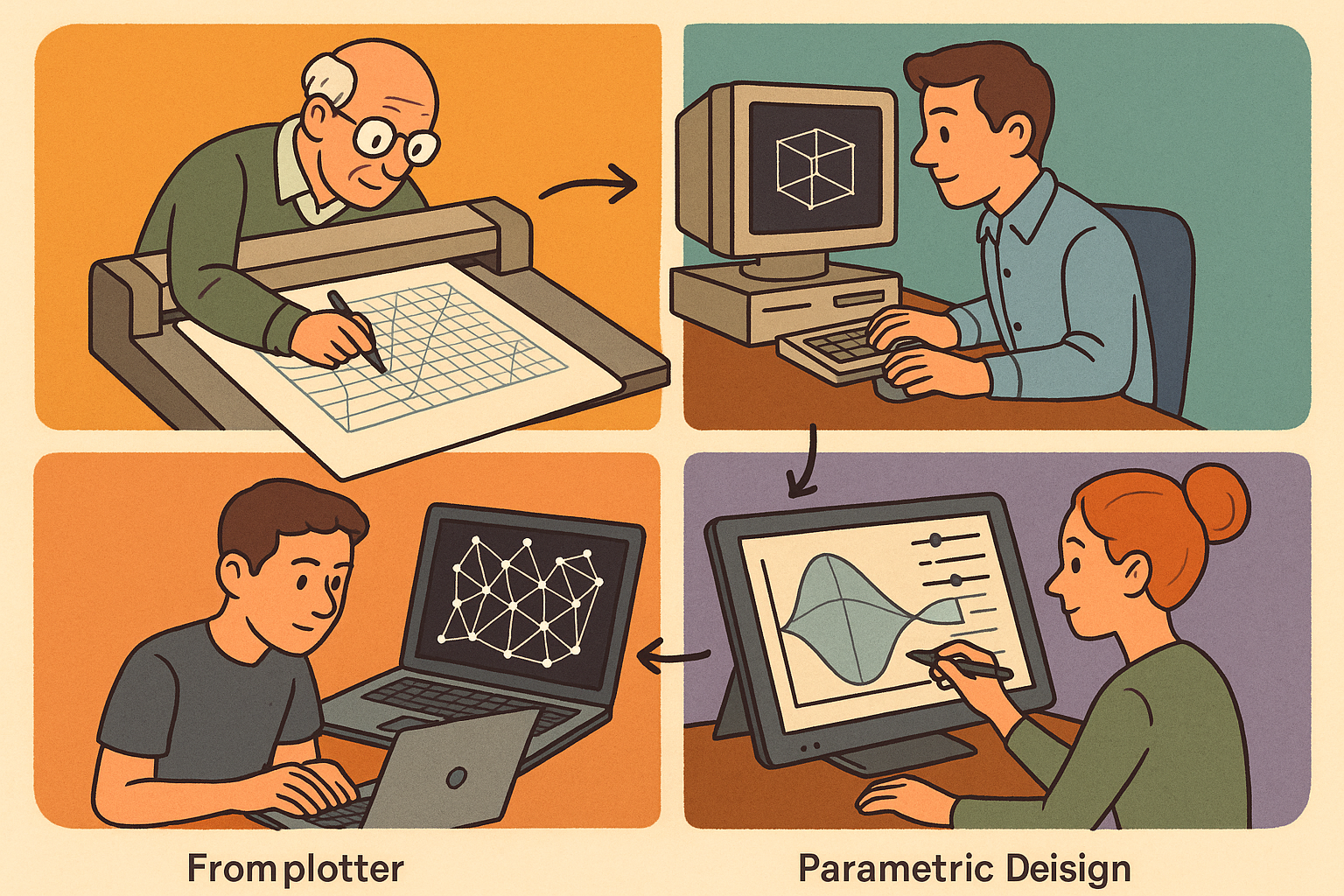


Origins and ideas: from plotters and pixels to procedural design intent
Generative art roots (1960s–1990s)
When computing first met drawing, early pioneers framed a language of rules, randomness, and precision that still underpins today’s parametric toolchains. In the late 1960s, Frieder Nake, Georg Nees, Vera Molnár, and Manfred Mohr programmed mainframes to drive pen plotters, converting numerical structures into machine motion. The physicality of the plotter forced clarity: every line had to be specified, every turn timed, and every stochastic variation constrained. That discipline seeded a fundamental insight: a design can be represented as a sequence of deterministic transformations, modulated by controlled randomness. Molnár’s “machine imaginaire” prefigured a mental model of procedural studios, where an artist imagines a system more than a single picture; Mohr’s move from gestural painting to algorithmic composition articulated constraints as a creative medium, not a limitation.
Within this environment, algorithmic drawing cultivated a culture of debugging aesthetics. Nake’s explorations of matrices and permutations mapped analytical structures onto visual grammar, and Nees’ stochastic processes demonstrated how seeds and distributions yield families of outputs without losing authorial intent. Plotter-driven variability—pen slippage, paper drift—made explicit the difference between code-space and output-space, foreshadowing today’s gap between CAD intent and manufacturing variation. That gap inspired techniques like sampling, tolerance bands, and feedback loops. By the 1980s and early 1990s, exhibitions at venues like the SIGGRAPH Art Show connected computational artists with computer graphics researchers, establishing a shared vocabulary around proceduralism that design software would later formalize into features, nodes, and solvers.
Encapsulating artistic intent in code: AARON and evolutionary systems
Harold Cohen’s AARON stands as a milestone for encoding design intent—not just geometry—into software. Rather than producing arbitrary marks, AARON applied rule systems for composition, occlusion, and color, proving that concept hierarchies could be codified as layered predicates. Cohen emphasized encapsulation: routines for pose selection, edge traversal, and stroke overlap were handled by modular procedures. This echoed what engineering would call “feature definitions,” decades before CAD mainstreamed the idea. Meanwhile, Ken Perlin introduced smooth noise (Perlin noise), a compact function for generating coherent randomness that shaped everything from textures to terrain and later informed procedural geometry variation in design visualization and manufacturing-aware mesostructures. The elegance of a noise function—cheap, deterministic given a seed, and infinitely tileable—became a template for practical proceduralism.
In parallel, William Latham and Stephen Todd’s Mutator and Karl Sims’ evolutionary artwork demonstrated fitness-driven form finding: encode a genotype (parameters), define phenotypes (geometry), and apply selection. Their interfaces—breeding galleries, sliders, and mutation operators—previewed workflows that would appear later in Galapagos for Grasshopper and Autodesk’s multi-objective solvers. The key operational takeaway was that authors could define evaluators rather than hand-picking shapes, a shift from designer as drafter to designer as curator of constraints and scoring functions. By the early 1990s, these experiments had sketched a full pipeline: rules to generate, noise to diversify, fitness to guide, and modular code to scale. That pipeline foreshadowed the procedural design intent now embedded in professional CAD and DCC platforms.
Foundational form-making grammars and math
Rule systems matured into formal grammars that designers could adopt with rigor. George Stiny and James Gips’ shape grammars articulated how a vocabulary of forms and production rules can yield infinite variations while maintaining recognizability, a direct analogue to feature libraries and conditional patterns in parametric CAD. Przemyslaw Prusinkiewicz’s L-systems encoded botanical growth with recursive rewriting, introducing branching typologies that still inform façade patterning, truss bifurcations, and robotically laid fibers. At the same time, Alan Turing’s reaction–diffusion model and cellular automata described emergent patterning whose thermodynamic plausibility made them compelling for surface articulation, from perforations to foam-like lattices.
Computational geometry offered further building blocks: Voronoi and Delaunay tessellations organized proximity and connectivity; medial axes captured skeletal intent behind shapes; distance fields and isosurfaces unified sculpting and Boolean logic. These constructs mapped cleanly onto manufacturable patterns once hardware caught up. Designers could, for instance, threshold a distance field to grow an isosurface, or modulate Voronoi cells to balance stiffness and mass in aerospace parts. The practical toolkit coalesced into repeatable motifs:
- Graph-based generation using rewrite rules (shape grammars, L-systems).
- Field-based modeling with signed distance functions and isovalue control.
- Stochastic texture via noise and reaction–diffusion for controlled variability.
- Proximity structures (Voronoi/Delaunay) enabling rationalized lattices and skins.
As these methods entered education and software libraries, they became stepping stones from artistic experiments to production geometry pipelines.
Academic bridges to design practice
The MIT Aesthetics + Computation Group under John Maeda fostered a designer-friendly coding ethos, culminating in Processing by Casey Reas and Ben Fry. Processing’s immediate-mode drawing commands, clean typography API, and lightweight IDE lowered the entry barrier for non-engineers, while enabling serious algorithmic work. Its influence extended beyond screens to fabrication plug-ins and toolpath prototypes. In parallel, the direct lineage from PostScript—where entire pages are coded with vector operations—validated the idea that a drawing is a program, a perspective echoed in AutoLISP for Autodesk AutoCAD, which let users script drafting routines and early parametric behaviors. AutoLISP’s command-wrapping and geometry query patterns prefigured modern CAD APIs.
Early CGI pipelines contributed scene graph scripting and node evaluation concepts: evaluating transforms top-down, sharing instanced geometry, and caching procedural results. Those ideas later surfaced in architectural modeling and product visualization pipelines, making it normal for designers to wire dependencies as graphs rather than linear steps. The convergence of these streams—Processing’s accessibility, PostScript’s geometric clarity, AutoLISP’s command introspection, and CGI scene graphs—shaped a culture where coding was not an exotic add-on but a core craft. That culture prepared the ground for the explosive adoption of visual programming in CAD and DCC, where nodes and wires became a lingua franca for intent and iteration.
Tooling crossovers: scripting and visual programming enter CAD and DCC
Parametric and scripting ecosystems
Rhinoceros from Robert McNeel & Associates offered precise NURBS modeling with an open ethos, and RhinoScript made automation accessible to designers comfortable with VBScript-style logic. The shift to Python opened a broader ecosystem, and David Rutten’s Grasshopper transformed node-based generative logic into a mainstream design practice. With Grasshopper, dependencies are explicit, parameter surveys are trivial, and third-party ecosystems thrive. Daniel Piker’s Kangaroo added physics-based form-finding, Giulio Piacentino’s Weaverbird supported mesh subdivision and thickening, and the built-in Galapagos brought embedded evolutionary search, making constrained exploration practical inside the modeling environment.
On the AEC side, Bentley’s GenerativeComponents, pioneered by Robert Aish, normalized parametric relationships for buildings, while Autodesk’s DesignScript and Dynamo, incubated by Ian Keough, extended visual programming into BIM contexts. For makers and reproducible design, Marius Kintel and Clifford Wolf’s OpenSCAD and the JavaScript port OpenJSCAD made code-as-CAD a viable path, trading UX for deterministic, versionable models. In cloud-native CAD, Onshape’s FeatureScript—led by Jon Hirschtick, John McEleney, and team—elevated user-defined features to first-class citizens, letting organizations codify standards directly in the modeler. The recurring theme is autonomy: with scripting and node graphs, designers author reusable logic rather than one-off geometry, baking company know-how into shareable components.
DCC influence and pipelines
Digital content creation tools seeded procedural methods that migrated into engineering workflows. Autodesk Maya’s MEL and Python APIs, 3ds Max’s MAXScript, and SideFX Houdini’s VEX and node graphs standardized practices like scattering, instancing, attribute-driven deformations, and cache-based iteration. Houdini, in particular, treated geometry as streams of attributes flowing through operators, a paradigm that maps neatly onto parameterized manufacturing constraints where overhang angles, wall thickness, and anisotropy are just attributes to compute and enforce.
Surface-centric applications like Alias and ICEM Surf set the benchmark for automotive and industrial design Class-A surfacing. Their scripting hooks, though less advertised than animation tools, quietly augmented surfacing workflows: generating curvature-analysis heatmaps at scale, standardizing fillet families, and aligning highlight flow across panels. These DCC habits shaped pre-CAD exploration—designers iterate visually with procedural scatters and field-driven deformations, then collapse to NURBS or solids once intent stabilizes. The pipeline loops back: visualization teams consume engineering geometry and enrich it with procedural detail, while manufacturing-aware modifiers from DCC environments inform upstream modeling choices. As toolchains blended, teams grew comfortable moving data between mesh-centric and NURBS/solid worlds, relying on scripting to translate, heal, and rationalize.
Under-the-hood enablers
Parametric tooling flourished only because kernels and constraint solvers matured. Parasolid (Siemens) and ACIS (Spatial) provided robust modeling primitives—intersection, offset, fillet—while OpenCASCADE supplied open-source access to boundary representations. D-Cubed’s constraint technology stabilized sketches and assemblies, enabling reliable solution of geometric conditions. These under-the-hood pieces mattered because generative systems compose many operations in series; fragile Booleans or non-manifold edges would collapse graphs. The steady improvement of robust Booleans, shelling, and blending expanded the search space that procedural tools could explore without manual cleanup.
Analysis integration deepened the loop between intent and performance. Early topology optimization in Altair OptiStruct and solidThinking Inspire demonstrated material redistribution guided by loads and constraints, and later ecosystems—nTopology, Autodesk Netfabb, Siemens NX lattice tools—made lattice authoring and FEA coupling accessible. This produced a new template: generate with parameters, evaluate in-situ, and rewrite parameters based on physics. The capabilities that enabled this stack can be summarized as:
- Constraint-aware kernels (Parasolid, ACIS, OpenCASCADE) tolerant of iterative edits.
- Assembly solvers (D-Cubed) stabilizing parametric dependencies.
- FEA/CFD hooks to close the loop for optimization and verification.
- Lattice engines for unit-cell mapping, grading, and manufacturability checks.
Together, they let procedural definitions graduate from demos to production-grade pipelines.
Process and collaboration shifts
As scripting and graphs became deliverables, organizations adopted software practices. Computational designers emerged as hybrid roles spanning architecture, ID, and manufacturing; repositories on Git or cloud-hosted services versioned parametric definitions alongside documentation and test models. Package ecosystems—from food4Rhino to Dynamo packages and pip-distributed CAD wrappers—encouraged reuse and governed dependencies. Interoperability evolved from IGES/STEP exports to programmable APIs/SDKs, where translations could capture not just geometry but metadata, constraints, and material hints. Onshape’s cloud evaluation of FeatureScript and Autodesk’s cloud services for generative runs normalized the idea that parametric evaluation could be a service callable by CI pipelines.
This transformed collaboration patterns:
- Teams share procedural assets (features, nodes, solvers) rather than just files.
- Design reviews target parameter ranges, constraints, and metrics, not only snapshots.
- Manufacturers receive shape families plus rules for segmentation, supports, and post-processing.
- Quality teams audit code to verify standard compliance before sign-off.
In effect, the process shifted from serial handoff to a feedback-rich loop where graphs and scripts function as living specifications, portable across projects and resilient to design changes.
Crossing into industrial design, architecture, and AM: representative trajectories
Product and fashion
The transition from generative aesthetics to manufacturable products crystallized in consumer goods and fashion. Nervous System, founded by Jessica Rosenkrantz and Jesse Louis-Rosenberg, used Processing and custom computational geometry to mass-customize jewelry and homeware on services like Shapeways and Materialise. Their Kinematics garments popularized hinged tessellations that collapse for printing yet articulate in wear, demonstrating that procedural hinges, clearance, and collision checks can be integrated into generation, not bolted on afterward. A complete pipeline emerged: sample a body scan or size chart, generate tiled panels with variable stiffness, simulate foldability, and emit build-ready meshes with labeling for assembly.
Footwear scaled these concepts under industrial constraints. Adidas, collaborating with Carbon, brought the Futurecraft 4D midsole to market, using data-driven lattices with unit-cell grading to balance cushioning, energy return, and durability. Lattice authoring moved beyond decorative voronoi patterns to cell families calibrated against mechanical tests. Designers learned to express comfort and performance using parameters like strut diameter, cell topology, and anisotropic gradients—a lexicon not far from Perlin noise and distance fields but tethered to force curves and fatigue models. Print-aware grading accounted for resin properties, print orientation, and post-cure behavior. The result: consumers experienced mass customization at scale, while design teams codified new heuristics for printable lattices embedded directly in CAD definitions.
Architecture and construction
In architecture, scripting rationalized complexity into buildable systems. Practices like Zaha Hadid Architects and Foster + Partners used GenerativeComponents and Grasshopper to orchestrate façade panelization, curvature analysis, and structure-aware ornament. Scripts encoded panel families, joint hierarchies, and local curvature thresholds, helping teams translate freeform intent into shop-drawings aligned with tolerances and procurement. The Sagrada Família’s digital continuation under Mark Burry embraced rule-based geometries—hyperboloids, helicoids, and ruled surfaces—implemented with parametric relations so that evolving constraints from engineering or site conditions could ripple through safely.
SHoP Architects’ Barclays Center skin adopted scripted variation for thousands of weathering steel panels, embedding constraints for bend radii, fastener spacing, and nesting efficiency. Academic labs, notably the ICD/ITKE at the University of Stuttgart with Achim Menges, tied bio-inspired rules to robotic fabrication, ensuring that fiber placement, tool reachability, and material curing were co-designed with geometry. These workflows normalized the idea that a drawing set is no longer a static artifact; instead, the authoritative representation is a procedural model bound to fabrication constraints. As contractors adopted CNC and robotic systems, the value of graphs that emitted both geometry and process metadata—toolpaths, layup sequences, QR-coded identifiers—became self-evident.
Engineering and manufacturing
In mechanical design, Autodesk Research’s Dreamcatcher evolved into Fusion 360 Generative Design, bringing scripted constraints and multi-physics objectives into a user-facing workflow. Designers specify loads, keep-out zones, manufacturing methods (3-axis milling, casting, additive), and material targets; the solver explores design spaces and returns families of candidates along a Pareto front. The message mirrored earlier artistic pipelines: author rules and evaluators, then navigate outcomes. Aerospace suppliers adapted quickly, inspired by patterns like topology-optimized brackets and turbine nozzles from companies including Airbus and GE, combining topology optimization with lattice infill where stress allowed. The interplay of solids and cellular structures created hybrids lighter than traditional parts yet robust under certification loads.
Robotic metal additive from Joris Laarman Lab and MX3D further tightened geometry-to-toolpath coupling. With wire-arc additive manufacturing (WAAM), scripts compute bead paths, dwell times, and weave patterns that become the geometry itself—no separate meshing step. Structural simulation feeds back into the path planner, modulating deposition to control residual stress and distortion. Such toolchains blur boundaries among CAD, CAM, and CAE: parameters drive geometry, simulation refines parameters, and fabrication closes the loop. The outcome is a production mindset in which simulation-in-the-loop and process-aware geometry are inseparable from the initial design definition.
Technical throughlines
Several technical throughlines connect these trajectories. First, seeds and randomization matured into reproducibility strategies: fixed seeds with described distributions allow QA to reproduce geometry exactly, while parameter sweeps explore sensitivities. Second, constraints replaced ad hoc adjustments. Overhang angles, minimum features, and tool access are encoded as predicates or cost terms; when violated, graphs either repair geometries or emit diagnostics. This approach dovetails with design-of-experiments: Latin hypercube sampling or Sobol sequences populate parameter spaces, and surrogate models (Gaussian processes, radial basis functions) accelerate evaluations.
Third, manufacturability is now coded, not inspected. Overhang control becomes a scalar field threshold; segmentation for build volume limits is automated with indexed joints; post-processing allowances propagate through shelling and filleting. Finally, coupling with FEA/CFD allows real-time or near-real-time feedback. Grasshopper and Dynamo connect to solvers through plug-ins and APIs, while specialized platforms like nTopology unify lattice generation and structural checks. Emerging workflows link mesh-based solvers with NURBS or implicit fields, avoiding fragile conversions. The net result is a practice where constraints, simulation, and generation form a single computational fabric rather than disjoint steps.
Conclusion: what the crossover changed—and what’s next
Lasting impacts
The most enduring change is the elevation of code as the carrier of design intent. Where drawings once served as the final narrative, now scripts and graphs capture not only geometry but reasoning—why dimensions vary, how loads redistribute, where tolerances matter. This shift enables reuse across projects, auditability for certification, and rapid exploration at scale when markets or constraints shift. Visual programming lowered barriers so that multidisciplinary teams can contribute; APIs and reliable kernels made results production-grade. Meanwhile, additive manufacturing transformed generative aesthetics into viable, high-performance parts by collapsing the distance between complex geometry and practical fabrication. A lattice that once lived as a shader or a sculpture is now a certified component with controlled porosity and fatigue life, and its generating code is part of the product record.
An equally significant impact is cultural: teams accept that no single “final model” exists. Instead, a managed family of models, each tied to parameters and contexts, forms the deliverable. Reviewers evaluate envelopes, constraint satisfaction, and performance distributions. Suppliers receive not just shapes but the logic to reconstitute shapes under variation, aligning incentives across the digital thread. That cultural shift reframes value: intellectual property resides in procedural systems—features, templates, solvers, playbooks—more than in static files.
Lessons for practitioners
Practitioners benefit by treating computational assets as engineered products. Scripts and graphs deserve version control, testing harnesses, and documentation. Parameter governance—naming, units, allowed ranges—prevents silent failures while enabling meaningful optimization. Integrating standards such as GD&T and PMI within procedural definitions ensures that tolerance semantics survive translation and manufacturing. STEP AP242 and related schemas become not just exchange formats but vehicles for binding intent with geometry. A disciplined approach helps teams scale without accumulating brittle graphs that only their authors can maintain.
Practical steps include:
- Establish a parameter taxonomy with explicit units, ranges, and ownership.
- Write unit tests that validate geometry invariants (thickness, clearances, continuity) against changes.
- Automate linting for graphs and scripts to flag anti-patterns, dead branches, and unbounded loops.
- Codify manufacturability with predicates (overhang, min radius, tool access) and block merges that violate them.
- Document rationale in-line: record the “why” next to constraints, not in separate slide decks.
Aligning generative rules with material and process limits pays back immediately when designs hit certification or supplier review, turning negotiation into parameter tuning rather than late-stage rework.
Emerging frontiers
Differentiable and AI-assisted CAD is progressing from research to tooling. Differentiable modeling—where geometry operations expose gradients—promises end-to-end optimization that reaches through kernels rather than around them, enabling shape derivatives for constraints like draft angles or curvature continuity. Physics-informed and PDE-driven generative models let designers optimize field variables directly (temperature, pressure, displacement), with geometry emerging as an isosurface or implicit field that satisfies equations. Real-time manufacturability prediction, powered by learned surrogates, can flag overhangs, heat accumulation, or tool collisions as sliders move. These systems draw on advances in geometric deep learning, mesh processing, and implicit neural representations.
Semantic CAD is another frontier: binding purposes, tolerances, behaviors, and inspection strategies to procedural geometry, ensuring that the digital thread carries meaning from concept to metrology. In practice this means features know why they exist (coolant channel vs. cosmetic fillet), which tests validate them, and how they should be adapted under material or process changes. Major vendors—Autodesk, Siemens, Dassault Systèmes—are incorporating AI-driven suggestions for constraints, feature selection, and parameter initialization, while open ecosystems refine libraries for implicit modeling and field-aware lattices. The direction is consistent: from shape-first to intent-first, with automation augmenting, not replacing, expert judgment.
Open challenges
Robustness remains the elephant in the room. Kernels differ subtly in tolerances, orientation conventions, and Boolean robustness; parametric histories that replay flawlessly in one system can fracture in another. Long-term archival of procedural histories demands stable representations with resolvable dependencies decades later, implying open schemas for graphs, feature semantics, and solver versions. Numerical stability is equally challenging: sensitivity to parameter perturbations can produce non-intuitive jumps in topology, breaking optimization loops or CI pipelines. Establishing best practices for regularization, constraint relaxation, and fallback meshing is now part of computational design craft.
Ethical and IP questions are growing sharper. If a family of forms is derived from a shared optimizer and public datasets, where does originality live? Provenance for code-derived geometries must capture seeds, solver versions, and data sources to ensure accountability, especially as optimization objectives embed trade-offs that can encode bias (weighting cost over safety, or aesthetics over accessibility). Licensing for reusable features and node graphs needs clarity so ecosystems can thrive without chilling innovation. Addressing these issues will determine whether the next decade of generative engineering scales as a trusted, auditable discipline or fragments into proprietary silos with limited interoperability.
Also in Design News