Your Cart is Empty


Design Software History: From Parametrics to Cloud Co-Design: How CAD and EDA Enabled Agile Hardware
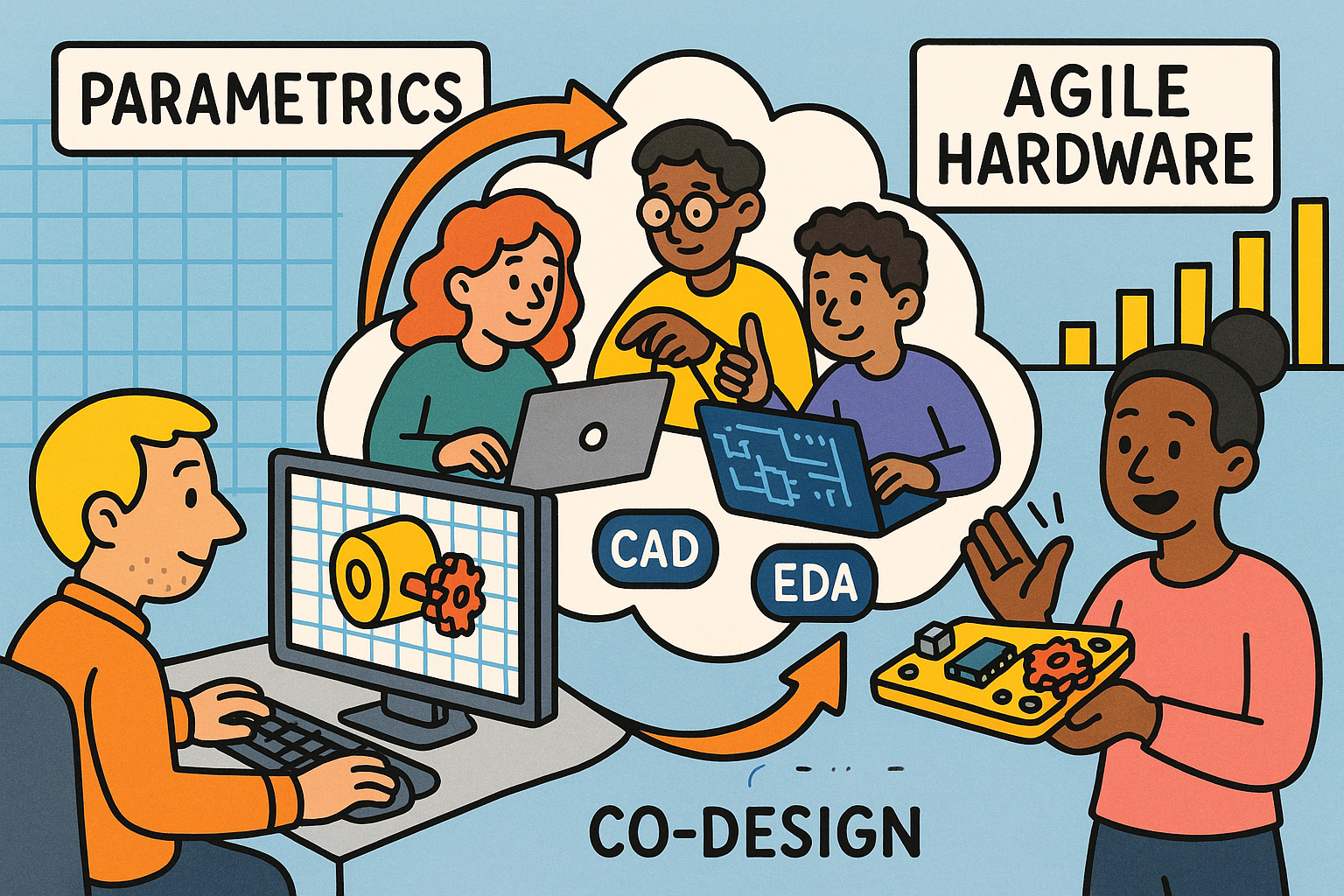


Agile hardware did not emerge because engineering suddenly became easy; it emerged because CAD and EDA quietly accumulated the capabilities necessary to shorten feedback loops without compromising traceability, quality, or manufacturability. Over three decades, parametric modeling matured, direct editing arrived to handle late-stage change, ECAD–MCAD interoperability moved from brittle file handoffs to live iteration, and cloud-native collaboration dissolved the friction of workstations, vaults, and file locks. In parallel, integrated simulation, quick-turn manufacturing, and live supply-data pipelines connected decisions to outcomes in days instead of months. The result is a pragmatic, tool-enabled culture in which sprints, backlogs, and visual flow controls are not buzzwords but working patterns. This article traces how that transformation unfolded across CAD and EDA vendors and standards bodies, identifies the technical foundations that make rapid iteration viable in electronics and mechatronics, and shows how today’s toolchains operationalize agile workflows from design intent to release. Throughout, the emphasis is on the specific people, products, and platform decisions—from Samuel P. Geisberg’s parametric revolution to Jon Hirschtick’s cloud-native collaboration—that turned aspiration into everyday practice.
From Waterfall to Sprints: A Brief History of Agile Hardware in CAD/EDA
Pre‑agile era: gated NPI, ECO-driven change, and workstation-era PDM constraints
Before agile language entered hardware, mechanical and electronic development were defined by gated New Product Introduction (NPI) and an Engineering Change Order (ECO) economy. Teams lived in UNIX and early Windows workstation ecosystems, where CAD ran on SGI, Sun, and later high-spec PCs, and PDM meant file check-in/check-out with lock semantics. Systems like PTC Pro/INTRALINK, Dassault SmarTeam, MatrixOne (later Dassault ENOVIA), and SDRC Metaphase (which evolved into Siemens Teamcenter) institutionalized vaulting, revision rules, and lifecycle states. Those capabilities were essential for enterprise control, but they also encouraged long phases: concept, detailed design, release, and then change via ECOs that rippled backward through drawings and part masters. Meanwhile, EDA data lived in separate repositories—Cadence Allegro and OrCAD, Mentor Graphics Board Station and Expedition (before becoming Siemens EDA), Zuken CR-5000 and later CR-8000—exchanging with mechanical via STEP or IDF files that were brittle and lossy. The cultural result was batch integration: synchronized handoffs at formal gates, with PDM enforcing serialization, not collaboration. When defects surfaced in late review or prototype bring-up, rework followed the ECO chain. The massive friction of vault locks, thick client installs, and departmental boundaries made “iteration” synonymous with churn. Agile was philosophically attractive, but the platforms were not ready to support short, closed-loop cycles with multi-domain traceability.
Parametric foundations: Pro/ENGINEER, SolidWorks, CATIA V5, and the rise of feature intelligence
The basis for agile hardware was laid in the 1990s by parametric, feature-based modeling. Under Samuel P. Geisberg, PTC’s Pro/ENGINEER introduced parametric constraints and history trees that preserved design intent as editable rules. Designers could drive geometry with dimensions, relations, and configuration tables, enabling change at the speed of parameter updates rather than wholesale remodels. Jon Hirschtick and the founding team at SolidWorks brought those ideas to Windows with a lighter footprint, popularizing feature trees, configurations, and design tables for mass customization. Dassault’s CATIA V5 extended the approach to complex surfacing and large assemblies used by aerospace and automotive OEMs, while enabling skeletal modeling and top-down control via publications and contextual references. This era’s breakthrough was not a file format but a mindset: models became programmable artifacts with constraints that could be recalculated across a family of variants. In effect, parametrics converted change from a labor cost to a computation cost. Engineers could build templates—driven by Excel, VBA, or APIs—that made design spaces navigable. That capability, widely distributed across PTC, Dassault, and later Siemens NX, created the conditions for sprint-level experiments: adjust a few parameters, regenerate, and test hypotheses quickly without redrawing. The paradox was that while parametrics invited speed, workstation-era PDM and monolithic desktop clients still put friction in the loop, limiting collaboration to small, colocated teams.
Direct modeling breakthroughs: SpaceClaim, Siemens Synchronous Technology, and Creo hybrids
Parametric history is powerful when you control it, but late-stage changes often arrive without warning, and history dependencies can fight the designer. Around 2005–2010, direct modeling gained momentum with SpaceClaim (founded by Mike Payne, Blake Courter, and Daniel Dean) promoting push–pull edits that ignored feature history. Siemens answered with Synchronous Technology in NX and Solid Edge, combining feature awareness with geometry inference so faces, blends, and patterns could move coherently without rebuilding the full tree. PTC, acknowledging the tension, evolved Pro/ENGINEER into Creo with hybrid workflows that let engineers mix history, parameters, and direct edits in the same model. The impact on agility was immediate: late-stage ECOs that once threatened schedules could be absorbed by direct edits that preserved downstream references, letting teams keep prototypes and tooling plans on track. Vendors also exposed rule engines—NX’s expressions and WAVE links, Creo’s relations and Flexible Modeling, SolidWorks’ Instant3D—so direct changes respected design intent where possible. In practice, direct modeling became the safety valve for sprint-friendly behavior: engineers could accept external STEP geometry from suppliers, clean it, defeature it for simulation, or patch issues without reverse-engineering a feature tree. By making “change” a first-class operation even when the history is imperfect, direct modeling allowed agile loops to continue deep into integration and validation.
ECAD–MCAD co-design evolves from file handoffs to live iteration
Electromechanical integration is where theory meets reality. Early ECAD–MCAD exchanges relied on IDF and STEP snapshots that required careful bookkeeping and frequent manual reconciliation. Altium pushed forward with early 3D PCB visualization in the mid-to-late 2000s, letting mechanical teams see component envelopes and keep-out volumes rather than abstract footprints. The arrival of the EDMD/IDX standard from ProSTEP iViP replaced static handoffs with interactive proposals—board outline tweaks, component moves, hole changes—that each side could accept or reject. Cadence Allegro and Mentor Xpedition (now part of Siemens EDA) adopted IDX workflows, and mechanical peers in SOLIDWORKS, Creo, and NX implemented round-tripping, turning co-design into an incremental conversation. The cumulative effect was cultural: instead of a PCB “release” landing on mechanical as a surprise, teams could iterate at the boundary condition level, with clearance, height, and thermal considerations shared early. Rigid‑flex constraints, mezzanine connectors, and antenna keep-outs became shared artifacts, not just text in a PDF. By shrinking the ECAD–MCAD latency, IDX-enabled flows raised the ceiling on how agile hardware could be in mixed-discipline contexts. Organizations discovered that visual, bidirectional negotiation beats redlines and emails, particularly under schedule pressure.
Cloud-native collaboration: Onshape, Fusion 360, and supply-aware electronics with Altium 365
The final barrier to agile behavior was collaboration friction: files, locks, and installations. Onshape, launched by Jon Hirschtick and John McEleney, reframed CAD as a real-time, cloud-native system with branching and merging, web viewers, and audit trails. Instead of moving files, teams move references; instead of locking, they branch, iterate, and merge with clarity. Autodesk Fusion 360 integrated CAD/CAM/CAE in a cloud-connected environment, bringing simulation and manufacturing closer to design intent. In electronics, Altium 365 bound design to live supply data via Octopart, so part selections reflected current availability, lifecycle, and risk, not just static library metadata. These shifts eliminated the IT overhead that once throttled iteration: VPNs, license servers, and enormous desktop installs. Reviews moved into browsers; markup and MBD/PMI reduced drawing churn; and design stakeholders could participate without bespoke clients. For agile teams, the benefits were not just speed but observability: who changed what, when, and why is visible without spelunking shared drives. That visibility underpins continuous improvement, enabling patterns like design sprints and architecture spikes in hardware contexts that used to resist them.
Cultural shift: Scrum, Kanban, and scaled frameworks adapted to hardware
Process change followed platform change. As CAD/EDA made short cycles practical, hardware organizations adapted Scrum and Kanban to their realities. Sprint boundaries aligned with meaningful integration moments—PCB bring-up, fixture availability, supplier quotes—and backlogs included CAD debt, DFM remediation, and test coverage. Scaled frameworks like SAFe for hardware were adopted by OEMs that needed synchronized cadence across electronics, mechanics, firmware, and compliance. Crucially, teams learned to externalize constraints: visualization of lead times, test lab capacity, and tooling windows ensures that sprint commitments are feasible. Design sprints, popularized by startups, became common even in advanced OEMs when PDM/PLM and compliance could be automated. The cultural hallmark of this period is the recognition that agility is a systems property: without ECAD–MCAD round-tripping, fast DFM feedback, and accessible simulation, standups and retros do little. With those enablers in place, hardware teams use WIP limits to favor flow, buffer for supplier uncertainty, and employ incremental baselines so integration efforts accumulate rather than reset. In effect, culture and tooling converged: ceremonies gained teeth because the platforms made frequent, traceable change safe.
Core Technologies Enabling Rapid Iteration in Electronics and Mechatronics
Geometry and modeling: hybrid editing, top-down control, and programmable features
Modern geometry engines blend parametric and direct editing so designs can be both intent-driven and resilient to late change. Top-down assemblies and skeletal modeling let architects define interfaces, reference planes, and kinematic skeletons that downstream parts respect. Reusable templates—assembly “kits,” driving sketches, master models—create a baseline for sprint-level variation. Automation is no longer a niche: Onshape FeatureScript enables custom features that encapsulate company rules, while the SOLIDWORKS API, PTC Creo Toolkit, and NX Open allow scripted geometry creation, batch property checks, and export pipelines. Mechatronics requires domain-specific features: sheet-metal tools account for bend allowances and K‑factors; wiring and routing modules build harnesses with pin maps and electrical rules; rigid‑flex PCB tools represent stackups and bending zones as mechanical constraints. The agile value is compounding: each template or custom feature eliminates recurring labor and variation. Practical strategies include: - Seed libraries for mounting patterns, sealing interfaces, and datum schemes that enforce CMM-friendly alignment. - Standardized parameter names across assemblies to allow global “what-if” sweeps with design tables. - Configured components that encode size ranges, materials, and finish options tied to supplier part numbers. When geometry is programmable, teams answer “can we?” with a parameter update, not a meeting. That shift unlocks short, closed-loop iterations where the cost of exploration is extremely low.
ECAD–MCAD interoperability: standards, links, and robust pipelines
Interoperability moved from files to protocols and live links. EDMD/IDX, driven by ProSTEP iViP, is now the backbone of ECAD–MCAD collaboration, exchanging proposals that capture intent—component moves, keep-outs, board outlines—with acceptance tracking. For full-product representation, STEP AP242 extends STEP with PMI/MBD and assembly structures, making drawingless release more practical. In PCB manufacturing, IPC-2581 and ODB++ (originating with Valor, later Mentor and now Siemens) carry fabrication, assembly, and test intent far beyond Gerber. Tool integrations operationalize these standards: Creo ECAD–MCAD Collaboration modules, SOLIDWORKS links to Altium (including SOLIDWORKS PCB history), and NX connectors for Xpedition and Allegro reduce translation loss. Open-source ecosystems benefit as well: KiCad, with CERN-backed improvements, now exports reliable STEP and IDF for integrating mechanical context into free EDA workflows. Robust pipelines look like this: - IDX for day-to-day co-design between PCB and enclosure teams. - STEP AP242 for consolidated electromechanical assemblies with PMI for supplier-facing releases. - IPC-2581/ODB++ for fab/assembly, ensuring DFM/DFT intent travels intact. When these standards are deeply integrated, electromechanical decisions become continuous rather than episodic, and issues surface while they’re still cheap to change.
Simulation in the loop: electronics, mechanical/thermal, and controls co-simulation
Agile requires test as a peer to design. Electronics relies on SPICE-family tools—LTspice, PSpice, and vendor-specific solvers—for functional verification, but high-speed and power integrity bring in Cadence Sigrity, Ansys SIwave, and Keysight ADS to manage impedance, crosstalk, and EMI. Mechanical teams employ Ansys Discovery/Mechanical, COMSOL, and Altair Inspire for structural and modal checks, and CFD via Siemens Simcenter or Ansys Fluent/Icepak for cooling. Controls and mechatronics leverage MATLAB/Simulink and Simscape, with FMI/FMUs enabling co-simulation across vendor tools. The digital twin concept—promoted by Siemens and Ansys—binds these domains to a single source of truth, parametrically connected to CAD and requirements. Sprint-friendly patterns include: - Early SI/PI screening on critical nets to freeze stackup assumptions before layout congestion rises. - Thermal feasibility checks with simplified models, iterating quickly on heat sink geometries and venting patterns. - Plant models exported as FMUs feeding HIL rigs so firmware targets real dynamics, not idealized placeholders. By front-loading simulation and keeping it lightweight where possible, teams maintain velocity while avoiding costly design-in errors. Crucially, automation scripts drive simulation setups from CAD metadata, making simulation-in-the-loop a habitual, low-overhead activity.
Manufacturing acceleration and DFX: integrated CAM, additive, and quick-turn ecosystems
Iteration does not end at CAD; manufacturability governs reality. Cloud-connected and integrated CAM—within Fusion 360, Siemens NX, and via connectors to Mastercam—lets designers verify tool access, surface finish implications, and fixture schemes without translation delays. Additive manufacturing tools bring lattice generation, topology optimization, and support strategies into the design loop so prototypes are production-representative, not merely appearance models. For PCBs, DFM/DFT tools like Valor NPI, Altium DRC/DFM, and DownStream CAM350 enforce fabrication rules and test coverage, shifting discoverability left. The fabrication marketplace accelerates the physical loop: Xometry and Fictiv for machined and printed parts, and JLCPCB, MacroFab, and OSH Park for PCBs and assembly, provide cost and lead-time clarity early. Agile-friendly practices include: - Automated export pipelines that package STEP, drawings/PMI, CAM toolpaths, and inspection plans with consistent metadata. - Parametric jigs/fixtures that print overnight, enabling consistent testing across sprints. - Early stencil and panelization planning to reduce iteration tax on assembly houses. When DFX is integrated, prototype-to-production drift shrinks, making each sprint a credible rehearsal for scale rather than a throwaway experiment.
Supply chain and variant management: live data, risk analytics, and PLM links
Component availability can make or break agility. Live part intelligence via Octopart (embedded in Altium), SiliconExpert integrations, and distributor APIs exposes lifecycle, stock, lead times, and environmental compliance at selection time. Variant management hinges on clean BOM discipline: configured parts across mechanical and electronic domains with approved alternates and Approved Vendor Lists (AVL). PLM systems—PTC Windchill (with Arena for cloud-native SMBs), Siemens Teamcenter, and Dassault ENOVIA/3DEXPERIENCE—anchor the digital thread, linking requirements, CAD, ECAD, simulation, BOMs, and releases. Effective patterns include: - BOM policies that prefer multi-source, lifecycle-stable components and enforce AVL at release gates. - Automated risk scoring rolled into design reviews so alternates are pre-approved before shortages hit. - Variant rules that propagate across domains: a mechanical finish change triggers corrosion testing; an MCU swap triggers firmware and HIL updates. With supply visibility and PLM synchronization, teams plan sprints against real-world constraints, reducing surprises and compressing redesign cycles caused by obsolescence or allocation events.
Agile Workflow Patterns Operationalized in Modern Toolchains
Short, closed-loop iterations: parameterized templates, rapid gates, and modular BOMs
In agile hardware, iteration cycles are deliberately small and traceable. Parameterized templates convert product families into adjustable models where new variants are born from design tables or configuration logic, not copy-paste. Modular BOMs mirror this strategy, decomposing products into swappable subassemblies with clear interface contracts. Rapid prototyping gates use 3D‑printed jigs and fixtures to standardize tests, while quick-turn PCB services provide evidence before architectural decisions harden. Effective patterns include: - Sprint definitions anchored to testable increments: a thermal target verified on a surrogate chassis; a control loop validated on a benchtop plant model. - Design tables and configuration managers that generate variant sets with consistent naming, metadata, and drawing/PMI assets. - Clear exit criteria that bind simulation to physical checks: a modal frequency margin backed by both FEA and shaker data. These loops rely on tools that regenerate and export consistently. Scripts pull CAD parameters into test plans and populate dashboards with mass, COG, and envelope deltas. With friction removed, teams treat every sprint as a hypothesis test that either strengthens the baseline or informs the next change, rather than as a mini-waterfall disguised by shorter timeboxes.
Collaboration, versioning, and review: cloud PDM/PLM, web viewers, and drawingless sign-off
Agile thrives on fast, shared understanding. Cloud PDM/PLM systems collapse the walls between authoring tools and stakeholders. Onshape provides branching and merging akin to software, with compare tools that highlight geometry differences. 3DEXPERIENCE, Teamcenter Active Workspace, and Fusion 360 Manage expose issues, change objects, and tasks in web interfaces, reducing license friction for reviewers. Integrations to Jira and Azure DevOps connect engineering artifacts to epics and user stories, aligning mechanical and electronic change with firmware and validation. Lightweight reviews use web viewers, markups, exploded views, and Model-Based Definition (MBD) / Product Manufacturing Information (PMI) to achieve drawingless sign-off where suppliers support it. Patterns that work: - Mandatory linkages between change requests and CAD/EDA states so approvals record exactly what geometry and nets changed. - Automated review packages that attach neutral formats (STEP AP242, 3D PDF, IPC-2581) and compliance checklists. - Supplier portals that accept comments against exact versions, eliminating “which file?” confusion. Because everyone sees the same artifact in the browser, cycle time drops and feedback increases in quality. Traceability stops being a chore and becomes a byproduct of normal work.
Automation and continuous integration for hardware: scripted checks and release pipelines
Continuous integration for hardware is practical when checks are scriptable and release packaging is deterministic. CAD APIs and geometry kernels enable automated interference detection, mass/COG targets, and envelope compliance on every commit. EDA CI runs rule decks: ERC/DRC, netlist/package audits, and high-risk signal checks that flag violations before layout freezes. BOM pipelines enforce AVL and generate alternates lists, while comparing live supply data to identify risks. Mature flows include: - Nightly geometry validations that export STEP/parasolid, regenerate meshes for simulation, and create thumbnails for reviews. - EDA batch jobs that build Gerbers/ODB++/IPC‑2581 from the source of truth, ensuring consistency across fabricators. - API-driven release packaging that produces traceable baselines: CAD, ECAD, simulation, test plans, and compliance documents all stamped with the same revision and hash. Automated quoting via Xometry/Fictiv and PCB houses closes the loop by turning release candidates into lead-time and cost data. The result is fast, low-drama releases where surprises are rare, and sprints end in artifacts that are both testable and manufacturable.
Mechatronics orchestration: MBSE, firmware alignment, and HIL at sprint cadence
Electromechanical products demand synchronized change across domains. Model-Based Systems Engineering (MBSE) with SysML—implemented in Cameo Systems Modeler (No Magic/Dassault) and IBM Rhapsody—captures requirements, interfaces, and behaviors as first-class models. Requirements trace into CAD and ECAD objects via PLM links, so a sensor accuracy target can be traced to enclosure stiffness, PCB layout constraints, and firmware filtering. Firmware alignment depends on Interface Control Documents (ICDs) and auto-generated harness pin maps, binding hardware interfaces to code. Hardware-in-the-Loop (HIL) rigs—using dSPACE, NI LabVIEW/VeriStand, or Speedgoat—let control algorithms run against real-time plant models and I/O under realistic latencies. To keep pace with sprints: - MBSE models define increments: which interfaces stabilize this sprint, which stay provisional. - Harness and PCB schematics auto-generate pin and signal maps consumed by firmware build systems. - HIL scripts execute nightly with FMUs, logging performance metrics to the same dashboards as mechanical and thermal results. When orchestration is tight, integration becomes a continuous activity, not an end-of-phase event. Teams detect cross-domain regressions quickly and negotiate changes from a shared model, keeping agility intact as the product’s complexity grows.
Conclusion
Where agile hardware stands, and what comes next
Agile hardware became practical when CAD and EDA matured to reduce the cost of change across the lifecycle. Parametrics turned geometry into editable intent, direct modeling absorbed late-stage edits gracefully, ECAD–MCAD co-design via IDX made electromechanical negotiation continuous, and cloud-native collaboration removed the file-lock friction that once serialized work. Standards—IDX, STEP AP242, IPC‑2581/ODB++—and integrated simulation closed the loop from concept to test, while quick-turn manufacturing and live supply data compressed iteration time and exposed real constraints early. The digital thread that ties requirements, models, BOMs, tests, and releases in PLM underpins repeatable rapid iteration across disciplines. Looking forward, AI will assist design and DFx by suggesting parameter ranges, predicting manufacturing issues, and surfacing supply-aware alternates in real time. Richer MBSE-to-CAD synchronization will propagate interface changes without manual rework, and scalable digital twins will make sprint-level validation both faster and more reliable by fusing telemetry with simulation. The trajectory is clear: the next gains won’t come from a single tool but from tighter, smarter connections between them, so that hardware teams can explore more, decide sooner, and build with confidence.
Also in Design News