Your Cart is Empty


Design Software History: From Mates to Multibody Motion: The Rise of Constraint‑Based Assemblies and Real‑Time Collision in CAD


Brief introduction
Context and scope
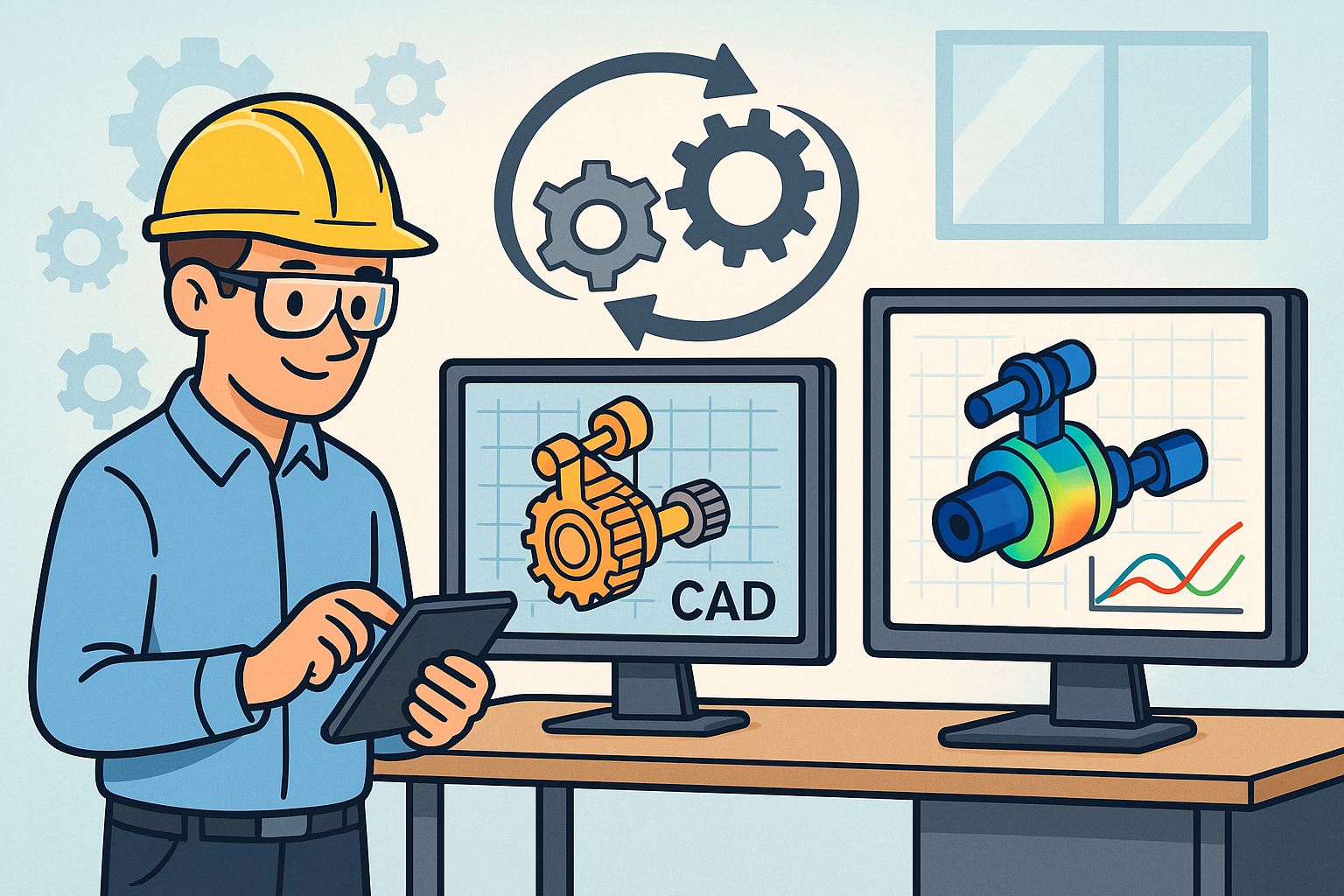
The modern story of assemblies in mechanical and architectural CAD is a migration from hand-placed parts and brittle ad hoc mates to constraint-based kinematics tied to real‑time collision avoidance and, increasingly, to multibody dynamics and path planning. What follows traces that arc from the late 1980s through today, focusing on the interplay between underlying geometric kernels, independent constraint and collision engines, and the productization decisions made by PTC, Siemens (UGS), Dassault Systèmes, SolidWorks, Autodesk, and cloud-era entrants. The emphasis is on the technologies and people who turned DOF bookkeeping, convex distance algorithms, and swept volumes into everyday engineering tools.Why this matters now
As organizations seek to validate Digital Mock-Up (DMU) at enterprise scale, the hard problems—robust constraints across huge bills of materials, interactive clearance under motion, flexible components, and robotics cohabiting with humans—are no longer niche. They are table stakes. Vendor-neutral algorithms like GJK and OBBTree have quietly standardized expectations across platforms, while supplier tech such as D‑Cubed, Parasolid, and ACIS has given even smaller vendors credible cores. Meanwhile, GPU-native signed distance fields and continuous methods hint at a future where collision assurance is always on, predictive, and differentiable. The sections below consolidate that history and outline the practical engineering decisions that made constraint-driven assemblies and real-time clearance not only possible but dependable.Foundations: From Mates to Constraint-Based Kinematics (late 1980s–1990s)
Problem framing
By the late 1980s, CAD users needed to position hundreds or thousands of rigid parts in complex products—gearboxes, aircraft interiors, medical devices—so that engineering intent was explicit: holes aligned, axes were concentric, faces were parallel or coincident, and fasteners could move within allowable degrees of freedom (DOF). Ad hoc transformations (translate/rotate) made for fragile assemblies: modify a part and everything nearby could drift or break. The industry pivoted to declarative constraints—mate, align, insert, tangent—so the solver, not the drafter, enforced topology-aware relationships. The abstraction mapped naturally to kinematic pairs: a concentric mate implied a revolute or cylindrical joint; a planar mate with a distance offset created prismatic behavior. The crux was bookkeeping. A single bolt-nut-washer stack can be over‑constrained with a few careless mates; a suspension linkage is easily under‑constrained. Efficient detection of redundancy and instability, and the capacity to retain free motion for studies, required graph structures for assembly constraints and rigorous DOF accounting. As real-world products accreted, constraint solvers needed to be tolerant of near-parallel faces, nearly-coincident axes, and finite numeric precision, while still converging rapidly when features moved parametrically.Early commercial milestones
In 1988, PTC’s Pro/ENGINEER, instigated by Samuel P. Geisberg, mainstreamed parametric feature-based modeling and constraint-driven assemblies. Pro/ENGINEER’s early mechanism modules demonstrated that assemblies weren’t just static arrangements; they could encode kinematic behavior and feed motion studies. Around the same era, Unigraphics (later UG, then UGS, and today Siemens NX) paired assembly constraints with the Parasolid kernel, integrating reliable topology/geometry services and early interference analysis. Dassault Systèmes transitioned from CATIA V4 to V5 (around 1999), introducing modern parametrics and the DMU Kinematics workbench, which unified assembly relations and motion within a large-scale Digital Mock-Up context. On the mid-market, SolidWorks (founded by Jon Hirschtick in 1993; first release 1995) popularized an intuitive “mates” UI that hid solver complexity behind terms engineers used on the shop floor (concentric, coincident, distance). SolidWorks also leveraged Parasolid, reinforcing the ecosystem’s kernel consolidation. These products proved that constraint-based assemblies could be both expressive and usable, and they seeded expectations for robustness that would drive supplier markets in solvers and geometric libraries.- PTC Pro/ENGINEER (1988): Parametric features; constraint assembly; mechanism option.
- Unigraphics/UG → NX (UGS; later Siemens): Assembly constraints; Parasolid-centered interference tools.
- Dassault CATIA V5 (1999): Modern parametrics; DMU Kinematics for large digital mock-ups.
- SolidWorks (1995): Intuitive “mates” UX for SMBs; Parasolid-based modeling.
Constraint technology suppliers and people
The rise in parametrics catalyzed an independent market for constraint solvers. In the UK, D‑Cubed, founded by John R. Owen, delivered the 2D DCM and 3D DCM for sketch and 3D constraints, plus the AEM (Assembly Engineering Manager) for assemblies and CDM (Collision Detection Manager) for proximity. Acquired by UGS in 2004 (and later part of Siemens Digital Industries Software), D‑Cubed became the quiet backbone of constraint management in numerous CAD systems. In parallel, geometric kernels—Spatial’s ACIS (originating from Spatial Technology, founded by Dick Sowar) and Siemens Parasolid (initially by Shape Data)—provided reliable topology, exact geometry, and boolean/interference APIs crucial for constraint placement and robust mating. In Novosibirsk, LEDAS, led technically by Dmitry Ushakov and colleagues, developed LGS 2D/3D, an independent constraint solver stack during the 2000s. LGS found adoption in Eastern European and international systems including KOMPAS‑3D (ASCON) and T‑FLEX (Top Systems). This plurality was healthy: it diversified solver strategies, pressure‑tested robustness, and decoupled innovation from the largest CAD vendors.Core methods that emerged
Under the hood, several standard approaches stabilized. Engineers modeled assemblies via constraint graphs: nodes for parts (or frames), edges for relations (mate, align), annotated with DOF contributions. Solvers performed DOF analysis to identify under‑ or over‑constrained regions and redundancy. For numerical solution, constraints were linearized about the current configuration; non-linear least-squares and projective methods such as Gauss–Newton and Levenberg–Marquardt iteratively drove residuals toward zero. For strict satisfaction of closure conditions, Lagrange multipliers enforced holonomic constraints, while stabilization (e.g., Baumgarte terms or projection) corrected drift in loops. To align the semantics of CAD “mates” with kinematics, vendors curated joint libraries mapping UI verbs to classical pairs: revolute, prismatic, cylindrical, spherical, and planar. Constraints like “tangent” between cams and followers were treated as contact relations with configurable rolling properties. This normalization allowed mechanism modules to share foundations with assembly solvers: a concentric fastener could spin freely (revolute DOF) unless locked by an additional angle constraint, and a sliding dovetail would be prismatic unless stopped by limits. Over time, diagnostics (conflict highlighting, redundancy alerts) and incremental solving made editing large, deeply nested assemblies practical.Collision Detection and Avoidance: From Batch Interference Checks to Real-Time Clearance (1990s–2000s)
Algorithmic breakthroughs (convex distance/intersection)
Interactive clearance demanded fast, robust distance and intersection testing. Three algorithmic pillars emerged for convex sets. First, the GJK (Gilbert–Johnson–Keerthi, 1988) algorithm framed distance queries via the Minkowski difference, iteratively refining a simplex toward the origin to compute the minimum distance or detect overlap. Second, Lin–Canny (1991) exploited temporal coherence—the fact that between animation frames, closest features rarely change dramatically—to incrementally update distances. Third, V-Clip (Brian Mirtich, 1998) provided robust vertex–face and edge–edge tracking for convex polytopes, with careful handling of degeneracies. These convex-core methods enabled reliable proximity for subcomponents idealized as convex hulls or decomposed into convex pieces. They also bridged into continuous queries: knowing exact closest features supports conservative time-of-impact estimates. In CAD, where parts are often represented as trimmed NURBS shells (B-reps), these algorithms usually operate on tessellations or convex decompositions, backed by the kernel for exact refinement when tolerances demand it.Hierarchies and broad-phase acceleration for large models
As assemblies scaled to millions of triangles, brute-force pair testing collapsed. The community converged on hierarchical bounding volume hierarchies (BVHs) and broad-phase culling. OBBTree (Gottschalk, Lin, Manocha, 1996) used oriented bounding boxes to tightly fit local geometry; its public embodiment, RAPID (1997), set a baseline for triangle–triangle testing in hierarchical form. PQP (Larsen, Gottschalk, Lin, Manocha, 1999) extended this to distance/proximity with specified tolerances, invaluable for clearance bands. Concurrently, k‑DOPs (Klosowski, Held, Mitchell, Sowizral, Žikán, 1998) traded slightly looser fits for faster overlap tests, while AABB trees, sweep‑and‑prune, and spatial hashing improved broad‑phase pair culling. CAD/DMU systems combined these ideas: A fast broad‑phase over part bounding boxes pruned obvious non‑interacting subtrees; per‑part BVHs (often OBB or AABB) supported narrow‑phase triangle or feature tests. The algorithms were tuned for CAD’s static meshes and slow motion: refitting hierarchies, exploiting frame‑to‑frame coherence, and parallelizing traversals across cores yielded interactive rates even for aircraft or plant models.From discrete “clash” to continuous motion safety
Batch “clash detection” caught hard penetrations in static snapshots. But fast motions can tunnel through thin features between frames. Continuous collision detection (CCD) addressed this, often via conservative advancement (Mirtich, late 1990s): step forward in time by a safe increment bounded by current separation and relative velocity, guaranteeing no missed contact. Complementary constructs—swept volumes and Minkowski sums—captured the envelope of moving tools, fixtures, or human reach spaces. In manufacturing, this enabled reliable path/clearance envelopes for robotics, NC toolpaths, and assembly sequence validations. The shift to continuous thinking also enabled contact modeling. Even where CAD treated parts as rigid, distinguishing between first contact (distance zero), allowed soft clash (clearance band violation), and penetration (negative distance) made reports actionable: find the nearest hits, compute penetration depth for parts that must be separated, and annotate the corresponding features. This information fed upstream: mechanism solvers could halt motion at contacts or trigger constraints that represented hard stops or joint limits.Practical CAD/DMU considerations
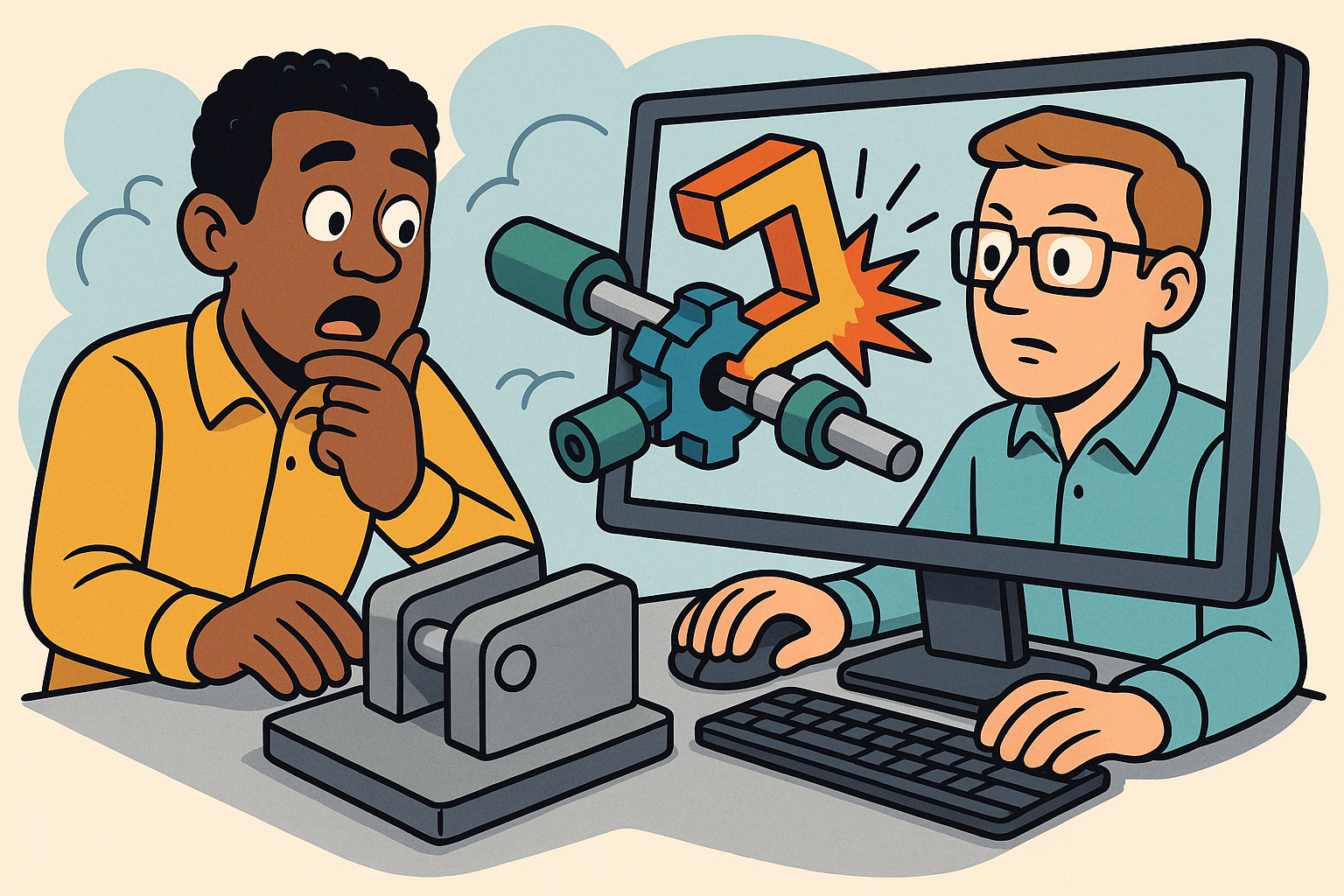
DMU practitioners live at the boundary between tessellated B‑reps and exact NURBS geometry. Triangulations deliver performance and GPU interactivity, but they carry discretization error. Tolerance management—chordal, angular, gap—became a core competency, along with robustness under near-coincident faces and sliver triangles. Many platforms used a two-tier approach: quickly triage with tessellations; when distances approach thresholds, refine using kernel queries or local re‑tessellation to keep false positives/negatives in check. Interference types matured into a taxonomy:- Hard clash: Penetration beyond tolerances; report depth, intersection curves, and culprit features.
- Soft clash: Clearance-band violations; useful for safety margins, insulation thickness, and ergonomic envelopes.
- Contact: Zero distance events with stable feature pairs; essential for motion stops and kinematic constraints.
Industrialization: Marrying Constraints, Multibody Dynamics, and Collision Avoidance (2000s–present)
Tight coupling of kinematic solvers and collision engines
With constraints and collision reliable in isolation, the next step was to integrate them for moving assemblies. Closed loops—four‑bars, planetary geartrains, door‑hinge‑latch systems—raised subtle issues: internal redundancy, numerical drift, and stabilization. Assembly solvers projected onto constraint manifolds; motion integrators advanced states; collision queries returned distances/contacts; and a resolver enforced non‑penetration and joint limits. The canonical pattern became: solve constraints → advance motion → query clearance → resolve contacts/limits → iterate until convergence per timestep. Constraint drift was a persistent adversary in loops. Techniques drawn from multibody dynamics—Baumgarte stabilization, velocity/position projection, and post‑stabilization—kept joints closed. Where elasticity mattered (bushings, compliance), penalty forces blended with constraint impulses. Threading in Featherstone’s articulated-body algorithm enabled real-time forward dynamics for tree structures, while loop closures fell back to constraint projection or Lagrange-multiplier solves. These hybrids turned CAD assemblies into simulable mechanisms without forcing users into heavyweight FEA or dedicated MBD packages.Productization in major platforms
Vendors systematized these pipelines across product lines. Dassault Systèmes combined CATIA DMU Kinematics and DMU Fitting with DELMIA for factory and robotics planning. Motion/path features drew on academic planning traditions—PRM (Kavraki, Švestka, Latombe, Overmars) and RRT (LaValle & Kuffner)—adapting them to CAD geometry, swept volumes, and clearance bands. Siemens NX Motion and Tecnomatix Process Simulate integrated Parasolid geometry with D‑Cubed AEM/CDM proximity pipelines; for large DMU they leaned on the lightweight JT format to mix decimated meshes in interactive views with on-demand refinement. PTC Mechanism Design (later Creo) matured from Pro/ENGINEER’s modules into a full motion environment; SolidWorks Motion inherited the COSMOSMotion/MSC ADAMS lineage for dynamics while using mates as joints; Autodesk Inventor offered Dynamic Simulation; and Onshape, a cloud CAD, adopted D‑Cubed components to deliver real-time mates and collision inside collaborative sessions. Key to adoption was keeping the user model intact: a “mate” or “constraint” became a joint automatically; adding a limit to a distance mate created a prismatic stop; turning on contact for two groups engaged clearance checking in the solver loop. Users saw consistent metaphors; the platform mediated the algorithms.Scaling to very large assemblies
Automotive, aerospace, and process industries forced the issue of scale. Product teams needed interactive motion and clearance across assemblies holding tens of thousands of parts. Solutions blended algorithmic and infrastructure advances:- Incremental BVH updates and temporal coherence to avoid rebuilding hierarchies as parts moved slightly.
- Multi-resolution meshes and decimation to maintain interactivity, with on-demand refinement near queried zones.
- Parallel broad-phase culling and BVH traversals across multi-core CPUs and GPUs.
- Distributed scenegraph and data streaming so only in-scope subassemblies were resident.
Special cases and domain nuances
Rigid parts are only part of the story. Hoses, cables, and wire harnesses demanded envelope approximations and curve/rod solvers with clearance bands. Vendors used centerline splines with circular/elliptical cross-sections to model flexible components; swept volumes or voxel SDFs provided quick checks against neighboring parts. Tighter integrations added bending stiffness, minimum bend radii, and clamps/fixtures as constraints that influenced routing. Manufacturing validation required swept solids for NC toolpaths and additive manufacturing (AM) verification. Tool/fixture clearance, fixture reachability, and build-head trajectories benefitted from Minkowski-sum-based offsets and conservative envelopes. Meanwhile, assembly planning leveraged collision-aware sequence checks: given preferred orders and component priorities, the system searched for insert/extract paths that honored clearance bands. In human–robot and cobot deployments, plants used SDF-based safety zones and predictive path replanning to enforce real-time separation, blending CAD-defined keep-out volumes with live perception. The upshot is a continuum: constraints define intent and nominal motion; collision engines and planners enforce feasibility and safety; dynamics add realism where mass/inertia and compliance matter.Collision Detection and Avoidance: Practical Integration Patterns and GPU-Era Advances
Iterative coupling loops in practice
In deployed systems, collision and kinematics are interleaved with care to balance stability and speed. A typical timestep might: (1) linearize and solve assembly constraints; (2) integrate motion with limits to get a predicted pose; (3) run broad-phase culling on moving sets; (4) perform narrow-phase distance queries; (5) detect contact transitions (separating to touching, touching to penetrating); (6) resolve with either constraint impulses, position correction, or penalty forces; (7) re-project onto the exact constraint manifold. Each stage exploits coherence—feature pairs and witness points are cached, BVHs are refit not rebuilt, and active contact sets are warm-started. For closed loops and stiff contacts, solvers often switch to mixed linear complementarity problem (LCP) formulations or projected Gauss–Seidel iterations to resolve normal and friction constraints, while retaining the semantics of CAD joints. In DMU tools that avoid exposing raw dynamics, the same math appears behind “stop at collision” modes and “limit mates,” ensuring the user’s intent holds as bodies push against assembled neighbors.GPU-native representations
As programmable GPUs matured, CAD/DMU adopted rasterization and compute kernels for proximity. Rasterization-based clearance maps leveraged depth peeling and occlusion queries to conservatively estimate gaps in screen space, effective for quick fit checks. More broadly, voxel SDFs stored signed distances in 3D grids; computing distances became O(1) lookups with trilinear interpolation, enabling dense sampling around moving parts. Multi-resolution SDFs (octrees) and narrow-band updates confined cost to relevant regions. Hybrid pipelines used SDFs to estimate time-of-impact and fallback to exact triangle/feature tests near thresholds to bound error. For assemblies with deforming or quasi-flexible parts, dynamic SDFs or GPU-friendly convex decompositions let systems maintain interactive rates under significant motion. The key is predictability: while exact B-rep feature tests are precise, SDFs provide stable runtimes and straightforward morphology (dilations/erosions) for clearance bands and safety zones.Accuracy, tolerances, and reporting
Industrial users need more than yes/no answers. Reports must enumerate:- Shortest distances between component pairs and the exact witness features (edge, face, vertex) involved.
- Penetration depths and suggested separation vectors for corrective actions.
- Classification (hard clash, soft clash, contact) with references to part and occurrence IDs in the BOM.
Organizational adoption patterns
Enterprises standardize collision and constraint practices through templates and governance: default mate types, acceptable DOF for subassemblies (e.g., bolts left free to spin), and required clearance bands by domain (electrical vs. HVAC vs. structures). Lightweight data formats like JT and 3DXML enable cross-discipline reviews, while neutral collision/distance engines—PQP, RAPID-like BVHs, or D‑Cubed CDM—ensure consistent results across authoring and review tools. Embedding collision checks in PLM workflows closes the loop: change requests trigger selective recomputation of proximity using incremental BVH updates and cached contact sets, notifying stakeholders without reprocessing the world.Industrialization Deep Dive: Large-Assembly Kinematics, Flexible Elements, and Human-in-the-Loop
Large-assembly kinematics and performance engineering
Real products are hierarchical: assemblies nest into subassemblies across disciplines and suppliers. To keep kinematics interactive, platforms treat distant subtrees as rigid aggregates with frozen internal DOF while users manipulate a focus area. Motion bounds derived from joint limits let the broad phase pre-prune improbable contacts. Meanwhile, incremental constraint graph updates avoid recomputing DOF analyses for untouched subgraphs. On the rendering side, multi-resolution meshes and instancing amortize geometry costs across repeated parts (fasteners, clips), while draw-call consolidation and GPU culling maintain frame rates. Where motion is localized (a door in an airframe), these techniques cut the effective problem size by orders of magnitude. Yet they preserve fidelity because the system escalates to finer meshes or exact geometry when user-specified tolerances demand it. The tight loop between focus-aware kinematics and proximity makes large-assembly manipulation feel lightweight without hiding the underlying scale.Flexible parts and clearance semantics
Hoses, seals, and cable harnesses challenge rigid-body assumptions. CAD tools represent them as centerlines with parameterized cross-sections and fittings; a rod or spline solver enforces minimum bend radius, endpoint constraints, and clamp pass-throughs. Collision is then computed over swept tubes or narrow-band SDFs about the centerline. Clearance semantics change: a soft gasket may tolerate minor interpenetration to ensure sealing force; a wire bundle may require a fixed clearance band for thermal reasons. Systems therefore tag components with material/behavioral attributes that modulate proximity rules. Fitting solvers in CATIA, NX Routing, and Inventor incorporate these constraints so that as users drag endpoints or insert clips, the path recomputes, and clearance checks run incrementally along updated spans rather than the entire route.Toolpath, fixture, and AM verification
Manufacturing adds its own geometry to the problem: tools, holders, fixtures, and, in AM, build heads and recoaters. Verifying feasibility means computing swept volumes over these elements along time-parameterized paths. Minkowski sums and conservative offsets approximate envelopes quickly; exact methods compute contact events to millisecond precision for 5‑axis motions. Collision-aware sequence validation ensures fixtures can be installed/removed and that subassembly insertions admit collision‑free paths given current constraints. In AM, the recoater’s clearance over part topologies—especially for warping scenarios—benefits from voxel SDF checks and build-simulation-in-the-loop. Integrating these analyses with constraint-driven kinematics lets manufacturing engineers iterate on both product and process intent together, preserving DOF where needed and locking down critical alignments.Human–robot collaboration and safety
As factories adopt collaborative robots, CAD-originated geometry seeds real-time safety zones. Keep-out volumes, fences, and dynamic SDF bubbles around moving robot links define margins; live perception updates modulate them. Motion planners—PRM, RRT, and their optimized descendants—run against these fields to replan when humans encroach. The constraint stack remains salient: end effector tasks translate to pose constraints, while joint limits, tool reach, and fixture avoidance enter the solver. The collision engine, accelerated by GPU SDFs and BVHs, certifies that replans are feasible in tens of milliseconds. Over time, these pipelines blur the boundary between design and operations: the same assemblies and constraints used to define the product govern safe, efficient cohabitation on the shop floor.Conclusion
What changed
Over three decades, assemblies moved from static placements to declarative, solver-driven kinematics with explicit DOF accounting. Constraint graphs, numerical projection, and joint libraries turned mates into robust, shareable intent. Collision checking evolved from offline clash lists to interactive, continuous, GPU-accelerated clearance with precise reporting and toleranced decisions. Importantly, the field consolidated around vendor-neutral algorithms—GJK, OBBTree, PQP—and supplier components—D‑Cubed, Parasolid, ACIS, LGS—that standardized capability across CAD ecosystems and lowered the barrier for entrants to meet professional expectations.Why it mattered
These advances enabled DMU at scale. Teams reduced physical prototypes, pulled fit/functional discovery earlier, and validated assembly sequences and maintenance access proactively. Tighter coupling of constraints, collision, and dynamics bridged CAD with robotics and manufacturing planning; path planners and multibody engines now sit comfortably alongside mates and BOMs. The common foundation made it possible to synchronize design intent, motion feasibility, and safety, shrinking iteration loops across mechanical, electrical, and production engineering.What’s next
Three threads stand out. First, AI-assisted mates and auto-constraining will learn from part semantics and history to suggest intent and resolve ambiguity, while learned surrogates predict clearance in massive assemblies to pre‑screen configurations before exact checks. Second, signed distance fields and continuous methods on GPUs will become default, offering always-on collision assurance in interactive sessions and background PLM workflows. Third, differentiable simulation and optimization will close the loop for design-in-the‑loop motion planning, so kinematic structure and component geometry can co‑evolve under performance, manufacturability, and safety constraints. Together, these trajectories point toward a digital thread where constraint-driven assemblies and real-time clearance aren’t isolated features but pervasive services spanning authoring, review, operations, and the twin.Also in Design News