Your Cart is Empty


Design Software History: From Academic CAD to Industrial Kernels: How Research Became Production-Grade Geometry
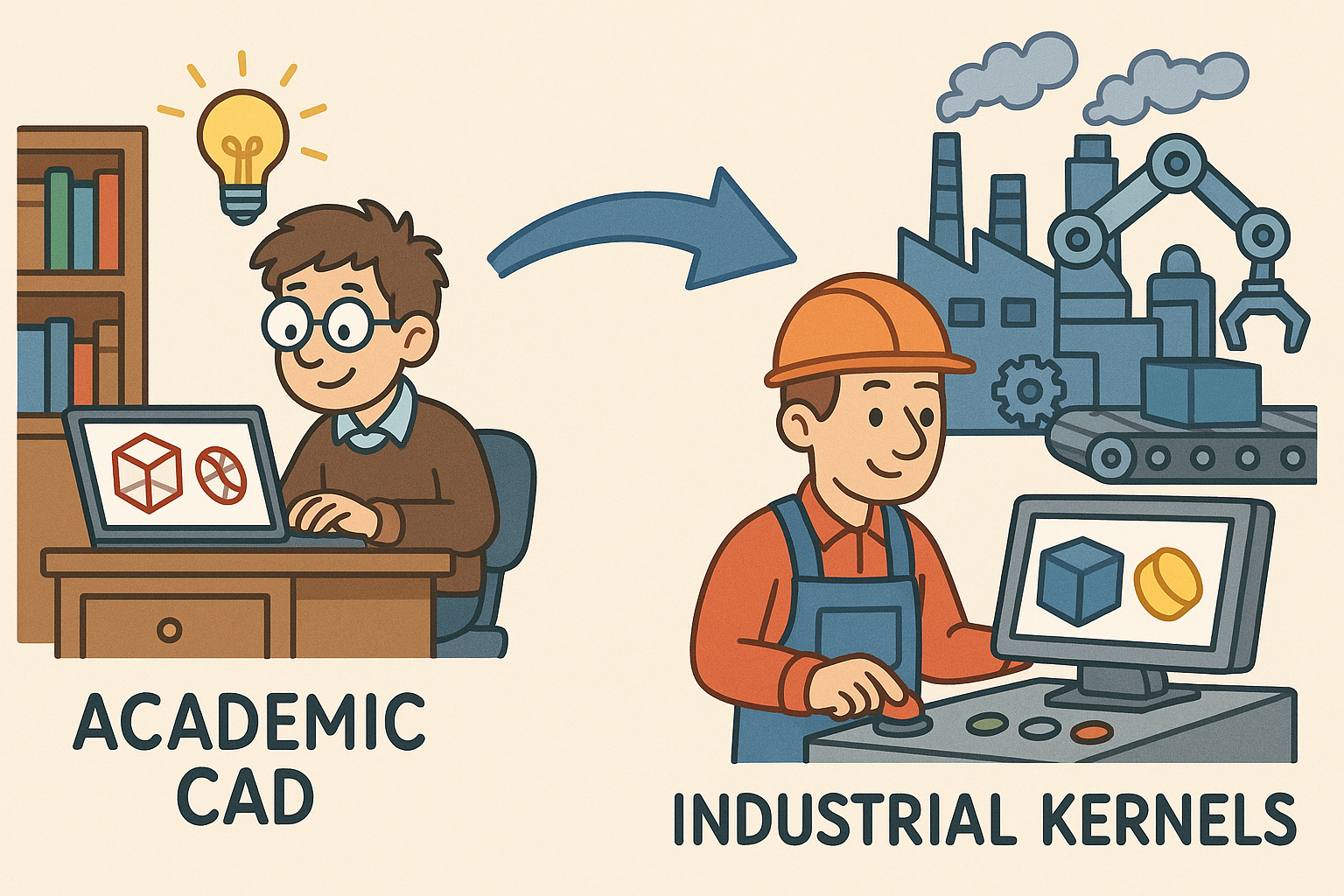


Setting the stage: why academic CAD products rise—and then fall
The archetypal trajectory from math to prototype
Across six decades of computational design, the most durable transformations have started not in sales demos but in papers, preprints, and lab notebooks. A familiar storyline repeats: a university group unveils new mathematics or data structures that make once-impossible geometry tractable; a prototype, often stitched from research code and scripts, proves the concept under controlled conditions; then a small inner circle—students, collaborators, and a few brave industrial partners—begins to “use” it. At this stage, the breakthrough is typically about a clean formalism: regularized set operations for solids, watertight boundary representations, constraint graphs over sketches, or subdivision stencils for smoothness. The software’s appeal is also cultural. It bundles a worldview: precision over heuristics, proofs over ad hoc fixes, and separations of geometry from topology that ease reasoning. Yet the same factors that make it exciting—novelty, minimalism, and academic elegance—usually guarantee its narrow reach. Early adopters tolerate command-line flags, sparse documentation, and the absence of plug-in ecosystems because they are chasing insight. Meanwhile, vendors and production shops need something else entirely: repeatability under deadline pressure, interoperability with PLM/PDM and CAM, and guarantees that thousands of heterogeneous models will not crumble under edge cases. The result is a rite of passage where a lab artifact grows just enough muscle to hint at commercial potential without yet carrying the load of day-to-day engineering.
- A lab builds a breakthrough: new representations (e.g., B-rep, r-sets), solvers, or interaction models show feasibility.
- Prototype becomes a “product”: a research-grade tool circulates among insiders, often funded by grants or consortia.
- Reality check: industrial needs—robustness, documentation, APIs, QA—reveal the distance to a sellable platform.
Confronting commercial realities: where prototypes stall
The first contact with the marketplace is not a demo booth; it is robust boolean unions on messy parts, import of decades-old IGES, resilient regeneration of parametric features, and predictable performance on models an order of magnitude larger than any lab corpus. Prototypes that sail through academic benchmarks can buckle under production variability: sliver faces from near-coincident intersections, self-intersections in offsetting, or topological ambiguities from mixed-precision kernels. The must-haves are mundane yet unforgiving: a stable C/C++ API with versioned contracts, thread safety on multi-core pipelines, undo/redo semantics across compound operations, crash telemetry, and a QA culture that treats geometric degeneracies as first-class citizens. Sales, field support, and training collateral loom equally large—areas orthogonal to formal theory but existential to adoption. Funding cycles accentuate the mismatch. A three-year grant rewards novelty; a core modeling kernel needs a decade of hardening. That is why academic “products” often plateau, even when the underlying science is exemplary: there is no budget or patience for the unglamorous grind of tolerancing, healing, localization, and regression suites spanning millions of models.
- Robustness at scale: numerical tolerance, exact predicates, topology repair, and reproducible booleans across vast edge cases.
- Operational scaffolding: documentation, SDK samples, binary compatibility, licensing, and telemetry for field failures.
- Workflow depth: sketch-to-feature ergonomics, data management hooks, and integrations with CAM/CAE/PLM ecosystems.
Why they still matter: how ideas outlive products
When academic tools fade, it is seldom a failure of ideas; instead, their intellectual DNA disperses through people, spinouts, standards, and acquisitions. Graduates become kernel architects at vendors; professors co-found startups; and research teams codify best practices into schemas that outlast any single codebase. The long arc of CAD/CAE/BIM is a palimpsest of such migrations. Concepts like regularized CSG, manifold B-reps, NURBS continuity, and constraint-based parametrics have been so thoroughly absorbed that many practitioners forget their academic origins. Equally consequential are the mechanisms of diffusion: licensable SDKs that let dozens of OEMs adopt the same proven core; standards bodies that turn experimental exchange semantics into stable interop; and M&A that folds research IP into broad commercial roadmaps. As a result, even defunct academic systems cast long shadows. Their theorems, algorithms, and data structures reappear—quietly but pervasively—in mainstream tools used daily by mechanical engineers, architects, and visualization specialists. The products may sunset; the theories recombine and endure.
- People: students and faculty carry methods across institutional boundaries.
- Spinouts and SDKs: kernels and solvers become embeddable components for many vendors.
- Standards: exchange and PMI semantics harden in STEP/IFC lineages.
- Acquisitions: larger firms integrate research IP into production-grade platforms.
From campus prototypes to industry mainstays
PADL‑2 and the permanence of regularized CSG
In the 1970s, A.A.G. Requicha and H.B. Voelcker at the University of Rochester developed PADL‑2, a system that distilled constructive solid geometry into a mathematically rigorous practice. Their formalization of r-sets (regularized sets) and the insistence on regularized boolean operations—union, intersection, difference—equipped modelers with operations that preserved physical realizability. The PADL‑2 codebase itself did not become a dominant product, but its semantics quietly defined “correctness” for solid modeling. Every modern kernel, whether crafted in-house or licensed, now treats regularization and validity predicates as table stakes. The specific software may have faded, yet the idea that booleans must produce closed, manifold results with consistent orientations migrated intact. The theory also anticipated the needs of feature-based CAD and manufacturing: that numeric robustness, boundary integrity, and topological coherence are inseparable. When today’s users perform a difference between complex parts and receive a clean, watertight result, they are seeing a direct descendant of those Rochester theorems, expressed in tens of millions of lines of modern C++—a story of a research-born concept achieving immortality by being embedded behind the scenes in countless production kernels.
- Requicha and Voelcker: formal r-set semantics, validity checks, and regularization.
- Stated legacy: robust booleans and topology integrity in every commercial solid kernel.
- Unstated legacy: test suites and predicates derived from the same mathematical framing.
From Cambridge research to ROMULUS and Parasolid
At the University of Cambridge, Ian Braid, Alan Grayer, and colleagues advanced boundary representation theory and practical algorithms for modeling in the late 1970s and early 1980s. Through Shape Data Ltd., they transformed those results into ROMULUS—one of the first commercial solid modeling kernels—and then into Parasolid, a watershed SDK that made industrial-grade B-rep modeling licensable. The commercial path was nonlinear: APIs hardened across versions, data structures were tuned for numerical stability, and operations acquired decades of edge-case handling. Parasolid moved through Unigraphics/UGS and ultimately to Siemens, powering Siemens NX and Solid Edge while also serving as the geometric backbone for many third-party tools; notably, Dassault Systèmes SolidWorks historically licensed Parasolid and continues to rely on it. The Cambridge lineage exemplifies how academic clarity becomes market ubiquity when packaged as a component. Vendors building sheet-metal, assembly, or simulation workflows could start from a proven modeling core rather than re-inventing geometry. The technology’s success also fostered an alumni network of kernel architects and application developers who internalized B-rep topological rigor and carried it into every corner of the CAD ecosystem.
- Shape Data: ROMULUS and then Parasolid crystalized B-rep research into an SDK.
- Vendor adoption: Siemens NX, Solid Edge, and many OEMs rely on Parasolid.
- Persistent influence: API design patterns and healing strategies propagated industry-wide.
ACIS and the rise of licensable kernels
Spatial Technology (founded by Richard “Dick” Sowar) launched ACIS as a modern, object-oriented geometric modeling engine in the late 1980s, drawing on Cambridge veterans such as Ian Braid, Alan Grayer, and Charles Lang. ACIS catalyzed a wave of mid-market CAD products in the 1990s and 2000s—providing B-rep, wireframe, and NURBS surfaces to vendors focused on application workflows rather than kernel invention. The model server concept and SAT file format gave developers transparent handles on persistent geometry. Spatial was later acquired by Dassault Systèmes, which also commercialized its internal kernel lineage as CGM; the coexistence of ACIS and CGM under the same corporate roof highlights how kernel technology stratifies by history, API idioms, and target markets. For developers, the practical impact was profound: the path from research paper to shipping feature compressed, because geometry was no longer a bespoke internal asset but a licensable platform. ACIS became the substrate for dozens of toolchains—from drafting and visualization to mid-range mechanical CAD—spreading academic insights on B-rep, NURBS continuity, and tolerant modeling to an audience far beyond research labs.
- Spatial ACIS: an embeddable kernel translating academic B-rep/NURBS into product-ready APIs.
- Ecosystem effect: dozens of CAD products emerged atop ACIS in the 1990s/2000s.
- Corporate arc: Dassault Systèmes acquisition; parallel availability of CGM to the market.
Variational geometry at MIT and the birth of parametrics
In the early 1980s, David T. Gossard and collaborators at MIT articulated the mathematical underpinnings of variational geometry: treating sketches and features as constraint graphs solved by numerical methods rather than fixed coordinates. This reframing liberated design intent, allowing dimensions, equalities, and tangencies to drive shape rather than merely describe it. The leap from this research to commercial impact happened with PTC’s Pro/ENGINEER—founded by Samuel Geisberg—which popularized feature-based, parametric, and associative modeling. The ideas echoed across the industry: SolidWorks (founded by Jon Hirschtick) brought accessible parametrics to Windows in the mid-1990s; Autodesk Inventor expanded adoption in the 2000s; and virtually every modern parametric modeler traces its constraint logic to that MIT lineage. Under the hood, parametrics demanded not just solvers but UI that exposed constraints and failure modes intelligibly. The academic core—solve nonlinear systems over a graph of geometric entities—was augmented with rollback strategies, regeneration orders, and diagnostics for over/under-constrained sketches. The result is one of the most successful idea migrations in CAD: a theory of constraints turned into a universally expected capability, from consumer-grade CAD to tier-one enterprise platforms.
- MIT’s contribution: constraint graphs, numerical solution, and design intent as first-class.
- Commercialization: Pro/ENGINEER pioneered feature-driven parametrics; SolidWorks and Inventor mainstreamed them.
- Operationalization: regeneration orders, rollback, and constraint diagnostics atop pure solvers.
D‑Cubed and LEDAS: industrialized constraint solving
The journey from academic constraint systems to ubiquitous, reliable solvers ran through specialized SDK vendors. In Cambridge, John Owen’s D‑Cubed productized 2D sketch constraints (DCM) and 3D assembly constraints (AEM) into libraries adopted by Siemens NX and Solid Edge, Dassault Systèmes SolidWorks, Autodesk Inventor, and many others; UGS acquired D‑Cubed, and through Siemens the group remains a quiet engine of industry constraint logic. In Novosibirsk, LEDAS—rooted in the Russian Academy of Sciences—built the LGS family of 2D/3D solvers licensed to BricsCAD, KOMPAS‑3D, and niche tools; Bricsys later acquired parts of LEDAS’s portfolio to deepen its geometric stack. These SDKs refined the first 90% solution into a production 99.99%: they offered consistent APIs, robust convergence on pathological cases, and decades of corner-case wisdom (e.g., coincident constraint cycles, degeneracies from tiny arcs, or perturbations that preserve design intent). Most importantly, they decoupled breakthrough math from application development timetables. A vendor could innovate in sheet-metal, simulation, or UI while relying on a battle-tested constraint engine that encapsulated hundreds of person-years of accumulated engineering.
- D‑Cubed: DCM/AEM embedded in major suites; acquired by UGS, now within Siemens.
- LEDAS: LGS solvers licensed broadly; technology transfers strengthened Bricsys capabilities.
- Impact: consistent constraint behavior across diverse OEM applications.
Freeform bridges: T‑splines and the CAD–CG continuum
Thomas W. Sederberg’s group at BYU introduced T‑splines, a generalization of NURBS that permits T‑junctions, drastically reducing patch counts while retaining high-order continuity. T‑Splines, Inc., led by CEO Matt Sederberg, implemented the theory as plugins (notably for Rhino) and as a modeling paradigm bridging freeform sculpting with CAD-grade surfaces. Autodesk’s acquisition brought the technology into Alias and Fusion 360, where Fusion’s Form workspace exemplifies how designers can sculpt with subdivision-style flexibility yet land on surfaces that interoperate with parametric workflows. The broader current here runs back to academia’s subdivision surfaces, especially the Catmull–Clark scheme from Edwin Catmull and Jim Clark (rooted in Utah and NYIT). Subdivision influenced animation through Pixar and SGI-era graphics, then looped back into product design via T‑splines and modern class‑A surfacing. The common thread is continuity management: ensuring that curvature, fairness, and editability coexist without exploding topology. By encoding that know‑how into accessible tools, T‑splines helped dissolve the historical wall between “artistic” modeling and “engineering” surfaces—an archetype of research reconciling two cultures under a single, practical workflow.
- T‑splines: T‑junctions with NURBS‑class continuity; acquired by Autodesk in 2011.
- Subdivision lineage: Catmull–Clark foundations in academia, mainstreamed via animation, returned to CAD.
- Outcome: hybrid sculpting + CAD surfacing workflows in mainstream tools.
Interaction pioneers and the standards that knit it all together
Ivan Sutherland’s Sketchpad at MIT (1963) framed the very idea of interactive computer graphics for geometry: constraints tied to drawn figures, direct manipulation, and object hierarchies. Sketchpad itself was not a commercial package, yet its spirit traversed generations through Evans & Sutherland, the Utah graphics lineage (with figures like Ed Catmull and Jim Blinn), and companies like SGI founded by Jim Clark. Meanwhile, data exchange matured through public‑private collaborations: IGES emerged with NBS/NIST involvement and industry partners to let mainframe‑era CAD share geometry; STEP (ISO 10303), propelled by PDES, Inc. and many universities, codified richer product data, tolerances, and eventually PMI semantics with application protocols like AP203 and AP214. In architecture, IFC from buildingSMART extended these ideas to BIM. These initiatives absorbed academic research on schemas, topology, tolerances, and semantics, then fed it back as standards everyone could build against. The grand effect is interoperability: without shared formats, no kernel or solver can thrive at scale. With them, the ideas from labs move fluidly across vendor boundaries, long after any single academic system has gone quiet.
- Sketchpad: the originating interaction paradigm; a wellspring for graphics/CAD culture and alumni networks.
- IGES and STEP: research‑informed schemas hardened into industry norms for geometry and PMI.
- IFC: a BIM‑oriented standard channeling academic and industry consensus into practice.
How migration actually happens (and why products “fall” but ideas don’t)
The channels: people, components, acquisitions, and standards
The movement from laboratory breakthrough to widespread capability follows repeatable channels that mitigate risk and amortize costs across the industry. Talent is the primal vector: graduate students and faculty carry tacit knowledge—how to reason about degeneracies, how to design APIs for evolvability, how to couple analysis with modeling—that cannot be fully captured in papers. Spinouts turn internal prototypes into licensable kernels and solvers, letting dozens of OEMs leverage the same core without reinventing numerics. M&A functions as industrial consolidation of intellectual property: Autodesk’s integration of T‑Splines fortified its freeform stack; UGS’s acquisition of D‑Cubed institutionalized constraint excellence within Siemens. Standards and open libraries provide neutral ground: STEP and IFC congeal interop semantics, while CGAL and Open Cascade broadcast computational geometry and modeling primitives beyond their original contexts. Each route shifts the burden of hardening from a single research team to a broader ecosystem, transforming an elegant idea into infrastructure. By the time end users notice, the concept is no longer controversial—it is simply part of how CAD works.
- Talent flow: students and professors become kernel architects, founders, or principal scientists.
- Spinouts/SDKs: Parasolid, ACIS, D‑Cubed, LEDAS exemplify scalable distribution of hard problems.
- M&A: technology buys roll innovations into mainstream product roadmaps.
- Standards/open libraries: STEP/IFC, CGAL, and Open Cascade stabilize and diffuse methods.
Why academic products fade: the robustness and endurance gap
Most academic “products” sunset not because the math was wrong, but because the remaining work is organizational, infrastructural, and capital intensive. Geometric robustness requires investment into exact predicates and adaptive precision arithmetic (think Shewchuk‑style techniques) blended judiciously with floating‑point performance. Healing engines must repair self‑intersections, stitch near‑coincident edges, and resolve sliver faces spawned by boolean and offset operations—without silently corrupting design intent. Tooling is equally nontrivial: fuzzers that generate adversarial geometry, regression farms that replay years of models, and telemetry pipelines that learn from field failures. Beyond engineering, ecosystem gravity exerts pull: customers demand CAM post‑processors, PLM integration, enterprise authentication, and long‑term archival. These expectations exhaust grant horizons and academic staffing models. Even with a supportive consortium, the time constants diverge: a paper wants novelty next year; a kernel needs stability for a decade. So the product plateaus, often finding a second life as a component or absorbed IP—but the ideas survive, precisely because vendors can extract them into durable, maintainable elements of larger platforms.
- Numerical rigor: exact predicates, tolerance management, and adaptive precision for stability.
- Topology healing: repair algorithms for slivers, T‑junctions, and near‑coincident intersections.
- Operational load: QA farms, support, documentation, and integrations far beyond lab scope.
- Business cadence: grants and academic incentives misalign with decade‑scale hardening.
What vendors actually integrate from academia
When vendors absorb research, they rarely adopt entire applications wholesale. Instead, they quarry reusable primitives that fit into layered architectures. Mathematical representations are the bedrock: B‑rep topology, CSG semantics, NURBS, subdivision limit surfaces, and, increasingly, implicit function fields for lattices and AM. Next come solvers and optimizers—constraint systems, parametrization engines for meshing and texture mapping, sparse linear algebra tuned for FEM/CFD, and non‑linear optimizers specialized for geometry and kinematics. Exchange semantics anchor interoperability: tessellation strategies, attribute propagation, and PMI data models from STEP APs or ISO tolerancing standards. Finally, performance enablers enter as cross‑cutting concerns: GPU pipelines inspired by graphics research, spatial indices (BVHs, k‑d trees) for selection and collision, and robust boolean pipelines that exploit exact arithmetic where necessary. Each integrated piece becomes a service, callable by many higher‑level features. In this way, research enriches the substrate of CAD rather than dictating surface UX—an approach that maximizes longevity and minimizes disruption.
- Representations: B‑rep, CSG, NURBS, subdivision, implicits.
- Solvers: constraints, parametrization, meshing, and optimization kernels.
- Exchange: geometry/PMI schemas, attribute and tessellation conventions.
- Performance: GPU pathways, spatial indices, and robust boolean toolchains.
The quiet craft of hardening: from theorem to production behavior
Moving an academic result into everyday reliability is a craft. It begins with defining behavioral contracts—what a boolean should return on degenerate inputs, how constraints should resolve cycles, how an offset should react to local self‑intersection—and encoding them as invariant tests. Tolerancing is systematized: modelers adopt absolute/relative tolerance strategies, “tiny geometry” policies, and adaptive heuristics that remain stable across locales and platforms. Algorithms are augmented with guards: fallback paths, perturbations to escape numerical traps, and post‑conditions that validate manifoldness. Data structures evolve to support incremental updates and undo/redo semantics without ghosting or leaks. Field telemetry informs triage: crash signatures cluster around families of models, leading to targeted robustness sprints. None of this changes the mathematics; it operationalizes it. The end result is what users experience as “it just works,” a phrase that masks thousands of design choices baked into kernels, solvers, and standards. The paradox is that success looks invisible—precisely because the academic breakthrough has been naturalized as infrastructure, quietly shaping every push‑pull, fillet, assembly mate, and export.
- Contracts: clear definitions for edge cases and invariants tied to tests.
- Tolerancing: consistent policies for small features and numeric thresholds.
- Guards and fallbacks: escape hatches from numerical dead‑ends.
- Telemetry‑driven QA: prioritize robustness based on real‑world failures.
Conclusion
The enduring pipeline from labs to the tools we use every day
Academic CAD systems often vanish as named products, but their essence saturates commercial practice through kernels, solvers, standards, and the people who ferry ideas across institutional boundaries. The industry’s most durable exports from academia are clear mathematical formalisms—regularized CSG, B‑rep topology, NURBS continuity, and variational constraints—and the decision to deliver them as componentized SDKs that vendors can embed. That pattern is alive: implicit modeling for lattices and additive manufacturing, influenced by Alexander Pasko’s FRep and R‑functions, now powers tools like nTopology and is echoing through mainstream kernels; AI‑assisted constraint inference and model repair, informed by graph learning and symbolic reasoning, is seeding the next generation of sketchers and remodelers; higher‑order surface schemes are making their way from approximation theory into class‑A pipelines. The strategic lesson is pragmatic. We do not need academic breakthroughs to “win” as standalone products. We need bridges—spinouts that respect operational realities, SDKs that encapsulate hard math behind stable APIs, and standards that let ecosystems adopt ideas incrementally. When those bridges are in place, research ceases to be a prototype on a lab machine and becomes the quiet, reliable substrate of design—a foundation on which engineers and architects build the manufactured and constructed world.
- DNA over brand: products fade; theories persist inside kernels and standards.
- Components over monoliths: SDKs and services speed diffusion and hardening.
- Bridge investment: spinouts, acquisitions, and standards turn breakthroughs into infrastructure.
Also in Design News